If your ecommerce business sells seasonal products, one of the safest ways to protect your Google ranking is to keep valuable URLs live, update them for each season, manage stock status accurately and only remove pages when the product is genuinely gone for good.
That matters particularly in ecommerce Malaysia, where demand can rise and fall around Ramadan and Hari Raya, Chinese New Year, Deepavali, Merdeka, school holidays, year-end gifting and major ecommerce campaigns such as 9.9, 11.11 and 12.12.
A Hari Raya hamper may sell strongly for a few weeks and barely move for the rest of the year. That does not mean the value of its webpage disappears when Syawal ends.
Delete the page and create a new URL every year, and Google will need to discover, crawl and evaluate that new URL. Keep the same useful URL, and you can preserve existing backlinks and internal links while refreshing the content for the next seasonal surge.
Why Can Seasonal Products Lose Their Google Ranking?
Seasonal products often lose rankings because businesses treat the end of a sales season as if the webpage itself has reached the end of its life.
A common cycle looks like this:
| Season Stage | What The Business Does | Potential SEO Problem |
|---|---|---|
| Before Season | Creates new product pages | New URLs start with limited existing signals |
| During Season | Promotes them heavily | Pages begin earning rankings and links |
| After Season | Deletes sold-out products | Links and visibility associated with those URLs may be lost |
| Next Year | Creates new URLs again | Google must discover and evaluate new pages |
For example, imagine a Malaysian gift retailer creates:
/hari-raya-hampers-2026/
The page performs well and earns links. After Raya, the company deletes it and creates:
/hari-raya-hampers-2027/
the following year.
A more sustainable structure could simply be:
/hari-raya-hampers/
The products, dates, offers and copy can change each year while the underlying URL remains stable.
How Should You Manage Seasonal Product URLs?
The first rule of handling seasonal products in ecommerce SEO is simple: do not change a useful URL just because the calendar changed.
For recurring search intent, an evergreen URL can help avoid unnecessary URL changes.
Instead of:
/cny-gift-box-2025/
/cny-gift-box-2026/
/cny-gift-box-2027/
consider maintaining:
/chinese-new-year-gift-box/
and refreshing it annually.
This works well for recurring categories such as festive gifts, seasonal fashion, mooncakes, Ramadan bundles, Merdeka promotions and year-end sales.
An evergreen category page and an individual product page do not always need identical treatment. A category such as /hari-raya-hampers/ may remain relevant every year, while a specific “2026 Premium Gold Hamper” might never return.
Your URL strategy should therefore reflect whether the search intent itself is recurring.
What Should You Do Before The Seasonal Demand Starts?
Seasonal SEO should begin before customers start searching heavily.
Waiting until the week before Hari Raya to optimise a category page leaves less time for Google to recrawl and process the changes. A better process starts well before demand peaks, often several weeks in advance.
Step 1: Review Last Season’s Performance
Use Google Search Console, analytics data and your ecommerce platform to identify:
- Pages that attracted organic traffic.
- Queries that generated impressions.
- Pages with low click-through rates.
- Seasonal pages that earned external links.
- Pages that converted well.
Do not judge pages only by revenue. A category page may still be valuable because it ranks for an important keyword and sends customers deeper into your site.
Step 2: Refresh The Existing Content
Do not simply change “2026” to “2027”.
Update the parts shoppers actually care about:
- Product Selection: Current designs, bundles, sizes or flavours.
- Pricing: Current prices and promotions.
- Availability: When products can be ordered.
- Delivery: Current cut-off dates and service areas.
- Images: Updated product photography and useful alt text.
- FAQs: Questions customers asked during the previous season.
The goal is to retain the existing URL while making the page genuinely useful for the new sales cycle.
Should You Keep Out-Of-Stock Seasonal Products Online?
If a product is temporarily unavailable and expected to return, keeping the page accessible is usually preferable to deleting it.
Google recommends keeping websites accessible when fulfilment problems are temporary. Ecommerce products can also remain visible to Search while being clearly marked as unavailable.
For example, after Chinese New Year, a seasonal category could say:
Our Chinese New Year collection has ended for this season. New festive products will return ahead of the next Chinese New Year.
You could then offer an email signup, related gift categories, similar year-round products or information about when the collection normally returns.
This gives visitors a useful next step without removing the page simply because inventory is unavailable.
Read This: Ecommerce SEO Guide to Faceted Navigation
How Should You Handle Product Availability In Structured Data?
Your visible product page, structured data and Merchant Center feed should tell the same story.
Google supports multiple availability values, including InStock, OutOfStock, PreOrder, BackOrder, LimitedAvailability, SoldOut and Discontinued.
| Product Situation | Appropriate Approach |
|---|---|
| Available now | Use InStock |
| Temporarily unavailable and not accepting orders | Use OutOfStock |
| New product not yet released but available to order | Use PreOrder where appropriate |
| Existing product unavailable but still accepting orders | Use BackOrder where appropriate |
| Permanently retired | Use Discontinued where applicable |
For preorder and backorder products, provide any availability-date information required by the platform or feed specification.
Google can use product structured data to understand availability, price, ratings, shipping and returns. It also recommends using structured data and Google Merchant Center where relevant.
If your website says “sold out” but Merchant Center says “in stock”, the mismatch can lead to warnings or product disapprovals.
Should You Delete A Seasonal Product That Will Never Return?
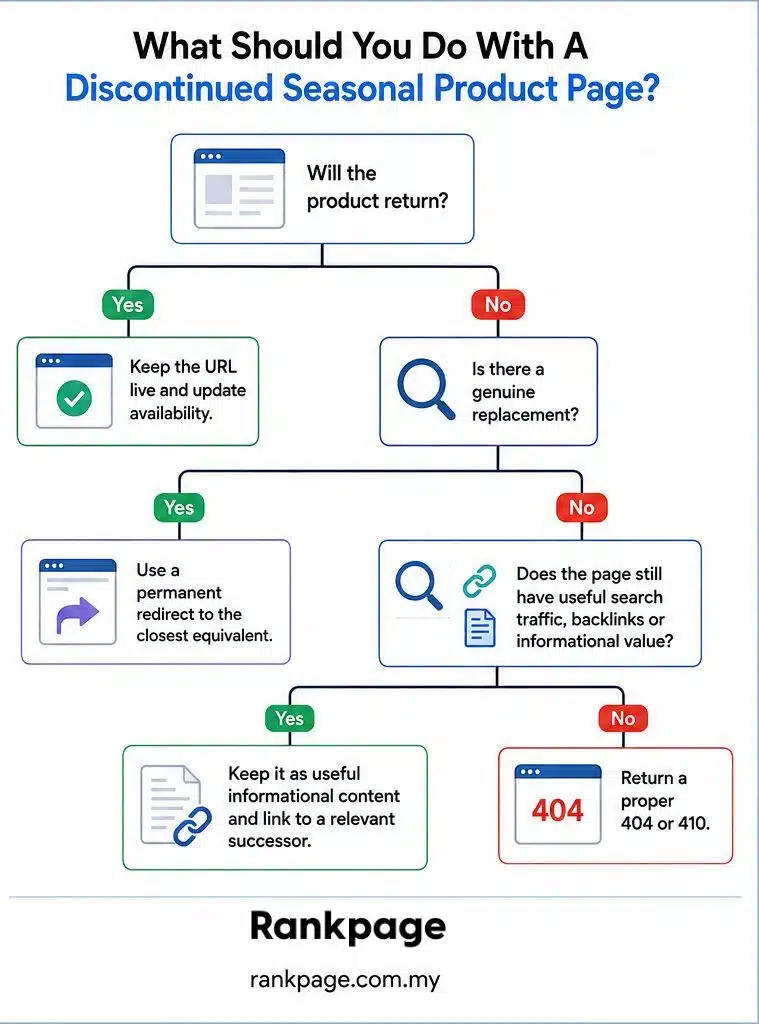
Sometimes, yes. Suppose you sold a limited-edition Merdeka 2026 sneaker that will never be manufactured again. There are three main possibilities.
1. There Is A Direct Replacement
If the old product has genuinely been replaced by a close equivalent, a permanent redirect may make sense.
For example,/merdeka-running-shoe-2026/ could redirect to /merdeka-running-shoe/if that page genuinely represents the continuing version.
2. There Is No Real Replacement
If the product has disappeared permanently and no suitable replacement exists, a proper 404 or 410 may be cleaner.
Do not redirect removed products to unrelated categories or the homepage simply to preserve perceived SEO value.
3. The Page Still Has Search Value
A discontinued product page may still attract searches, backlinks or informational traffic.
Before deleting it, check whether people are looking for specifications, sizing information, reviews or a newer model. In those cases, the page may be worth retaining as useful informational content while pointing visitors towards a genuine successor.
The decision should depend on user intent, not an automatic rule.
How Can Internal Linking Help Seasonal Pages Rank Again?
Seasonal pages can become difficult to discover during the off-season when homepage banners, menus and category links disappear.
As the next season approaches, rebuild those internal connections.
For example, a Malaysian ecommerce site preparing for Ramadan might link its /hari-raya-gifts/ category from:
- The homepage seasonal banner.
- The main gift category.
- Relevant blog guides.
- Ramadan campaign pages.
- Related product categories.
Internal linking helps users navigate your store while also helping search engines discover pages and understand their relative importance.
Avoid changing the destination every year unless there is a genuine reason.
How Should You Update Seasonal Content Without Starting Over?
Strong seasonal pages usually combine evergreen information with time-sensitive details.
Evergreen Layer: Product type, buying guidance, delivery areas, gift recommendations and FAQs.
Seasonal Layer: Current stock, prices, campaign dates, delivery deadlines and promotions.
For example, a Hari Raya hamper category might always explain who the hampers suit, delivery areas, corporate versus personal gifting and halal considerations where relevant.
Each year, you then refresh the products, prices, stock levels and campaign information.
This gives shoppers current information without rebuilding the page from zero.
What Should Malaysian Businesses Do During The Peak Season?
Once demand increases, the SEO job shifts from preparation to monitoring.
| Area | What To Monitor |
|---|---|
| Stock | Whether availability on-site matches Merchant Center |
| Indexing | Whether important categories remain indexed |
| Rankings | Movement for priority seasonal keywords |
| Technical SEO | Broken links, accidental noindex tags and redirect errors |
| Conversion | Whether high-ranking pages lead to purchases |
Do not make major structural changes simply because a page moves down a few positions for a day.
Seasonal organic search results can become more competitive as retailers optimise seasonal content and customer demand changes. Paid search and promotional activity may also increase, but these should be monitored separately from organic rankings.
Make decisions based on meaningful trends rather than every small ranking fluctuation.
What Should You Do After The Season Ends?
When sales fall, resist the temptation to delete everything seasonal.
Instead, review each important page:
Did The Page Earn Traffic Or Backlinks?
If yes, retaining it may give you a stronger starting point next season.
Will The Search Intent Return?
“Chinese New Year hampers Malaysia” is recurring. A one-off model number may not be.
Will The Product Return?
Temporary unavailability and permanent discontinuation need different handling.
Is There A Genuine Replacement?
Redirect only when the destination reasonably satisfies what the original visitor wanted.
What Does A Good Seasonal Ecommerce SEO Workflow Look Like?
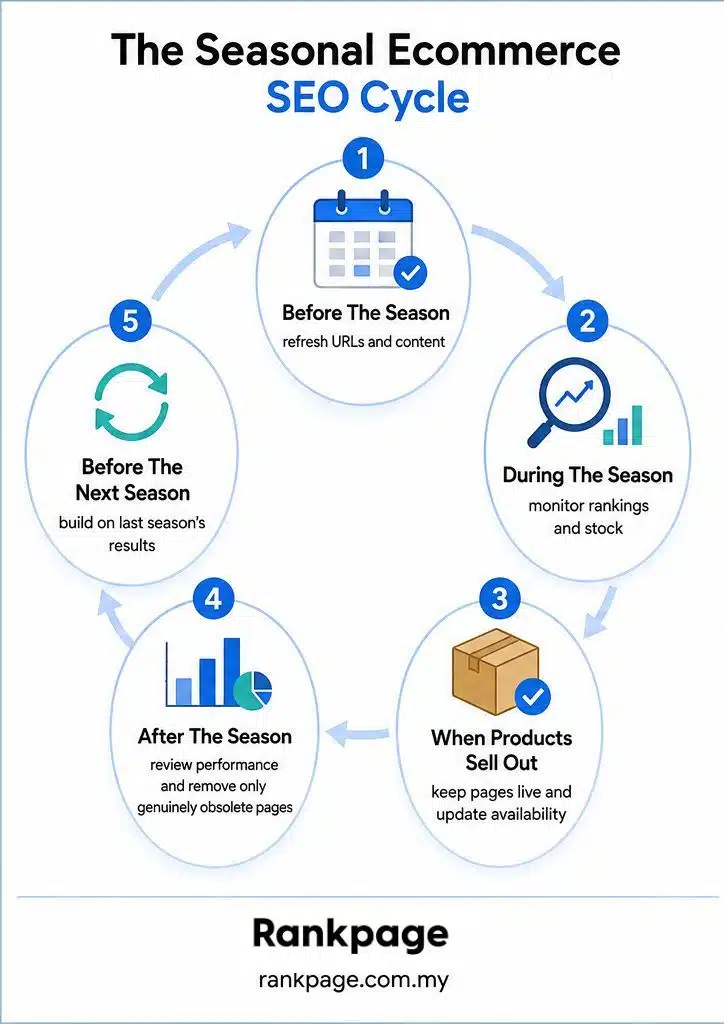
Seasonal SEO works best as a repeating cycle.
Before The Season
Refresh evergreen URLs, update product information, restore internal links and confirm technical SEO.
During The Season
Monitor rankings, stock, structured data, Merchant Center feeds, indexing and conversions.
When Products Sell Out
Keep temporarily unavailable products accessible, update availability accurately and offer useful alternatives.
After The Season
Review performance, retain valuable recurring URLs and remove only pages that genuinely no longer serve users.
Before The Next Season
Build on what worked instead of rebuilding your SEO footprint from zero.
This is where an experienced ecommerce SEO strategy can compound over time by strengthening a stable set of commercially valuable pages.
Seasonal Products Should Not Mean Seasonal Rankings
Seasonal demand will always rise and fall. Your Google ranking does not have to follow the same pattern. For most recurring products and categories, the smarter approach is to preserve useful URLs, refresh their content, communicate stock accurately and strengthen them before demand returns.
When individual products are permanently discontinued, redirects, 404 or 410 responses and replacement pages should be chosen according to what genuinely helps the visitor.
For Malaysian businesses looking to turn seasonal search demand into sustainable organic visibility, Rankpage is an experienced SEO agency that can help build an SEO strategy that protects valuable pages while preparing your ecommerce site for the next demand cycle.
Our SEO services can support technical URL management, ecommerce optimisation, content, structured data and long-term ranking growth.
Frequently Asked Questions About How to Handle Seasonal Products Without Losing Rankings
Should I Delete Seasonal Product Pages When The Season Ends?
Usually not if the product or category is likely to return. Keeping a useful URL live lets you refresh and reuse it next season. If the product has permanently disappeared with no suitable replacement or continuing usefulness, a proper 404 or 410 may be appropriate.
Do Out-Of-Stock Products Hurt Google Rankings?
Being temporarily out of stock does not automatically mean the page should disappear from Google. Keep the page useful, make its availability clear and ensure your website, structured data and Merchant Center information remain consistent.
Should Seasonal Ecommerce URLs Include The Year?
Generally, avoid years in URLs for categories that return annually unless the year defines genuinely distinct content. An evergreen URL such as /hari-raya-hampers/ can reduce unnecessary URL changes and lets you keep improving the same page.
When Should I Start SEO For Seasonal Products?
Start before search demand peaks. Preparing several weeks ahead is practical for many campaigns, while competitive seasons may justify more lead time. This gives Google time to process updated content and gives you time to strengthen internal links and product data.
Should I Redirect Discontinued Products To The Category Page?
Not automatically. Redirect when there is a genuine replacement that satisfies substantially the same intent. If no suitable replacement exists, a proper 404 or 410 can be acceptable.
How Can Ecommerce Malaysia Businesses Improve Seasonal Google Rankings?
Build stable seasonal category URLs, refresh them before each sales period, maintain accurate stock information, use appropriate product structured data, strengthen internal links and monitor performance in Google Search Console.
The goal is to build on your SEO efforts from one season to the next, rather than starting from scratch each year.