To optimise category pages for SEO, make each page the strongest possible answer to a product-category search. That means targeting the right keyword, clearly explaining what the category contains, improving metadata and internal links, keeping navigation crawlable, and helping shoppers find the right product.
For an ecommerce business, category pages are much more than digital shelves. Someone searching for “men’s running shoes Malaysia” may not know which exact shoe they want. A category page gives them choices, filters and enough information to compare options.
Search engines also use links and site structure to discover and understand pages. Google recommends using words people search for in prominent locations such as titles and headings, while ensuring important pages remain accessible through crawlable links.
That makes category pages an important meeting point between ecommerce SEO, merchandising and user experience.
Why Are Category Pages Important for Ecommerce SEO?
Category pages typically target broader commercial searches than individual product pages.
| Page | Possible Search Intent | Example Keyword |
| Homepage | Broad store search | Online electronics store Malaysia |
| Category Page | Browse products | Android phones Malaysia |
| Subcategory Page | Narrower selection | Samsung phones Malaysia |
| Product Page | Specific purchase research | Samsung Galaxy S26 price Malaysia |
| Blog Article | Informational research | How to choose an Android phone |
The category page often serves shoppers who know roughly what they want but are still comparing brands, prices or specifications.
From an SEO perspective, categories also act as hubs connecting higher-level navigation with individual products. Google notes that links from category pages can help it discover other URLs on a site.
Important categories should therefore be treated as genuine landing pages, not just automatically generated product grids.
How Do You Optimise a Category Page?
A category page does not need 2,000 words of copy squeezed underneath the products.
The goal is simpler: make the page useful, clear and easy to navigate.
A practical process is:
- Identify the primary search intent and category keyword.
- Build a clear category and subcategory hierarchy.
- Optimise the URL, title tag, H1 and meta description.
- Add useful category content.
- Strengthen internal links and breadcrumbs.
- Manage filtering, sorting and faceted navigation.
- Improve mobile usability and performance.
- Review indexing and search performance over time.
How Should You Choose Keywords for Category Pages?
Start with the type of product collection the page represents.
For a furniture store, examples might include:
- Sofas: “sofa Malaysia”
- Office Chairs: “office chair Malaysia”
- Dining Tables: “dining table Malaysia”
- Mattresses: “mattress Malaysia”
Match the keyword to the right level of the site.
A general mattress category should not primarily target “king size memory foam mattress under RM2,000” if only a few products match. That query may be better suited to a subcategory or dedicated filter landing page.
Think in terms of:
Broad category → Subcategory → Attribute combination → Individual product
For Malaysian businesses, local terms such as “Malaysia”, “KL”, “RM” or locally recognised product names may also be relevant when they reflect genuine search behaviour.
Do not force them into the page purely for SEO.
What Should an SEO-Friendly Category Page Include?
A common mistake is choosing between two extremes: no category content at all, or a huge block of keyword-heavy copy.
Neither is ideal.
Google emphasises helpful, people-first content. For ecommerce categories, that usually means supporting the shopping decision without getting in the way of the products.
A short introduction near the top can explain what the category offers.
Further down, useful content might include:
- Buying Guidance: Who different product types suit.
- Important Features: Sizes, materials, compatibility or specifications.
- Brand Options: Major brands available.
- Common Questions: Recurring questions shoppers ask.
- Related Categories: Useful alternatives or complementary products.
The aim is context, not word count.
Read More: Content SEO for Ecommerce: What Works at Every Stage of the Funnel
How Should You Optimise Titles and Metadata?
Every important category should have a clear title, H1 and meta description.
| Element | Example |
| URL | /office-chairs/ |
| Title Tag | Office Chairs Malaysia: Ergonomic & Work Chairs |
| H1 | Office Chairs |
| Meta Description | Shop office chairs in Malaysia, from ergonomic work chairs to mesh and adjustable designs. |
Keep these elements aligned around the same topic without making them identical.
Google may generate title links from signals including the <title> element, visible headings and other prominent text. Clear, descriptive titles therefore give stronger signals about the page.
Meta descriptions should work more like persuasive search-result copy than keyword containers.
Tell shoppers what they will find and mention useful differentiators such as delivery, pricing, warranties or installation where relevant.
What URL Structure Works Best?
Keep category URLs descriptive and predictable.
For example, example.com/furniture/office-chairs/ is easier to understand than example.com/cat?id=12894.
A shorter structure such as example.com/office-chairs/ can also work well.
What matters most is consistency and clarity.
Avoid changing established URLs simply because a new structure looks cleaner. URL changes introduce redirects, recrawling and other technical considerations.
How Can Internal Linking Improve Category Page SEO?
A category page that is difficult to reach and receives few relevant internal links may appear less important within the site’s structure.
Internal links help both shoppers and Google understand relationships between pages.
Useful ecommerce internal links include:
Main Navigation: Link to major commercial categories.
Breadcrumbs: Show relationships between parent categories, subcategories and products.
Subcategory Links: Link broad collections to narrower ones.
Related Categories: Connect complementary collections.
Editorial Content: Link relevant buying guides to commercial categories.
Anchor text should describe the destination. “Browse our ergonomic office chairs” gives more context than “click here”.
How Should Filters and Faceted Navigation Be Handled?
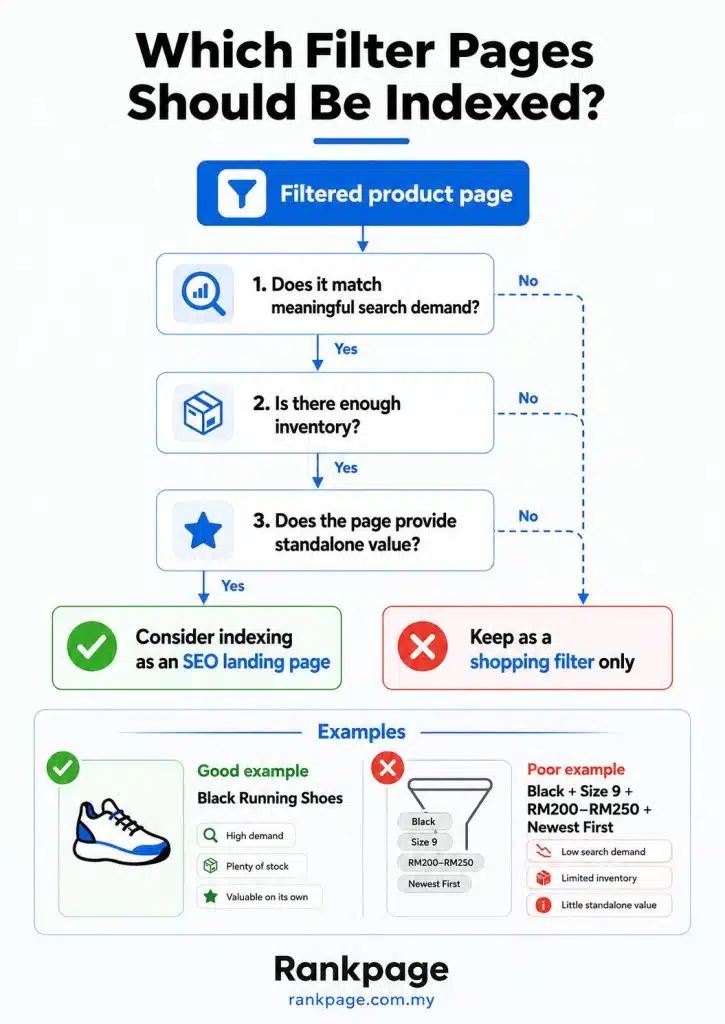
Faceted navigation is useful for shoppers but can create large numbers of URLs.
A shoe category might include filters for brand, colour, size, gender, price and style, creating URLs such as /shoes/?brand=nike&colour=black&size=9.
With enough combinations, this can produce hundreds or thousands of variations.
Google warns that poorly managed faceted navigation can lead to excessive crawling.
The solution is not to remove filters. Instead, decide which combinations provide enough standalone value to become search landing pages.
For example, “black running shoes” may deserve a dedicated page if there is meaningful demand and sufficient inventory.
“Black + Size 9 + RM200-RM250 + Newest First” probably does not.
Useful filter combinations can be considered for indexing. Other faceted URLs may need their crawling or indexing controlled.
How Should Pagination and Infinite Scroll Be Optimised?
Large categories often use numbered pagination, “load more” buttons or infinite scrolling.
The SEO priority is making sure products remain discoverable through crawlable URLs and links.
Google generally discovers pages through URLs in <a href> links and does not interact with buttons in the same way a user does.
If you use infinite scroll or “load more”, make sure products are still accessible through URLs such as /office-chairs?page=2 and /office-chairs?page=3.
Each page should work without requiring someone to press a JavaScript button first.
How Does Navigation Affect Category Page SEO?
A logical ecommerce structure might look like:
Home → Furniture → Office Furniture → Office Chairs → Product
This gives shoppers and search engines a clear route through the catalogue.
Google recommends logical site structures and links between important, relevant pages.
Navigation labels should also make sense to people. “Shoes”, “Skincare” or “Mobile Phones” are clearer than awkward keyword-stuffed labels such as “Cheap Best Shoes Malaysia Online”.
Good SEO should make a website clearer, not stranger.
Read More: Ecommerce Keyword Research In 2026: A Malaysian Business Guide
How Does User Experience Affect Category Pages?
Getting a visitor onto the category page is only half the job.
They still need to shop.
Useful category-page UX normally prioritises:
Product Visibility: Let users reach the product grid quickly.
Filtering: Make key filters easy to find.
Sorting: Offer sensible options such as price or newest.
Images: Use clear thumbnails with useful alt text where appropriate.
Performance: Keep pages responsive even with many images and products.
Core Web Vitals measure important aspects of page experience including loading performance, responsiveness and visual stability.
For Malaysian ecommerce businesses, mobile usability deserves particular attention because a technically optimised page can still perform poorly if it is difficult to browse.
What Category Page SEO Mistakes Should You Avoid?
Watch for these common problems:
- Creating several categories for the same search intent. This can make the site’s structure less clear.
- Writing generic descriptions. “High-quality products at competitive prices” says little about the collection.
- Stuffing copy above the products. Shoppers usually arrive to browse.
- Allowing every filter URL to become crawlable. Faceted systems can create enormous numbers of URLs.
- Hiding products behind JavaScript-only controls. Important products should remain accessible through crawlable links.
- Ignoring internal links. Important categories should not become isolated.
- Reusing metadata across categories. Important collections should have distinct search propositions.
How Can Malaysian Businesses Measure Results?
Do not judge category SEO only by whether one keyword moved from position 11 to position 7.
Category pages can rank for many related queries.
Use Google Search Console to review impressions, clicks, click-through rate, queries and average position.
Then combine this with ecommerce analytics.
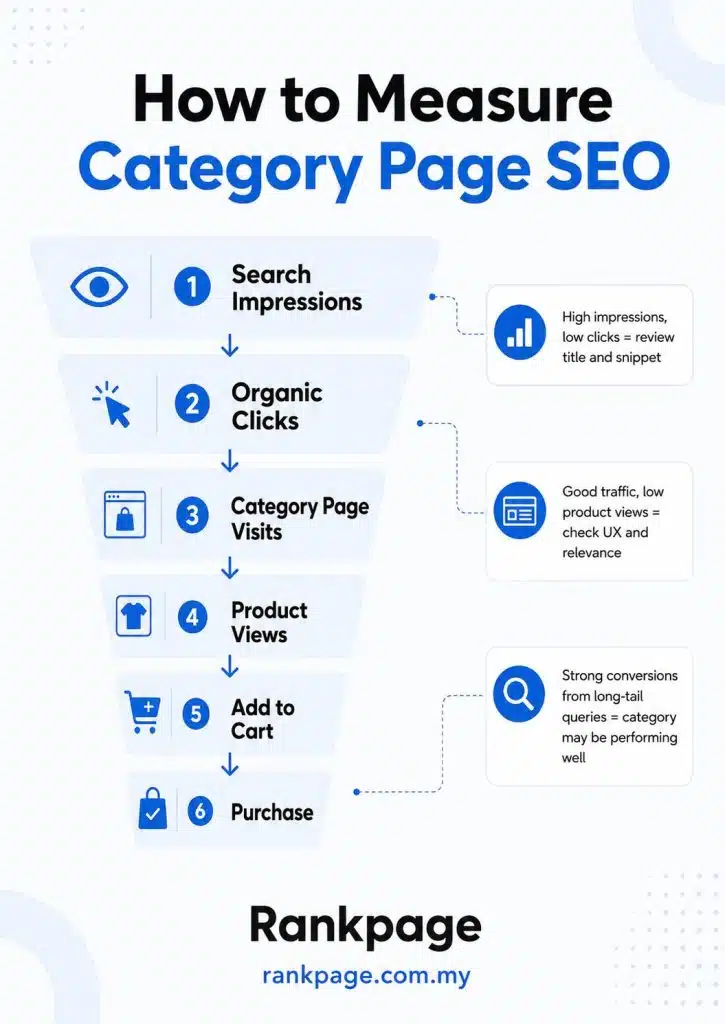
Organic Visits → Category Page → Product View → Add to Cart → Purchase
A page receiving strong search visibility but few product views may have a usability problem.
A page receiving many impressions but relatively few clicks may be worth reviewing for its title, snippet and query relevance.
A category attracting sales from many long-tail queries may be performing well even if its main keyword does not rank first.
How Often Should Category Pages Be Updated?
Category pages do not need rewriting every month just to look fresh.
Update them when something meaningful changes, such as:
- Inventory: Major ranges are added or removed.
- Demand: New search terminology becomes important.
- Structure: A category needs new subcategories.
- Content: Existing copy no longer reflects shopper needs.
- SEO: Search Console reveals new opportunities.
- UX: Mobile behaviour shows problems with filtering or navigation.
The goal is not freshness for its own sake. It is keeping the page accurate, useful and commercially relevant.
What Makes a Category Page SEO-Friendly?
The best category pages balance three jobs: help search engines understand the collection, help shoppers find the right products, and help the business move visitors closer to a purchase.
That means targeting a clear search intent, writing useful content, optimising metadata, strengthening internal links, managing faceted navigation and providing a fast, intuitive browsing experience.
For Malaysian ecommerce sites with large catalogues, category optimisation can also strengthen the wider site structure because these pages often sit at the centre of how customers and search engines move through the website.
If your category structure has become difficult to manage or important pages are struggling to gain visibility, Rankpage is a trusted SEO agency in Malaysia that can help e-commerce sites identify technical, content and structural opportunities. Our SEO services are designed to improve how search engines discover, understand and rank commercially important pages while keeping the experience useful for real customers.
Frequently Asked Questions About How to Optimise Category Pages for SEO
What Is a Category Page in SEO?
A category page groups related products under a broader topic, such as “Running Shoes”, “Office Chairs” or “Skincare”. These pages can target broader commercial searches while helping users navigate towards individual products.
How Much Content Should an Ecommerce Category Page Have?
There is no ideal word count. Include enough content to explain the category and help shoppers without burying the product listings.
Should Category Pages Target Keywords?
Yes. Each important category should have a clear primary topic, used naturally in elements such as the title, H1, URL, introductory copy and internal links where appropriate.
Should Filter Pages Be Indexed?
Only filter combinations that provide useful standalone landing pages should normally be considered for indexing. Other faceted URLs may need their crawling or indexing controlled.
Are Category Pages More Important Than Product Pages for SEO?
They serve different search intents. Category pages are useful for broader browsing and comparison searches, while product pages suit specific product or model queries.
How Can I Improve Category Page Rankings?
Review search intent, keyword targeting, titles, content, internal links, navigation, faceted URLs, mobile usability and performance. Focus on making the page easier for both shoppers and search engines to understand.