What Is Faceted Navigation in Ecommerce SEO?
Faceted navigation is a filtering system that allows users to refine product listings based on attributes such as price, brand, size, colour, or ratings.
Each filter creates a variation of a category page, typically through URL parameters.
Example:
- /laptops
- /laptops?brand=asus
- /laptops?brand=asus&price=3000-5000
Summary: Faceted navigation creates multiple paths to the same product set, which is great for users but complex for search engines.
From an SEO services perspective, faceted navigation introduces:
- Multiple URLs with similar content
- Dynamic page generation
- Potential duplication issues
(Source: Google Developers — Managing crawling of faceted navigation URLs; Sitebulb; Oncrawl)
Why Is Faceted Navigation Important for Ecommerce SEO?
Faceted navigation often improves user experience in large ecommerce stores by helping shoppers narrow choices faster. When implemented well, that smoother discovery flow can also support conversions, but the impact depends on catalogue size, merchandising, and performance.
Without filters, users are forced to:
- Scroll through long product lists
- Manually search for attributes
- Spend more time to find relevant products
This creates friction and increases drop-off rates.
Real Malaysian Scenario
Imagine a user browsing for a laptop in Kuala Lumpur. They typically want to filter by:
- Price (RM2,000 to RM4,000)
- Brand (Asus, Acer, Lenovo)
- RAM size
- Delivery availability
If your site does not support these filters, users will likely return to Shopee or Lazada, where filtering is standard.
Business Impact
Better filtering can reduce friction in discovery:
- Faster discovery → stronger purchase intent
- Better navigation → lower bounce rates
- Relevant filtering → improved product mix visibility (often supporting higher AOV)
However, these UX benefits must be balanced with SEO control.
(Source: Shopify; Botify; Oncrawl)
How Does Faceted Navigation Work? (Simple + Technical)
Faceted navigation works by dynamically filtering product data and generating page variations based on selected attributes.
How It Works Step-by-Step
- User selects a filter (for example, brand = Asus)
- The system queries the database
- A filtered product list is generated
- A new URL is created
This URL often includes parameters like:
- ?brand=asus
- ?price=2000-4000
Types of Implementation
Parameter-based URLs
- Common in many ecommerce implementations (including Shopify storefront filtering)
- Easier to ship quickly
- Can be harder to govern at scale unless you explicitly control what gets crawled and indexed
Static or rewritten URLs
- Example: /asus-laptops/
- More SEO-friendly
- Requires additional development and governance
Key Insight
Traditional navigation is hierarchical. Faceted navigation is multi-dimensional. This flexibility is what makes it powerful and also risky.
(Source: Oncrawl; Sitebulb; Shopify Dev Docs)
What Are the Core SEO Risks of Faceted Navigation?
Index Bloat
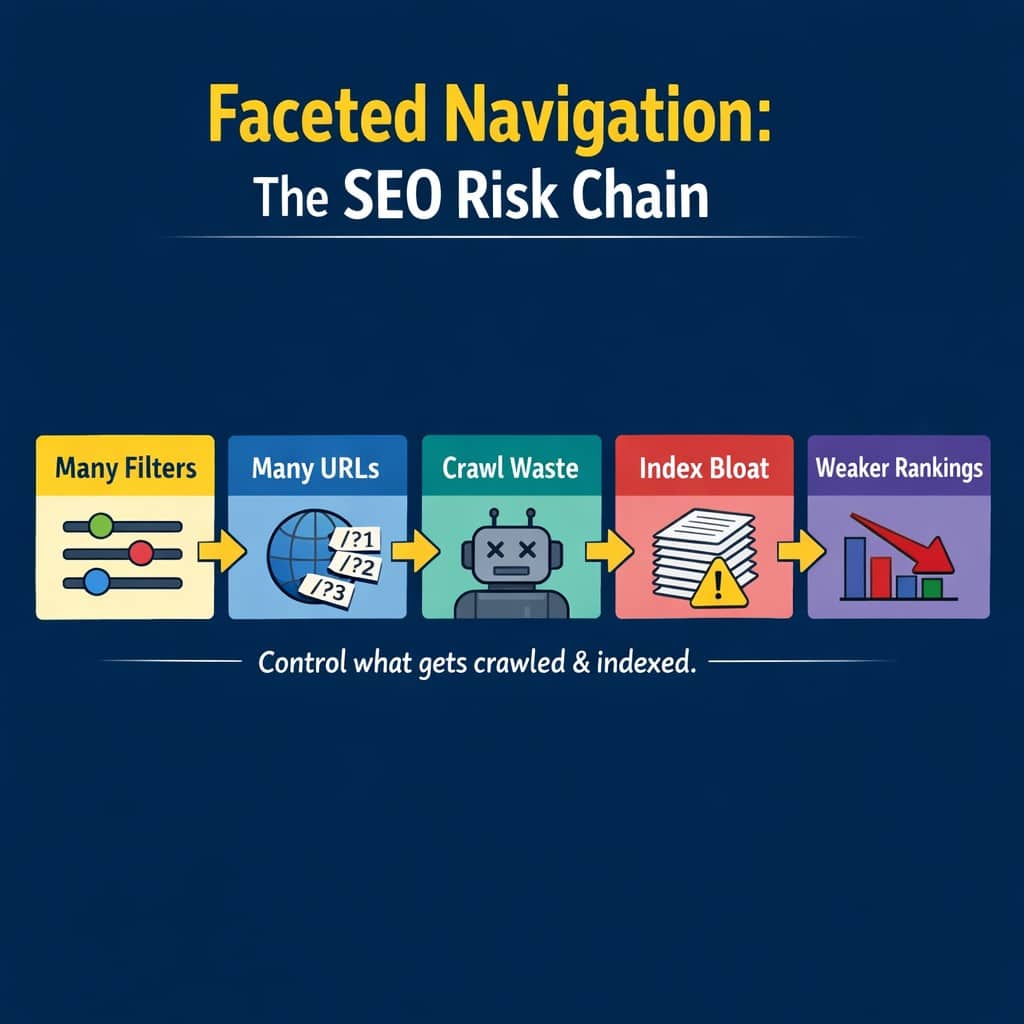
Index bloat happens when search engines index too many low-value filter pages.
A single category with:
- 5 brands
- 5 price ranges
- 5 sizes
Could produce 125 URL combinations (before adding more filters like colour, storage, rating, etc.).
Now multiply that across your entire catalogue.
Summary: Most of these pages have little to no unique value.
Crawl Budget Waste
Google describes crawl budget as the number of URLs Googlebot can and wants to crawl, influenced by crawl rate and crawl demand.
If bots spend time crawling:
- Filter combinations
- Duplicate pages
They may crawl key pages less often, such as:
- New products
- Updated categories
- Critical content changes
Summary: Important pages get discovered and refreshed more slowly.
(Source: Google Search Central; Google Developers — Crawl budget + faceted navigation)
Duplicate Content
Filtered pages often display:
- The same products
- Slight variations in ordering or selection
This creates duplication signals that can reduce clarity about which page should rank.
Keyword Cannibalisation
Multiple filtered pages may unintentionally target overlapping keywords, such as:
- “cheap laptops Malaysia”
- “budget laptops under RM3000”
This can split authority across pages instead of consolidating it on the best page.
Link Equity Dilution
Internal links spread across multiple versions of similar pages can reduce the strength of your core category pages.
(Source: Google Developers; Sitebulb; Oncrawl)
What Are the SEO Benefits When Done Right?
When properly controlled, faceted navigation can capture high-intent, long-tail search traffic.
Example Queries:
- “nike running shoes size 9 malaysia”
- “office chair under rm200 malaysia”
These searches often:
- Have lower competition
- Show stronger conversion intent
Benefits
Faceted navigation can become an SEO asset when structured correctly:
- Improves internal linking depth to relevant product sets
- Targets niche search queries with curated landing pages
- Enhances product discoverability (without indexing everything)
The difference lies in strategy, not just implementation.
(Source: Search Engine Journal; Oncrawl; Sitebulb)
Do You Actually Need Faceted Navigation?
Not all ecommerce businesses benefit from complex filtering systems.
You Likely Need It If:
- You have a large catalogue (hundreds or thousands of SKUs)
- Your categories are broad
- Users require multiple filters to narrow results
You May Not Need It If:
- Your catalogue is small
- Products are easily browsable
- Filters add more confusion than clarity
Summary: Faceted navigation should reduce friction, not create it.
Faceted Navigation in Malaysia: What Makes It Different?
In Malaysia, shoppers tend to be value-led (promotions and “value for money” matter), and mobile usage is extremely high, so filters should be designed mobile-first and centred around the facets people use most.
Local User Expectations
In practice, Malaysian users often care most about:
- Price ranges (RM) and value cues (promotions/discounts)
- Shipping-related options (delivery speed, and often free shipping)
- Trust signals (ratings/reviews, where relevant)
Local Insight
The common SEO failure mode isn’t “filters are bad”.
It’s leaving every facet combination crawlable and indexable by default, which can create large volumes of low-value URLs if you don’t govern them.
Summary: Local behaviour should shape your filtering UX, but SEO rules should still control what gets indexed.
Facet Indexation Framework (What Should Be Indexed?)
Not all filters should be indexed. Strategic selection is essential. Treat this as a starting point, then validate with keyword demand and business value.
Facet Type | Index? | Reason |
Brand | Often yes | Frequently matches search demand |
Category | Yes | Core SEO pages |
Price | Usually no | Too many combinations; low uniqueness |
Sort | No | No SEO value |
Availability | Depends | Can matter during sales/seasonality |
Ratings | Usually no | Often low direct search demand |
Summary: Only index filters with real search demand and unique value.
(Source: Oncrawl; Sitebulb; Google Developers)
Best Practices for Faceted Navigation SEO
Control Indexation
- Use canonical tags to consolidate signals
- Apply noindex to low-value pages
- Block unnecessary parameters from crawling where appropriate
Limit Crawl Paths
- Avoid linking to every filter combination
- Control navigation structure so bots don’t discover infinite paths
Optimise URL Structure
- Keep parameters consistent
- Avoid duplicate URL variations (case, order, trailing slashes, duplicates)
Use Data to Guide Decisions
Track:
- Indexed pages
- Crawl stats
- Traffic distribution across category vs. filtered pages
Test and Iterate
Faceted navigation requires ongoing optimisation, not a one-time setup.
(Source: Google Developers; Sitebulb; Oncrawl; Botify)
The Hidden Cost of Faceted Navigation
Faceted navigation introduces technical and SEO complexity that many businesses underestimate.
Costs
- Development time
- SEO maintenance
- Performance overhead
Risks
- Poor implementation can lead to ranking drops
- Over-indexation reduces crawl efficiency
Summary: Faceted navigation is a long-term system, not a quick feature.
How Google AI Overviews Treat Faceted Pages (2026 Insight)
Google’s AI features are designed to surface helpful content. In practice, thin or near-duplicate faceted URLs often add limited unique value, which makes them weaker candidates as landing pages compared with well-built category pages or curated facet landing pages.
Summary: Invest in strong category and curated landing pages first, then selectively allow indexation only where a filtered view genuinely adds unique value and matches real search demand.
(Source: Google Search Central — AI features guidance)
Common Mistakes Malaysian Ecommerce Stores Make
- Indexing all filter combinations
- Ignoring canonical tags
- Overloading filters
- Not monitoring crawl behaviour
- Assuming UX improvements automatically equal SEO improvements
Examples of Faceted Navigation Done Right
Fashion Ecommerce Store
Ideal For: Large product catalogues with multiple attributes
- Indexes brand pages where demand exists
- Controls crawlable filter combinations
- Avoids indexing size filters unless there’s clear search value
Electronics Store
Ideal For: High-value, specification-driven products
- Focuses on strong category pages
- Creates curated landing pages for high-demand facets (brand + key specs)
- Limits indexation to a controlled set of filters
SME Shopify Store
Ideal For: Small to mid-sized businesses
- Common issue: default filters left crawlable/indexable
- Needs clear SEO rules (canonicals/noindex + parameter governance)
- Benefits from a small set of curated indexable pages (not everything)
Using Faceted Navigation Well
Faceted navigation is not just about filtering products. It is about structuring how users and search engines experience your ecommerce store.
When implemented strategically, it improves shopping discovery and can support conversions while unlocking long-tail SEO growth. When ignored, it creates hidden technical issues that quietly impact rankings and crawl efficiency.
If you want to ensure your ecommerce filters are helping rather than hurting your SEO, we can help audit and optimise your structure. At Rankpage, your trustworthy and reliable SEO agency, we build SEO systems that scale with your business and adapt to how search engines evolve.