
Shopify is generally better for Malaysian businesses that prioritise ease of use, fast setup and simplified store management. WooCommerce is often better for businesses that need greater customisation and control.
A first-time seller may prefer Shopify because hosting, updates and core infrastructure are managed within one service. A business with developers, specialised requirements or an existing WordPress website may prefer WooCommerce.
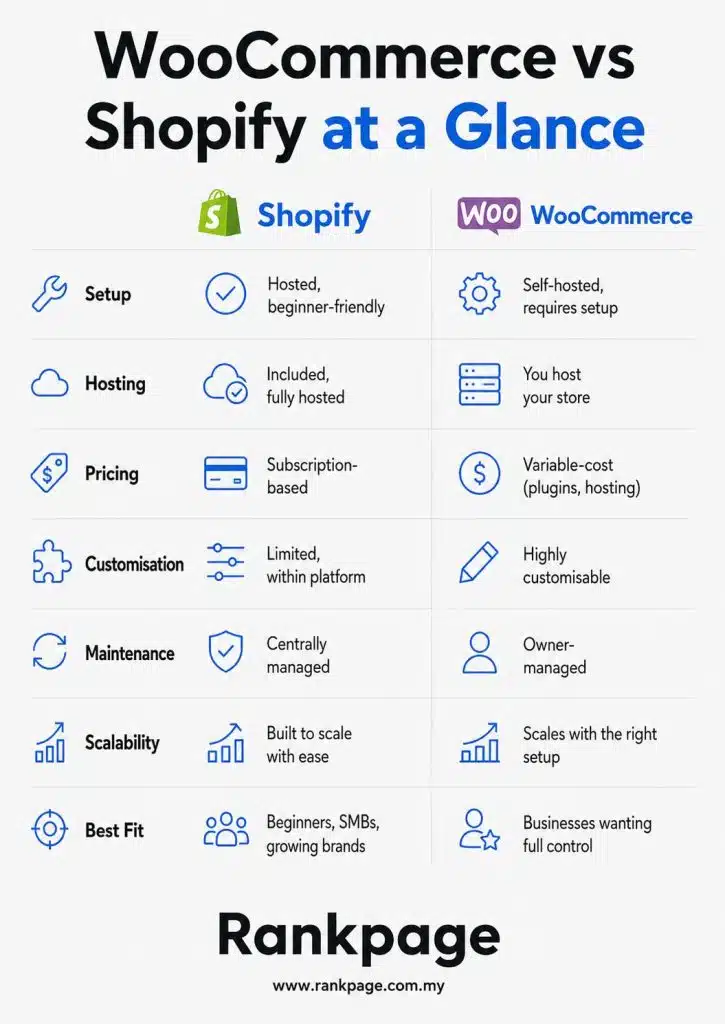
WooCommerce vs Shopify at a Glance
| Area | Shopify | WooCommerce |
|---|---|---|
| Platform type | Hosted ecommerce platform | Open-source WordPress platform |
| Ease of use | Easier for beginners | Requires more setup |
| Hosting | Included | Purchased separately |
| Pricing | Monthly subscription | Free core software plus other costs |
| Features | Strong built-in tools | Extended through plugins |
| Customisation | Flexible within Shopify | Extensive code and hosting control |
| Scalability | Infrastructure managed by Shopify | Depends on hosting and optimisation |
| Maintenance | Mostly managed | Managed by the owner or developer |
| Security | Core platform managed centrally | Depends on the full website setup |
| SEO | Strong built-in basics | Greater technical control |
| Best for | Simplicity and speed | Flexibility and ownership |
Which Platform Is Easier to Use?
Shopify is generally easier because most technical components are managed within one platform.
Its dashboard brings together products, orders, customers, inventory, discounts and reports. Businesses do not need to arrange separate hosting, configure a server or manage core platform updates.
WooCommerce requires businesses to arrange hosting, install WordPress, configure the store and select suitable themes and plugins. Store owners must also manage updates, backups, security, performance and compatibility.
Managed hosting or developer support can reduce this workload, but it adds to the operating cost.
Which Is Better for Ease of Use?
Shopify is better for businesses that want the fastest route to launching a store.
WooCommerce is manageable for non-developers, but it is better suited to businesses familiar with WordPress or supported by a technical team.
What Ecommerce Features Do They Offer?
Both platforms support products, inventory, orders, discounts, shipping and customer accounts.
Shopify Features
Shopify includes:
- Product and inventory management.
- Order processing and refunds.
- Discounts and promotions.
- Abandoned checkout recovery.
- International market settings.
- Connections to selected sales channels.
- Sales and customer reporting.
- App integrations.
Its main advantage is that native tools are built to work within the same ecosystem. However, specialised features may require paid apps.
Some local-currency and payment capabilities depend on Shopify Payments, which is not currently available to businesses based in Malaysia.
WooCommerce Features
WooCommerce provides core store functions and can be expanded through plugins and custom development.
It can support subscriptions, bookings, memberships, wholesale pricing, digital products, marketplaces, custom pricing and specialised checkout processes.
This flexibility suits businesses with unusual workflows or integrations. However, outdated or incompatible plugins may create security, performance or compatibility problems.
Which Platform Has Better Features?
Shopify is generally better for standard ecommerce requirements.
WooCommerce is better for specialised functionality and custom workflows.
Which Platform Offers More Customisation?
WooCommerce offers greater customisation because businesses can access the website’s code, database, hosting environment and wider WordPress ecosystem.
Shopify allows businesses to customise themes, templates, navigation and storefront content. Developers can also use Shopify’s APIs and custom apps.
However, Shopify remains a managed platform. Businesses do not have unrestricted access to its servers or core software, and some checkout changes depend on the selected plan or available tools.
WooCommerce supports custom themes, plugins, code, API connections, database integrations and server configuration. This makes it more suitable for complex projects, although greater flexibility also creates more maintenance and security responsibility.
Which Is Better for Customisation?
WooCommerce is better for maximum flexibility.
Shopify is better for businesses that want useful customisation without managing the entire technical environment.
How Much Do Shopify and WooCommerce Cost?
What Does Shopify Cost?
As of July 2026, Shopify Malaysia lists annual-billing prices of:
| Plan | Price |
|---|---|
| Basic | US$19 per month |
| Grow | US$49 per month |
| Advanced | US$299 per month |
Shopify also lists third-party payment-provider rates of 2% on Basic, 1% on Grow and 0.6% on Advanced.
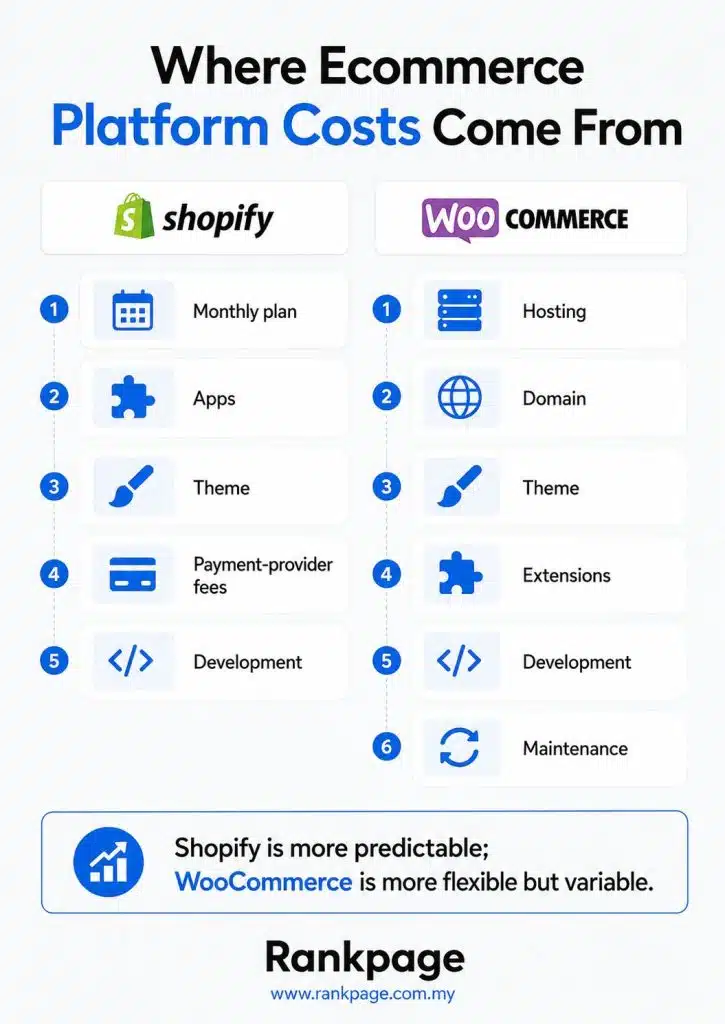
Other costs may include paid apps, premium themes, domains, payment processing and custom development.
Because Shopify Payments is not currently available to businesses based in Malaysia, merchants generally need a third-party provider. They should account for both the provider’s processing charges and Shopify’s applicable transaction fee.
Is WooCommerce Free?
The core WooCommerce software is free, but operating a store involves other costs.
| Cost | Examples |
|---|---|
| Hosting | Server resources, storage and support |
| Domain | Registration and renewal |
| Theme | Free, premium or custom |
| Extensions | Payments, shipping and other features |
| Development | Setup and customisation |
| Maintenance | Updates, backups and support |
A simple WooCommerce store may cost less than Shopify. A customised store with premium hosting and ongoing development may cost more.
Which Platform Is Cheaper?
Shopify is easier to budget for because many costs are bundled into the subscription.
WooCommerce provides more spending control, but its total cost is less predictable.
Which Platform Is More Scalable?
Both platforms can support growing ecommerce businesses.
Shopify manages the hosting infrastructure, so businesses do not need to configure servers as traffic increases. Merchants can move to higher plans and add apps as their needs grow.
WooCommerce can support large catalogues and high order volumes, but performance depends on hosting, caching, database efficiency, theme and plugin quality, integrations and ongoing maintenance.
Which Is Better for Scalability?
Shopify is better for businesses that want infrastructure scaling managed for them.
WooCommerce is better for businesses that want control over how infrastructure is built and expanded.
Which Platform Requires More Maintenance?
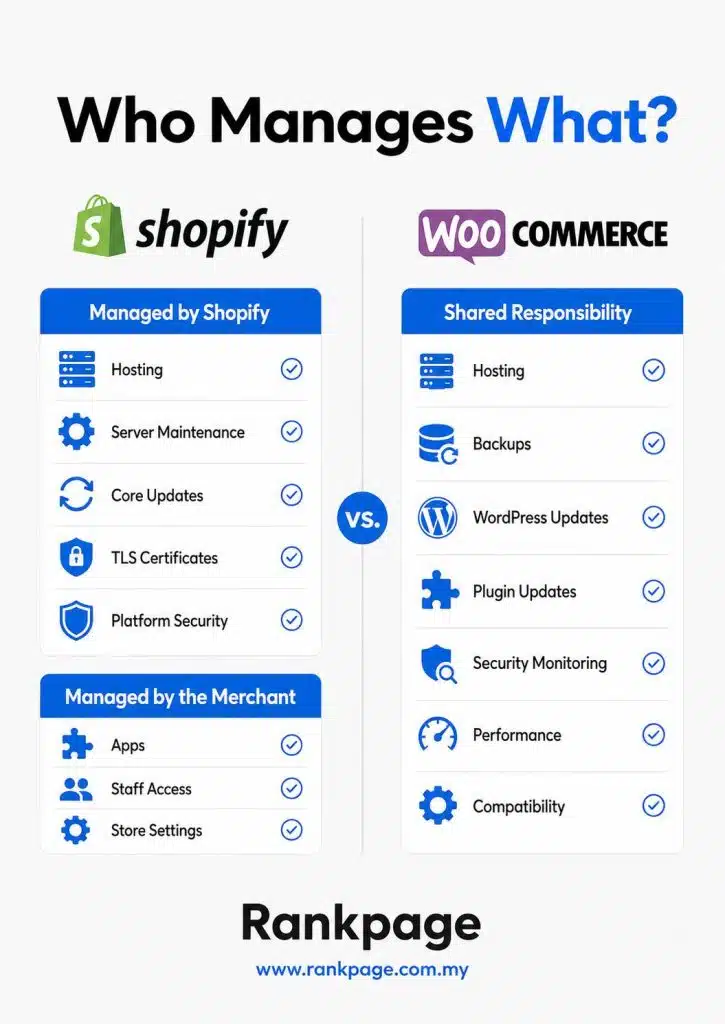
Shopify manages platform updates, hosting, server maintenance, TLS certificates and core security patches.
Merchants remain responsible for store content, user permissions, apps, theme changes and custom integrations.
WooCommerce requires more direct maintenance, including:
- WordPress and WooCommerce updates.
- Theme and plugin updates.
- Backups and security monitoring.
- Performance optimisation.
- Compatibility testing.
- Hosting management.
Managed hosting can automate some tasks, but responsibility remains shared between the business, host and developers.
Which Is Better for Maintenance?
Shopify is better for businesses that want to minimise technical maintenance.
WooCommerce suits businesses willing to manage more technical work in exchange for greater control.
Read More: Technical SEO for eCommerce: Scaling Malaysian SEO (2026)
Which Platform Is More Secure?
Shopify manages security across its hosted infrastructure and includes TLS certificates. Its pricing page states that Shopify is Level 1 PCI DSS compliant and that Shopify-powered stores are PCI compliant by default.
Merchants must still protect staff accounts, review installed apps and maintain secure internal processes.
WooCommerce security depends on the wider website environment. Store owners must select secure hosting, install updates, manage access, protect backups and choose reliable payment gateways.
WooCommerce states that PCI DSS responsibility ultimately rests with the store owner and extends to hosting, extensions and security practices.
Which Is Better for Security?
Shopify is generally easier to manage securely because its core infrastructure is maintained centrally.
WooCommerce can also be secure, but the result depends more heavily on hosting, configuration and maintenance.
Which Platform Is Better for SEO?
Shopify supports canonical tags, XML sitemaps, editable titles and meta descriptions, image alt text and redirects.
WooCommerce provides greater control over URLs, schema, internal linking, templates, site architecture and hosting performance through WordPress.
WooCommerce offers more flexibility, but that does not automatically produce better rankings. A poorly maintained store may perform worse than a well-built Shopify website.
Which Platform Wins for SEO?
WooCommerce provides greater technical and content flexibility.
Shopify is easier for businesses that want reliable SEO service fundamentals without managing the wider technical environment.
SEO should be considered alongside pricing, usability and maintenance rather than treated as the only deciding factor.
Which Works Better With Malaysian Payments?
Shopify Payments is not currently available to businesses based in Malaysia. Malaysian merchants generally need a compatible third-party provider.
Depending on the provider, available methods may include cards, online banking, e-wallets and bank transfers. Merchants should compare processing charges, settlement terms and Shopify’s applicable third-party transaction fee.
WooCommerce allows businesses to install payment gateway plugins. Depending on the provider, these may support FPX online-banking payments, cards, bank transfers, e-wallets and other local methods.
Merchants should confirm that each plugin is secure, actively maintained and compatible with the current WooCommerce version.
Read More: Ecommerce SEO Malaysia: Complete Guide to Higher Rankings & Sales
Which Is Better for Malaysian Payments?
WooCommerce generally offers greater gateway flexibility.
Shopify provides simpler management, but merchants should closely review provider support and total transaction costs.
Shopify Pros and Cons
Pros
- Fast setup.
- Beginner-friendly dashboard.
- Managed hosting and maintenance.
- Centralised platform security.
- Predictable core pricing.
- Managed infrastructure scaling.
Cons
- Recurring plan and app costs.
- Third-party payment fees.
- No Shopify Payments in Malaysia.
- Limited server and backend control.
- Restrictions on some checkout changes.
- Dependence on apps for specialised features.
WooCommerce Pros and Cons
Pros
- Greater hosting and infrastructure control.
- Extensive customisation.
- Flexible feature development.
- Strong WordPress content capabilities.
- Broad payment-gateway flexibility.
- Free core software.
Cons
- More technical responsibility.
- More complex setup.
- Less predictable costs.
- Greater security responsibility.
- Plugin compatibility risks.
- Fragmented support.
When Should You Choose Shopify or WooCommerce?
Choose Shopify When You Want Simplicity
Shopify is likely to suit businesses that:
- Want to launch quickly.
- Have limited technical resources.
- Prefer managed hosting and maintenance.
- Sell relatively standard products.
- Want more predictable operating costs.
Choose WooCommerce When You Need More Control
WooCommerce is likely to suit businesses that:
- Already use WordPress.
- Require specialised features.
- Need custom integrations.
- Want control over hosting.
- Have access to technical support.
- Need greater payment flexibility.
Which Is Better Overall?
Shopify is the stronger all-round choice for businesses that value convenience, faster setup and simpler daily management.
WooCommerce is better for businesses that value customisation, control and the freedom to build a more specialised store.
The decision should be based on total operating costs, required features, technical resources, growth expectations, maintenance capacity and payment needs.
For many Malaysian small and medium-sized businesses, Shopify will be easier to launch and maintain. WooCommerce may provide greater long-term flexibility for businesses with custom requirements and technical support.
Rankpage SEO Agency can help Malaysian brands improve Shopify and WooCommerce websites through technical optimisation, ecommerce SEO, content strategy and sustainable organic growth.
Sources
- Shopify Malaysia Pricing: Plans, prices, transaction rates and included services.
- Shopify Help Center: Shopify Payments availability and payment-provider requirements.
- Shopify SEO Documentation: Built-in SEO features.
- WooCommerce Documentation: Setup, server requirements and scalability.
- WooCommerce Security Guidance: PCI DSS and store-owner responsibilities.
- PayNet: Official information about FPX payments in Malaysia.
Prices, features and payment availability may change. Businesses should confirm current information before choosing a platform.
Frequently Asked Questions About WooCommerce vs Shopify
Is Shopify Better Than WooCommerce for Beginners?
Shopify is generally better for beginners because hosting, platform maintenance and many security tasks are included. WooCommerce requires more setup and ongoing technical management.
Is WooCommerce Cheaper Than Shopify?
WooCommerce can be cheaper for a simple store because the core software is free. However, hosting, extensions, development and maintenance can raise the total cost.
Which Is Better for a Growing Business?
Shopify is easier when the business wants managed infrastructure. WooCommerce offers more control but requires stronger hosting and technical management.
Can I Move From Shopify to WooCommerce Later?
Yes. Products, customers and orders can be migrated, but customer passwords, apps, custom functions, URLs and redirects may need additional work. The new store should be tested carefully before launch.
Which Platform Is Better for an Existing WordPress Website?
WooCommerce is usually the more natural choice for a business that already uses WordPress because it can integrate with the existing content, design and website structure. Shopify may still be suitable when the business prefers a separate managed store.
Can Malaysian Businesses Use Shopify?
Yes. Malaysian businesses can use Shopify, but Shopify Payments is not currently available in Malaysia. Merchants generally need a compatible third-party payment provider and should review all applicable fees.