What Makes Technical SEO for eCommerce Different From Normal Websites?
Ecommerce technical SEO is defined by scale, automation, and constant change.
A typical business website might have:
- 10 to 50 pages
- Static content
- Minimal duplication
An ecommerce site, on the other hand, can easily have:
- Thousands of product pages
- Dynamic URLs generated by filters
- Constant inventory changes
This changes how SEO works at a fundamental level.
Instead of focusing on optimising every page, ecommerce SEO requires you to:
- Decide which pages should exist in search
- Prioritise crawl resources
- Control duplication and page generation
At this point, the challenge shifts from optimisation to decision-making. You are no longer asking “how do I rank this page?” but rather “should this page even exist in search at all?”
This distinction is what separates scalable ecommerce SEO from traditional SEO approaches.
Factor | Normal Websites | eCommerce Websites |
Page Volume | Low to medium | Very high |
Crawl Priority | Less critical | Highly critical |
Duplicate Content | Minimal | Frequent |
Revenue Impact | Indirect | Often commercial |
(Source: Google Search Central; Ahrefs; Search Engine Journal)
Why Crawl Budget Becomes a Visibility Bottleneck
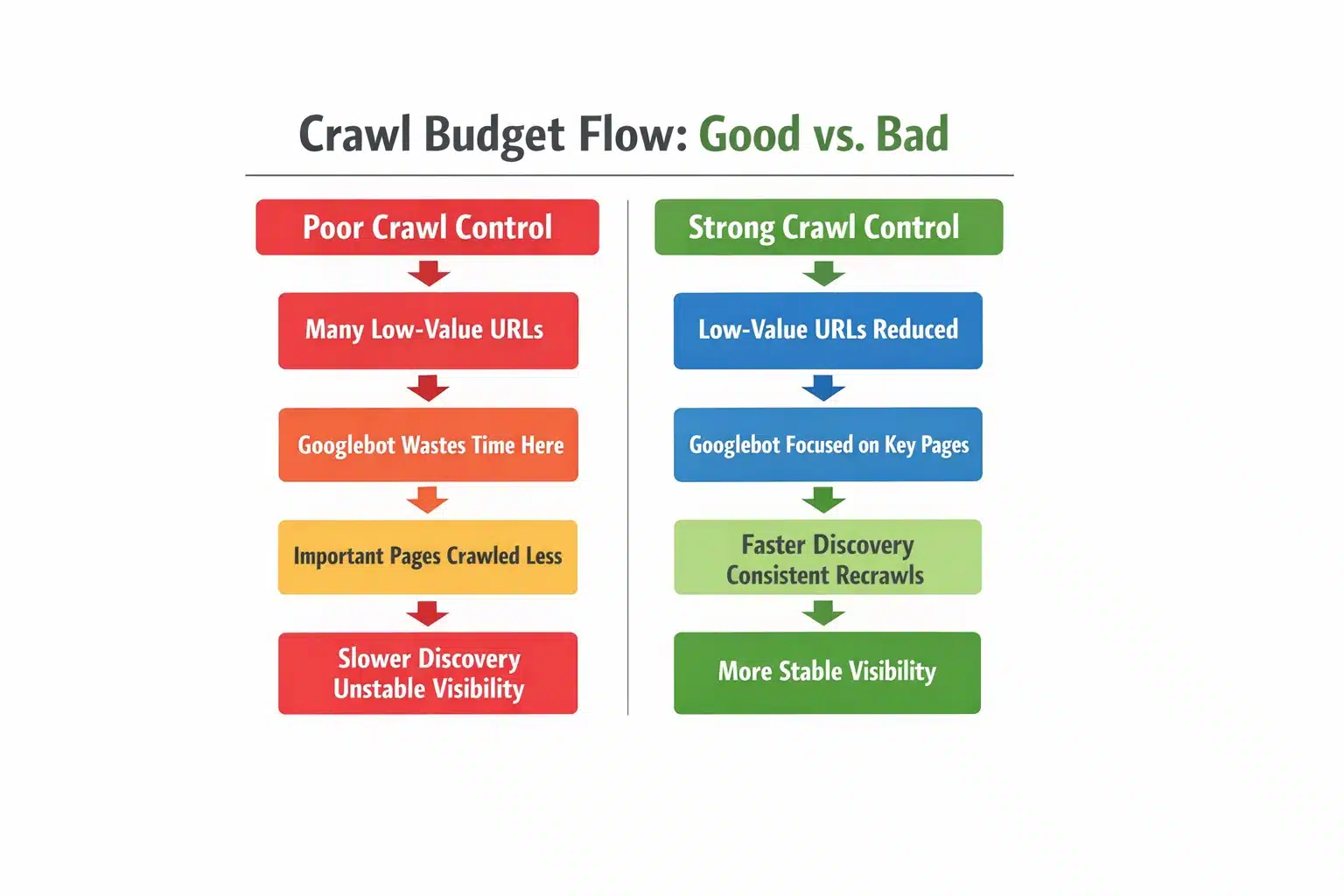
If search engines cannot crawl your products efficiently, visibility can lag and stability becomes harder to maintain.
Search engines allocate a limited amount of crawling attention to each website. This is known as crawl budget. For small websites, this is rarely a problem. For ecommerce stores, it becomes critical.
Imagine you have:
- 5,000 products
- 20 categories
- Hundreds of filter combinations
Search engines may only crawl a portion of these regularly. If your important pages are not prioritised, they may:
- Take longer to appear in search
- Drop out of indexation
- Miss ranking opportunities
This is where technical SEO can start to influence commercial outcomes: if important pages are crawled and revisited less often, indexing and visibility can lag, especially at scale.
To manage crawl budget effectively:
- Focus internal links on important pages
- Reduce low-value URLs
- Keep your site structure clean and shallow
Over time, this creates a compounding advantage. The more efficiently search engines crawl your site, the faster new products get discovered and the more stable your rankings become.
(Source: Google Search Central; Screaming Frog; Moz)
How Faceted Navigation Quietly Weakens Performance
Filters create exponential URL combinations that overwhelm search engines.
Faceted navigation is essential for user experience. It allows customers to filter products by:
- Price
- Size
- Colour
- Brand
However, each filter combination creates a new URL. This leads to:
- Massive duplication
- Crawl inefficiency
- Competing pages targeting the same intent
For example:
- /laptops?brand=asus
- /laptops?price=3000-5000
- /laptops?brand=asus&price=3000-5000
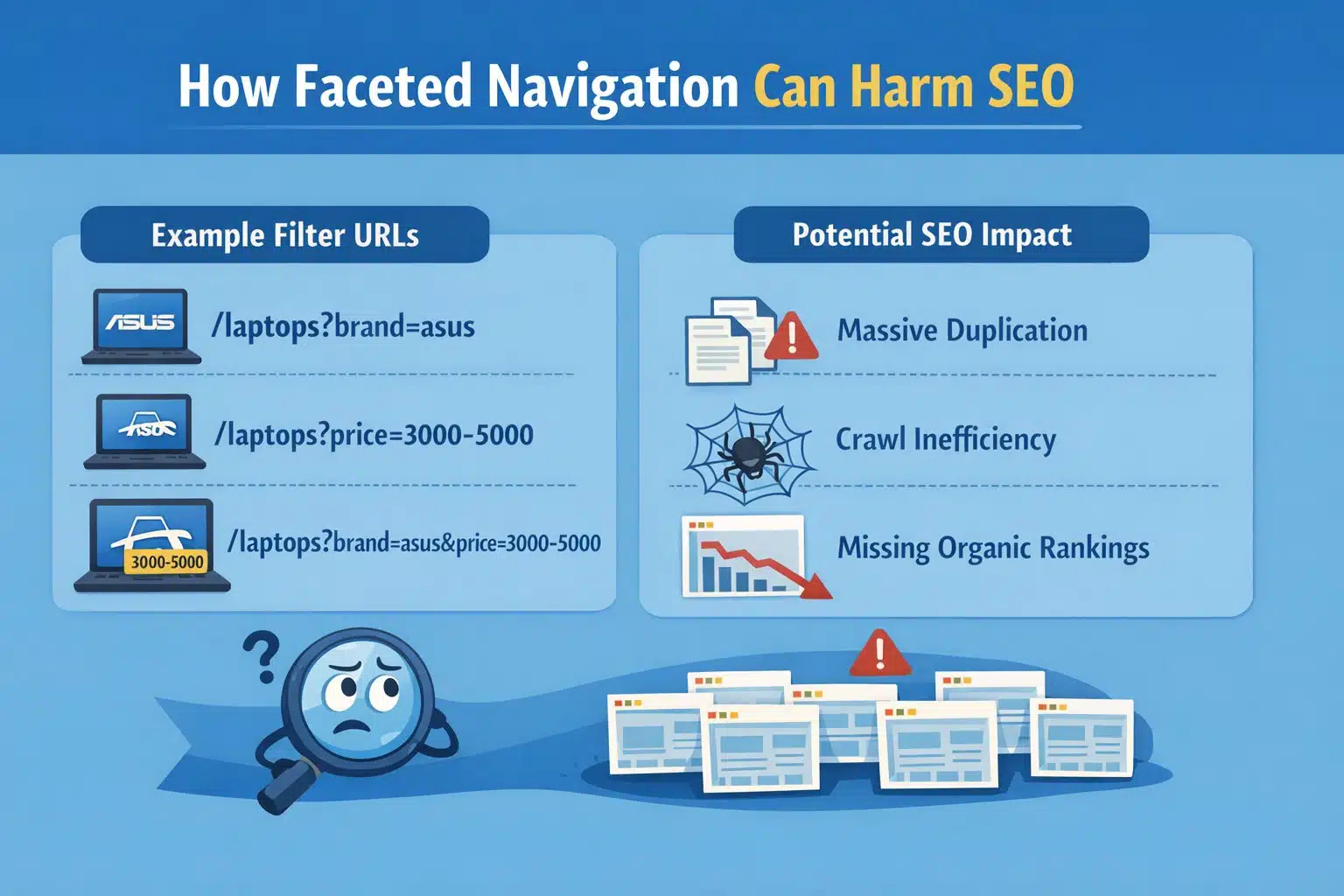
Multiply this across your store, and you may end up with thousands of near-identical pages.
The key is not to remove filters, but to control them strategically:
- Index only high-demand combinations
- Canonicalise similar pages
- Block unnecessary parameters
Left unmanaged, faceted navigation doesn’t just create clutter. It can waste crawl resources and flood your site with near-duplicate URLs, making it harder for search engines to focus on the pages you actually want to perform.
(Source: Google Search Central; Search Engine Land; DeepCrawl)
How to Control Indexation Without Killing UX
The goal is not to index everything, but to index what matters.
A common mistake among ecommerce sites is allowing every page to be indexed. While this may seem beneficial, it often creates more harm than good.
Low-value pages such as:
- Empty categories
- Filter combinations
- Duplicate variations
can dilute your site’s overall ranking strength.
A more effective approach includes:
- Applying noindex to low-value pages
- Using canonical tags to consolidate duplicates
- Selectively indexing pages with real search demand
Think of indexation as a filtering process rather than a default setting. The more intentional you are, the stronger your site’s overall SEO performance becomes.
(Source: Google Search Central; Ahrefs)
Why Category Pages Can Outperform Product Pages
Category pages are often strong traffic drivers in ecommerce SEO, but the split depends on your niche.
Product pages are highly specific and often target long-tail keywords. Category pages, however, target broader and more competitive search terms.
For example:
- “Office chairs Malaysia” → category page
- “Ergonomic mesh chair model X” → product page
Category pages also:
- Accumulate backlinks more easily
- Serve as central hubs for internal linking
- Help distribute authority across the site
Optimising category pages improves:
- Crawl prioritisation
- Ranking potential
- Overall site structure
In many ecommerce stores, category pages can be major traffic drivers because they target broader queries and act as internal-linking hubs, though the category vs. product traffic split varies a lot by niche and catalogue size.
(Source: Search Engine Journal; Backlinko)
The Hidden Problem of Index Bloat in eCommerce Sites
Too many indexed pages can weaken your entire site.
Index bloat occurs when search engines index large numbers of low-value or duplicate pages. This is common in ecommerce due to:
- Filter-generated URLs
- Tag pages
- Thin or incomplete listings
The result:
- Search engines struggle to identify important pages
- Ranking signals become diluted
- Crawl efficiency decreases
Managing index bloat involves:
- Removing unnecessary pages from indexation
- Consolidating duplicate content
- Maintaining a clear hierarchy of importance
In practice, reducing index bloat can improve performance faster than adding more pages, because it sharpens the signals that search engines rely on.
(Source: Ahrefs; SEMrush; Google Search Central)
How Product Lifecycle Affects Technical SEO
Your SEO strategy must adapt to how products change over time.
Unlike static websites, ecommerce stores constantly evolve. Products may:
- Go out of stock
- Be discontinued
- Be replaced with newer versions
Poor handling of these scenarios can lead to:
- Broken pages
- Lost rankings
- Poor user experience
Best practices include:
- Keeping valuable pages live even when out of stock
- Redirecting discontinued products to relevant alternatives
- Updating internal links to reflect changes
Handled correctly, product lifecycle management ensures that your SEO equity continues to compound rather than reset with every inventory change.
(Source: Google Search Central; Shopify Documentation)
Technical SEO Challenges Across Platforms
Your platform determines how much control you actually have.
Different ecommerce platforms offer different levels of flexibility and technical SEO challenges:
Shopify
- Easier to use but limited technical control
- Heavy reliance on apps can affect performance
WooCommerce
- Highly customisable
- Requires proper technical management
Headless Commerce (e.g. Next.js, Sanity)
- High performance potential
- Requires advanced development resources
Choosing the right platform is not just a business decision. It directly affects your ability to implement technical SEO effectively, especially as your store scales.
(Source: Shopify; WooCommerce; Google Search Central)
Malaysia-Specific Technical SEO Considerations
Local infrastructure and behaviour play a significant role in SEO outcomes.
While global SEO principles apply, Malaysian ecommerce stores face unique challenges:
Hosting and Latency
If your origin server is far from Malaysian users, latency (like TTFB) can rise. Better real-user performance can help you hit Core Web Vitals targets and improve user experience, especially on mobile connections.
Payment Gateway Scripts
Local payment gateways and other third-party checkout tools often add extra JavaScript. Depending on how they load, they can increase page weight and slow down key checkout interactions, so it’s worth measuring their impact on Core Web Vitals and real-user performance (and optimising script loading where possible).
Dual Language SEO (Bahasa Malaysia and English)
Managing multiple languages can lead to:
- Duplicate content issues
- Confusion in indexation
Proper use of canonical tags (where appropriate) and hreflang is essential.
Mobile-First Behaviour
Most Malaysian users browse and shop via mobile devices. This makes:
- Page weight
- Navigation
- Checkout flow
critical factors for both SEO and conversions.
These local nuances are often underestimated, but they can significantly influence how well your technical SEO performs in a Malaysian context.
(Source: Google Search Central; Statista; Cloudflare)
The Most Overlooked Technical SEO Mistakes in eCommerce
Most ecommerce sites do not fail due to lack of effort, but due to lack of prioritisation.
Common overlooked issues include:
- Indexing every generated page
- Ignoring crawl budget limitations
- Treating all pages equally
- Over-relying on plugins or apps
- Failing to monitor index growth
Fixing these does not require more SEO work. It requires better control, clearer priorities, and a more strategic approach to how your site evolves over time.
(Source: Ahrefs; SEMrush; Search Engine Journal)
Improving your Ecommerce Business with Technical SEO
Technical SEO for ecommerce is ultimately about managing scale, prioritising what matters, and ensuring search engines focus on pages that drive real business results. As your store grows, the ability to control crawl behaviour and indexation becomes a competitive advantage rather than a technical task.
At Rankpage, Malaysia’s number one SEO agency, we help Malaysian ecommerce businesses build SEO systems that scale with their growth. If your store is expanding and technical complexity is increasing, our SEO services are designed to keep your visibility and performance aligned. Don’t miss this chance to work with Rankpage and boost your ecommerce business.