When users in Malaysia search for terms like “restaurant near me”, “auto repair near me”, “haircut near me”, or “clinic near me”, they are usually looking for a business they can contact, visit, or book soon.
Here’s an example of a search for “restaurant near me”:
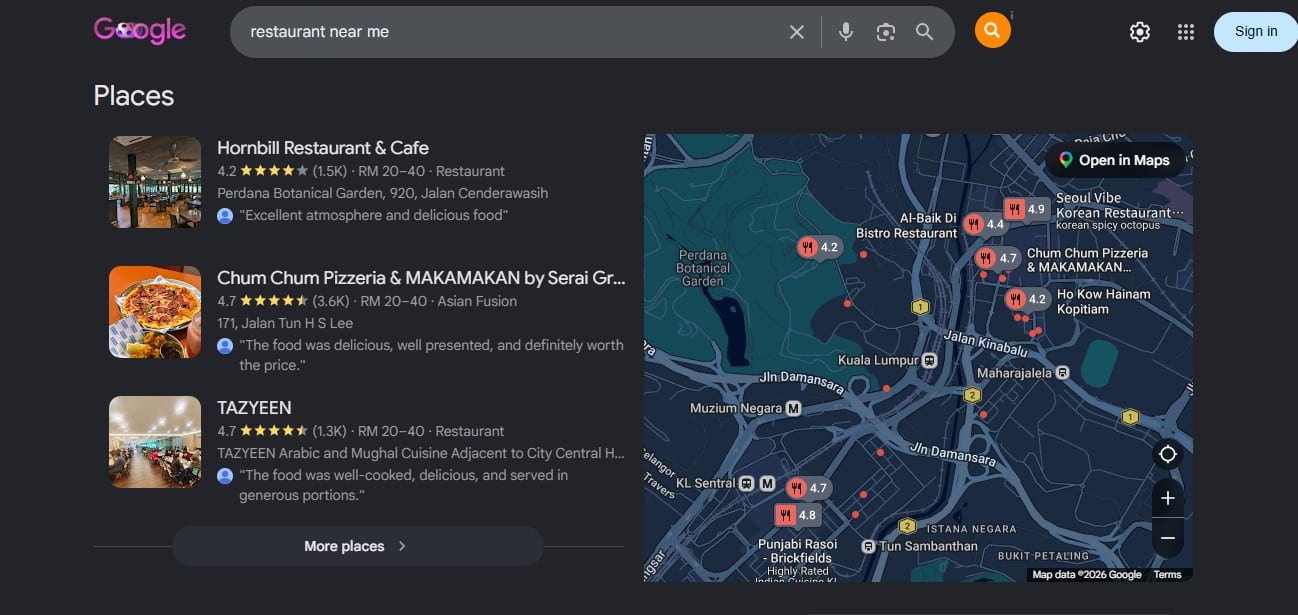
These searches often trigger Google Maps results or the Local 3-Pack because Google understands that the user is looking for nearby options, not general information.
For SMEs, this makes local visibility highly valuable. A business needs to send the right local signals through its website and Google Business Profile so Google can understand:
- Where the business is located
- What products or services it offers
- Whether it matches the searcher’s intent
- How trusted it appears
- Whether users are likely to engage with it
What Are “Near Me” Searches?
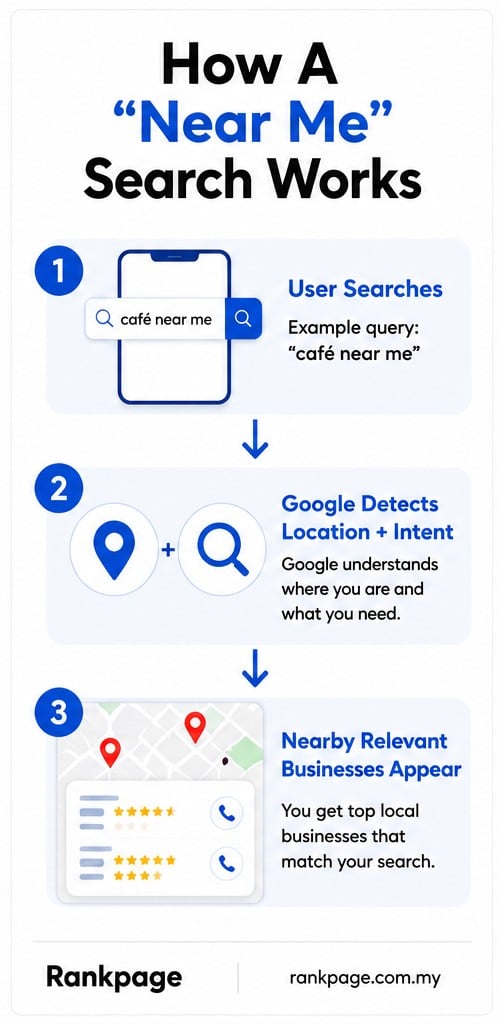
“Near me” searches are location-based queries where users look for businesses, products, or services close to their current location or a specific area.
Common examples include:
- “coffee shop near me”
- “AC repair near me”
- “pet grooming near me”
- “car workshop near me”
- “clinic near me”
- “plumber near me”
These searches carry strong local intent. Google interprets them as: “Show me businesses that match what I need and are close enough to be useful.”
Why “Near Me” Searches Matter
“Near me” searches are often action-driven. Users are usually comparing nearby options and deciding what to do next.
They may want to:
- Call a business
- Check opening hours
- Get directions
- Read reviews
- Book an appointment
- Visit a physical location
For Malaysian SMEs, this means local ranking can directly affect calls, walk-ins, bookings, and enquiries.
Common Characteristics Of “Near Me” Searches
Characteristic | What It Means |
Location-based | Results are influenced by where the user is searching from. |
High intent | Users are often ready to call, visit, book, or compare options. |
Map-driven | These searches commonly trigger Google Maps or Local 3-Pack results. |
Trust-sensitive | Reviews, ratings, and business reputation can influence user choice. |
Action-focused | Users often want quick access to calls, directions, opening hours, or bookings. |
The Main Local SEO Ranking Factors
Google’s local search results are mainly shaped by three core factors: proximity, relevance, and prominence.
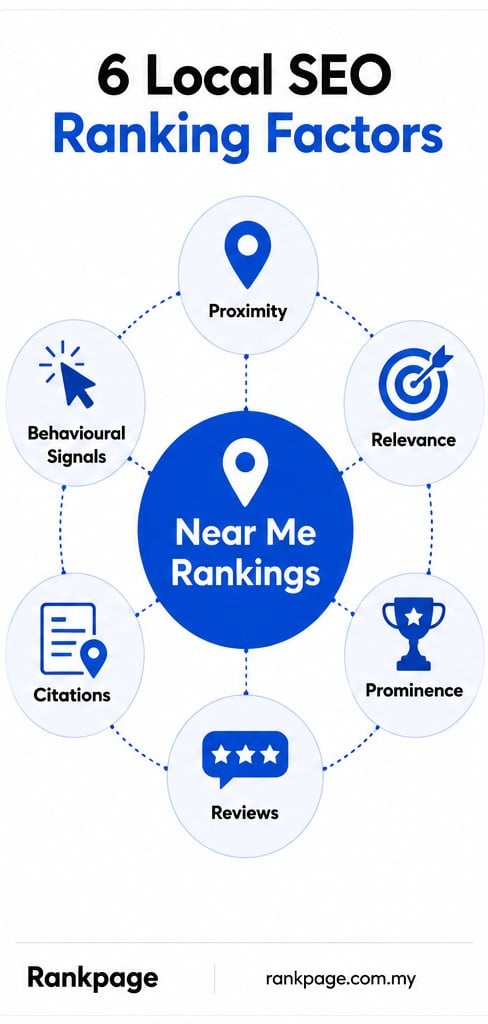
Other supporting signals also matter, especially in competitive local markets. Reviews, citations, and behavioural signals can strengthen a business’s visibility and trust.
Ranking Factor | What It Measures |
Proximity | How close the business is to the searcher or searched location. |
Relevance | How well the business matches the search query. |
Prominence | How well-known, trusted, and established the business appears. |
Reviews | What customers say about the business and how actively they review it. |
Citations | How consistently the business appears across online listings. |
Behavioural signals | How users interact with the listing or website after seeing it. |
Proximity
Proximity refers to how close a business is to the searcher or to the location included in the search query.
For example, a user searching “café near me” in Petaling Jaya is more likely to see cafés nearby. A user searching “plumber near me” in Subang Jaya is more likely to see plumbers serving that area. A search like “car workshop Bangsar” gives Google a specific location to match against.
What Proximity Can Depend On
Proximity may be influenced by:
- The searcher’s current location
- The location mentioned in the search query
- The business address
- The business service area
- The distance between the user and available local options
Why Proximity Matters
Proximity matters because local searches are practical. Users usually want a business that is convenient, accessible, and close enough to visit or contact quickly.
For service-area businesses, such as plumbers, electricians, cleaners, or mobile repair services, proximity may depend more on the areas they serve.
Proximity Is Not The Only Factor
The closest business does not always rank first. A nearby business may still lose visibility if it has:
- Weak relevance to the search query
- Poor or outdated reviews
- Low prominence
- Inconsistent business information
- Limited user engagement
Relevance
Relevance is how well a business matches what the user is searching for.
If someone searches for “car aircond repair near me”, Google will look for businesses that clearly relate to car air-conditioning repair. A general car workshop may appear, but a business with stronger service relevance may have an advantage.
What Relevance Can Be Based On
Relevance can be shaped by:
- Business category
- Products or services offered
- Business description
- Website content
- Local landing pages
- Customer review content
- Search terms associated with the business
- Location and service-area information
Malaysian Search Context
For Malaysian SMEs, relevance may also involve multilingual search behaviour. Some users search in English, while others may use Bahasa Melayu or mixed local terms.
For example:
- “car repair near me”
- “bengkel kereta near me”
- “klinik gigi near me”
- “kedai tayar near me”
- “mamak near me”
A business that clearly reflects its services, location, and customer language is easier for Google to match with the right searches.
Prominence
Prominence refers to how well-known, established, and trusted a business appears online and offline.
A business with strong prominence may have more public recognition, stronger online mentions, better reviews, local links, and a stronger reputation than competitors.
Signals That Can Support Prominence
Prominence can be influenced by:
- Reviews and ratings
- Local media mentions
- Directory listings
- Backlinks from relevant websites
- Brand searches
- Social visibility
- Offline reputation
- General online presence
Why Prominence Matters In Competitive Areas
Prominence becomes especially important in competitive locations such as Kuala Lumpur, Petaling Jaya, Shah Alam, Johor Bahru, Penang, Subang Jaya, Cheras, and Mont Kiara.
In dense markets, many businesses may be close to the searcher and offer similar services. Prominence helps Google decide which businesses appear more trustworthy, established, and worth showing.
Reviews
Reviews are one of the most visible trust signals in local search.
They influence both Google’s understanding of a business and the customer’s decision-making process. When users compare several nearby businesses, reviews often help them decide which one to call, visit, or book.
Review Signals That Matter
Important review-related signals include:
- Average star rating
- Total number of reviews
- Review freshness
- Review detail
- Review sentiment
- Keywords naturally mentioned by customers
- Owner responses
How Reviews Support Relevance
Reviews can reinforce what a business is known for. For example, a salon with recent reviews mentioning “haircut”, “colouring”, “friendly staff”, and “Bangsar” sends stronger service and location signals than a profile with only a few short or outdated reviews.
Similarly, a car workshop with reviews mentioning “aircond service”, “tyre replacement”, or “battery change” may send clearer relevance signals for those services.
Reviews Also Influence Conversion
For SMEs, reviews are not just a ranking factor. They are also a conversion factor.
Even if two businesses appear close together in search results, users may choose the one with:
- More recent reviews
- A higher average rating
- More detailed customer feedback
- Better responses from the business owner
Citations
Citations are online mentions of a business’s key details, usually its name, address, and phone number. These details are commonly known as NAP.
Citations can appear across:
- Business directories
- Local listing websites
- Industry directories
- Social media profiles
- Map platforms
- Chamber of commerce pages
- Local blogs
- Review platforms
Why Citation Consistency Matters
Citations help search engines verify that a business is real, active, and located where it claims to be.
Common citation issues include:
- Different business names across platforms
- Old addresses still appearing online
- Multiple phone numbers
- Incorrect opening hours
- Duplicate listings
- Outdated branch information
For Malaysian SMEs, citations are especially useful when they appear across relevant local and industry-specific platforms. They support local rankings by reinforcing business identity, location accuracy, contact details, and credibility.
Behavioural Signals
Behavioural signals refer to how users interact with a business after seeing it in local search results.
These signals help indicate whether users find a listing relevant, trustworthy, and useful enough to act on.
Examples Of Behavioural Signals
Behavioural signals may include:
- Clicking to call
- Requesting directions
- Visiting the website
- Viewing photos
- Reading reviews
- Saving the listing
- Clicking booking links
- Returning to the listing later
Why Behavioural Signals Matter
For “near me” searches, behavioural signals matter because users often want to act quickly.
A useful local result is not just one that appears in search. It is one that users engage with.
For example, a business that regularly receives calls, direction requests, and website visits from local searches may appear more useful than a listing that users ignore.
How These Local Ranking Factors Work Together
Local SEO ranking factors do not work in isolation. Google considers multiple signals together when deciding which businesses to show.
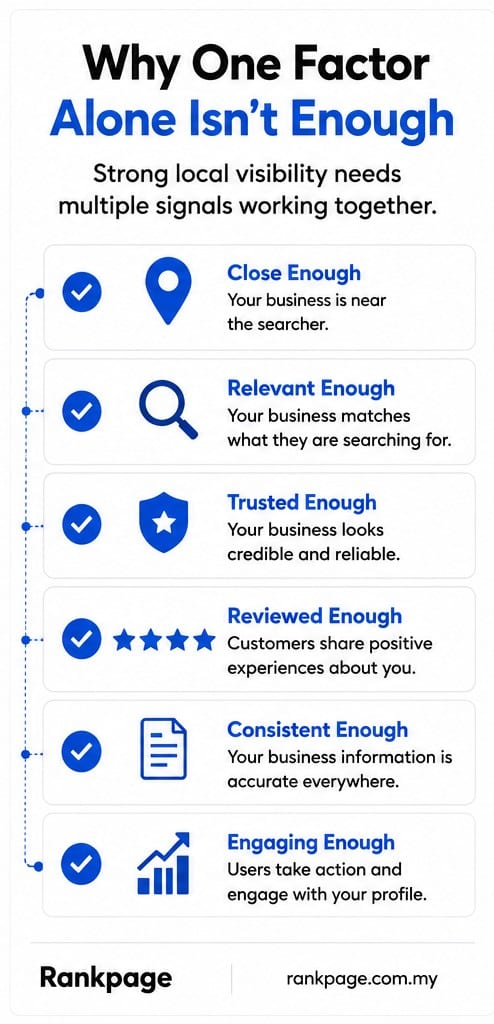
A nearby restaurant may have strong proximity, but weak reviews and poor prominence can limit its visibility. A highly rated restaurant may have strong reviews, but if it is too far from the searcher, it may not appear for that specific “near me” query. A business with many citations may appear credible, but if its services do not match the search, relevance will still be weak.
A Strong Local Result Usually Combines
- Proximity: The business is close enough to the searcher.
- Relevance: The business matches the query.
- Prominence: The business appears trusted and established.
- Reviews: Customers show confidence in the business.
- Citations: Business details are consistent across the web.
- Behavioural signals: Users interact positively with the listing.
Why These Factors Matter For Malaysian SMEs
For Malaysian SMEs, local search is highly practical. Many users search while commuting, shopping, comparing services, or looking for urgent help.
Common Malaysian “near me” searches include:
- “mamak near me”
- “clinic near me”
- “tayar shop near me”
- “bengkel kereta near me”
- “dentist near me”
- “plumber near me”
- “printing shop near me”
- “tuition centre near me”
- “car wash near me”
Malaysia Has Its Own Local Search Patterns
In Malaysia, local visibility can also be affected by:
- Dense competition in urban areas
- Mixed-language search behaviour
- Multi-branch business locations
- Service-area businesses without storefronts
- Mobile-first search habits
- Review-driven decision-making
- Citation consistency across platforms
For SMEs, local rankings are not only about search visibility. They directly affect calls, walk-ins, bookings, enquiries, and revenue.
Common Misconceptions About Local Search Rankings
“Adding ‘Near Me’ Everywhere Will Make My Business Rank”
Not necessarily. Google does not rank businesses simply because they repeat the phrase “near me”. It looks at location, relevance, prominence, reviews, citations, and user behaviour.
“The Closest Business Always Ranks First”
Proximity is important, but it is not the only factor. A slightly farther business may rank higher if it has stronger relevance, better reviews, and higher prominence.
“Reviews Only Matter For Customers, Not Rankings”
Reviews influence both trust and local visibility. Review quantity, quality, freshness, and sentiment can all support local performance.
“Citations Are Only Useful For Old-School SEO”
Citations still help verify business information. Consistent mentions across trusted platforms can strengthen local credibility.
“A Website Is Enough For Local Rankings”
A website helps, but local rankings also depend on map visibility, reviews, citations, engagement, and business profile signals.
Local Rankings Depend On Location, Trust, And Relevance
Ranking higher in “near me” searches is not about one trick or one keyword. It depends on whether Google sees your business as nearby, relevant, trusted, and useful.
For Malaysian SMEs, the most important local SEO ranking factors are:
- Proximity
- Relevance
- Prominence
- Reviews
- Citations
- Behavioural signals
A business that performs well across these areas is more likely to appear in Google Maps, attract high-intent local users, and turn nearby searches into calls, visits, bookings, and enquiries.
If your business needs help boosting local visibility, contact Rankpage, Malaysia’s trusted SEO agency, today. Rankpage is a SEO agency in Malaysia with 8+ years of experience, and can help local businesses improve search visibility where it matters most,