Handling negative Google reviews professionally means staying calm, checking the facts and offering a practical next step. The goal is not to win a public argument, but to show that your business listens and responds responsibly.
Google reviews may influence whether customers call, visit, book or choose another business. This is particularly important for restaurants, clinics, workshops, tuition centres, retailers and professional service firms.
A single one-star review does not necessarily define your reputation. A professional reply can show that you value feedback, while an argumentative or dismissive response may cause more damage. Even if your business has top-notch SEO services that help visibility, responding professionally to negative reviews is still vital to maintain customer trust and reputation.
How Should You Respond to a Negative Google Review?
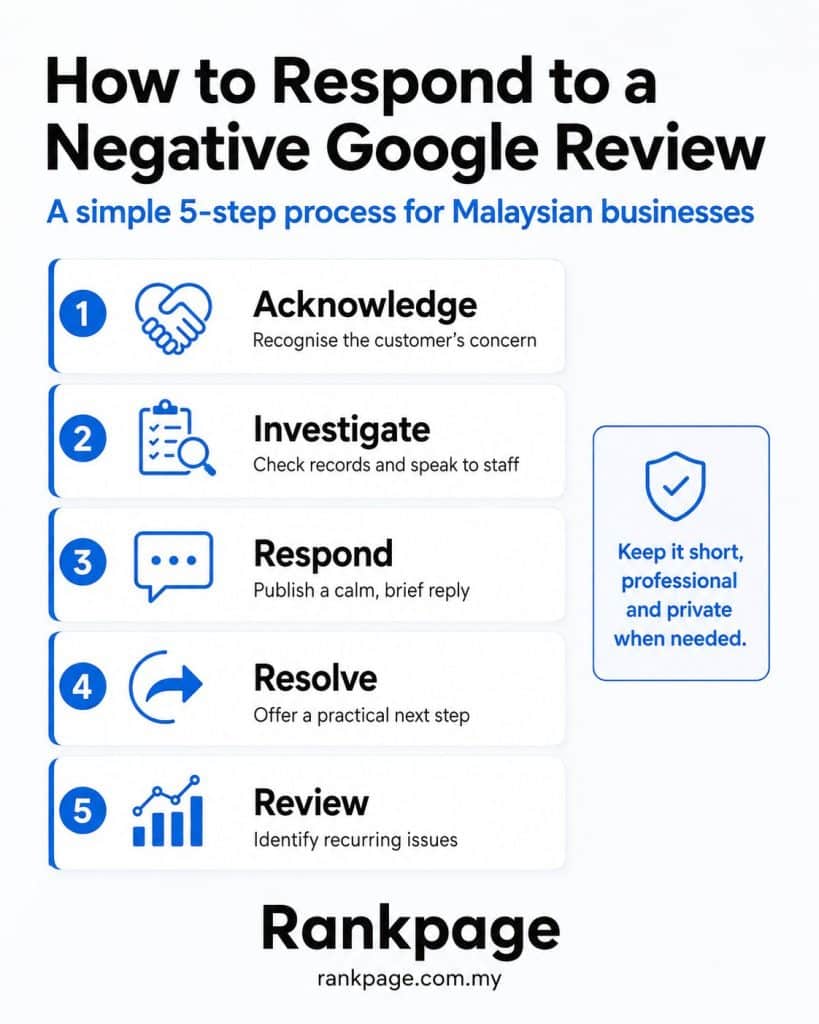
Investigate the complaint, acknowledge the customer’s experience and offer a realistic way forward. Keep the reply brief and move sensitive details offline.
| Stage | What to Do |
|---|---|
| Acknowledge | Recognise the concern |
| Investigate | Check records and speak to staff |
| Respond | Publish a calm reply |
| Resolve | Offer a practical next step |
| Review | Identify recurring issues |
What Are the Steps for Handling Negative Google Reviews?
Step 1: Pause Before You Reply
Do not respond while angry or defensive.
Negative reviews can feel personal, especially for owner-managed SMEs. Take a short pause and focus on the complaint rather than the reviewer’s tone.
Step 2: Identify the Main Complaint
Determine what the customer is unhappy about.
- Service Issue: Slow service, poor communication or staff behaviour.
- Product Issue: Damage or an inaccurate description.
- Process Issue: A delayed refund, booking problem or delivery error.
- Expectation Issue: The customer expected something that was not promised.
- Serious Allegation: Safety, discrimination, fraud or misconduct.
This helps determine whether customer service, management or a professional adviser should be involved.
Step 3: Check Your Records
Review bookings, receipts, order histories, appointment records, delivery logs and customer-service messages.
The reviewer may have used another name or booked through someone else. Do not call a review fake simply because you cannot identify it immediately.
| Finding | Recommended Action |
|---|---|
| Complaint matches your records | Acknowledge it and offer a solution |
| Complaint is partly accurate | Accept the valid point and clarify carefully |
| Reviewer cannot be identified | Ask for details privately |
| Service is not offered | Respond cautiously and consider reporting |
| Review appears abusive or fraudulent | Preserve evidence and check Google’s policies |
Step 4: Investigate Internally
Speak to the relevant employees, confirm which policy applied and identify any communication failure. Base your response on facts rather than assumptions.
Step 5: Decide Who Should Respond
| Complaint Level | Examples | Response Owner |
|---|---|---|
| Low Risk | Waiting time, slow service | Customer service or branch staff |
| Medium Risk | Refund disputes, damaged products | Manager or department head |
| High Risk | Safety, discrimination, fraud claims | Senior management or adviser |
Businesses with several locations should define who can reply publicly.
Step 6: Write a Short and Specific Reply
Keep most replies short and focused. Three to six sentences may be a useful internal guideline.
A professional response usually includes:
- A polite greeting.
- Recognition of the issue.
- An apology or expression of regret.
- A practical next step.
- A private contact channel.
Hi [Name], we are sorry to hear that your experience did not meet expectations. We are reviewing the issue involving [brief description]. Please contact us through [email, phone or WhatsApp] with your visit or order details so we can assist you directly.
Customise each response. Repeated generic replies may appear insincere.
Step 7: Show Empathy Without Automatically Admitting Fault
You can recognise frustration without agreeing with every allegation.
| Avoid | Better Alternative |
|---|---|
| “Everything you said is false.” | “We are sorry to hear that you were dissatisfied.” |
| “Our staff did nothing wrong.” | “We are reviewing the matter with the team involved.” |
| “You misunderstood our policy.” | “The policy may not have been communicated clearly.” |
When the business was at fault, apologise directly. When the complaint is disputed, acknowledge the experience and limit your response to facts that can safely be shared.
Read More: Local SEO Ranking Factors: Rank Higher in “Near Me” Searches
Step 8: Offer a Realistic Next Step
Possible actions include:
- Reviewing an order.
- Arranging a replacement.
- Clarifying a charge.
- Scheduling a manager call.
- Providing an approved refund.
Do not promise compensation publicly unless it has been authorised.
Step 9: Move Sensitive Details Offline
Use email, telephone, WhatsApp Business or another private channel when personal details are required.
This is particularly important for complaints involving payments, medical information, account details or employee conduct.
Do not ask customers to post their IC number, bank details, phone number, health information or order reference publicly.
Step 10: Follow Up
Confirm that the promised action was completed and record the outcome. You may mention that reviews can be updated, but do not pressure the customer to remove genuine criticism.
What Should You Say in a Negative Review Response?
Genuine Service Failure
Hi Aina, we are sorry about the long waiting time during your visit. Our team did not manage the queue as well as we should have. Please contact our branch manager so we can follow up directly.
Customer Cannot Be Identified
Hi, we are sorry to hear about your experience. We cannot identify the booking from the information provided. Please contact us privately with the date and branch so we can investigate.
Privacy-Sensitive Complaint
Hi, we take concerns of this nature seriously. To protect your privacy, we cannot discuss individual records publicly. Please contact our management team through [private channel].
What Should You Avoid When Replying?
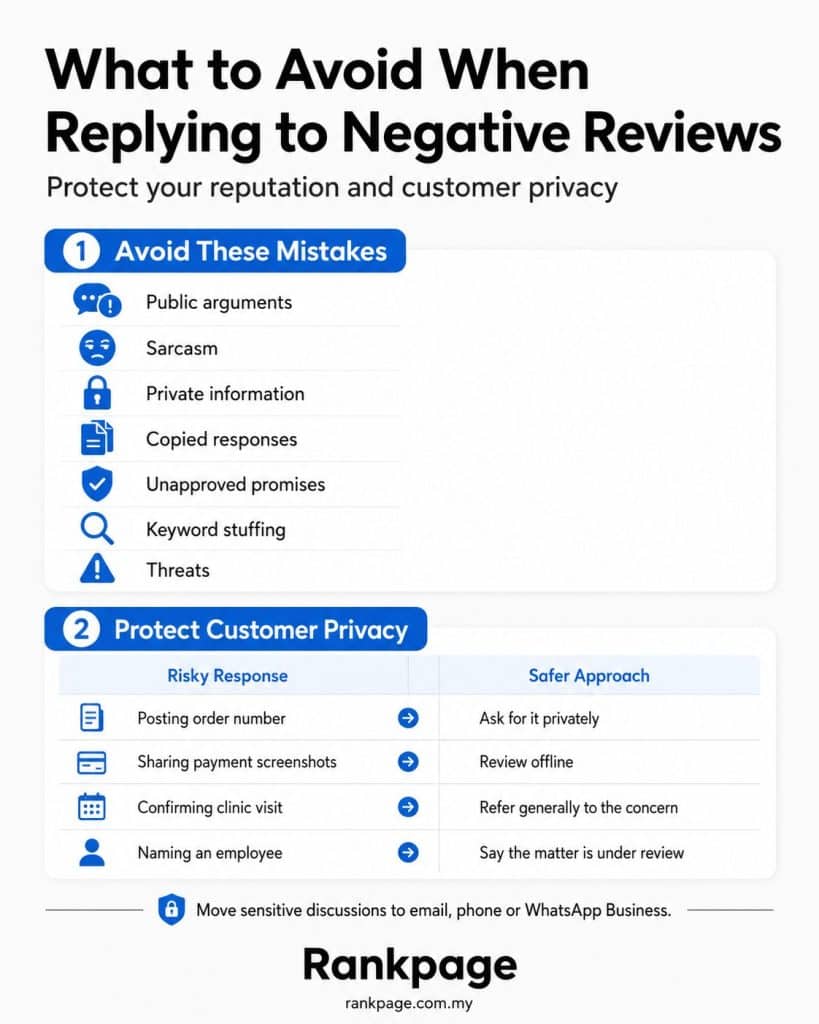
- Public Arguments: Do not respond point by point.
- Sarcasm: Avoid jokes or passive-aggressive wording.
- Private Information: Never publish medical details or payment records.
- Copied Responses: Repeated replies may appear insincere.
- Unapproved Promises: Do not offer unauthorised refunds or replacements.
- Keyword Stuffing: Do not force SEO phrases into the response.
- Threats: Avoid public legal threats unless professionally assessed.
How Quickly Should You Respond?
Businesses may use 24 to 48 hours as an internal target for ordinary complaints, provided there is enough time to check the facts. This is not a Google requirement.
| Situation | Suggested Approach |
|---|---|
| Simple complaint | Aim to respond within 24 to 48 hours |
| Investigation required | Post a short acknowledgement |
| Serious allegation | Escalate immediately |
| Suspicious review | Document and assess before replying |
Accuracy matters more than speed.
Should You Apologise When You Disagree?
Yes. You can express regret about the customer’s experience without accepting every claim.
We are sorry that the experience did not meet your expectations. After reviewing the available information, we have been unable to confirm some of the circumstances described. However, we would be happy to discuss your concerns privately.
Avoid “We are sorry you feel that way,” which can sound dismissive.
How Should Malaysian Businesses Protect Customer Privacy?
Public review responses may remain visible for a long time. Even when you have evidence that contradicts a reviewer, publishing personal information may be inappropriate.
| Risky Response | Safer Approach |
|---|---|
| Confirming a clinic visit | Refer generally to the concern |
| Posting an order number | Ask for it privately |
| Sharing payment screenshots | Review the issue offline |
| Naming an employee | Say the matter is under review |
Malaysian businesses should handle personal data carefully under the Personal Data Protection Act 2010, as amended by the Personal Data Protection (Amendment) Act 2024.
Identification numbers, financial details, contact information and health records should not be requested or disclosed publicly.
Can You Remove a Negative Google Review?
A review cannot usually be removed simply because the business disagrees with it. Reviews may be reported when they appear to violate Google’s policies.
Possible violations include:
- Fake engagement.
- Rating manipulation.
- Impersonation.
- Conflicts of interest.
- Harassment.
- Threatening content.
- Spam.
A practical process is:
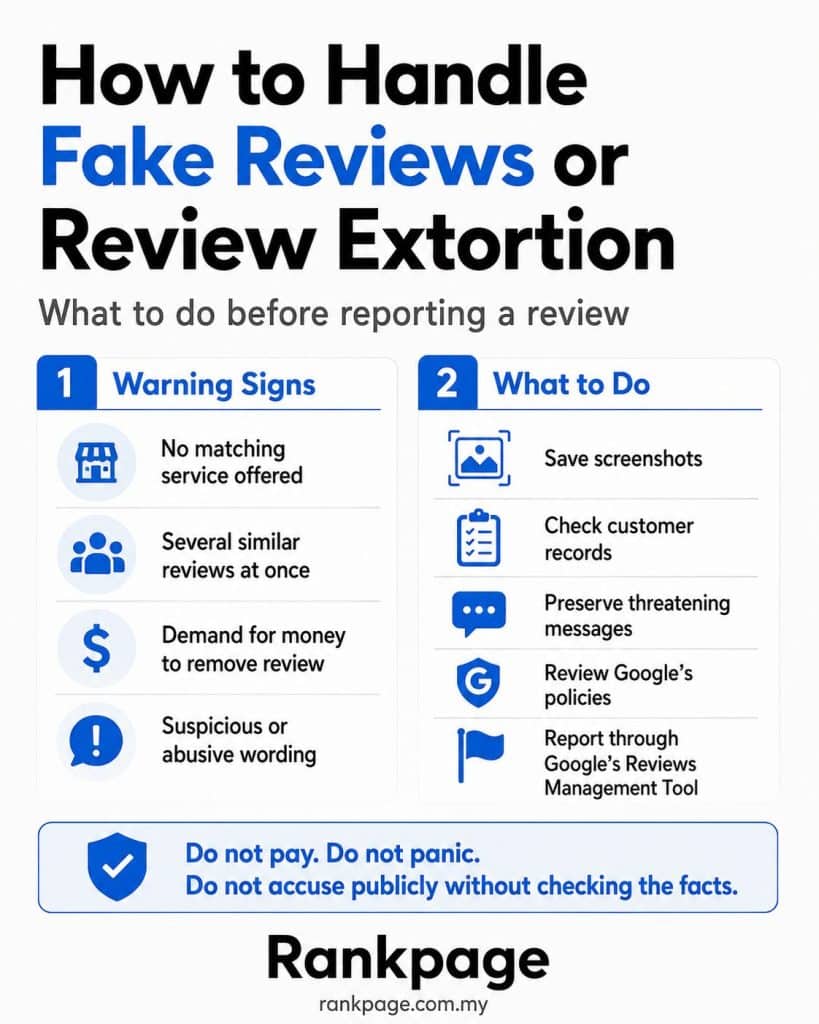
- Save screenshots.
- Check customer records.
- Preserve threatening messages.
- Review Google’s policies.
- Report the review through Google’s Reviews Management Tool.
- Appeal when the option is available.
- Publish a restrained response if appropriate.
Do not buy positive reviews, organise mass reporting or offer incentives for removing criticism.
Read More: Service Area Business SEO: Ranking Without a Physical Storefront
How Should You Handle Fake Reviews or Review Extortion?
Warning signs may include services your business does not offer, several similar reviews appearing together or demands for payment in exchange for removal.
However, the absence of a matching customer record does not prove that a review is fake.
A cautious response may say:
We take customer feedback seriously, but we have been unable to identify a transaction matching the details in this review. Please contact our management team privately so we can investigate.
What Are the Main Challenges of Managing Reviews?
Responding Without Becoming Defensive
Written guidelines help staff focus on facts rather than emotions.
Getting the Full Story
Assign one person to investigate complaints involving several employees or branches.
Maintaining a Consistent Tone
All branches should follow the same standards for tone, privacy and escalation.
Dealing With Unreasonable Demands
Explain what the business can reasonably offer without arguing publicly.
Managing Several Languages
Translation accuracy matters when reviews appear in English, Bahasa Malaysia, Mandarin or Tamil.
Do Responses to Google Reviews Help Local Visibility?
Professional responses can make a Google Business Profile more helpful and may improve customer confidence. However, replying to reviews does not guarantee higher rankings.
Google states that local results are mainly based on relevance, distance and prominence. Review management should support, not replace, accurate business information, useful content and Google Business Profile optimisation.
Avoid unnatural keyword use in complaint responses.
How Can You Create a Review Management Process?
A simple process should include:
- Assigning someone to monitor reviews.
- Setting internal response targets.
- Creating tone and privacy guidelines.
- Defining which complaints need approval.
- Tracking recurring complaint categories.
- Reviewing patterns monthly.
Useful metrics include response time, resolution rate and recurring complaint themes.
Responding to Negative Reviews While Protecting Your Reputation
Negative Google reviews should be handled with a calm and repeatable process. Investigate the complaint, protect customer privacy, respond specifically and offer a realistic next step.
Consistent review management can reveal service gaps and strengthen a business’s online presence.
Rankpage SEO agency helps Malaysian companies improve online visibility through practical SEO services, including Google Business Profile optimisation and local SEO support.
Sources
- Google Business Profile Help: Manage Customer Reviews
- Google Business Profile Help: Tips to Get More Reviews
- Google Business Profile Help: Report Inappropriate Reviews
- Google Business Profile Help: Tips to Improve Local Ranking
- Google Maps User-Generated Content Policy: Prohibited and Restricted Content
- Personal Data Protection Act 2010, Malaysia
- Personal Data Protection (Amendment) Act 2024, Malaysia
- Department of Personal Data Protection Malaysia: Personal Data Protection FAQ
Frequently Asked Questions About Responding to Negative Google Reviews Professionally
Should I Respond to Every Negative Google Review?
Most genuine negative reviews deserve a response. Spam, harassment and irrelevant content may be reported instead.
How Long Should a Response Be?
Keep it short and focused. Three to six sentences is a useful guideline, depending on the complaint.
Can I Ask a Customer to Delete a Negative Review?
You may mention that reviews can be updated after resolution. Do not pressure or reward customers for removing genuine criticism.
What If I Cannot Identify the Reviewer?
Explain that you cannot locate the transaction and invite the reviewer to provide details privately.
Can Google Remove a Fake Review?
Google may remove reviews that violate its policies, but not simply because a business disagrees with them.
Do Negative Reviews Hurt SEO?
One negative review does not automatically determine local rankings. Repeated complaints may reduce customer trust, but Google does not publish their precise ranking effect.