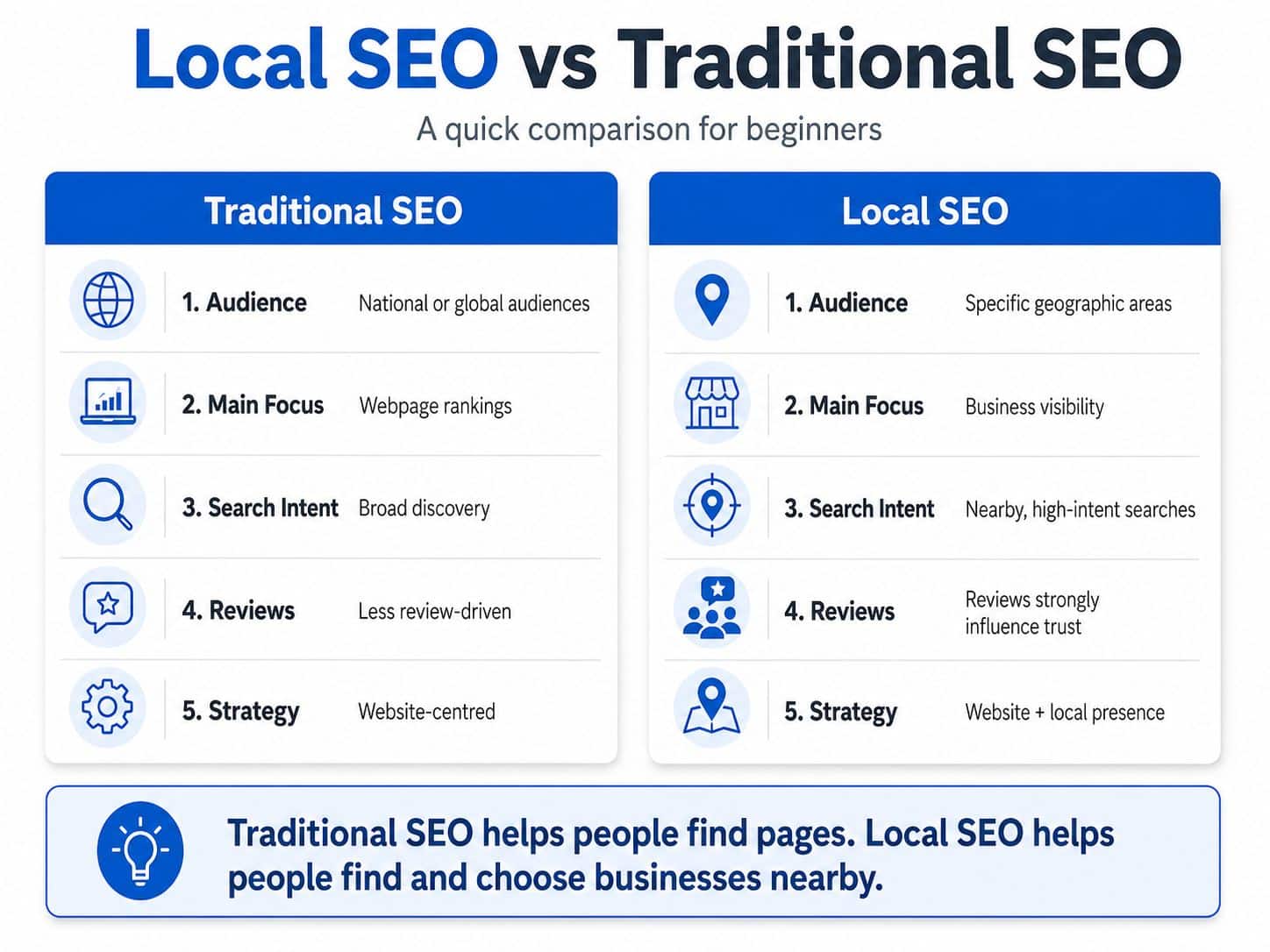
Local SEO vs Traditional SEO
Traditional SEO | Local SEO |
Targets national or global audiences | Targets specific geographic areas |
Focuses on webpage rankings | Focuses on business visibility |
Usually less driven by customer reviews directly | Reviews can significantly influence local visibility and trust |
Website-centred strategy | Website and local presence strategy |
If traditional SEO is about ranking pages, local SEO is about helping potential customers find and choose your business.
Why Local SEO Matters More Than Ever
Consumer behaviour has shifted heavily toward mobile. Many people now use their phones to find nearby services instead of relying on directories or browsing lists of options.
As a result, local search is a high-intent channel. People often search when they’re close to taking action, such as calling a business, requesting directions, booking an appointment, or visiting a location.
For businesses, this means local SEO can influence:
- Phone calls
- Website enquiries
- Direction requests
- Store visits
- Appointment bookings
- Service enquiries
The businesses appearing prominently in local search results are often the businesses receiving these opportunities.
How Google Determines Local Rankings
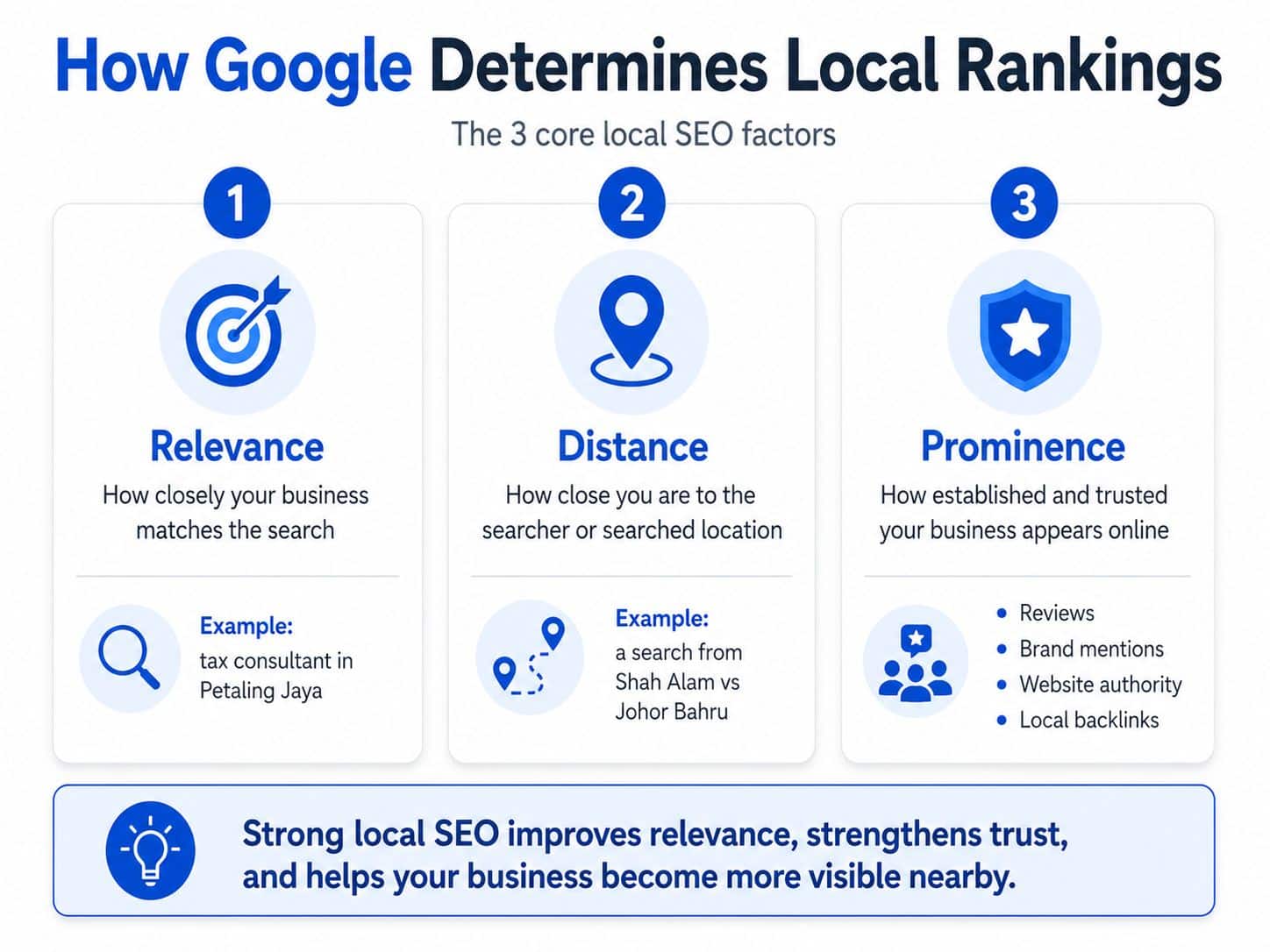
Google uses many signals to rank local businesses, but three core factors are consistently highlighted in local search: relevance, distance, and prominence.
Relevance
Relevance refers to how closely a business matches the user’s search.
For example, someone searching for “tax consultant in Petaling Jaya” expects businesses that clearly offer tax consulting services rather than general financial services.
Distance
Distance measures how close a business is to the searcher or the location specified in the search.
A user searching from Shah Alam may see different results from someone searching the same keyword from Johor Bahru.
Prominence
Prominence reflects how established and trusted a business appears online.
Factors that contribute to prominence include:
- Reviews
- Brand mentions
- Website authority
- Local backlinks
- Business reputation
Most local SEO activities ultimately aim to improve one or more of these three factors.
Who Needs Local SEO?
Local SEO is beneficial for almost any business that serves customers within a specific location.
Brick-and-Mortar Businesses
Physical stores, restaurants, cafés, clinics, and retail outlets depend heavily on local visibility to attract nearby customers.
Service-Area Businesses
Electricians, plumbers, cleaners, and contractors often serve multiple locations and can benefit from local search visibility across their service regions.
Professional Service Firms
Lawyers, accountants, consultants, architects, and agencies often compete locally before expanding nationally.
Multi-Location Businesses
Businesses with several branches need local visibility for each location to maximise enquiries and foot traffic.
Small Businesses
Local SEO often allows smaller businesses to compete effectively against larger brands by focusing on relevance and local trust rather than overall company size.
Where Does Local SEO Actually Happen?
Many people think local SEO only happens on Google Maps. In reality, it exists across several connected platforms.
Your Business Profile
Business profiles help search engines understand who you are, what you do, and where you operate.
Your Website
Your website provides detailed information about your services, locations, expertise, and credibility.
Reviews
Reviews help both users and search engines evaluate trustworthiness.
Local Directories
Business directories and industry listings reinforce important business information.
Local Mentions
Mentions from local organisations, publications, and community websites help strengthen authority signals.
Together, these elements create the ecosystem that supports local visibility.
The Local SEO Framework
Rather than viewing local SEO as a collection of isolated tasks, it is more useful to think of it as a system built on several pillars.
Pillar 1: Business Information Accuracy
Search engines need consistent information about your business.
Accurate details help build confidence in your legitimacy and location.
Pillar 2: Website Optimisation
Your website remains an important source of relevance and authority signals.
It helps search engines understand your services and target locations.
Pillar 3: Reputation & Trust
Positive customer experiences create reviews, recommendations, and repeat business.
These signals contribute directly to both visibility and conversions.
Pillar 4: Local Authority
Authority is built through mentions, links, partnerships, and recognition within your local market.
Pillar 5: User Experience
Generating visibility is only part of the equation. Visitors must also be able to contact, visit, or enquire easily.
Local SEO Roadmap: Step-by-Step Implementation
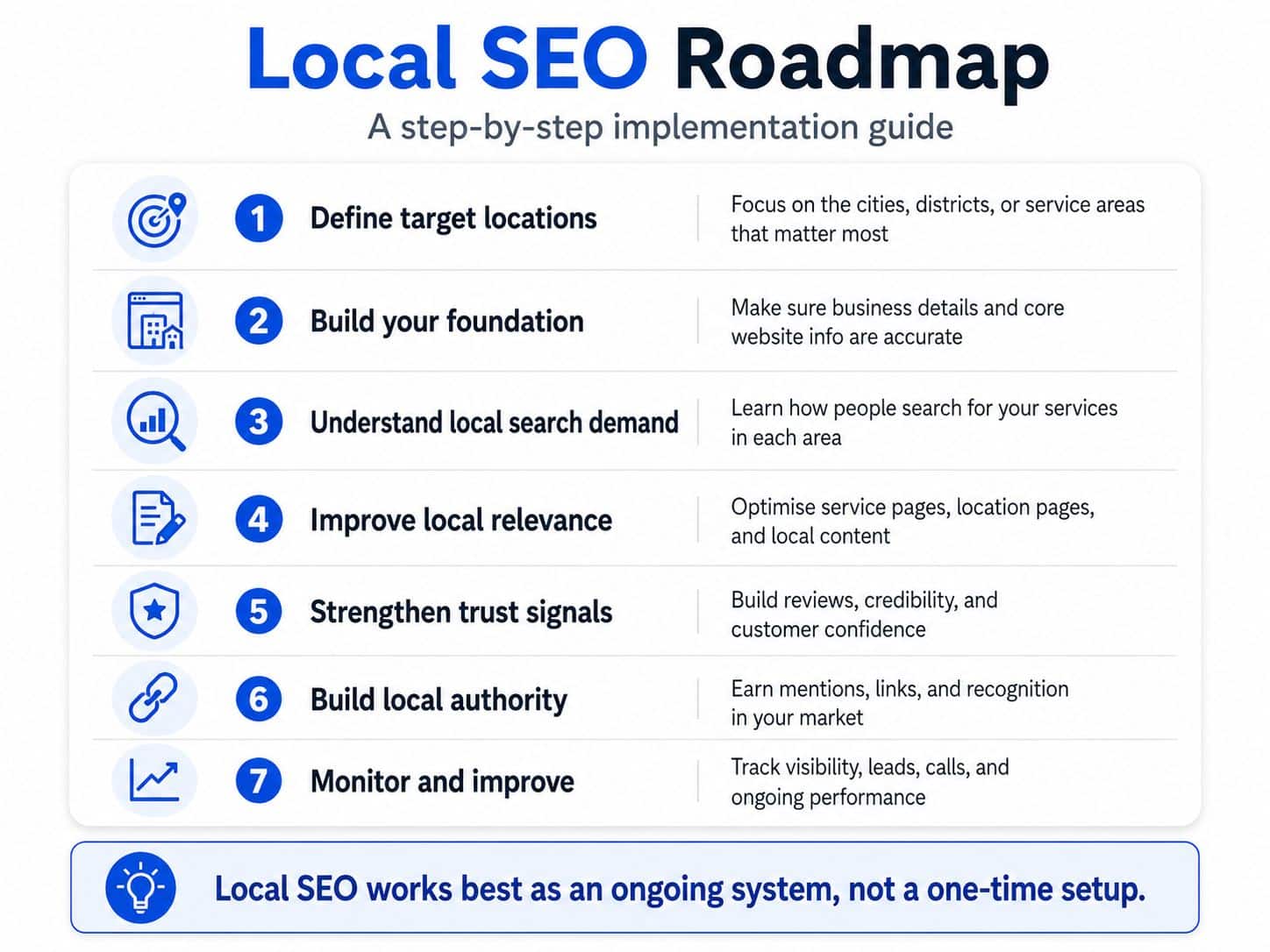
Step 1: Define Your Target Locations
Identify the cities, districts, or service areas that matter most to your business.
Prioritise areas that generate the highest commercial value rather than trying to target every location immediately.
Step 2: Build Your Foundation
Ensure your business information is accurate and consistent across all major platforms.
Your website should clearly communicate:
- Services
- Locations served
- Contact information
- Business credibility
Step 3: Understand Local Search Demand
Research how potential customers search for your services.
Location modifiers often reveal valuable opportunities, such as:
- Accounting firm Kuala Lumpur
- Dentist Penang
- SEO agency Johor Bahru
Understanding these searches helps align your content with real user behaviour.
Step 4: Improve Local Relevance
Optimise your website content to demonstrate relevance to your target locations and services.
This includes service pages, location pages, contact pages, and supporting content.
Step 5: Strengthen Trust Signals
Trust remains one of the strongest drivers of local success. Focus on:
- Reviews
- Customer satisfaction
- Brand credibility
- Community presence
Step 6: Build Local Authority
Authority develops gradually through consistent marketing efforts, relationships, and industry recognition.
Local authority often becomes a major differentiator in competitive markets.
Step 7: Monitor and Improve
Local SEO is not a one-time project. Monitor:
- Visibility
- Rankings
- Calls
- Leads
- Website traffic
- Customer enquiries
Continuous improvements help maintain and grow performance over time.
Common Local SEO Mistakes
Treating Local SEO as a One-Time Task
Many businesses complete an initial setup and assume the work is finished.
In reality, local SEO requires ongoing optimisation and maintenance.
Ignoring Customer Reviews
Reviews influence both visibility and customer decisions.
A lack of reviews can weaken trust and performance.
Inconsistent Business Information
Conflicting details across platforms create confusion for both users and search engines.
Focusing Only on Rankings
The goal of local SEO is not rankings alone.
Ultimately, success should be measured through leads, calls, appointments, and revenue.
How Long Does Local SEO Take?
Results vary depending on competition, location, and the current state of your online presence.
In many cases, businesses see early movement within a few months, with more measurable improvements often appearing around 3–6 months—especially once the basics (business info, website clarity, and reviews) are consistent.
Local SEO is a long-term investment rather than a quick win.
Local SEO in the Age of AI Search
AI-generated search experiences continue to evolve, but local SEO fundamentals remain important.
AI systems still rely heavily on trusted business information, reputation signals, website content, and local authority to understand which businesses deserve recommendations.
Businesses that build strong local SEO foundations today are generally better positioned for both traditional search and AI-powered discovery experiences.
DIY Local SEO vs Hiring an Agency
Whether you should manage local SEO internally or hire an agency depends on your resources and objectives.
DIY approaches can work well for smaller businesses with limited competition and available time.
However, businesses operating in competitive industries often benefit from specialist expertise, structured processes, and ongoing optimisation.
The right choice depends on your budget, growth goals, and internal capabilities.
Doing Local SEO the Right Way
Local SEO is no longer an optional marketing tactic for businesses that rely on local customers. It has become one of the most effective ways to connect with people who are actively searching for services nearby.
The businesses that perform best in local search typically focus on building a strong foundation, improving trust, strengthening authority, and maintaining consistent optimisation over time. By approaching local SEO as a long-term system rather than a one-time project, businesses can generate sustainable visibility, qualified leads, and lasting competitive advantages.
If you are looking to accelerate your local SEO growth, our team at Rankpage, Malaysia’s trustworthy SEO agency, can help develop a tailored strategy that aligns with your business goals, locations, and target audience.
Sources
- Google Business Profile Help: Guidance on improving local rankings and how Google describes relevance, distance, and prominence.
- Think with Google (Micro-moments research): Evidence that local searches often lead to real-world actions such as visits and purchases.
- Ahrefs (SEO timelines research/polling): Industry data on commonly reported timeframes for SEO results, used here to frame expectations (actual results vary).