What Is Crawl Budget in SEO
Crawl budget is the set of URLs Googlebot can crawl and wants to crawl on your site (driven by crawl capacity and crawl demand). (Source: Google for Developers)
You can think of it as a balance between how much Google can crawl and how much it wants to crawl.
Crawl Rate Limit (Crawl Capacity)
Crawl rate limit determines how aggressively Googlebot can crawl your site without overwhelming your server. (Source: Google Search Central Blog; Google for Developers)
It is influenced by:
- Server performance and uptime
- Page speed and response time
- Error rates such as 5xx or timeouts
If your site is slow or unstable, Google will reduce crawling to avoid causing issues. (Source: Google for Developers)
Crawl Demand
Crawl demand determines how often Google chooses to crawl your pages. (Source: Google for Developers)
It is influenced by:
- Popularity signals (how important Google believes a URL is)
- How often Google expects the content to change (staleness)
- The perceived importance of certain pages
Pages that stay important and are likely to change tend to be revisited more often. (Source: Google Search Central Blog; Google for Developers)
Putting It Together
Crawl budget exists at the intersection of:
- Technical capacity (how much Google can crawl)
- Importance signals (how much Google wants to crawl)
Understanding both sides is key to improving how your site is discovered. (Source: Google for Developers)
Why Crawl Budget Matters (And When It Doesn’t)
Crawl budget only matters when it starts limiting your visibility. (Source: Google Search Central Blog)
For many small business websites:
- If your site has fewer than a few thousand URLs, it is usually crawled efficiently
- Service-based sites typically have low crawl complexity
This is why most small sites do not need to obsess over crawl budget. (Source: Google Search Central Blog)
However, crawl budget becomes important when:
- Your site has thousands of URLs
- You run ecommerce with filters and dynamic URLs
- You publish content at scale
- You experience indexing delays (important pages take too long to show up)
In these cases, inefficient crawling can lead to:
- Important pages not being discovered
- Delayed indexing
- Reduced search visibility
Ultimately, if Google is not crawling the right pages, your SEO service performance will suffer. (Source: Google Search Central Blog; Google for Developers)
How Crawl Budget Works in Practice
To understand crawl budget properly, it helps to visualise it as a process:
Website → Crawl → Index → Rank → Visibility
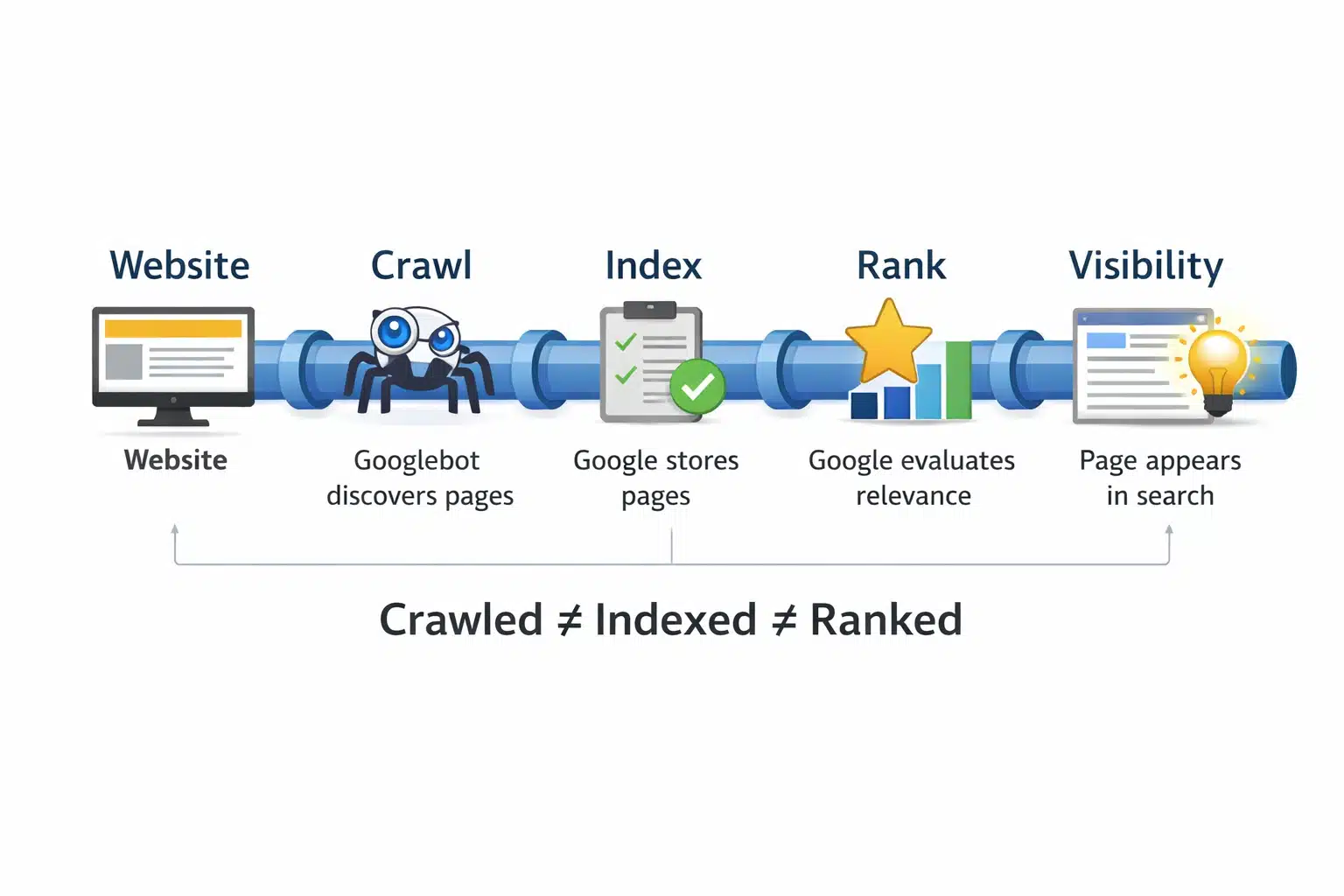
Each stage filters content further.
- Crawl: Googlebot discovers and visits URLs
- Index: Google decides whether the page is worth storing
- Rank: Google evaluates relevance and authority
- Visibility: The page appears in search results (and other search experiences)
Here is the critical insight:
Not all crawled pages are indexed, and not all indexed pages rank. (Source: Google for Developers)
This is why crawl budget must be tied to quality, not just quantity.
Crawl Budget vs Indexation (The Critical Link)
Crawling is only the first step. Indexation is where many pages fail. (Source: Google for Developers)
A common scenario:
- Pages are crawled
- But not indexed
This is often visible in Google Search Console as:
- “Crawled but not indexed” (Source: Google Search Console Help)
The reasons are often not purely technical, but qualitative:
- Thin or duplicate content
- Lack of unique value
- Weak internal linking
- Low authority signals
This creates a hidden inefficiency:
Google is spending crawl resources on pages that it ultimately discards. (Source: Google for Developers)
The problem is not that Google is not crawling your site. The problem is that it is crawling the wrong things. (Source: Google Search Central guidance on crawl budget + low-value URLs)
What Affects Crawl Budget
Technical Factors
Technical SEO health plays a major role in crawl efficiency. (Source: Google for Developers)
Common issues include:
- Slow-loading pages reducing crawl activity
- Server errors limiting crawl frequency
- Redirect chains wasting crawl resources
These issues signal instability and cause Google to crawl less aggressively. (Source: Google for Developers)
Site Structure
How your site is organised affects how easily Google navigates it.
Key factors:
- Internal linking strength
- Click depth of pages
- Logical hierarchy
Pages buried deep within a site are less likely to be crawled frequently, especially if they are not well-linked. (Source: Google Search Central Blog)
Content Signals
Content quality and freshness influence crawl demand.
Important signals include:
- Meaningful updates (not just date changes)
- Unique, valuable content
- Ongoing importance and usefulness
Low-value pages reduce overall crawl efficiency because they give Google less reason to revisit. (Source: Google Search Central Blog; Google for Developers)
URL Management
URL structure is one of the most overlooked factors.
Common problems:
- Parameter-based URLs
- Duplicate variations of the same page
- Infinite URL combinations (filters generating endless permutations)
These create unnecessary crawl paths that dilute attention away from your key pages. (Source: Google Search Central Blog; Google for Developers)
Common Crawl Budget Issues in Malaysia
Ecommerce Filter Explosion
Many Malaysian ecommerce sites adopt filter-heavy navigation:
- Size, colour, price, brand
Each filter combination can generate a new URL.
This leads to:
- Thousands of near-duplicate pages
- Excessive crawl paths
Result: Google spends time crawling low-value variations instead of prioritising key category and product URLs. (Source: Google Search Central Blog; Google for Developers — faceted navigation)
Duplicate Service Pages by Location
Businesses often create multiple pages targeting different locations:
- “SEO Agency KL”
- “SEO Agency PJ”
- “SEO Agency Malaysia”
If content is largely identical, Google sees little added value.
Result:
- Duplicate crawling
- Indexing filters (some pages get ignored) (Source: Google Search Central Blog)
Multilingual Duplication
Malaysia’s bilingual environment introduces complexity:
- English and BM versions of the same content
- Weak or inconsistent hreflang implementation
Without clear signals, Google may:
- Crawl multiple versions unnecessarily
- Struggle to prioritise the correct page for the right user (Source: Google for Developers — crawling myths/alternate URLs)
Thin Content Publishing
Some businesses focus on quantity over quality:
- High volume of short blog posts
- Minimal depth or originality
Result:
- Pages are crawled
- But not indexed
This wastes crawl resources and can reduce overall site quality signals. (Source: Google for Developers)
The Crawl Efficiency Framework (What Actually Matters)
Instead of focusing only on crawl budget, a better approach is to focus on crawl efficiency.
Crawl Efficiency (framework) ≈ Crawl Budget × Value of URLs Crawled
Where:
- Crawl Budget = how much Google can and wants to crawl
- Value of URLs Crawled = whether Google is spending time on pages that actually matter
This is a practical way to frame the real goal: you do not need more crawling, you need better pages being crawled. (Source: Google Search Central Blog; Google for Developers)
A smaller site with high-value content can outperform a large site full of low-value pages.
How to Optimise Crawl Budget (Prioritised Approach)
Focus on High-Intent Pages
Start with pages that drive business outcomes:
- Service pages
- Product categories
- Conversion-focused landing pages
These should be:
- Well-linked internally
- Regularly updated (when there is real change)
Reduce Crawl Waste
Identify and reduce low-value URL patterns:
- Consolidate duplicates with canonicalisation (and remove true duplicates where possible)
- Block crawling of truly unimportant URL patterns (like certain filter/facet URLs) via robots.txt (Source: Google for Developers)
- If your goal is to keep a page out of Google, use noindex or restrict access; robots.txt alone is not a reliable “keep it out of Google” mechanism (Source: Google Search Central robots.txt guidance)
- Remove thin or outdated content that does not deserve to be indexed
Improve Technical Performance
Ensure your site is easy to crawl:
- Optimise loading speed
- Fix server errors
- Reduce redirect chains (Source: Google for Developers)
Strengthen Internal Linking
Internal links guide Google’s crawling priorities.
Best practices:
- Link to important pages more frequently (naturally, not spammy)
- Avoid orphan pages
- Keep key pages within a few clicks from the homepage (Source: Google Search Central Blog)
Maintain Clean URL Structures
Simplify your URL system:
- Limit parameter usage
- Control faceted navigation
- Avoid unnecessary URL variations (Source: Google for Developers — faceted navigation; crawl budget)
If filters matter for users but do not need to rank, keep them functional while reducing indexable crawl paths.
Monitor Crawl Behaviour
Use tools like Google Search Console to:
- Track crawl activity (Crawl Stats report) (Source: Google Search Console Help)
- Identify indexing issues (Indexing reports)
- Spot crawl inefficiencies (parameter spam, duplicates, soft 404s)
This allows you to adjust your strategy over time.
Do Malaysian SMEs Really Need to Worry About Crawl Budget
For many small websites, crawl budget is not the bottleneck. Crawl efficiency and page quality are. (Source: Google Search Central Blog)
You should prioritise crawl budget optimisation if:
- Your site has thousands of URLs
- You operate in ecommerce or marketplaces with filters and parameter URLs
- You consistently experience slow discovery or indexing delays for important pages (Source: Google Search Central Blog)
If not, your focus should be:
- Content quality
- Clear site structure
- Authority building
These factors usually have a much bigger impact on SEO performance.
How Google Uses Crawl Data Today (Beyond Crawling)
Crawl budget is not just a technical concept.
Crawling supports indexing, and indexing supports ranking. The practical takeaway is still the same:
Make your best pages:
- Easy to find (strong internal linking)
- Fast to fetch (solid technical performance)
- Worth indexing (unique value, clear answers, structured content) (Source: Google for Developers)
Search evolves, but crawl efficiency remains a stable advantage because it helps Google spend its time on your most valuable content.
Understanding Crawl Budget Well
Crawl budget is not about how many pages Google visits. It is about whether Google is spending its time on the pages that actually matter to your business.
If you want to improve how your site is crawled, indexed, and surfaced in search, we can help you build a crawl-efficient SEO system that aligns with how Google works today. At Rankpage, we focus on turning technical SEO into measurable business outcomes. Don’t miss the chance to partner with Rankpage, Malaysia’s number one SEO agency, and improve your SEO performance.