
What Is UI And What Is UX?
User Interface (UI)
User interface refers to the visual and interactive components users directly engage with. This includes:
- Buttons and call-to-action elements
- Navigation menus
- Page layout structure
- Colour schemes and typography
- Icons, forms, and interactive modules
UI is the visible layer of your website.
User Experience (UX)
User experience refers to how smooth, intuitive, and satisfying it is to use your website. It covers:
- Ease of navigation
- Logical information flow
- Clarity of messaging
- Emotional comfort and trust
- Efficiency in completing tasks
UX is the overall journey.
(Source: Nielsen Norman Group; Google Search Central)
How UI And UX Work Together
UI and UX are closely connected but not interchangeable.
Think of it this way:
- UI is how your site looks and responds.
- UX is how your site works from start to finish.
You can have beautiful design but poor usability. For example:
- Attractive homepage banners
- Complicated checkout process
- Confusing service navigation
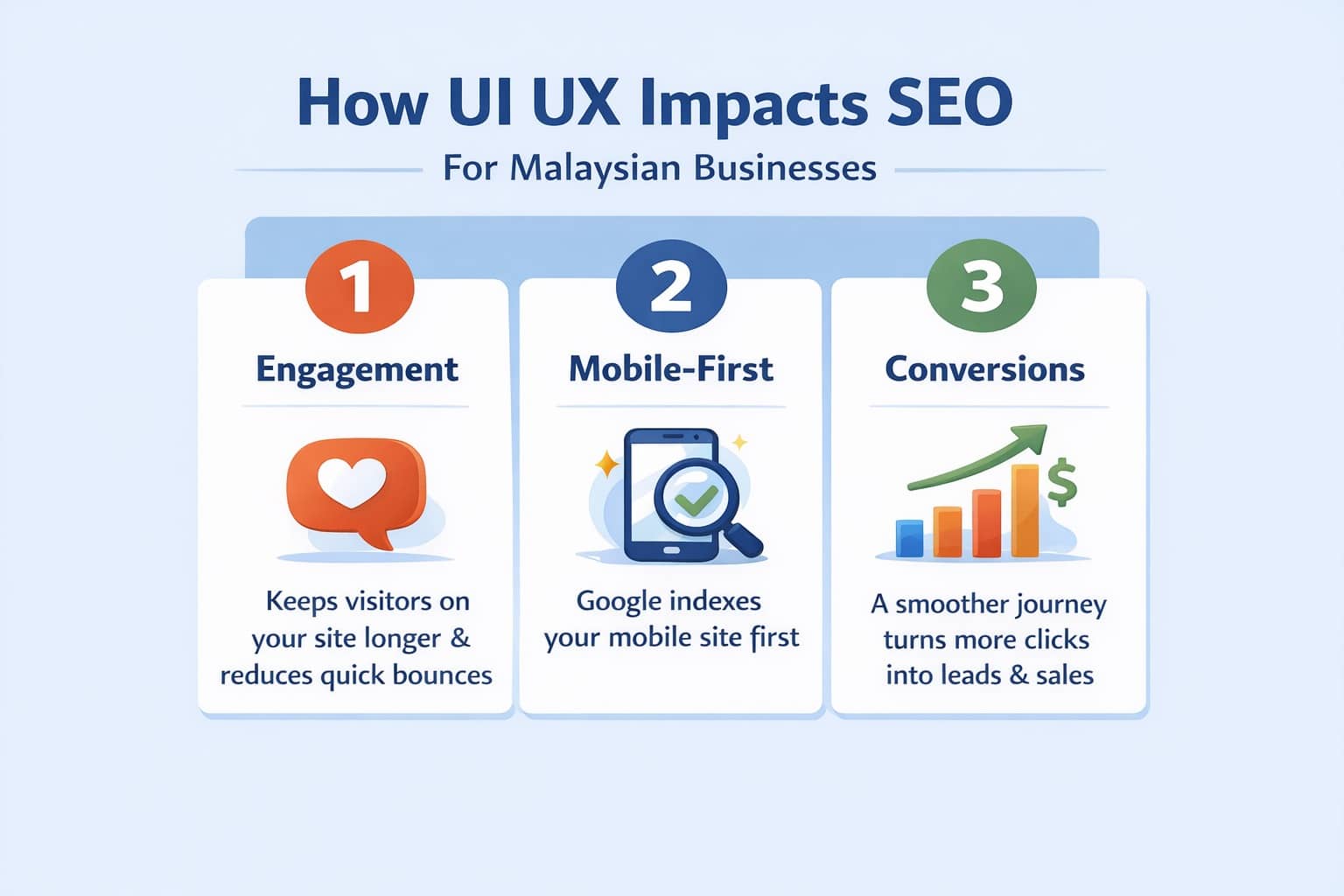
In such cases, engagement drops, conversions suffer, and SEO performance weakens.
Search engines aim to surface pages that satisfy users. When users quickly return to search results, it signals dissatisfaction.
(Source: Google Search Central; Think with Google)
Why UI UX Matters For SEO In Malaysia In 2026
Malaysia’s Digital & Mobile Reality (2024–2025)
To understand why UI UX matters so much in Malaysia, it helps to look at how people actually go online.
Recent national and regional studies show that:
- Around 98% of Malaysians are internet users, and mobile phone usage is close to universal.
- Among internet users, almost all own a smartphone, and the smartphone is the primary device for going online.
- Malaysians spend several hours per day on the internet via mobile devices.
- Mobile commerce now accounts for more than half of all online transactions in Malaysia, with some estimates placing mobile’s share of eCommerce volume at well over 50%.
In simple terms: if your site feels clumsy, slow, or confusing on a phone, you are creating friction in the exact environment where Malaysians are most active. That friction shows up in weaker engagement, fewer leads, and lower revenue, even if your rankings look “okay” on paper.
For SEO and business growth, improving mobile UI UX is not a nice-to-have. It is the baseline for staying competitive in how Malaysians search, compare, and buy.
(Source: Department of Statistics Malaysia; Telenor Asia; DataReportal; Malaysian eCommerce reports)
Page Experience Is Now Competitive Baseline
Google’s page experience framework includes performance, responsiveness, and visual stability. While content relevance still matters most, poor experience can hold a page back.
(Source: Google Search Central)
Malaysian Mobile Usage Is Dominant
Malaysia has very high mobile and smartphone adoption. Almost all individuals use mobile phones, and nearly all internet users own a smartphone, with the smartphone being their primary device for accessing the internet.
As a result, a large share of product searches, local searches, and service enquiries now happens on smartphones.
If your mobile layout is cramped or difficult to navigate, rankings may decline, especially in competitive sectors like eCommerce, property, finance, and B2B services.
(Source: Department of Statistics Malaysia; Telenor Asia; DataReportal; Malaysian eCommerce reports)
Users Are Less Patient Than Ever
Malaysian consumers compare multiple sites quickly. If your competitor’s website feels easier to use, they win the click and the conversion. SEO in 2026 is about reducing friction.
Core UI UX Aspects That Influence SEO Performance
This section focuses on user-facing experience elements, not deep technical SEO mechanics.
Clarity And Visual Hierarchy
Visitors should immediately understand:
- What you offer
- Who it is for
- What action to take next
Clear headings, structured content, and intuitive layout reduce confusion and improve engagement.
Good hierarchy improves readability, which increases time on page and lowers frustration.
Navigation Simplicity
Users should reach important pages within a few clicks.
Strong UX navigation includes:
- Logical menu categories
- Clear service segmentation
- Internal links that guide users forward
When users move naturally through your site, engagement improves.
Content Readability
User experience basics often start with formatting.
Effective UX content structure includes:
- Short paragraphs
- Descriptive subheadings
- Bullet points for clarity
- Proper spacing
Dense text walls increase abandonment, especially on mobile.
Trust Signals And Credibility
Malaysian users are cautious online.
Strong UX includes:
- Visible contact details
- Testimonials
- Clear pricing or service explanation
- Professional design consistency
Trust improves conversion and reduces bounce behaviour.
Mobile Layout Experience
A responsive design is more than shrinking a desktop site.
Good mobile UX ensures:
- Buttons are thumb-friendly
- Text does not require zooming
- Forms are easy to complete
- Sticky elements do not block content
Google uses the mobile version of your site for indexing and ranking (mobile-first indexing), so issues on mobile (from missing content to slow or unstable layouts) can limit how well your pages perform in search.
(Source: Google Search Central)
UI UX And Technical SEO: Where They Intersect
To avoid overlap, it is important to clarify that technical SEO focuses on how search engines access and interpret your site, while UX focuses on how users interact with it.
However, some areas influence both.
Site Speed And Performance
From a technical SEO perspective, speed affects crawl efficiency and indexing.
From a UX perspective, speed affects user patience and satisfaction.
Optimising:
- Image sizes
- Script loading
- Hosting performance
improves both search performance and user engagement.
(Source: Google PageSpeed Insights; Think with Google)
How To Measure UX-Related SEO Signals
You do not need a huge dev team to start measuring UX impact on SEO. A few free tools go a long way:
- Google Search Console – Core Web Vitals reports show how real users experience your pages over time.
- PageSpeed Insights and Lighthouse – combine lab tests and field data to highlight performance bottlenecks.
- Web analytics platforms – help you track bounce rate, scroll depth, time on page, and conversion funnels.
- Session recordings and heatmaps – reveal where users tap, hesitate, or abandon key journeys on mobile.
Use them together: Search Console tells you which pages are weak technically; analytics and UX tools tell you why users are not engaging.
Core Web Vitals
Core Web Vitals measure:
- Loading speed
- Interactivity
- Layout stability
These are technical metrics that reflect real user experience quality.
They sit at the intersection of UX and technical SEO.
For practical implementation, Google currently recommends targeting:
- Largest Contentful Paint (LCP) under 2.5 seconds
- Interaction to Next Paint (INP) under 200 milliseconds
- Cumulative Layout Shift (CLS) below 0.1
These thresholds are based on real user data, not just lab tests. Meeting them consistently signals that users can load, interact with, and read your pages comfortably.
(Source: Google Search Central)
Structured Layout Stability
Avoiding layout shifts, intrusive pop-ups, and unstable elements improves user comfort and search evaluation. Technical fixes enable stable UI presentation.
Practical Malaysian Business Examples
Example 1: SME Retail Website
Before improvement:
- Slow loading hero images
- Overloaded promotional banners
- Hard-to-find checkout button
After simplifying UI and improving performance:
- Bounce rate reduced
- Mobile conversions increased
- Organic rankings stabilised
No major keyword changes were made; the primary adjustment was experience improvement.
Example 2: B2B Service Provider
Problem:
- Strong on-page SEO
- Detailed service pages
- Weak user journey
Users were unsure where to click next.
By restructuring service categories, clarifying calls-to-action, and simplifying forms, enquiry rates increased significantly without additional content expansion.
This demonstrates how UX improvements can enhance SEO outcomes indirectly.

Common UI UX Mistakes Malaysian Businesses Make
- Designing for aesthetics rather than usability
- Overusing animations that slow interaction
- Ignoring mobile usability testing
- Hiding contact information
- Treating on-page SEO as keyword insertion rather than structured clarity
In 2026, good SEO requires cohesive design and strategic structure.
UI UX, On-Page SEO, And Business Growth
On-page SEO services traditionally focus on:
- Keyword placement
- Meta tags
- Header structure
- Internal linking
Modern on-page SEO services must also consider:
- Readability
- Content flow
- Engagement triggers
- Conversion clarity
SEO that drives traffic without usability optimisation leaves revenue untapped.
(Source: Search Engine Journal; Google Search Central)
How Malaysian Businesses Can Improve UI UX In 2026
Practical action steps:
- Conduct a mobile usability audit
- Review Core Web Vitals performance
- Analyse user flow in analytics
- Simplify menu structure
- Clarify calls-to-action
- Remove unnecessary visual clutter
Start with friction reduction rather than dramatic redesign.
Small UX improvements often produce measurable ranking and conversion gains.
Quick UX Action Checklist For Malaysian SMEs
If you have limited time and budget, start with these priorities:
- Fix obvious mobile pain points: Test key journeys (home → product/service → enquiry/checkout) on a mid-range Android phone. Remove or minimise pop-ups that block content, especially on smaller screens.
- Speed up above-the-fold content: Compress hero images and upload in modern formats. Defer non-essential scripts and minimise heavy third-party tags.
- Clarify your offer in 5 seconds: Make your main headline state what you do and for whom. Add a primary call-to-action that is visible without scrolling.
- Simplify forms: Remove non-essential fields. Use large, thumb-friendly inputs and buttons.
- Track one or two key metrics: For lead gen: completed forms or enquiries. For eCommerce: checkout completion rate and mobile conversion rate.
Review these every quarter, or after major algorithm updates and redesigns. Small, continuous UX improvements typically create more sustainable ranking and revenue gains than occasional big redesigns.
UI and UX as the Core of Your Website
In 2026, UI UX is not decorative; it is strategic. For Malaysian businesses competing in increasingly saturated markets, user experience and user interface quality directly influence SEO performance, brand perception, and revenue.
Businesses that want SEO to drive real growth must integrate UI UX, technical optimisation, and structured on-page SEO into one unified system. If you are looking to strengthen rankings while improving business outcomes, Rankpage is Malaysia’s number one SEO agency, offering SEO strategies that align user experience, technical SEO, and content optimisation to create scalable, performance-driven growth.
Don’t hesitate, get in touch with Rankpage and grow your business the right way.