What Is Entity SEO?
Entity SEO (also called entity-based SEO) is the practice of helping search engines clearly understand a brand, organisation, person, or concept as a distinct entity.
Unlike traditional SEO that often emphasises keywords, entity SEO focuses on:
- Meaning and context
- Consistent identity signals
- Relationships between topics and entities
- Brand recognition and corroboration across the web
Search engines use large databases, often described as knowledge graphs, to store information about entities and how they relate. Google’s Knowledge Graph is described as a database of billions of facts. (Source: Google Search Help, “How Google’s Knowledge Graph works”)
Examples of common entities include:
- Companies
- People
- Products
- Locations
- Organisations
- Concepts
Each entity can be associated with attributes (like a company’s name, website, founders, industry, and location) and with relationships (like competitors, subsidiaries, topics it’s known for, and notable products).
Example Of Entity Relationships
Entity | Attributes | Related Entities |
Restaurant | Cuisine, location | Reviews, dishes |
Software company | Products, founders | Industry |
Digital agency | Services, location | Marketing topics |
These relationships help search engines interpret search queries more accurately and provide more relevant results.
How Google Understands Brands
Search engines don’t just analyse individual pages in isolation. They attempt to understand brands as entities within a larger information network.
Knowledge Graph Recognition
Google uses the Knowledge Graph to connect entities and facts, and knowledge panels draw from this system. (Source: Google Blog, “About the Knowledge Graph and Knowledge Panels”)
When a brand is recognised as an entity, systems may associate it with:
- Its industry
- Founders or leadership
- Products or services
- Geographic presence
- Related brands or competitors
Entity Relationships
Search systems map relationships between entities across the web.
For example:
Entity | Connected Topics |
Law firm | Legal services, cases |
SEO agency | Search marketing, content |
Restaurant | Cuisine, location, reviews |
These connections help interpret queries beyond simple keyword matching.
Cross-Source Verification (Corroboration)
Google explains that knowledge panels and entity information can come from various sources across the web, and sometimes data partners. (Source: Google Search Help, “About knowledge panels”)
That’s why consistency matters. Search systems often compare signals across sources like:
- Official websites
- Business directories
- Social media profiles
- News or media coverage
- Industry publications
When multiple independent sources agree on your brand details, it becomes easier to corroborate your identity and key attributes.
Do Brand Mentions Affect SEO?
Brand mentions can influence how search systems interpret reputation and context, but it’s important to frame this carefully.
What We Know
- Backlinks still matter, especially for discovery and authority signals.
- Mentions can help with entity understanding, because they reinforce who you are and what you’re associated with.
- Mentions are most useful when they appear with clear context, like your brand name plus what you do, your location, or your niche.
What Gets Overstated
A common claim is that unlinked mentions are a confirmed Google ranking factor. That’s not something Google has clearly confirmed, and Google representatives have pushed back on “brand mentions” being a defined algorithmic concept the way marketers often describe it. (Source: Search Engine Journal, “Are Brand Mentions Important to Google’s Algorithm?”)
What’s Plausible
Mentions may still matter indirectly because:
- Search systems can treat some references like citations, even if they aren’t clickable links.
- The concept of implied links (linkless references) appears in Google patents. A patent isn’t proof of live ranking usage, but it supports the idea that systems can process mentions as signals. (Source: Google Patent, “Ranking search results”)
- Mentions across reputable, independent sources can reinforce corroboration, which helps systems feel more confident about an entity’s identity and attributes. (Source: Google Search Help, “About knowledge panels”)
Practical Takeaway
Instead of thinking “mentions = rankings,” it’s safer to think:
- Mentions help confirm your entity
- Mentions help shape topical association
- Mentions help build trust signals over time
- Links still tend to be the more direct lever for SEO impact, but mentions can support the bigger entity picture
Examples Of Brand Mentions
- News articles
- Industry blogs
- Business directories
- Social media profiles
- Online forums and communities
- Professional platforms like LinkedIn
Why Entity Mentions Across the Web Matter
Mentions across multiple platforms can act as validation signals, not because “more is always better,” but because consistent, credible references help confirm identity and context.
Entity Corroboration (Identity Confirmation)
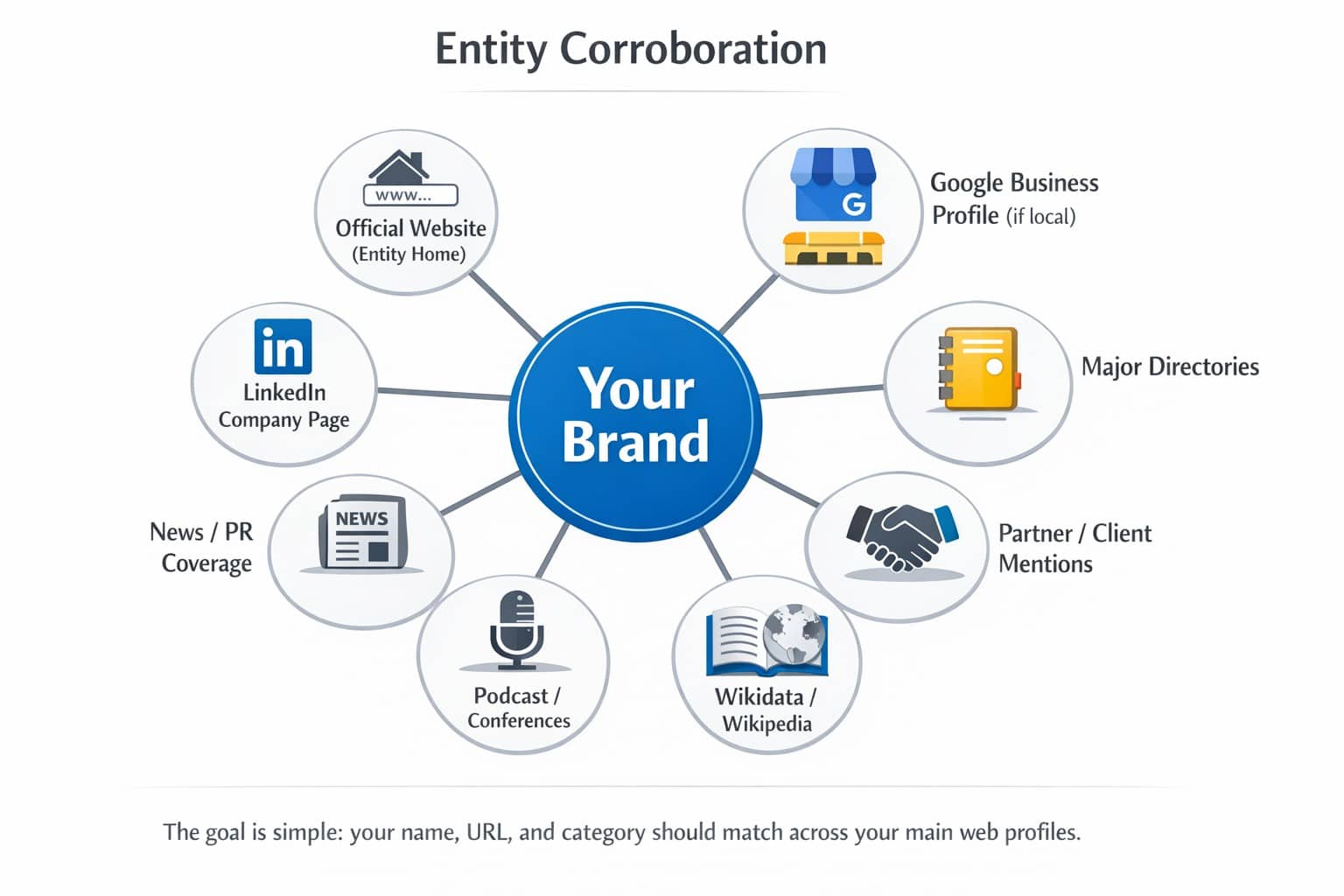
Search systems look for alignment across sources:
Google notes that knowledge panel info comes from various sources across the web, which is why corroboration across those sources matters. (Source: Google Search Help, “About knowledge panels”)
Topical Association (What You’re Known For)
Mentions also help connect brands with subjects. If a company consistently appears in discussions about:
- Digital marketing
- SEO tools
- Analytics platforms
…the brand is more likely to be associated with those topics over time.
Authority Signals, Quality > Quantity
Not all mentions carry the same weight. A single mention from a respected industry publication can be more meaningful than dozens of low-quality directory citations.
A practical way to think about mention quality:
- Tier 1, strongest: Major industry publications, recognised organisations, authoritative databases, reputable news sites.
- Tier 2, solid: Established niche blogs, podcasts, credible communities, trade associations, reputable partner sites.
- Tier 3, weakest: Thin directories, spammy sites, low-moderation forums. These can help discovery, but they’re typically weaker trust signals.
“Corpus Coverage” (A Clearer Practical Model)
A useful way to visualise entity reinforcement is to think about corpus coverage, how often your brand appears across a large corpus of webpages in relevant contexts with consistent facts.
Think of the internet as a massive corpus of documents. When your brand appears repeatedly alongside a topic, and the information is consistent across sources, systems can more confidently associate your entity with that subject.
Example
Brand | Topic | Credible Mentions Across Web |
Brand A | SEO services | 200 |
Brand B | SEO services | 15 |
All else equal, Brand A may be easier to associate with SEO services, especially if mentions appear in reputable, independent sources.
Important note: This is not an official Google metric. Treat it as a mental model rather than a published ranking factor. (Source: Google Blog, “Introducing the Knowledge Graph: Things, Not Strings”)
How Businesses Can Increase Entity Authority
Here are practical strategies that strengthen entity signals in ways search systems can corroborate.
1) Create an “Entity Home” Page (Your Primary Source of Truth)
Every brand should have a clear page that acts as the “entity home,” often your homepage or About page.
Make it easy for systems (and people) to confirm:
- Official business name
- What you do (clear category/positioning)
- Website and contact details
- Location (if relevant)
- Leadership/team (where appropriate)
- Logo and brand assets
This supports consistency when other sources reference you. (Source: Google Search Help, “About knowledge panels”)
2) Maintain Consistent Brand Information Everywhere
Consistency is critical for corroboration. Ensure your brand details match across platforms:
- Business name
- Website URL
- Address (if applicable)
- Contact details
- Social profiles
Inconsistent information can create uncertainty, especially when multiple brands share similar names. (Source: Google Search Help, “About knowledge panels”)
3) Implement Structured Data (Schema Markup)
Structured data helps search engines interpret your entity and its attributes more clearly.
Common schema types include:
- Organization
- Person
- Product
- LocalBusiness
A best practice in entity SEO is using sameAs to connect your entity to verified profiles, LinkedIn, Crunchbase, Wikidata/Wikipedia where appropriate, authoritative directory pages, and so on. This helps systems unify references to the same entity. (Source: Schema App, “What is Entity SEO and How Do I Implement It?”)
4) Build Topic Clusters (But Make Them Entity-First)
Content clusters reinforce topical authority, especially when internally linked and clearly structured.
Example structure:
Pillar Topic | Supporting Content |
SEO strategy | keyword research guide |
SEO strategy | technical SEO tips |
SEO strategy | content optimisation |
To make clusters more entity-forward, add:
- Clear definitions and “what it is / why it matters” sections
- Author bios (especially for expert content)
- References to related entities (tools, standards, platforms)
- Primary-source citations where relevant
5) Earn Media And Industry Mentions (Third-Party Credibility)
Third-party coverage can reinforce trust and topical association:
- PR coverage
- Industry interviews
- Guest articles
- Expert commentary
- Partner features
Aim for mentions that include context, what you do, who you serve, and why you’re credible.
6) Strengthen Professional Profiles (And Keep Them Aligned)
Platforms like LinkedIn and reputable professional directories can help corroborate your identity.
Strong profiles typically include:
- Consistent company description
- Official website link
- Industry category
- Matching brand name and logo
- Team/leadership alignment (when public)
7) Participate In Industry Discussions (High-Signal Visibility)
Appear in places where your audience already trusts the conversation:
- Conference speaking engagements
- Podcast interviews
- Industry reports and roundups
- Community forums (high-quality, moderated)
- Webinars and panels
These can create relevant mentions with real context, often more valuable than generic citations.
Entity SEO Checklist (Optional Add-On)
- Publish an entity home page with clear “who we are” info
- Keep your name, URL, and business details consistent across key sites
- Add Organization schema and use sameAs for official profiles
- Build a topic cluster that matches your actual services and expertise
- Prioritise Tier 1 and Tier 2 mentions over low-quality volume
- Make it easy to verify leadership, location, and category
- Track and fix inconsistencies across directories and profiles quarterly
(Sources: Google Search Help, “About knowledge panels”; Schema App, “What is Entity SEO and How Do I Implement It?”)
Entity SEO and the Future of Search
Entity SEO reflects a major shift in how search engines understand the web. Instead of relying solely on keywords, modern systems evaluate brands as entities connected to topics, industries, and information networks. (Source: Google Blog, “About the Knowledge Graph and Knowledge Panels”)
Businesses that build consistent brand signals, publish entity-clear content, implement structured data, and earn credible mentions across independent sources can strengthen entity recognition over time. If you want to grow your online presence through strategic SEO, Rankpage can help your brand earn credible mentions and build long-term authority.
Place your trust in Rankpage, Malaysia’s most reliable SEO agency, and get in touch today to boost your brand signals the right way.