15 Best SEO Tools in 2026 Compared
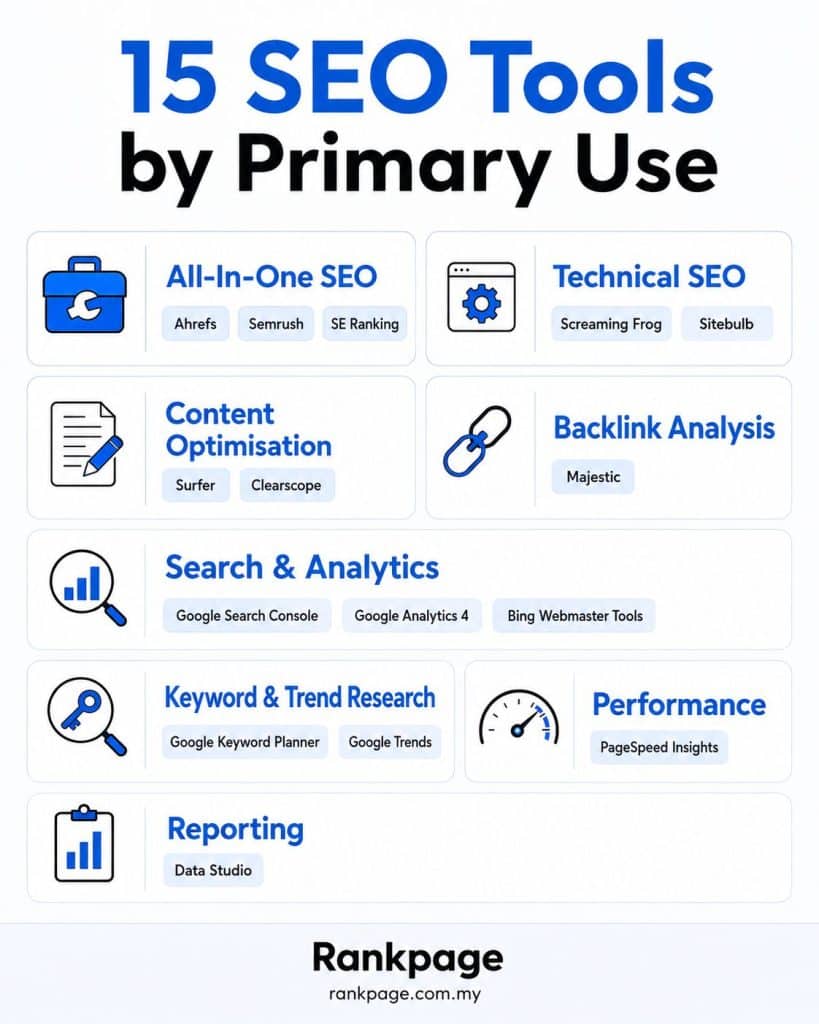
| SEO Tool | Best For | Main Strength | Free Option? |
| Ahrefs | Overall SEO research | Backlinks and competitor research | Yes, limited |
| Semrush | All-in-one SEO | Broad SEO toolkit | Trial/limited access |
| Google Search Console | Search performance | First-party Google data | Yes |
| Screaming Frog | Technical SEO | Website crawling | Yes |
| SE Ranking | SEO teams | Rank tracking and research | Trial |
| Surfer | Content optimisation | SERP-driven recommendations | Limited/trial |
| Clearscope | Content teams | Topical optimisation | Trial |
| Sitebulb | Technical audits | Visual technical reporting | Trial |
| Majestic | Backlink analysis | Link intelligence | Limited |
| Google Analytics 4 | Traffic measurement | User and conversion data | Yes |
| Google Keyword Planner | Keyword discovery | Google keyword data | Yes |
| PageSpeed Insights | Site performance | Core Web Vitals | Yes |
| Google Trends | Trend research | Search interest over time | Yes |
| Data Studio | SEO reporting | Custom dashboards | Yes |
| Bing Webmaster Tools | Bing SEO | Search and indexing insights | Yes |
How Did We Select These SEO Tools?
The selection focuses on practical usefulness rather than feature count alone.
Key criteria included:
- Keyword Research: Finding topics, search demand and opportunities.
- Technical SEO: Detecting crawling, indexing and website issues.
- Content Optimisation: Improving topic coverage and search intent.
- Backlink Analysis: Reviewing referring domains and link opportunities.
- Performance Tracking: Monitoring rankings, traffic, key events and conversions.
- Usability: Turning data into actions without unnecessary complexity.
- Value: Matching features and cost to actual SEO needs.
1. Ahrefs
Ahrefs is one of the strongest all-round SEO tools for competitor, keyword and backlink research.
Best For: Competitive research and backlinks
Key Strengths
Its main tools cover keyword research, backlinks, site audits, rank tracking and content research. It is especially useful when analysing why competitors rank, which keywords they target and where their backlinks come from.
Ahrefs has also expanded into AI-search visibility and content research features, such as AI Content Helper and AI Translations (for keywords), and an AI brand radar to track your brand across AI searches.
What To Keep In Mind
Its full plans can be relatively expensive for smaller businesses, so it makes more sense when SEO is an ongoing priority.
Ahrefs also provides limited free tools and access options, which may be enough for basic research or website monitoring.
2. Semrush
Semrush offers one of the broadest SEO and digital marketing toolsets.
Best For: Businesses wanting an all-in-one platform
Key Strengths
It combines keyword research, competitor analysis, site auditing, rank tracking and increasingly, AI-search visibility features.
This breadth can be useful for in-house teams that want fewer separate subscriptions.
What To Keep In Mind
The platform can feel overwhelming if you only need a small number of SEO functions.
Teams should focus on the tools they actually use rather than paying for features that do not support their current strategy.
Read More: Semrush vs. Ahrefs: Which SEO Tool Is Better in 2026?
3. Google Search Console
Google Search Console should be one of the first tools connected to any website.
Best For: Monitoring Google Search performance
Key Strengths
It shows clicks, impressions, search queries, ranking pages and indexing information directly from Google.
It can also help diagnose indexing issues and inspect individual URLs.
For SEO teams, this makes it one of the most useful sources of first-party search performance data.
What To Keep In Mind
It is mainly focused on your own website, so it is not a competitor research platform.
For competitive analysis, it is usually paired with a third-party SEO platform.
4. Screaming Frog SEO Spider
Screaming Frog is a staple for technical SEO audits.
Best For: Website crawling
Key Strengths
It crawls websites and highlights issues involving redirects, metadata, internal links, page status codes and other technical elements.
The free version allows crawling of up to 500 URLs, which can be enough for smaller websites and basic audits.
What To Keep In Mind
The data is detailed, but beginners may need technical SEO knowledge to understand which issues deserve attention first.
Not every warning uncovered by a crawler will have the same impact on organic performance.
5. SE Ranking
SE Ranking offers a broad mix of SEO tools that can suit agencies and growing in-house teams.
Best For: Rank tracking and SEO management
Key Strengths
Its platform includes rank tracking, keyword research, competitor analysis, backlink research and website audits.
It has also expanded into GEO and AI-search tracking, helping teams monitor brand visibility across newer search experiences.
What To Keep In Mind
Smaller businesses may not need the full feature set.
Before subscribing, consider whether you need a broad platform or simply a strong rank tracker and keyword research tool.
6. Surfer
Surfer focuses heavily on SEO content optimisation.
Best For: Writers and content teams
Key Strengths
It analyses competing search results and suggests relevant topics, terms and content elements.
This can help standardise optimisation across larger content teams and give writers a clearer framework when producing search-focused content.
What To Keep In Mind
Content scores should be treated as guidance, not as a target to chase blindly.
Good SEO content still needs to satisfy search intent, demonstrate expertise and remain useful to readers.
7. Clearscope
Clearscope is another content-focused SEO platform.
Best For: Editorial SEO workflows
Key Strengths
It helps teams research topics, optimise content and monitor existing pages.
Its recommendations can help identify missing concepts and related terminology without relying only on exact-match keyword repetition.
What To Keep In Mind
It may be difficult to justify as a separate subscription for businesses that publish content only occasionally.
Teams with lower publishing volume may get more value from an all-in-one SEO platform with built-in content tools.
8. Sitebulb
Sitebulb combines technical crawling with easier-to-understand reporting.
Best For: Technical SEO reporting
Key Strengths
It highlights technical problems and presents them using prioritised recommendations and visualisations.
This can make technical findings easier to explain to developers, clients or management.
What To Keep In Mind
Like any crawler, it can identify issues but does not automatically determine which ones will have the greatest business or ranking impact.
Human prioritisation still matters.
9. Majestic
Majestic remains focused primarily on backlinks.
Best For: Link analysis
Key Strengths
It provides link metrics such as Trust Flow, Citation Flow and Topical Trust Flow alongside referring-domain analysis.
It can be useful for link-building research, competitor backlink comparisons and understanding the topical relevance of referring sites.
What To Keep In Mind
It is more specialised than Ahrefs or Semrush, so many businesses will use it alongside another SEO platform rather than as their only SEO tool.
10. Google Analytics 4
Google Analytics 4 helps marketers understand what happens after visitors reach the website.
Best For: Traffic and conversion measurement
Key Strengths
It tracks acquisition, engagement, user behaviour, key events and conversions.
Combined with Search Console, it can help connect organic search visibility with what visitors actually do after they arrive.
This is especially useful when measuring leads, purchases, sign-ups or other meaningful business actions.
What To Keep In Mind
Traffic alone is not enough.
Track key events, conversions and business outcomes instead of focusing only on sessions or page views.
11. Google Keyword Planner
Google Keyword Planner remains useful for basic keyword research.
Best For: Free keyword discovery
Key Strengths
It provides keyword ideas and search-demand estimates based on Google data.
Location targeting can also help Malaysian businesses assess keyword demand within specific markets.
What To Keep In Mind
Keyword Planner was built primarily for Google Ads.
Dedicated SEO platforms usually provide more organic-search context, such as keyword difficulty, ranking competitors, SERP analysis and backlink information.
12. PageSpeed Insights
PageSpeed Insights helps marketers evaluate website performance and user experience.
Best For: Core Web Vitals
Key Strengths
It reports performance data and highlights metrics such as Largest Contentful Paint (LCP), Interaction to Next Paint (INP) and Cumulative Layout Shift (CLS).
It can also highlight areas developers may need to investigate when improving loading speed and user experience.
What To Keep In Mind
Do not chase a perfect performance score simply for the sake of reaching 100.
The more important goal is to provide a fast, stable and responsive experience while meeting Google’s recommended Core Web Vitals thresholds where possible.
13. Google Trends
Google Trends helps marketers understand how search interest changes over time.
Best For: Seasonal and trending topics
Key Strengths
It allows users to compare search interest across locations and time periods.
This can be useful for Malaysian seasonal campaigns involving Raya, school holidays, major sales events or emerging consumer trends.
What To Keep In Mind
Google Trends reports relative search interest rather than exact monthly search volume.
Use it to understand direction, seasonality and comparative interest rather than as a direct replacement for keyword-volume data.
14. Data Studio
Data Studio is useful for turning SEO data into clearer reports.
Best For: Dashboards
Key Strengths
It can combine data from platforms such as Google Search Console and GA4 into customised reports.
This is especially useful for agencies and in-house teams presenting SEO performance to management, clients or other stakeholders.
Dashboards can bring rankings, organic traffic, landing-page performance and conversions into a more accessible reporting format.
What To Keep In Mind
A dashboard is only useful if it tracks meaningful KPIs.
Avoid adding charts simply because the data is available. Focus on metrics that help stakeholders understand SEO performance and make decisions.
15. Bing Webmaster Tools
Bing Webmaster Tools gives website owners another view of search and indexing performance.
Best For: Bing search visibility
Key Strengths
It provides data on Bing search performance, indexing and website health, and can complement Google-focused tools for businesses that want broader search coverage.
What To Keep In Mind
For most Malaysian businesses, Bing will usually be a secondary channel rather than the main SEO focus.
Statcounter estimated Google at about 92.5% of Malaysian search-engine usage in July 2026, compared with about 4.7% for Bing.
That does not mean Bing should be ignored, but businesses should prioritise channels according to their own audience and traffic data.
Which SEO Tools Do You Actually Need?
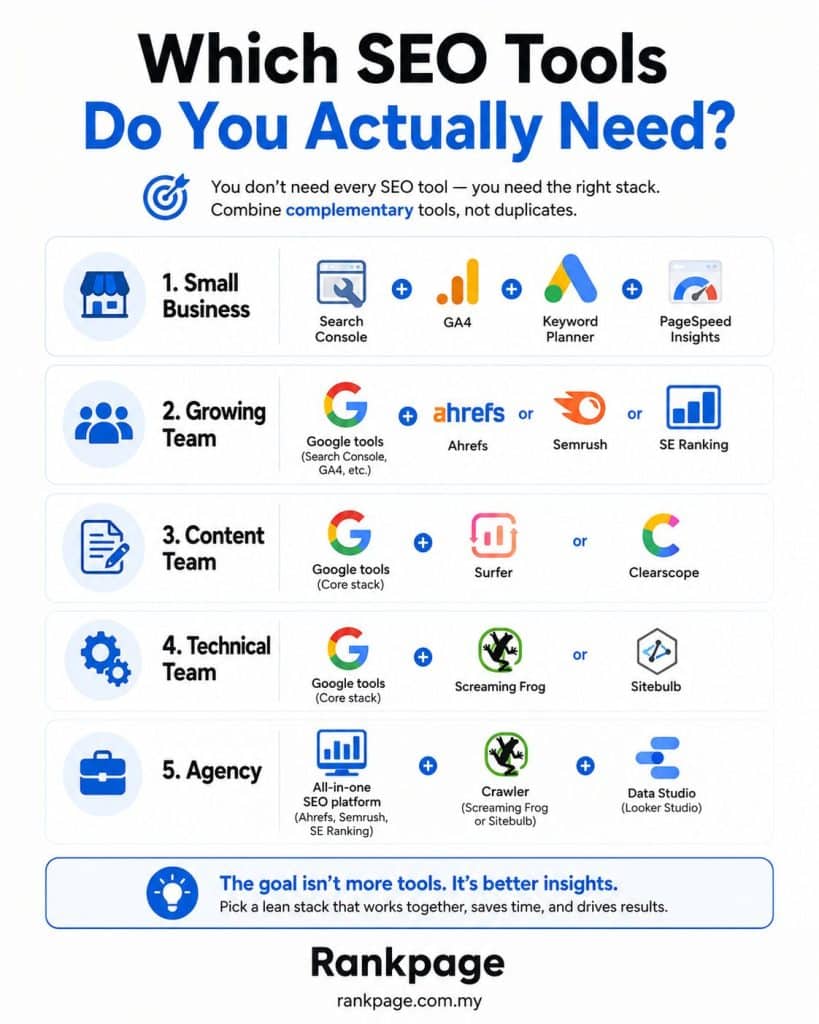
Most businesses do not need every tool on this list.
A practical setup might look like:
- Small Business: Search Console + GA4 + Keyword Planner + PageSpeed Insights.
- Growing Team: Google tools + Ahrefs, Semrush or SE Ranking.
- Content Team: Add Surfer or Clearscope.
- Technical Team: Add Screaming Frog or Sitebulb.
- Link-Building Team: Use Ahrefs, Semrush or Majestic.
- Agency: Combine an all-in-one platform with a crawler and reporting tools such as Data Studio.
Overlap is normal.The goal is to avoid paying for multiple platforms that solve the same problem without adding enough value.
Choosing the Right Tools
The best SEO tools in 2026 are the ones that help marketers identify opportunities, fix problems and measure whether SEO is actually producing results.
For many Malaysian businesses, starting with Google’s free tools and adding one strong paid platform is more than enough.
Businesses that prefer expert support can also work with Rankpage, Malaysia’s trustworthy SEO partner, for professional SEO services covering research, optimisation and ongoing performance improvements.
The right combination of tools and strategy can turn SEO data into measurable organic growth.