The most important ecommerce structured-data areas include Product, Offer, ProductGroup, Review and AggregateRating, BreadcrumbList, Organization or OnlineStore, MerchantReturnPolicy, and shipping-related markup.
Together, these help search engines understand what you sell, how much products cost, whether they are available, how variants relate to one another and what shoppers can expect after purchasing.
For Malaysian ecommerce businesses, good schema implementation can also make product information eligible for richer Google Search and shopping-related experiences. Here’s what we’ve uncovered at Rankpage.
Schema Markup Summary Table
| Schema Markup | Main Purpose | Best Used On | Potential SEO Benefit |
|---|---|---|---|
| Product | Defines the product | Product pages | Better product understanding and rich result eligibility |
| Offer | Defines price and availability | Product pages | Price, stock and merchant information |
| ProductGroup | Connects product variants | Products with sizes, colours or models | Better variant understanding |
| Review / AggregateRating | Describes reviews and ratings | Eligible product pages | Rating and review information |
| BreadcrumbList | Describes page hierarchy | Product and category pages | Clearer page relationships |
| Organization / OnlineStore | Identifies the ecommerce business | Homepage or About page | Stronger merchant information |
| MerchantReturnPolicy | Explains return conditions | Organization or product offers | Return policy information |
| ShippingService / OfferShippingDetails | Describes shipping | Organization or product offers | Delivery and shipping information |
How Does Rankpage Prioritise Ecommerce Schema?
Not every Schema.org type needs to be implemented simply because it exists. At Rankpage, we prioritise ecommerce structured data based on four considerations:
- Google Support: Relevant to Google Search and merchant experiences.
- Ecommerce Relevance: Describes information useful to shoppers and search engines.
- Search Visibility: Can support richer search appearances where eligible.
- Scalability: Practical to maintain across growing ecommerce catalogues.
A useful way to think about ecommerce schema is through three layers:
Product Layer: Product, Offer and ProductGroup describe what you sell, how it can be purchased and how product variants relate to one another.
Trust Layer: Review, AggregateRating and Organization or OnlineStore provide information about customer feedback and the business behind the products.
Commerce Layer: MerchantReturnPolicy, ShippingService and OfferShippingDetails describe important parts of the purchase experience, including returns and delivery.
The goal is not to implement the largest possible number of schema types. It is to provide accurate, useful structured data that reflects what customers can actually see and experience on the website.
1. Product Schema
Product schema tells search engines that a page represents a specific product rather than a general webpage or category.
Google uses Product structured data for product snippets and merchant listing experiences. Depending on eligibility, results may show information such as ratings, prices and availability.
This makes Product schema one of the most important starting points for ecommerce SEO because it establishes the main entity on the page. Other structured data, including Offer, Review and AggregateRating, can then provide additional information about that product.
An Important Difference
It is also useful to distinguish between Google’s two main Product structured-data experiences. Product snippets can enhance product-related search results, including pages where the product is not directly sold, while merchant listings are intended for pages where customers can purchase the product.
The distinction affects which properties matter. Merchant listings can support deeper commercial information such as product availability, shipping and return policies, so ecommerce stores should not think of Product schema as one single search feature.
Important Product Properties
Common Product properties include:
- Name
- Image
- Description
- SKU
- Brand
- GTIN
- MPN
- Offers
- AggregateRating
- Review
Product identifiers are particularly useful because they help search engines identify products accurately.
Where identifiers such as GTIN or MPN genuinely exist, they should be supplied accurately rather than invented. The same principle applies to brand information, SKU values and other product attributes.
Where Should You Use Product Schema?
Product schema belongs primarily on individual product pages.
Google recommends using Product structured data on pages representing one product or variants of the same product rather than broad category pages containing unrelated products.
For example, a specific smartphone product page is suitable. A category such as “Smartphones Under RM1,500” should not be marked up as one Product entity.
The structured data should also describe the product users can actually see on the page. If the schema refers to a different model, price or configuration, that creates a mismatch between the markup and the visible content.
2. Offer and AggregateOffer Schema
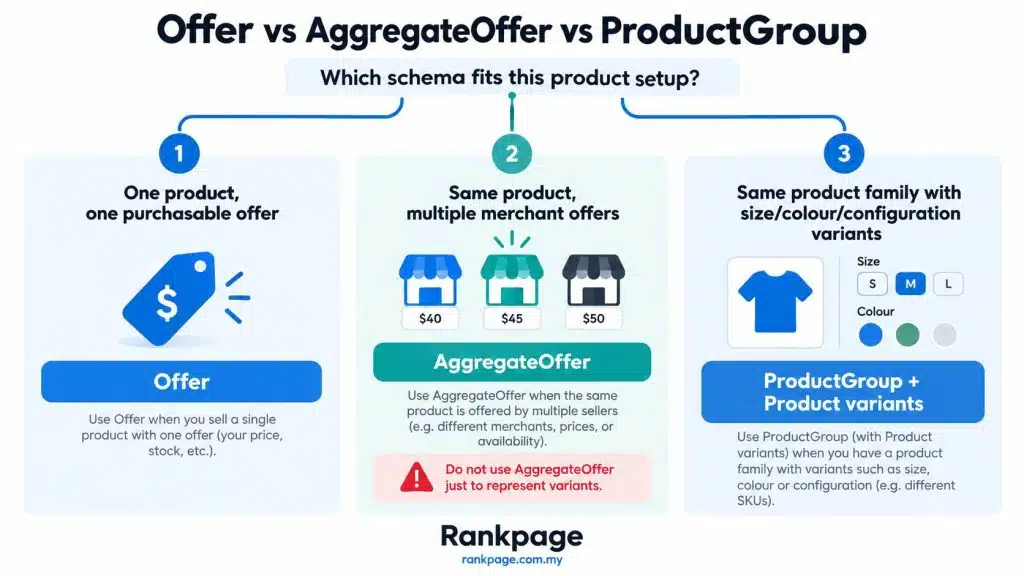
A Product tells Google what something is. An Offer explains how it can be purchased.
This distinction matters because commercial information such as price and availability may change much more frequently than the basic product details.
Important Offer Properties
An Offer may include:
- price
- priceCurrency
- availability
- itemCondition
- URL
- seller
For Malaysian stores, priceCurrency will commonly be MYR.
Offer data should remain synchronised with the visible product information. A reliable implementation typically generates structured data from the same product database that controls prices and stock availability.
What About AggregateOffer?
AggregateOffer represents multiple offers for the same product, such as when the same item is available from different merchants. It can include properties such as lowPrice, highPrice and offerCount.
For Google merchant listing experiences, an individual Offer is required. AggregateOffer should not be used simply to represent product variants. Where products differ by colour, size or configuration, ProductGroup and individual Product variants are generally more appropriate.
3. ProductGroup Schema
ProductGroup schema helps search engines understand products that come in multiple variants, such as:
- T-shirts in different sizes
- Shoes in different colours
- Smartphones with different storage capacities
- Furniture in different materials
Instead of treating each version as an unrelated product, ProductGroup connects them as variants of the same product family.
Useful ProductGroup Properties
Typical properties include:
- productGroupID
- variesBy
- hasVariant
- brand
- name
The variesBy property identifies what changes between variants, such as colour, size or material, while hasVariant connects the individual products to the group.
Make Individual Variants Crawlable
Where variants have separate URLs, each URL should directly load the corresponding version. For example, a URL for a black size-eight shoe should display that specific variant without requiring Google to interact with product selectors first.
Individual variants should also use accurate identifiers where available.
4. Review and AggregateRating Schema
Review schema describes individual reviews, while AggregateRating summarises ratings across customers.
Google may use valid review and rating markup in eligible product search experiences.
Common AggregateRating properties include:
- RatingValue
- ReviewCount
- RatingCount
- BestRating
- WorstRating
If 327 customers have given a product an average rating of 4.6 out of 5, those figures should match what appears on the page.
Do Not Manufacture Ratings
Schema should never create or exaggerate ratings.
If the visible page says a product has 4.2 stars but the structured data claims 4.9, the information is inconsistent.
Automating review schema from your ecommerce review system is usually safer than maintaining ratings manually.
Read More: Why Your Online Store Gets Traffic But No Sales
5. BreadcrumbList Schema
BreadcrumbList schema describes a page’s position within your website structure.
For example:
Home > Electronics > Headphones > Wireless Headphones > Product
This gives search engines context about how a product relates to categories and subcategories while also helping users navigate.
A Malaysian electronics store might use:
Home > Mobile Phones > Android Phones > Samsung > Galaxy S Series
The breadcrumb trail should represent a logical user path rather than an artificial keyword-heavy hierarchy created purely for SEO.
6. Organization and OnlineStore Schema
Structured data can describe the ecommerce business behind the products as well as the products themselves.
Organization markup provides company information, while OnlineStore is a more specific Organization type for ecommerce businesses. Google recommends placing Organization markup on the homepage or another page that describes the business.
Useful Organization Information
This can include:
- Name
- URL
- Logo
- ContactPoint
- sameAs
- Address
- hasMerchantReturnPolicy
- hasShippingService
For Malaysian ecommerce businesses, these details should remain consistent with the company’s official information.
Organization-level markup can also describe policies that apply across the store, such as standard shipping and return conditions, rather than unnecessarily repeating the same information for every product.
Ecommerce businesses with genuine physical locations can also use an appropriate LocalBusiness subtype for individual branches.
7. MerchantReturnPolicy Schema
MerchantReturnPolicy provides structured information about return conditions.
It can describe:
- Return Window
- Return Method
- Return Fees
- Refund Type
- Applicable Country
For example, a Malaysian ecommerce site could specify that eligible purchases may be returned within 14 days and clarify who pays return delivery costs.
If most products follow the same policy, it can be associated with the Organization.
If certain products have different terms, those conditions can instead be defined at Offer level.
Return-policy markup is not especially niche either. Schema.org’s August 2026 web-index data places MerchantReturnPolicy usage in the 100,000 to 1 million domain range, while the merchantReturnDays property falls within the same range.
This highlights an important shift in ecommerce structured data: search engines can increasingly receive machine-readable information about what happens after the purchase, not just what the product is and how much it costs.
8. ShippingService and OfferShippingDetails Schema
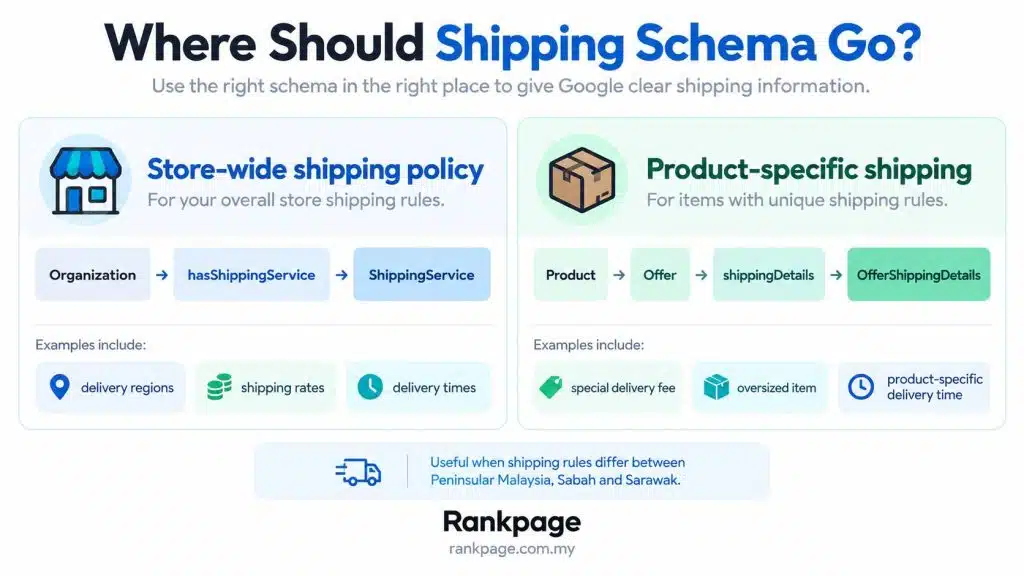
Shipping information can be structured differently depending on whether it applies across the entire store or to a particular product.
For a store-wide shipping policy, ShippingService can be associated with Organization using hasShippingService.
For product-specific shipping details, OfferShippingDetails can be added to an Offer using shippingDetails.
Structured shipping information can describe:
- Shipping Destination
- Shipping Rate
- Delivery Time
- Shipping Conditions
This is particularly useful in Malaysia because delivery costs or timings may differ between Peninsular Malaysia, Sabah and Sarawak.
A store can define broad merchant-level policies and use product-specific shipping details where exceptions apply.
Shipping Data from Schema.org
Shipping-related structured data is also more widely implemented than it may appear. Schema.org’s August 2026 usage data, based on monthly aggregations from Google’s web index, places OfferShippingDetails in the 100,000 to 1 million domain range.
This suggests that ecommerce structured data is increasingly extending beyond basic product and price information into fulfilment details. For Malaysian stores, that can be particularly useful where delivery costs and timelines differ between Peninsular Malaysia, Sabah and Sarawak.
Should You Use JSON-LD for Ecommerce Schema?
For most ecommerce implementations, JSON-LD is the most practical format.
Google recommends JSON-LD, although Microdata and RDFa can also be valid.
The more important issue is keeping structured data synchronised with your ecommerce database.
If a product goes out of stock, your page should not say “Out of Stock” while stale schema still marks it as available.
The same applies to:
- Prices.
- Reviews.
- Variants.
- Shipping.
- Returns.
Dynamic ecommerce information should ideally generate schema from the same source of truth as the visible page.
For large ecommerce sites with frequently changing prices or inventory, Rankpage suggests:
Avoid treating schema as an afterthought injected independently from the product system. Google recommends placing Product structured data in the initial HTML for merchants optimising for shopping results and notes that JavaScript-generated markup can be less reliable for rapidly changing information.
How Should Malaysian Ecommerce Websites Implement Schema Markup?
A sensible implementation order is:
- Product and Offer markup.
- ProductGroup where variants exist.
- Genuine Review and AggregateRating data.
- BreadcrumbList.
- Organization or OnlineStore.
- Merchant return policies.
- Store-wide and product-specific shipping information.
Then validate the implementation using Google’s Rich Results Test and inspect important URLs through Google Search Console.
For larger ecommerce websites, template-level implementation is generally more practical than maintaining schema manually on individual URLs.
How Do You Measure Whether Ecommerce Schema Is Working?
Do not stop at checking whether your markup passes Google’s Rich Results Test. After implementation, monitor the Merchant listings and Product snippets reports in Google Search Console for valid items, warnings and errors.
Then compare Search performance before and after deployment, particularly impressions, clicks and CTR for affected product pages. This gives you a much more useful measurement than simply reporting that “schema was installed.”
Common Ecommerce Schema Problems Rankpage Looks for During Audits
Having schema on a website does not necessarily mean it is implemented correctly. Some of the common issues worth checking include:
- Incorrect Prices: Structured data no longer matches the visible product price.
- Wrong Availability: Out-of-stock products remain marked as available.
- Inaccurate Ratings: Structured ratings do not match genuine reviews shown on the page.
- Missing Variant Relationships: Sizes, colours or configurations are treated as unrelated products.
- Misused AggregateOffer: Product variants are incorrectly represented as multiple offers.
- Conflicting Schema: Multiple plugins or systems generate competing Product entities.
- Category Misuse: Category pages containing unrelated products are marked up as a single Product.
- Outdated Static Data: Prices, stock, shipping or return information becomes stale.
For larger ecommerce sites, we also look beyond whether schema simply “exists”. Coverage, completeness, consistency and scalability matter because an implementation that works on a handful of URLs may not necessarily work correctly across thousands of products.
Schema should ultimately make the website easier for search engines to interpret, not introduce another source of conflicting information.
Improving Your Ecommerce Structured Data
Good ecommerce schema is not about implementing every Schema.org property available. Prioritise structured data that accurately describes the information most important to shoppers and search engines, then keep it synchronised as products, prices, stock and policies change.
Schema also works best as part of a broader technical SEO foundation. For Malaysian ecommerce businesses, Rankpage reliable SEO agency that can help identify structured-data gaps alongside crawlability, internal linking, product optimisation and other technical SEO opportunities that may affect organic search visibility.
Frequently Asked Questions About Essential Schema Markups
What Is Schema Markup for an Ecommerce Website?
Schema markup is structured data added to ecommerce pages to describe products, prices, availability, reviews, variants, shipping and other information in a format search engines can understand more precisely.
What Is the Most Important Schema for Ecommerce?
Product and Offer are generally the starting point because they identify what is being sold and provide information such as price, currency and availability.
Does Product Schema Help Ecommerce SEO?
Product schema can improve how search engines understand product pages and make eligible pages available for product snippets and merchant listing experiences. It does not guarantee better rankings.
Can Ecommerce Category Pages Use Product Schema?
General category pages containing unrelated products should not be marked up as though the entire page represents one Product. Product schema is better suited to individual products or variants of the same product.
What Is the Difference Between Offer and AggregateOffer?
Offer describes an individual commercial offer. AggregateOffer represents multiple offers for the same product, such as offers from different merchants.
For Google merchant listing experiences, an individual Offer is required. AggregateOffer should not be used simply to represent product variants.
How Can I Check Whether My Ecommerce Schema Is Working?
Use Google’s Rich Results Test and URL Inspection in Google Search Console, then monitor structured-data issues after deployment. Keep dynamic information such as price, availability and ratings up to date.