What Is Site Hierarchy in SEO
Site hierarchy refers to the structured organisation of your website’s pages into logical levels, helping both users and search engines navigate and understand your content more easily.
At a basic level, many websites follow a pyramid-style model:
- Homepage at the top
- Category pages covering broad topics
- Subcategory or service pages targeting narrower areas
- Individual pages focused on specific products, services, or articles
This hierarchy is not just visual. It affects how search engines discover pages through links, interpret relationships between pages, and understand how sections of your website connect.
(Source: Google Search Central, Link Best Practices; Google Search Central Blog, Importance of Link Architecture)
Key functions of site hierarchy:
- Defines relationships between pages
- Helps users move through topics logically
- Supports internal link flow across the site
- Improves discoverability of deeper pages
From a user perspective, hierarchy reduces friction. From a search engine perspective, it creates clarity and supports more efficient crawling and understanding.
(Source: Google Search Central, SEO Starter Guide; Google Search Central, Link Best Practices)
Why Site Hierarchy Is Important for Website SEO
Site hierarchy is a foundational SEO and UX element because it influences crawling, internal linking, discoverability, and navigation.
Improves Crawlability and Indexing
Search engines do allocate crawl resources per site, often referred to as crawl budget. However, crawl-budget optimisation is mainly important for very large or frequently updated websites. For many SME websites, keeping internal links clean and maintaining updated sitemaps is usually more practical than over-focusing on crawl budget itself.
(Source: Google Crawling Infrastructure, Optimize Your Crawl Budget; Google Search Central, Learn About Sitemaps)
A clear structure still helps because:
- Important pages are easier to discover
- Navigation paths are easier to follow
- Search engines can understand site sections more clearly
Poor structure can lead to:
- Underlinked or isolated pages
- Important pages being buried too deeply
- Reduced discoverability over time
(Source: Google Search Central, Link Best Practices; Google Search Central Blog, Importance of Link Architecture)
Enhances User Experience (UX)
Users do not want to think too hard when navigating a website. They expect:
- Clear menu options
- Logical grouping of content
- Fast access to relevant pages
A strong hierarchy helps by:
- Reducing friction
- Making navigation feel intuitive
- Helping visitors reach key pages faster
In Malaysia, a good UX matters even more because mobile phone and internet usage are extremely high. Recent DOSM data shows 99.5 percent mobile phone usage among individuals and 96.8 percent household internet access in 2024. That makes mobile-friendly structure and navigation essential.
(Source: Department of Statistics Malaysia, ICT Use and Access by Individuals and Households Survey Report 2024)
Strengthens Topical Organisation
Search engines do not only assess isolated pages. They also use internal links and site structure to understand how related content fits together.
A structured hierarchy allows you to:
- Group related topics clearly
- Build depth around key subjects
- Reinforce relevance across a topic area
For example, a Malaysian accounting website with clear sections for tax, audit, and compliance is easier to interpret than one with scattered, unrelated pages.
(Source: Google Search Central, Link Best Practices)
Supports Conversion and Business Goals
Hierarchy is not just about traffic. It shapes how users move through your website.
A well-structured site can:
- Guide users from awareness to decision
- Highlight important services or products
- Reduce friction in enquiry or checkout paths
This is especially important for SMEs, where every extra step can reduce conversions.
How Site Hierarchy Works in Modern SEO
Today, site structure affects core SEO performance and can also influence how clearly your content is understood in newer AI-powered search experiences.
Traditional SEO worked like this:
- Crawl pages
- Index content
- Rank based on relevance and authority
Today, strong structure also helps search systems:
- Understand context
- Recognise page relationships
- Process content more clearly across modern search experiences
Google’s guidance is clear that standard SEO services best practices remain the right foundation for visibility in AI features. That means structure matters, but not because there is a separate AI optimisation framework. It matters because well-organised content is easier to understand and present.
(Source: Google Search Central, AI Features and Your Website)
Modern requirements:
- Content should be clearly segmented
- Relationships between pages should be obvious
- Internal links should reinforce connected topics
- Information should be easy to scan and understand
Well-structured pages may be easier for search systems to interpret, but visibility still depends on overall relevance, usefulness, and content quality.
(Source: Google Search Central, AI Features and Your Website; Google Search Central, SEO Starter Guide)
Key Elements of a Strong Website Structure
A high-performing site hierarchy is built through multiple interconnected elements.
Navigation System
Your navigation is the front-facing representation of your hierarchy.
Best practices:
- Limit top-level menu items to essential categories
- Use clear, descriptive labels
- Ensure strong mobile usability
Poor navigation is often the first sign of poor structure. (Source: Google Search Central Blog, Importance of Link Architecture)
URL Structure
URLs should reflect your hierarchy clearly.
Examples:
- Good: /services/accounting/sst-filing
- Poor: /page?id=123
Benefits:
- Improves clarity
- Enhances user trust
- Makes content easier to manage
Google recommends simple, descriptive URLs and advises using words relevant to your audience. (Source: Google Search Central, URL Structure Best Practices)
Internal Linking
Internal links are what turn your hierarchy into a working system.
Strong internal linking:
- Guides users to relevant pages
- Helps search engines discover pages
- Reinforces relationships between topics
Weak internal linking can leave content isolated and harder to find. (Source: Google Search Central, Link Best Practices)
Breadcrumbs
Breadcrumbs help both users and search engines understand where a page sits within the broader site.
They:
- Show page position within the hierarchy
- Improve navigation
- Reinforce structural context
(Source: Google Search Central, Breadcrumb Structured Data)
Sitemaps
Sitemaps act as a backup discovery system.
They:
- Help search engines find pages
- Support indexing of deeper content
- Indicate important URLs and alternate language versions
(Source: Google Search Central, Learn About Sitemaps)
Pillar Pages and Cluster Pages (Modern SEO Structure)
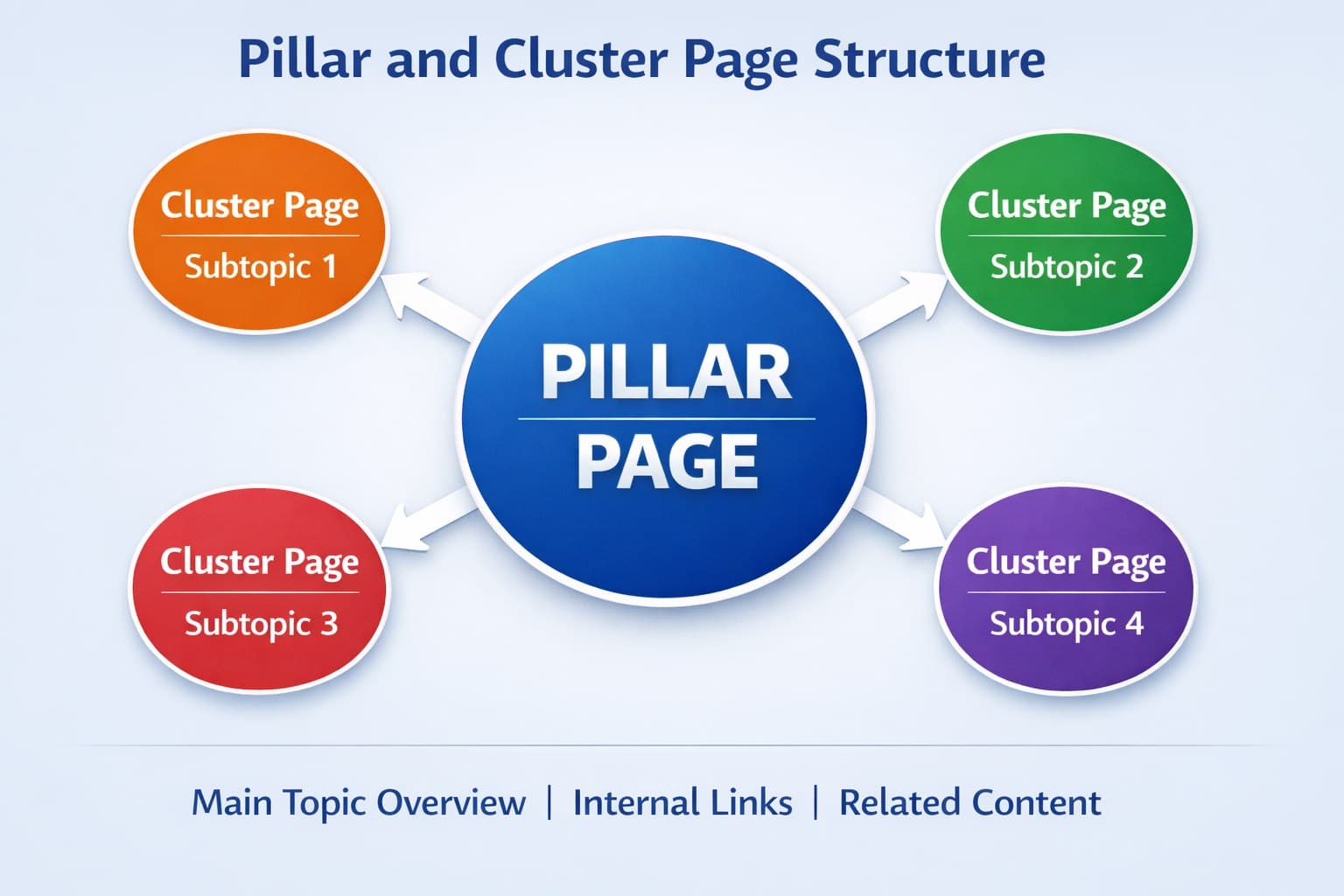
The pillar-cluster model is a common and effective way to organise content around topics, especially for content-heavy websites.
Pillar Page
- Covers a broad topic
- Targets a core search theme
- Acts as a central reference point
Cluster Pages
- Focus on specific subtopics
- Target narrower search intent
- Link back to the main pillar page
Why This Structure Works
- Builds clearer topical organisation
- Creates a stronger internal linking system
- Helps search engines understand relationships between related pages
- Improves content depth around important topics
(Source: Google Search Central, Link Best Practices; Google Search Central Blog, Importance of Link Architecture)
Malaysia Example
For a digital marketing website:
- Pillar: SEO Malaysia
- Cluster: Local SEO Malaysia
- Cluster: Technical SEO Malaysia
- Cluster: SEO Content Strategy
This approach supports clearer topic coverage and easier navigation for both users and search engines.
How Site Hierarchy Impacts UX and UI
Your structure directly affects how users interact with your website interface.
Mobile-First Behaviour in Malaysia
- Mobile and internet usage are very high
- Navigation needs to be simple and fast
- Deep structures can make important pages harder to reach on smaller screens
Given Malaysia’s high mobile-device usage, structure must work smoothly on mobile, not just desktop. (Source: Department of Statistics Malaysia, ICT Use and Access by Individuals and Households Survey Report 2024)
Multilingual Navigation Reality
Malaysia’s web audiences often interact with content across multiple languages, so your structure should support clarity across language versions.
That means:
- Using clear labels
- Avoiding overly technical naming
- Keeping translated or localised sections consistent
- Structuring language variations properly
For multilingual SEO, Google recommends clear handling of localised versions and proper signals such as hreflang where relevant. (Source: Google Search Central, Localized Versions)
UI Design Implications
- Keep menus concise
- Avoid overcrowding
- Prioritise key pages
- Reduce unnecessary layers
If users cannot find what they need quickly, they leave. Structure directly affects retention and usability.
Types of Website Structures
Not all structures perform equally well for SEO or usability.
Hierarchical Structure (Recommended)
- Clear levels
- Easy navigation
- Best fit for most websites
Sequential Structure
- Linear flow
- Useful for funnels, onboarding, or step-based journeys
Database Structure
- Common in ecommerce or large content libraries
- Can generate many dynamic pages
- Requires stronger control to avoid SEO issues
Google’s ecommerce guidance also warns that URL and filtering systems can create indexing and duplication problems when not handled properly. (Source: Google Search Central, Designing a URL Structure for Ecommerce Sites)
Real-World Examples (Malaysia Context)
Applying hierarchy makes the concept practical.
SME Service Website
Typical structure:
- Homepage
- Services
- Individual service pages
Outcome:
- Clearer user journey
- Better local topic targeting
- Higher conversion potential
Ecommerce Website
Typical structure:
- Homepage
- Categories
- Product pages
Risk:
- Filter combinations can create too many crawlable URLs
- Duplicate or near-duplicate pages can dilute site clarity
(Source: Google Search Central, Designing a URL Structure for Ecommerce Sites)
Content Website
Typical structure:
- Pillar topic
- Supporting articles
- Internal linking network
Outcome:
- Builds topical depth over time
- Captures more specific long-tail searches
- Strengthens discoverability across related content
Common Site Structure Mistakes
These are frequent issues seen in business websites.
- Too many menu items that overwhelm users
- Deep page nesting beyond what users can navigate comfortably
- Orphan or underlinked pages
- Duplicate pages created by filters or parameters
- No clear keyword-to-page alignment
These issues often limit performance more than the content itself. (Source: Google Search Central Blog, Importance of Link Architecture; Google Search Central, Designing a URL Structure for Ecommerce Sites)
How to Audit Your Site Hierarchy
A structured audit helps identify weaknesses quickly.
Step 1: Map Your Pages
- List all URLs
- Group them by hierarchy level
Step 2: Check Page Depth
- Aim to keep important pages within a few clicks of the homepage
Google has long recommended making it easy to get from general pages to more specific content and keeping key pages reachable within several clicks. (Source: Google Search Central Blog, Importance of Link Architecture)
Step 3: Analyse Internal Links
- Identify underlinked pages
- Strengthen connections between related topics
Step 4: Align Content With Intent
- One main page per primary topic or intent
- Avoid unnecessary duplication
Step 5: Simplify Structure
- Remove unnecessary layers
- Improve navigation clarity
- Keep the user journey obvious
Ecommerce vs Service Website Structure
Factor | Ecommerce | Service Website |
Structure complexity | High | Moderate |
Navigation | Filter-heavy | Simpler |
SEO risk | Duplicate URLs, crawl inefficiency | Thin or overlapping pages |
Focus | Discovery and crawl control | Clarity and conversion |
Improving Your Site Hierarchy to Improve Your Business
Site hierarchy is not just a technical SEO detail. It is the system that shapes how effectively your website performs across search visibility, user experience, and conversions.
If your website feels disorganised or underperforms despite strong content, the issue is often structural. A clear hierarchy helps users find what they need, helps search engines understand your pages, and gives your content a stronger foundation for long-term growth.
At Rankpage, we help Malaysian businesses build scalable SEO systems, from site architecture to content strategy, so your website continues to perform as your business grows. Don’t miss this chance to partner with Malaysia’s most reliable SEO agency, and help kickstart your business growth!