Disclosure & Conflict-of-Interest Note
Rankpage provides SEO services as an external agency, which means we may benefit if a reader chooses to work with an agency. Because of that, we want to be clear: this article is intended to be informational and to help you choose the best operating model for your business, NOT to imply that outsourcing is always the right answer.
We’ve worked with Malaysian businesses that succeed with agency-led, in-house, and hybrid setups, and outcomes depend far more on execution quality, governance, and consistency than on the label of the model. Use the decision matrix in this guide to choose what fits your budget, timeline, and internal capabilities.
In-House SEO vs SEO Agency (2026 View)
Factor | In-House SEO | External SEO Agency |
Cost structure | Higher fixed cost | Flexible retainer / project-based |
Capability | Deep business knowledge | Broad, cross-industry expertise |
Speed to impact | Slower to ramp | Faster execution |
Control | Full control | Shared control (needs governance) |
Scalability | Limited by headcount | Scales with scope and budget |
Tooling | You fund tools & stack | Often partially included |
AEO readiness | Depends on team maturity | Depends on agency maturity |
What Is an In-House SEO vs External SEO Agency?
In-house SEO means you build internal capability: either hiring an SEO specialist, creating a team, or embedding SEO inside your marketing department.
An external SEO agency is a third-party team that manages your SEO strategy and execution, usually covering technical SEO, content strategy, content production, and off-page work.
A useful way to think about the difference:
In-house builds depth in one business. Agencies build pattern recognition across many businesses.
That difference matters when your industry is competitive, your website has technical issues, or you need to scale content quickly.
Features Comparison: Depth vs Breadth
In-House SEO Strengths
Deep business integration
Your team is embedded in day-to-day operations, making it easier to align SEO priorities to revenue goals.
Stronger brand understanding
Internal teams naturally understand product nuance, tone, compliance rules, and customer objections.
Faster internal coordination
Approvals, access to product teams, and stakeholder buy-in are easier when everyone is under one roof.
Long-term capability building
You’re building an asset: internal knowledge, internal processes, and institutional SEO memory.
External SEO Agency Strengths
Cross-industry experience
Agencies see what works across multiple markets; useful when your niche is changing or highly competitive.
Specialised coverage
Instead of one person doing everything, you can get access to:
- Technical SEO specialists
- Content strategists and editors
- Digital PR / link-building specialists
- Analytics and reporting support
Proven systems and processes
Most agencies run on frameworks for audits, content briefs, editorial QA, internal linking, and reporting.
Faster adaptation
Agencies often test new approaches across multiple clients, which can speed up learning cycles.
Malaysia Context: Why “Efficiency” Matters More Than People Admit
A big reason this decision matters in Malaysia is that many businesses (including the ones we’ve worked with) operate with lean teams. For SMEs especially, growth usually depends on output consistency (publishing content, fixing technical issues, and improving conversion pages) without pausing everything else.
Malaysia’s MSMEs contribute a major share of the economy, so competition for attention is real. When you’re up against bigger players with deeper budgets, the key advantage isn’t just “knowing SEO”, it’s executing consistently with a system.
This is why the question isn’t only:
“Agency vs in-house?”
It’s:
“Which model gives us reliable output and measurable progress every month?”
Pricing Comparison: Malaysia Context (Amended)
Cost is often the deciding factor, but the real comparison should be based on output and results, not just monthly fee.
In-House SEO Costs (Malaysia)
Building in-house usually involves more than one hire once you account for content, technical work, and reporting.
Typical cost inputs:
- SEO Executive (Malaysia average): ~RM4,200/month (varies by company, experience, and location)
- SEO Specialist commonly: RM4,800–RM7,000/month, with seniority and responsibilities affecting the ceiling
- SEO tools: many SEO tools and platforms range from ~US$30 to US$450+ per month per tool depending on plan and seats
- Training, recruitment, onboarding time, and turnover risk
Reality check: Once you include salary + tools + hiring overhead, the all-in monthly cost is often meaningfully higher than “one salary,” especially if you need both content output and technical delivery.
External SEO Agency Costs (Malaysia)
Agency retainers vary by scope, competitiveness, and deliverables. In Malaysia, it’s common to see:
- SME retainers: ~RM1,500–RM9,000/month
- Larger scopes / enterprise: RM10,000+/month depending on sitesize, content velocity, technical complexity, and competition
Key advantage: You get specialist coverage without building a full internal team immediately.
What You’re Really Buying: SEO “Operating System” vs Just SEO Work
This section is where most businesses make the wrong comparison.
You’re not only paying for keyword research or blog posts, you’re paying for a system that produces outcomes.
Leading indicators (track monthly)
These tell you whether SEO work is happening and compounding:
- Pages published / updated per month
- Technical fixes closed per month
- Indexed pages growth
- Non-branded impressions trend
- Top 3 / Top 10 keyword share trend
- Internal linking coverage (content-to-money-page flow)
Lagging indicators (track quarterly)
These reflect real business impact:
- Qualified organic leads
- Assisted conversions from organic
- Revenue influenced by organic
- CAC comparison: organic vs paid over time
If your agency or in-house team can’t show you leading indicators clearly, results become unpredictable, regardless of who you hire.
Speed vs Control: What Matters More?
This is usually the real trade-off.
In-house SEO prioritises control:
- You own strategy and execution
- You can align tightly to internal priorities
- You can build long-term capability
But it often comes with slower ramp-up:
- Hiring and onboarding
- Training and process building
- Tool stack setup
- Internal stakeholder alignment
Agencies prioritise speed:
- Existing specialists
- Ready workflows
- Faster delivery cadence
In competitive industries (healthcare, education, eCommerce), speed can decide whether you become the default option or stay invisible.
Hidden Risks Nobody Talks About (And How To Reduce Them)
In-House Risks
- Hiring the wrong person (SEO is broad; titles don’t guarantee competence)
- Over-reliance on one employee (single point of failure)
- “Busy work” without a clear KPI system
Risk reducer: Require a monthly operating dashboard (leading indicators + lagging indicators) and a documented SEO playbook.
Agency Risks
- Low-quality or outdated tactics (thin content, spammy links, shortcuts)
- Misalignment with business goals (traffic without revenue relevance)
- Overpromising unrealistic results
Risk reducer: Define governance early: approvals, timelines, deliverables, and KPI ownership.
SEO in 2026: Why AEO Changes How You Write and Structure Content
SEO has evolved beyond “rank this keyword.”
Search experiences increasingly reward content that is:
- Easy to interpret
- Well structured
- Directly answerable
- Grounded in real expertise
This is why AEO (Answer Engine Optimisation) matters: it focuses on making your content “answer-ready,” not just “keyword-ready.”
AEO-ready content checklist (use this for every page)
- One primary question per section heading (H2/H3)
- Give a short, direct answer early in the section
- Support with examples, steps, or proof points
- Use consistent terminology and definitions
- Add FAQs where it matches user intent (not as filler)
- Ensure pages demonstrate real expertise (experience, credentials, processes)
- Strengthen internal linking from informational pages to revenue pages
- Maintain technical cleanliness (indexation, canonical, speed, mobile UX)
Whether you go in-house or agency, this checklist becomes the baseline standard in 2026.
Compliance & Data Handling in Malaysia
If your SEO workflow touches any customer data, such as form submissions, CRM exports, remarketing lists, and lead lists, you ensure your processes align with Malaysia’s PDPA responsibilities. This is especially important if an agency helps with tracking, analytics setup, or lead handling.
You don’t need to overcomplicate it, but you should define:
- who can access what data
- how data is stored and shared
- what gets anonymised
- what happens when a vendor relationship ends
This protects your business and reduces operational risk.
Hybrid Model: Who Owns What?
A hybrid model often works best when responsibilities are clear:
Function | In-House Owns | Agency Owns |
Business goals & priorities | Yes | No |
Brand voice & approvals | Yes | No |
Product truth / internal SMEs | Yes | No |
SEO strategy & roadmap | Shared | Shared |
Technical backlog execution | No | Yes |
Content briefs + editorial QA | Final approval | Production system (drafts + workflow) |
Content production velocity | Shared | Shared |
Digital PR / link strategy | Shared | Shared |
Reporting dashboard & insights | Shared | Shared |
If you run a hybrid model without this clarity, you’ll get duplication, delays, and missed deadlines.
Real Business Scenario Examples in Malaysia
SMEs (Clinics, Salons, Local Services)
Typical challenges:
- Limited budget
- Need faster visibility
- Small internal teams
Often best approach: Outsource SEO to get consistent output and technical fixes without building a full team.
Growing eCommerce Brands
Typical challenges:
- Scaling content and category pages
- Technical issues across filters, variants, and duplicates
- Tracking + attribution clarity
Often best approach: Hybrid internal brand ownership + agency execution systems for scale.
Large Enterprises
Typical challenges:
- Multiple stakeholders and approvals
- Complex site structure and tech constraints
- Long-term investment horizon
Often best approach: In-house team supported by specialist agencies for technical projects, content scaling, or digital PR.
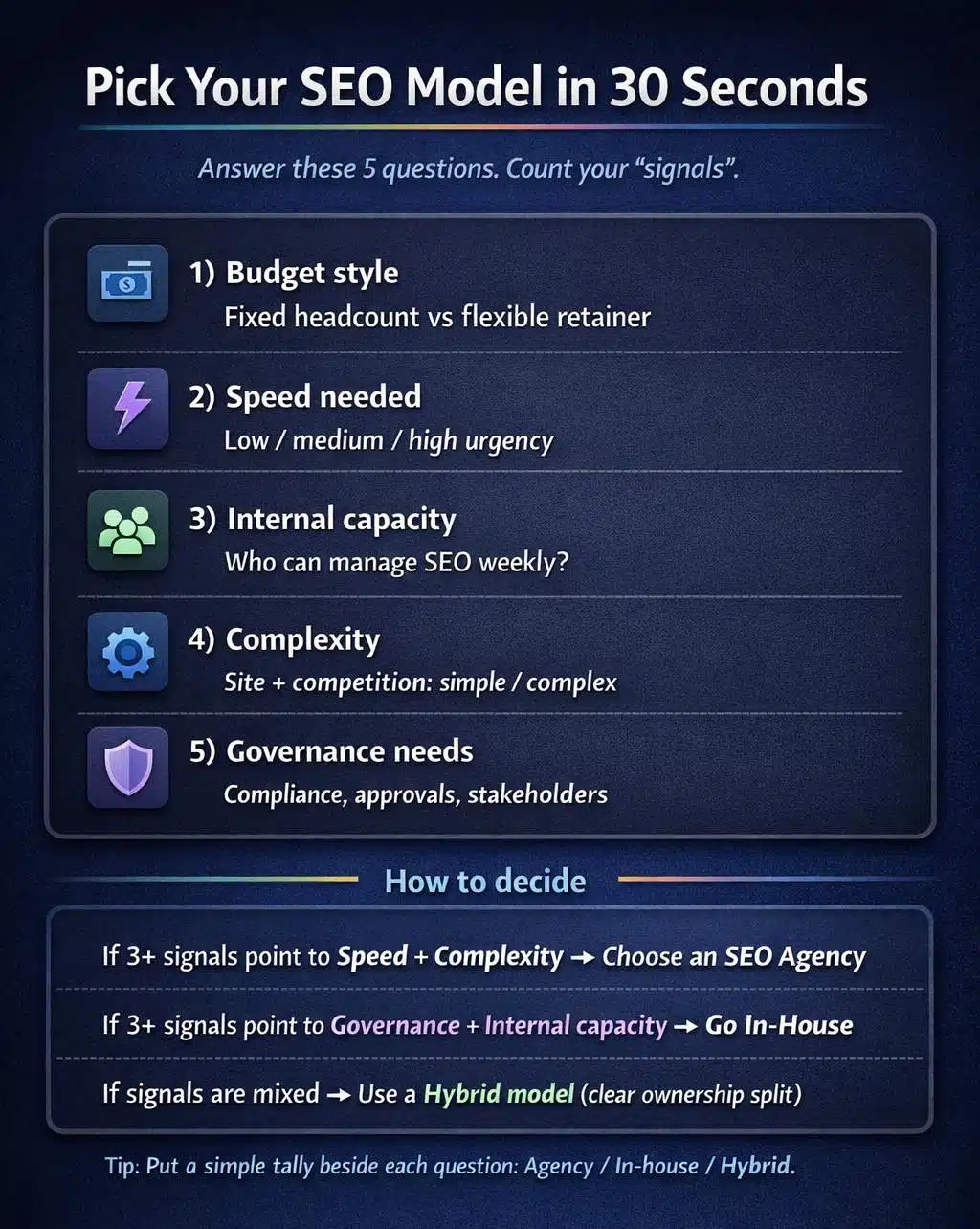
Decision Matrix: What Should You Choose?
Quick decision
- SEO Agency: when you need speed and your site/competition is complex
- In-house: when you need control, tighter governance, and someone can run SEO weekly
- Hybrid: when the signals are mixed—keep approvals/brand in-house, scale execution with an agency
Making the Right Choice
There’s no single “correct” answer. The better question is:
Which model gives you a repeatable system that produces measurable progress every month?
The right choice depends on your budget, timeline, internal capacity, and how complex your market is. Whatever you choose, SEO in 2026 works best when it runs on a system: consistent output, technical hygiene, and content structured to answer real questions.
If you’d like help implementing that system, Rankpage can audit your current setup and propose a 90-day execution roadmap, including what to keep in-house and what to outsource for speed. Contact Malaysia’s trusted SEO agency Rankpage, to get a plan tailored to your business.
Sources
- Google Search Central — “AI features and your website” (accessed 2026)
- Google Search — “AI Overviews” information page (accessed 2026)
- Google Blog — AI Overviews expansion update (28 Oct 2024)
- Department of Statistics Malaysia (DOSM) — MSMEs Performance 2024 release (31 Jul 2025)
- MDEC — SME digitalisation grant programme pages (accessed 2026)
- Department of Personal Data Protection (Malaysia) — PDPA Act 2010 (Act 709) reference (accessed 2026)
- Indeed Malaysia — SEO Executive salary (updated 15 Mar 2026)
- Indeed Malaysia — SEO Specialist salary (updated 6 Mar 2026)
- JobStreet Malaysia — SEO Specialist salary guide (published 1 Mar 2026)
- Ahrefs — Pricing/plan information (accessed 2026)
- Semrush — Pricing/plan information (accessed 2026)
- CXL — Answer Engine Optimisation (AEO) guide (15 May 2025)
- Recruitment process reference (Malaysia) — time-to-hire overview (accessed 2026)