SEO services for B2B digital banking help banks attract and convert business clients by ranking for high-intent queries related to financing, accounts, and operational banking solutions.
In Malaysia, digital banks operate in a fully digital environment where search visibility can strongly influence growth. For B2B, this is even more pronounced because business buyers typically evaluate multiple providers in parallel and need clarity on eligibility, costs, timelines, and operational fit.
Unlike traditional banks that rely heavily on branches and relationship managers, digital-first banking depends on discoverability, transparency, and trust built through content.
Why this matters now
- SME/MSME research happens before application
- Decision-making often involves comparing multiple providers
- Onboarding, approval, and servicing are increasingly digital
The shift in 2026
- Traditional SEO: broad visibility
- B2B digital banking SEO: decision-stage clarity + conversion
If your content does not clearly communicate approval process, pricing/fees, eligibility, and operational fit, it may attract traffic but fail to convert.
Why SEO Matters for Digital Banking in Malaysia (B2B Perspective)
SEO captures business demand at the moment SMEs evaluate financial solutions, while reducing reliance on CPC-heavy paid channels.
1) Paid Acquisition Can Be Costly at Scale
In paid search, high-intent financial services terms can become expensive as competition increases. SEO helps reduce long-run dependence on rising cost-per-click by building compounding visibility for decision-stage queries.
2) Strong MSME Demand in Malaysia
MSMEs represent a major share of Malaysia’s economic activity, creating steady search demand for:
- business accounts
- working capital
- payroll and payouts
- merchant payments
- cash flow tools
- credit and financing
3) Search Drives Business Decisions
In B2B banking, visibility isn’t just awareness. It can determine whether your product makes the shortlist when prospects compare:
- eligibility
- documentation requirements
- fees/rates and total cost
- approval and disbursement timelines
- product features and operational fit
4) Visibility Builds Trust for Digital Banks
Without a branch network, credibility is earned through:
- regulatory clarity
- transparent product disclosures
- security and privacy communication
- clear support and complaint pathways
- credible third-party mentions and references
Quick Snapshot: SEO vs Paid Ads in Banking
| Factor | SEO | Paid Ads |
|---|---|---|
| Cost over time | Often improves with compounding content equity | Can rise with competition |
| Trust signal | Higher (earned visibility + content depth) | Medium (sponsored placement) |
| Speed | Slower start | Immediate |
| Longevity | Strong | Stops when spend stops |
Who You Are Targeting (B2B Digital Banking Personas)
Business banking decisions often involve multiple stakeholders.
- SME founders: speed, simplicity, access to capital
- Finance managers / CFOs: cost, repayment structure, controls, governance
- Startups and digital businesses: integrations, scalability, automation
Your SEO content should address all personas without becoming generic. The cleanest way is to map intent to page types (product pages, comparisons, requirements, calculators, FAQs).
How SMEs Search for Digital Banking Solutions (Intent Mapping)
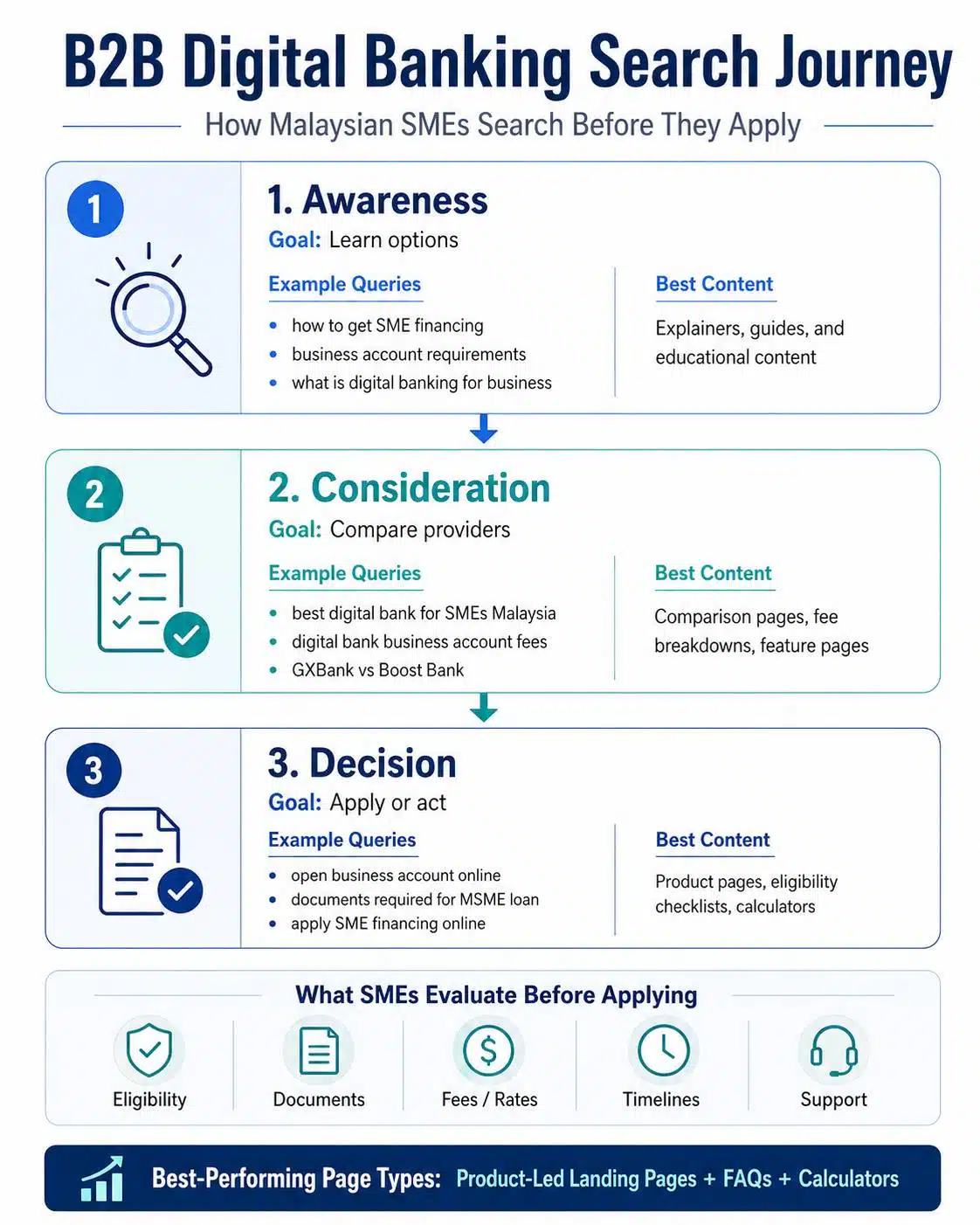
B2B search behaviour is structured around evaluation, not just discovery.
Awareness stage
- “how to get SME financing”
- “business account requirements”
- “what is digital banking for business”
Consideration stage
- “best digital bank for SMEs Malaysia”
- “digital bank business account fees”
- “GXBank vs Boost Bank” (example comparison intent)
Decision stage
- “open business account online”
- “documents required for MSME loan”
- “apply SME financing online”
Most banking content targets awareness queries. The B2B opportunity is capturing consideration and decision-stage traffic, where conversion potential is highest.
Core SEO Strategy for B2B Digital Banking (Step-by-Step)
Step 1: Keyword Strategy (Business-Focused)
Focus on keywords that reflect real business intent.
- Core: business bank account, MSME financing, SME loan eligibility
- Supporting: documents required, fees, timeline, repayment calculator
- Strategy: long-tail queries that signal readiness to apply
Authority upgrade: add “Eligibility + Documents” sections to every product page. This directly answers what business buyers search for.
Step 2: Build Product-Led Landing Pages
Align pages with real products, not generic topics.
Minimum content blocks for conversion
- Eligibility criteria (plain language)
- Required documents (checklist + alternatives)
- Pricing (fees/rates/profit rates where applicable) + effective date
- Timeline ranges (what affects speed)
- How the process works (step-by-step)
- FAQ (decision-stage questions)
- Clear CTA (“Check eligibility” / “Apply now”)
Product-led pages reduce friction by answering key questions upfront.
Read More: YMYL SEO Guide For Malaysian Businesses
Step 3: Content Clusters for Authority
Build topical depth to strengthen rankings and trust.
Financing cluster
- eligibility and common rejection reasons
- documentation checklists
- pricing and total cost explained
- repayment structures
- approval and disbursement process
Accounts and cards cluster
- account types, limits, and fees
- onboarding steps and verification
- corporate cards and spend controls
Operations cluster
- payroll and bulk payments
- invoicing and collections
- payment methods and settlement timelines
- integrations with accounting tools (only if verified)
A strong cluster improves rankings and helps users self-qualify before applying.
Step 4: Optimise for AI Search Experiences
Structure content for AI-driven discovery without sacrificing readability.
- Start sections with direct answers
- Use clear headings and bullet lists
- Include comparison tables for decision queries
- Ensure every factual claim is supportable
- Use structured data where appropriate (Organization, Breadcrumb, and eligible FAQ where content matches)
This increases the likelihood of being selected in AI summaries and conversational results.
Step 5: Build Authority with Links and Credible References
Authority signals are critical in financial SEO.
Prioritise link earning and references from:
- SME associations, chambers, and industry groups
- recognised finance or business publications
- reputable business directories (high-quality, not spammy)
- partners (accounting platforms, ecosystem tools) (only if real relationships exist)
Authority upgrade ideas
- Publish a “Fees & Transparency” explainer others can cite
- Release a quarterly SME insights note (even small, with clear methodology)
- Co-author content with an SME body or industry partner
Building Trust in Digital Banking SEO (E-E-A-T + Compliance)
Trust signals influence rankings and conversions.
Trust signals checklist (add to all key product pages)
- Clear BNM licensing statement and “regulated entity” wording (accurate to your status)
- Prominent fees and charges page
- Rates/profit rates where applicable, with effective dates and examples
- Eligibility criteria and “who is not eligible”
- Documentation checklist with acceptable alternatives
- Timeline ranges and what causes delays
- Security posture explained in plain language (MFA, encryption, fraud prevention) (only if accurate)
- Privacy notice: data categories, purpose, retention, and sharing
- Support channels and complaint escalation steps
Content governance (authority upgrade)
- Named author + credentials
- “Reviewed by Compliance” line
- “Last updated” date + mini changelog for regulated pages
This is one of the simplest ways to increase perceived legitimacy and reduce drop-offs.
Digital Bank Differentiation (What You Must Highlight in SEO)
Digital banks must communicate advantages without overpromising.
- Onboarding speed: many digital banks position around faster app-based onboarding (time varies by verification and profile).
- Approval speed: some lenders promote same-day to a few-day decisioning, but timelines vary by documentation and underwriting.
- User experience: end-to-end digital workflows
- Controls: spend limits, approvals, audit trails (where applicable)
- Integrations: accounting and business tooling (only if verified)
Publish “What affects approval time?” and “Why applications get delayed” pages: these tend to convert highly because they reduce uncertainty.
Conversion SEO for Digital Banking (Turning Traffic Into Applications)
Conversion optimisation ensures SEO translates into applications.
- Tools: repayment estimators, fee calculators, eligibility checklists
- CTAs: “Check eligibility”, “See required documents”, “Apply now”
- Proof: testimonials, process timelines, simple case examples
- Reduce anxiety: “What happens after you apply?” section
Example (safe format):
- “Illustration only: RM50,000 facility over X months. Example repayments shown; final terms depend on assessment.”
This boosts confidence without promising approval or fixed rates.
Technical SEO for Financial Platforms
Technical performance, boosted by technical SEO, supports rankings and trust.
- Mobile-first UX and accessibility
- Speed and stability improvements (Core Web Vitals focus)
- Strong security hygiene (HTTPS, secure headers, patching)
- Indexing hygiene (sitemaps, canonicals, clean URL structures)
- Structured data that matches content (avoid spammy markup)
- Clear internal linking from product pages to disclosures and support
Authority upgrade: create a “Security & Privacy” hub and link it from every product page and every CTA.
Competing With Fintech and Traditional Banks
Positioning helps you win evaluation-stage searches.
High-performing comparison content includes:
- Digital bank vs traditional bank for SMEs
- Business account fees comparison (transparent table)
- SME financing requirements comparison
- “Best for” and “Not ideal for” sections (strong trust builder)
These pages attract high-intent users actively deciding.
Common Challenges in Digital Banking SEO
- High competition for finance keywords
- Compliance constraints on messaging
- Trust barrier for newer digital brands
- Longer decision cycles and multiple stakeholders in B2B
The solution is consistency: product-led pages + clusters + proof assets + compliance clarity.
Cost of SEO for B2B Digital Banking (Authority-Safe Version)
SEO budgets vary widely depending on:
- Number of product pages and content clusters
- Level of technical work (platform complexity)
- Compliance review cycles
- Analytics and conversion tracking maturity
- Link earning and PR support
If you publish pricing, also publish scope assumptions:
- Deliverables per month (pages, articles, refreshes)
- Review workflow (including compliance sign-off)
- Reporting cadence and KPIs
- What is included vs not included
This prevents “random ranges” and increases buyer trust.
SEO Is the Growth Engine for Digital Banking in 2026
SEO for B2B digital banking is about aligning your content with how businesses evaluate financial solutions, from research to application. It requires intent targeting, trust-building, and conversion-focused execution.
If you’re looking to scale your digital banking presence in Malaysia, Rankpage is your trustworthy SEO partner. We help build SEO systems designed for high-intent, conversion-driven growth, combining AI-search-friendly structure, E-E-A-T practices, and local market execution.
Disclaimer: This article is for general informational and marketing purposes only and does not constitute financial, legal, or tax advice. Product features, eligibility, fees, rates/profit rates, timelines, and regulatory requirements may vary by provider and may change over time. Always refer to official product disclosures and relevant regulator information, and consult qualified professionals for advice specific to your situation.
Sources
- Bank Negara Malaysia (BNM) — Digital bank licensing framework
- Bank Negara Malaysia (BNM) — Announcement of successful applicants for digital bank licences
- Bank Negara Malaysia (BNM) — Financial Sector Participants Directory (digital bank tag/directory)
- Department of Statistics Malaysia (DOSM) — MSMEs Performance 2024 release
- Google Search Central — AI features guidance and structured data documentation
Frequently Asked Questions About Digital Banking SEO With a B2B Focus
What Is Digital Banking SEO?
Digital banking SEO is the process of optimising a bank’s website so it ranks for relevant financial queries and turns that visibility into sign-ups or applications.
How Is B2B Banking SEO Different From Retail Banking SEO?
B2B banking SEO focuses on business intent (financing, business accounts, fees, eligibility, documentation, and operational needs) while retail SEO targets consumer products and everyday banking use cases.
Why Is BNM Licensing Important For SEO?
Clear licensing and regulatory messaging improves trust and reduces hesitation for digital-first banks. For business buyers, it also helps validate legitimacy during the shortlist stage.
What Keywords Convert Best In Digital Banking SEO?
High-intent keywords usually convert best; queries tied to applying or deciding, such as business account setup, SME/MSME financing, eligibility, required documents, fees, and approval timelines.
How Long Does SEO Take For Digital Banks?
SEO is typically a medium-term channel. Early movement can happen within months, but meaningful growth depends on competition, technical health, and the depth and quality of content. It also compounds over time.
Is SEO Better Than Paid Ads For Banking?
SEO tends to produce stronger long-term efficiency and trust, while paid ads deliver immediate visibility. Many banking brands use both, with SEO reducing reliance on high CPCs over time.