
What Is SEO for Manufacturers (And How It Differs from Traditional SEO)
SEO for manufacturers focuses on attracting high-intent B2B buyers using technical, specification-driven search queries rather than broad consumer keywords.
Unlike traditional SEO campaigns that prioritise traffic volume, manufacturing SEO is about precision and qualification. Every page should serve a purpose in the buyer’s evaluation journey, from discovery to a request for quotation (RFQ).
Comparison: Traditional SEO vs Manufacturing SEO
Factor | Traditional SEO | Manufacturing SEO |
Audience | General consumers | Engineers, procurement teams, sourcing managers |
Keywords | Broad, high-volume | Long-tail, technical, specification-based |
Goal | Traffic | RFQs, qualified inquiries, partnerships |
Content | Blogs, guides | Specs, certifications, case studies, application pages |
What This Means in Practice
- Content must answer technical questions, not just introduce services.
- Pages should be structured around use cases, industries, materials, and compliance needs.
- SEO success is measured by inquiries and deal quality, not just impressions.
Why Malaysian Manufacturers Have a Unique Advantage in Global SEO
Malaysia is strategically positioned as an export-ready manufacturing hub, and SEO helps companies surface that positioning to global buyers during early research.
Several macro shifts support this:
- Global buyers are actively diversifying supply chains.
- ASEAN continues attracting investment and expanding its role in global supply chains.
- Many organisations are prioritising risk mitigation and resilience alongside cost.
How to Translate This Into SEO Content
Instead of generic positioning, embed strategic signals into your pages:
- “ASEAN-based manufacturing partner for export markets”
- “Alternative supplier aligned with China Plus One sourcing strategies”
- “ISO-certified Malaysian manufacturer with global export capability”
Why This Matters
Overseas buyers are not just searching for suppliers. They’re searching for reliable, risk-reduced partners. SEO content that reflects evaluation criteria tends to outperform generic marketing copy.
Who Actually Searches for Your Factory (And Why It Matters)
The real search users are engineers and procurement professionals who evaluate suppliers based on technical fit, compliance, and capability.
This changes both your keyword strategy and your content structure.
Key Buyer Personas
- Procurement officers, focused on cost, delivery, and compliance
- Engineers, focused on specifications, materials, and tolerances
- Sourcing managers, focused on scalability, continuity, and long-term supply
How They Search
Role | Search Behaviour |
Engineer | Searches by material, tolerance, process |
Procurement | Searches by supplier location, certifications, compliance |
Manager | Searches by capacity, export readiness, scalability |
High-Intent Query Patterns
- Problem-based: “supplier for corrosion-resistant steel components”
- Specification-based: “±0.01mm CNC machining Malaysia aerospace”
- Compliance-based: “ISO 13485 medical device manufacturer Malaysia”
These queries may have lower search volume, but they’re closely tied to purchasing intent.
Step-by-Step: How SEO Generates Overseas Leads
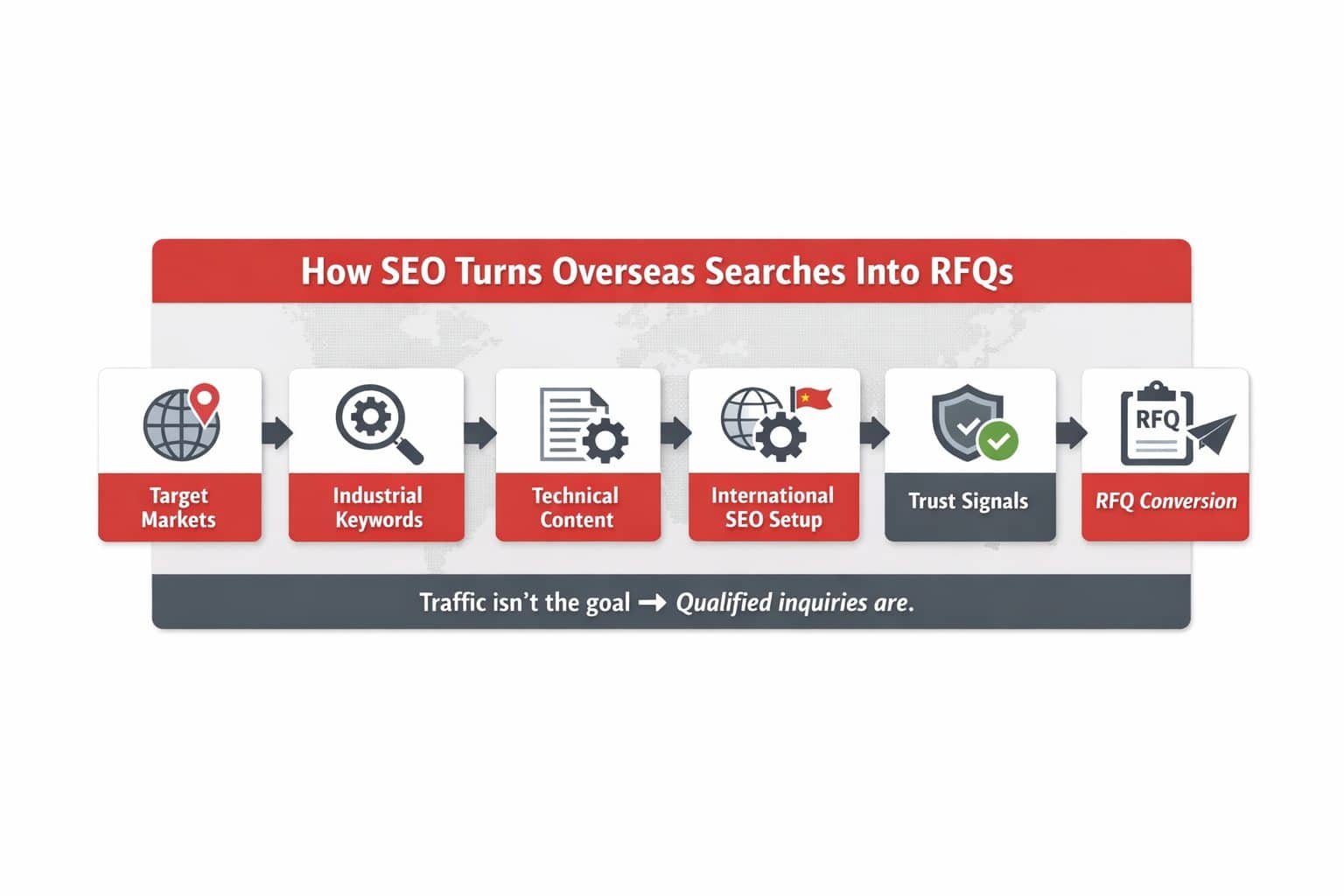
Step 1: Identify Target Export Markets
Focus on markets where your operational strengths align with demand and logistics efficiency.
Rather than targeting globally at once, prioritise:
- Nearby markets with lower friction, such as Singapore
- Quality-driven markets like Australia and Japan
- Growth regions like the Middle East (where relevant to your category)
Strategic tip:
- Map your certifications and capabilities against market requirements. Certain certifications can unlock specific industries and geographies.
Step 2: Build an Industrial Keyword Strategy
Long-tail keywords are the foundation of high-quality lead generation because they match how engineers and procurement teams actually search.
Use this framework:
- Product + Material + Process + Location
Expand further:
- Add certification layers: “ISO-certified”, “GMP”, “HACCP”
- Add industry layers: “automotive”, “medical”, “aerospace”
- Add performance specs: “high tolerance”, “corrosion-resistant”
Example:
Instead of: “Plastic manufacturer Malaysia”
Use: “Medical grade plastic injection molding Malaysia ISO certified”
Step 3: Create Technical, Buyer-Focused Content
Your website should reduce the buyer’s research effort, not add to it.
High-performing pages include:
- Detailed specifications with tolerances and materials
- Application-based positioning (for example, “for automotive components”)
- Downloadable technical sheets
- Visual diagrams or process explanations
- Clear quality and inspection methods (what you measure, how you measure it)
Content depth matters:
- Thin pages rarely convert in industrial B2B. Buyers need enough detail to shortlist you before they reach out.
Step 4: Implement International SEO Structure
Technical SEO ensures your content reaches the right audience in the right region.
Key elements:
- Hreflang tags for language and region targeting (when relevant)
- Country-specific landing pages for key markets
- Clear URL structures for segmentation (by market, industry, or capability)
Additional enhancements:
- Use regional hosting or CDNs to support faster load times for international visitors
- Optimise mobile performance (many initial checks happen on mobile, even in B2B)
- Use structured data where it fits to help search engines understand your pages and enable eligible rich results
Step 5: Build Authority and Trust Signals
Trust signals are often the deciding factor in overseas supplier selection, especially when buyers are comparing unfamiliar vendors.
Strengthen credibility by showcasing:
- Certifications (for example ISO, GMP, HACCP, industry-specific compliance where applicable)
- Export experience and markets served
- Client industries and real use cases
- Factory capabilities and production capacity
- Quality systems and inspection capabilities
Add trust signals that align with helpful, reliable content expectations:
- Real photos of facilities, equipment, and QC processes
- Named engineers or technical leads (where appropriate)
- Case studies with measurable outcomes (lead time reductions, defect rate improvements, yield gains, cost stabilisation)
Step 6: Convert Traffic Into RFQs
Conversion optimisation turns visibility into revenue. Overseas buyers often want clarity, speed, and low friction.
Best practices:
- Place “Request Quotation” buttons where buyers make decisions (capability pages, spec pages, case studies)
- Offer downloadable specs or checklists in exchange for inquiries (only if it genuinely helps the buyer)
- Set expectations on response time (and meet it)
- Provide multiple contact methods (form, email, phone, messaging if applicable)
- Ask for the minimum information needed to quote accurately (material, drawing, tolerance, quantity, delivery location)
Conversion insight:
- Buyers typically create and rank a shortlist before reaching out, and often contact their preferred vendor first. Make evaluation frictionless so you stay near the top of that shortlist.
Content That Wins Overseas Buyers
The best-performing manufacturing content supports evaluation, comparison, and decision-making.
High-impact content formats:
- Technical datasheets (simple, downloadable, current)
- Material comparison tables (clear, practical, application-driven)
- Industry-specific landing pages (capabilities mapped to standards and use cases)
- Case studies with problem-solution outcomes
- FAQ blocks that address common qualification questions (MOQ, lead time, inspection, tolerances, export packing)
Example Upgrade
Instead of: “We provide high-quality machining services”
Use: “Precision CNC machining for aerospace aluminium components with ±0.01mm tolerance and ISO 9001 certification”
Specificity builds trust and improves relevance for technical queries.
Common Challenges Malaysian Manufacturers Face
Execution gaps often limit visibility more than capability.
Key challenges:
- Targeting broad, low-intent keywords
- Lack of technical detail in content
- No localisation for international markets (even simple market-focused pages help)
- Weak site architecture that hides key capabilities
- Poor conversion design (hard to request quotes, unclear next steps)
Additional hidden challenge:
- Many manufacturers treat their website like a brochure. In reality, it should function as a technical sales platform.
Cost vs ROI of SEO for Manufacturers
SEO can deliver compounding returns, making it one of the most efficient long-term growth channels when executed consistently.
Costs vary widely based on:
- Your starting point (site quality, technical health, current content depth)
- Target markets and languages
- Number of product lines and industries
- Compliance requirements and how technical the content needs to be
- Internal resources (engineering support, documentation, photography)
ROI Comparison (High-Level)
Channel | Cost | Longevity | Lead Quality |
Trade shows | High | Short-term | Medium to high (depends on follow-up) |
Paid ads | Medium–High | Short-term | Medium (can be high with strong targeting) |
SEO | Medium (varies) | Long-term | High (when aligned to technical intent) |
ROI insight:
- SEO builds over time. A well-ranked technical page can generate inquiries continuously without additional spend per click, unlike paid campaigns.
Real Scenario: How SEO Converts a Global Buyer
A typical overseas buyer journey can start with online research and end with a supplier inquiry.
Example:
- An engineer searches: “precision CNC aluminium aerospace parts ASEAN”
- A Malaysian manufacturer appears with detailed capability and specification content
- The engineer reviews certifications, tolerances, and inspection methods
- Downloads a datasheet or checks process diagrams
- Submits an RFQ with drawings and quantity requirements
This can happen without cold outreach, making SEO an efficient inbound channel.
When Should Malaysian Manufacturers Start SEO?
SEO works best when it begins before entering new markets because rankings and authority take time to build.
Ideal timing:
- Before launching export strategies
- When expanding product lines
- When aiming to reduce reliance on intermediaries
- When building a direct global pipeline
Where SEO Fits in Your Export Strategy
SEO complements traditional channels by adding a consistent inbound lead generation layer.
It works alongside:
- Trade shows
- Distributors
- Strategic partnerships
While traditional channels build relationships, SEO improves discoverability at scale, especially during early-stage supplier research.
Turning Search Visibility into Global Revenue
SEO has become a practical growth channel for Malaysian manufacturers aiming to compete internationally. It helps businesses attract qualified overseas buyers, demonstrate credibility with technical proof, and generate consistent inquiries without relying solely on intermediaries.
At Rankpage, Malaysia’s most reliable SEO agency, we help Malaysian manufacturers build SEO systems that go beyond rankings, focusing on attracting the right global buyers and converting them into real business opportunities.
Sources
- Google Search Central — Localized versions (hreflang): hreflang guidance for language/region targeting.
- Google Search Central — Managing multi-regional and multilingual sites: international site structure and country targeting.
- Google Search Central — Intro to structured data: structured data basics and rich results eligibility.
- Google Search Central — Structured data policies: structured data rules and compliance.
- Google Search Central — Creating helpful, reliable, people-first content: trust signals, transparency, and expertise.
- 6sense — Buyer Experience Report: B2B buyer self-research and shortlist behaviour.
- Search Engine Land — How long does SEO take to work?: SEO timelines and factors affecting speed.
- com — How long does SEO take?: SEO timeline variability (supporting reference).
- ISIS Malaysia — Driving factors of China Plus One: China Plus One context for ASEAN/Malaysia positioning.
- ASEAN — ASEAN Investment Report: ASEAN investment and supply chain relevance.