What is B2B SEO (and how it differs from B2C SEO)
B2B SEO is different from B2C SEO, as it focuses on attracting business decision-makers who are actively researching solutions, not casual consumers.Unlike B2C SEO, where success often depends on volume and impulse buying, B2B SEO operates in a more complex environment:- Longer decision cycles, often spanning weeks or months
- Multiple stakeholders involved in decision-making
- Higher transaction values (often thousands to six-figure RM ranges, depending on industry and scope)
- Lower search volume but significantly higher intent
- B2C: “Best office chair Malaysia”
- B2B: “Ergonomic office chair supplier Malaysia bulk pricing”
Why B2B SEO matters in Malaysia (2026 context)
Malaysian buyers are increasingly digital-first, but trust is still built through local validation.Before reaching out, many buyers will:- Search for solutions on Google
- Compare multiple vendors
- Validate credibility through website content
- Look for pricing signals, proof, or case studies
- Strong sensitivity to pricing and ROI
- Preference for familiar or credible brands
- Reliance on compliance, legitimacy, and “can we trust this vendor?” signals
- Discovery happens online
- Trust is built through local relevance and proof
When B2B SEO is worth it (decision framework)
B2B SEO services are not universally effective. They work best under specific business conditions.SEO is worth it if:
- Your deal value is high (often RM5k and above per customer engagement)
- Your buyers actively search for solutions online
- Your sales cycle requires education and comparison
- Your industry has measurable search demand (even if it’s small)
- You can produce expertise-driven content consistently
SEO is less effective if:
- Your business relies heavily on personal relationships and referrals
- Sales are driven by tenders or closed networks
- Your market has very little search behaviour
- Your product is so niche that search demand is almost non-existent
Core aspects of a successful B2B SEO strategy
1) Search intent mapping
B2B buyers don’t convert instantly. They move through stages:- Awareness: identifying a problem
- Consideration: evaluating solutions
- Decision: choosing a vendor
2) Keyword strategy (Malaysia-focused)
Focus on:- “Service + Malaysia” queries
- Problem-based searches
- Industry-specific long-tail keywords
- Decision-stage terms (comparison, pricing, supplier, compliance, requirements)
- “Accounting services Malaysia SME”
- “Magnet supplier Malaysia food industry”
- “Payment gateway Malaysia comparison”
3) Content that builds authority (not just traffic)
High-performing B2B content usually includes:- Case studies with measurable outcomes
- Comparison pages (your approach vs alternatives)
- Industry-specific guides
- Regulatory or compliance explanations (where relevant)
- “Process” pages (how onboarding works, timelines, deliverables)
- 3–5 client outcomes (numbers, timeframes, context)
- Logos or industries served (with permission)
- A clear methodology (what you do first, second, third)
- A “who this is not for” box (filters out bad-fit leads and increases trust)
4) Technical SEO and site structure
Your website should support your content, not fight it:- Clear service pages with strong internal linking
- Logical site architecture (industry → service → use case)
- Fast loading speed and stable mobile experience
- Clean navigation so buyers can validate you quickly
5) Authority and trust signals
Malaysian B2B buyers often look for credibility before contacting you. Trust signals include:- Clear company identity and legitimacy (e.g., SSM registration details)
- Proof of results (case studies, before/after metrics, testimonials)
- Industry experience and certifications (where applicable)
- Compliance awareness aligned with regulators when relevant (e.g., finance)
SEO vs paid ads for B2B in Malaysia
SEO and paid ads are not competitors, but they behave very differently.| Aspect | SEO | Paid ads |
| Cost structure | Upfront investment | Ongoing spend |
| Longevity | Compounding | Stops when budget stops |
| Trust | Higher | Lower |
| Speed | Slower | Immediate |
- Use paid ads to validate messaging and learn which keywords convert
- Turn the winners into SEO assets (service pages, comparisons, FAQs, case studies)
- Retarget decision-stage visitors with proof (case studies, webinars, demo pages)
A Malaysia-specific ROI way to judge B2B SEO (without chasing vanity traffic)
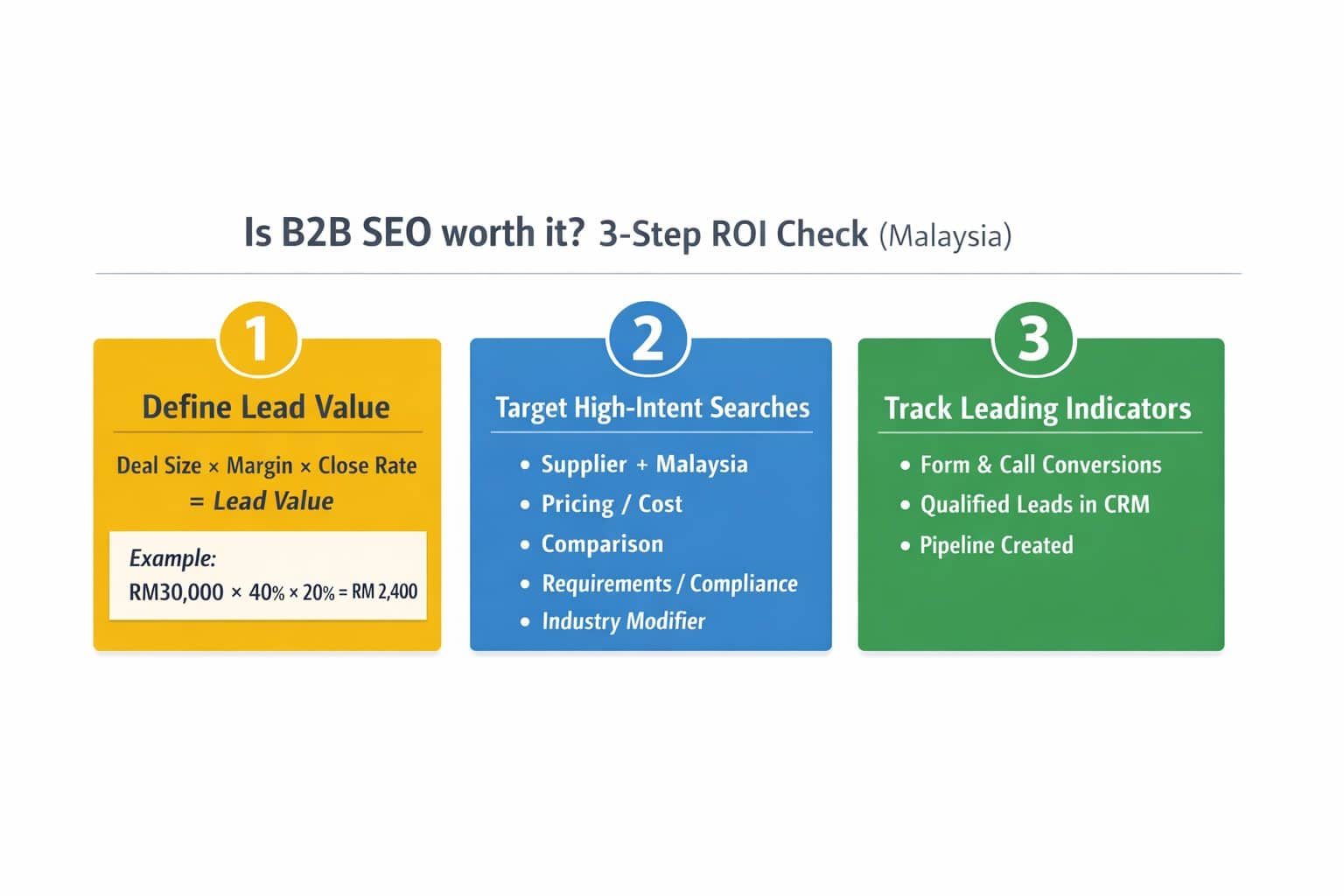 If you’re a Malaysian B2B company, the real question isn’t “How much traffic will we get?” It’s: Will SEO create qualified conversations at a cost that beats our alternatives?Here’s a practical way to judge ROI without overcomplicating it:
1) Define your “lead value”
Start with your average deal size and margin, then apply a realistic close rate.Example:- Average project: RM30,000
- Gross margin: 40%
- Close rate (qualified leads): 20%
2) Identify searches that produce qualified intent
In B2B, the best keywords are often not high-volume. They include:- Supplier + location (“X supplier Malaysia”)
- Compliance-driven queries (“requirements,” “standards,” “regulations”)
- Comparison/shortlist terms (“best,” “vs,” “pricing,” “cost,” “alternatives”)
- Industry modifiers (“for manufacturing,” “for SME,” “for food grade,” etc.)
3) Use leading indicators early (not revenue alone)
Early wins often show up as:- More impressions for bottom-of-funnel terms
- More branded searches (people searching your company name)
- More quote requests from decision-stage pages
- Sales teams reporting “they already knew what we do” on first calls
- Track form fills, calls, WhatsApp clicks, and brochure downloads as conversions
- Tag leads by source in your CRM (SEO vs paid vs referral)
- Report “cost per qualified lead” and “pipeline created,” not just traffic
The role of AI search (AEO) in 2026
SEO is no longer just about ranking; it is also about being selected and cited as an answer.With AI-driven experiences (including AI Overviews and other AI search interfaces), visibility can come from:
- Clear, direct answers
- Structured content (headings, lists, definitions, FAQs)
- Demonstrated expertise and verifiable proof
- Pages that are easy to quote, cite, and validate
- You may gain visibility by being a cited source, not only by ranking #1
- Content clarity matters more than keyword repetition
- Authority signals (proof, expertise, legitimacy) influence whether your content is trusted
Real Malaysian B2B examples
Example 1: Accounting firm
Search: “Accounting services Malaysia SME”Even with modest volume, each lead can translate into long-term retainers.Example 2: Industrial supplier
Search: “Magnet supplier Malaysia food industry”Highly niche, but extremely high intent and conversion potential.Example 3: Fintech / SaaS
Search: “Payment gateway Malaysia comparison”Decision-stage keyword where buyers are close to choosing a provider.Common mistakes Malaysian B2B companies make
- Chasing traffic instead of qualified leads
- Ignoring local context and regulatory relevance
- Treating SEO as just blog writing
- Expecting quick results without sales alignment
- Publishing generic content with no proof, no differentiation, and no trust signals
Conclusion
B2B SEO is still worth it in Malaysia, but only for businesses that align with how modern buyers search, evaluate, and make decisions.When executed correctly, SEO becomes a long-term growth engine: it supports discovery, builds credibility, and generates qualified inbound opportunities, especially for high-intent, decision-stage searches.At Rankpage, we help Malaysian businesses build SEO strategies that generate real, qualified leads through structured, high-intent content designed for both search engines and AI-driven discovery. Don’t miss the chance to partner with Rankpage, Malaysia’s number one SEO agency, to build your B2B company the right way.Sources
- Department of Statistics Malaysia (DOSM) — Malaysia Digital Economy 2025 (26 Nov 2025)
- DataReportal (Kepios) — Digital 2025: Malaysia (3 Mar 2025)
- Google Search Central — AI features and your website (accessed 2026)
- Google — How AI Overviews in Search work (PDF, July 2024)
- Google Search Central — Understanding page experience in Google Search results (accessed 2026)
- Think with Google — B2B buyer journey / shortlist research resources (accessed 2026)
- Companies Commission of Malaysia (SSM) — company verification and e-Search resources (accessed 2026)
- Malaysia Digital Economy Corporation (MDEC) — MyDIGITAL / digital economy blueprint resources (accessed 2026)