You can track AI search visibility using AIRM by monitoring how often your brand appears, how AI describes it, which sources are cited, which competitors are recommended, and how your visibility changes across relevant prompts and AI platforms.
AIRM stands for AI Reputation Management. It is a platform developed by Rankpage to help businesses understand how their brands are represented across AI search and generative AI platforms.
Traditional SEO gives businesses familiar metrics such as rankings, clicks, impressions and organic traffic. AI search works differently.
When someone asks ChatGPT, Gemini or another AI platform for a recommendation, the response may present several brands, explanations and, in some cases, supporting sources rather than a conventional list of search results.
This creates a different question for Malaysian businesses:
When customers ask AI about your industry, does your brand become part of the answer?
AIRM helps answer that by monitoring AI-generated responses for brand mentions, citations, competitor visibility, recommendation context and changes over time.
Instead of manually checking a handful of prompts, businesses can use AIRM to build a more structured picture of their AI search visibility.
What Does AI Search Visibility Include?
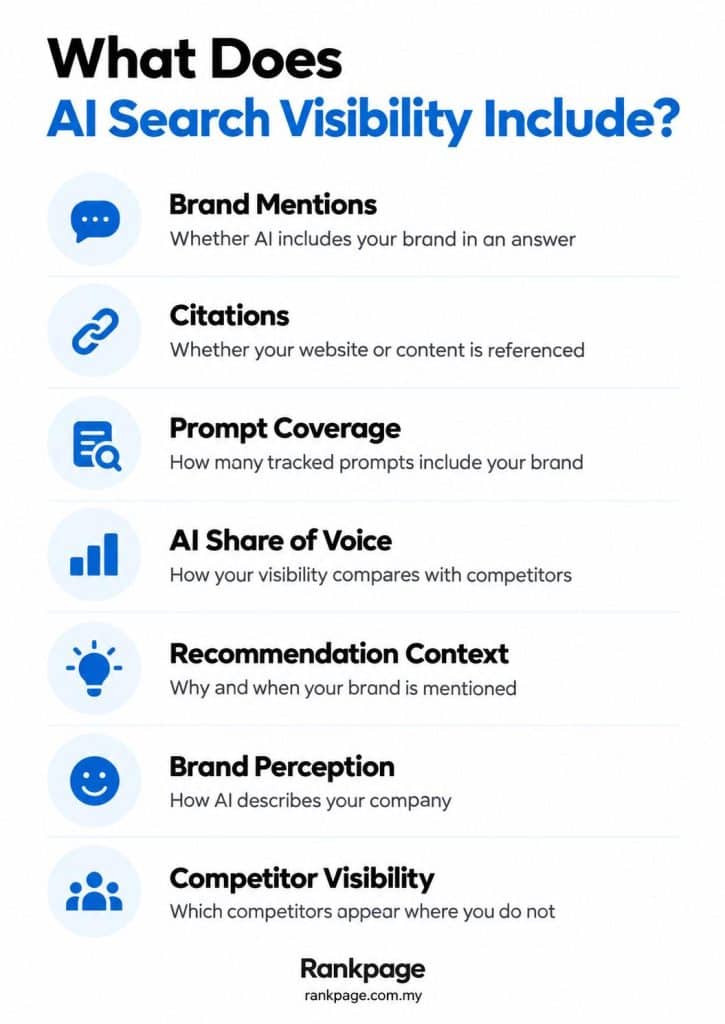
AI search visibility is broader than simply asking whether ChatGPT recognises your company name.
A business might appear when someone searches its exact brand name but disappear when a customer asks for recommendations.
For example, an HR software company may appear for “What does ABC HR Software do?”, but the more valuable prompt may be “What are the best payroll systems for Malaysian SMEs?”
If competitors appear and your company does not, that reveals a different type of visibility gap.
| AI Visibility Signal | What It Shows |
|---|---|
| Brand Mentions | Whether AI includes your brand in an answer |
| Citations | Whether your website or content is referenced |
| Prompt Coverage | How many tracked prompts include your brand |
| AI Share of Voice | How your visibility compares with competitors |
| Recommendation Context | Why and when your brand is mentioned |
| Brand Perception | How AI describes your company |
| Competitor Visibility | Which competitors appear where you do not |
One useful metric is AI Share of Voice.
This compares how often your brand appears against competing brands within a defined set of tracked prompts.
If your brand receives 20 mentions while a competitor receives 100 across the same dataset, the competitive picture is very different from the raw number alone.
How Does AIRM Track Brand Mentions and Citations?
AIRM records signals such as brand mentions, citation sources, competitor visibility, recommendation context and changes over time.
A Brand Mention Shows Whether You Are Part of the Conversation
A mention occurs when an AI response names your company.
For example:
“Some SEO agencies Malaysian businesses may consider include Brand A, Brand B and Rankpage.”
If your company appears, it has received a brand mention.
Mentions are particularly useful for non-branded prompts because the user did not specify which company should be discussed.
A Citation Shows Whether Your Content Is Supporting the Answer
A citation is different.
Your brand may not be recommended as the provider, but your website could still be referenced as a source supporting an AI-generated answer.
For example, a guide to Malaysia’s e-Invoice requirements might be cited when an AI system explains e-Invoicing to an SME owner.
A business can therefore be:
- Mentioned and cited
- Mentioned but not cited
- Cited but not recommended
- Neither mentioned nor cited
Tracking these patterns over time gives a more useful picture than repeatedly asking, “Does ChatGPT know my brand?”
AIRM can also help businesses examine the wider online information surrounding a brand, including websites, third-party references and reviews.
These may provide information AI systems can retrieve or reference, but factors such as reviews, media mentions or structured information should not be treated as confirmed universal ranking factors across every AI platform.
Which Prompts and Competitors Should You Monitor?
The quality of AI visibility tracking depends heavily on the prompts you choose.
Tracking hundreds of random prompts is not automatically better than tracking a smaller set closely connected to real buying decisions.
For a Malaysian accounting firm, useful prompt types could include:
Discovery: “Best accounting firms for SMEs in Malaysia”
Problem-Led: “Who can help my company implement e-Invoicing in Malaysia?”
Comparison: “Accounting Firm A vs Accounting Firm B”
Recommendation: “Which accounting firm is suitable for a growing Malaysian ecommerce company?”
Service-Specific: “Companies providing outsourced payroll services in Kuala Lumpur”
A strong prompt set should include a mix of branded, service-based, comparison, reputation and discovery queries.
Your AI Competitors May Not Be Your Usual SEO Competitors
Monitor three main groups:
Direct Competitors: Businesses selling similar products or services.
Search Competitors: Websites competing with you in organic search.
AI Competitors: Brands repeatedly surfaced by AI for your important prompts.
A company may not concern you much in Google’s conventional results but could appear consistently in AI recommendations.
That makes it an AI visibility competitor, even if it is not one of your traditional SEO rivals.
How Can AIRM Identify Visibility Gaps?
One of the most useful parts of AIRM is showing where your brand is underrepresented compared with competitors.
Suppose a Malaysian cybersecurity provider tracks these topics:
| Topic | Your Brand | Competitor A | Competitor B |
|---|---|---|---|
| Cybersecurity Companies Malaysia | Strong | Strong | Medium |
| Penetration Testing Malaysia | Weak | Strong | Strong |
| Cybersecurity for SMEs | Medium | Strong | Weak |
| Managed Security Services | Strong | Medium | Medium |
Overall visibility may look healthy, but penetration testing is clearly underperforming.
That gap could point to several areas to investigate:
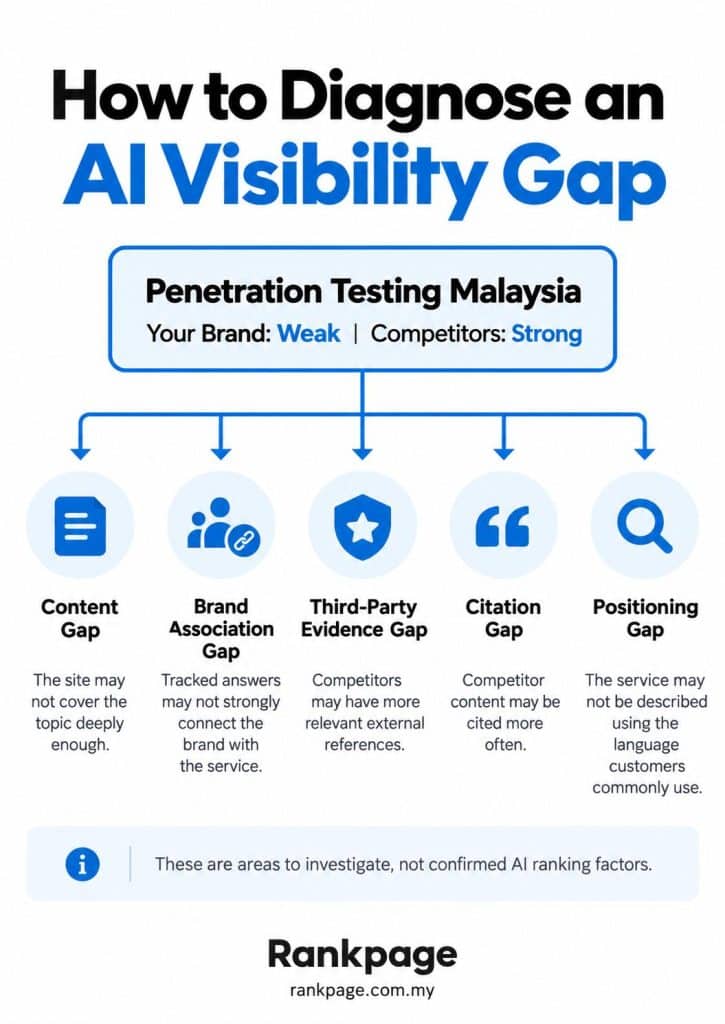
These are diagnostic areas, not guaranteed explanations of how an AI platform selects brands.
Look for Patterns, Not One Missing Answer
AI answers can vary depending on prompt wording, conversation context and platform.
One missing brand mention does not automatically indicate a serious problem.
Repeated absence is more meaningful.
If competitors repeatedly appear across 30 commercially relevant prompts while your brand rarely does, that is a much stronger visibility signal.
How Should You Use AI Share of Voice?
AI Share of Voice turns a collection of mentions into a competitive benchmark.
A simple mentions-based calculation is:
Your Brand Mentions ÷ Total Mentions Across Tracked Brands × 100
For example:
| Brand | AI Mentions | Share of Voice |
|---|---|---|
| Your Brand | 120 | 30% |
| Competitor A | 160 | 40% |
| Competitor B | 80 | 20% |
| Competitor C | 40 | 10% |
Your AI Share of Voice would be 30%.
That does not mean you own 30% of the actual market. It means your brand captured 30% of measured mentions within that tracked dataset.
There is no single industry-standard formula for AI Share of Voice. Some tools use simple mention counts, while others may apply weighting for prominence or position.
The important thing is to understand the methodology and use it consistently over time.
You can also break the metric down by platform, topic, intent or market where your tracking setup supports it.
What Should You Include in an AIRM Report?
An AIRM report should help someone make decisions, not simply present hundreds of prompts.
A useful report can include:
Overall AI Visibility: Brand mentions, citations, prompt coverage and AI Share of Voice.
Platform Performance: Differences between the AI platforms you monitor.
Competitor Comparison: Which competitors appear most often and where.
Visibility Gaps: High-value prompts where competitors appear and your brand does not.
Brand Perception and Accuracy: Whether AI describes your services, positioning and expertise correctly.
Recommended Actions: Clear priorities based on the gaps identified.
For example, actions could include improving an underperforming service page, publishing decision-stage content, strengthening clear information around a service or investigating why competitors receive stronger citations.
How Often Should You Track AI Search Visibility?
There is no universal reporting frequency.
For many Malaysian businesses, monthly reporting is a practical starting point, while highly competitive industries or active campaigns may justify more frequent monitoring.
The important part is consistency.
Keep a stable core group of prompts so Month 1 can be meaningfully compared with Month 2 and Month 3.
A simple rhythm could be:
Monthly: Core prompts, mentions, citations and AI Share of Voice.
Quarterly: Broader competitor, topic and positioning analysis.
Campaign-Based: Additional tracking after major AI SEO implementation, content, PR, product or branding activity.
The goal is to understand long-term direction rather than react to every individual fluctuation.
Why Should AI Search Visibility Be Tracked Alongside SEO?
AI search visibility does not make traditional SEO irrelevant.
The two can overlap, especially when AI products retrieve information from the web.
SEO continues to provide important performance data such as organic traffic, keyword rankings, impressions, indexed pages and conversions.
AIRM adds another layer:
Across the AI platforms and prompts you track, how often is your brand being mentioned, cited or recommended?
Looking at both can give businesses a broader picture of modern search visibility. Your website might rank well for an important keyword but rarely appear in the AI answers you monitor.
Alternatively, your content could receive AI citations even before you reach the organic search position you want.
Neither metric tells the whole story on its own.
Using AIRM to Help Your Business Track Visibility
Tracking AI search visibility means moving beyond checking whether your brand appears in one ChatGPT answer.
Malaysian businesses need to understand mentions, citations, prompt coverage, AI Share of Voice, competitor visibility and the context in which their brands appear.
The key is to treat those metrics as evidence from a defined set of tracked prompts and platforms, rather than assuming they reveal the internal ranking logic of every AI system.
If you want to turn those findings into broader organic growth, Rankpage SEO Agency can combine AIRM insights with SEO services to strengthen visibility across traditional search and AI-driven discovery.
Sources
- Rankpage, AIRM – AI Reputation Management
- Rankpage, SEO Package Upgrade and Pricing Adjustment
- AIRM, What Is AI Share of Voice and How Do You Measure It?
- AIRM, How to Check What ChatGPT Says About Your Brand
- AIRM, Why Is My Brand Not Appearing in AI Answers?
- AIRM, How Does ChatGPT Decide Which Brands to Recommend?
- OpenAI Help Center, Searching the Web with ChatGPT
- Google Gemini Apps Help, View Related Sources from Gemini Apps
Frequently Asked Questions About How to Track AI Search Visibility Using AIRM
What Does AIRM Stand For?
AIRM stands for AI Reputation Management. It is a platform developed by Rankpage to help businesses monitor how their brands are mentioned, cited, described and compared across tracked AI-generated answers.
What Is AI Search Visibility?
AI search visibility measures how frequently and accurately a brand appears within a defined set of AI-generated answers. It can include brand mentions, citations, recommendations, prompt coverage, competitor comparisons and AI Share of Voice.
What Is the AIRM Tool?
The AIRM tool is Rankpage’s AI reputation management and visibility platform. It helps businesses track brand mentions, citations, competitor visibility, AI Share of Voice, brand perception and related AI search signals.
Can AIRM Track Competitors in AI Search?
Yes. AIRM can monitor competitor activity within tracked AI-generated answers, helping businesses identify prompts or topics where competing brands appear more frequently.
What Is the Difference Between an AI Mention and an AI Citation?
An AI mention occurs when an AI-generated answer names your brand. A citation occurs when the AI system references your website or content as a supporting source. A brand can receive one without necessarily receiving the other.
How Often Should Malaysian Businesses Track AI Visibility?
Monthly monitoring is a practical starting point for many Malaysian businesses.The most important factor is using a consistent prompt set and methodology so changes can be compared meaningfully over time.