ChatGPT can access and retrieve content from websites, but there is no single crawler doing everything.
OpenAI documents several user agents, including OAI-SearchBot, GPTBot and ChatGPT-User. OAI-SearchBot supports ChatGPT search features, GPTBot is associated with model improvement and training, while ChatGPT-User may appear when a user action causes ChatGPT to visit a webpage.
For Malaysian businesses, server logs can show which OpenAI system visited, which pages it accessed and what happened when it did.
That matters because businesses are increasingly tracking visibility beyond Google. Without checking logs, it can be difficult to tell whether technical restrictions are preventing OpenAI’s systems from reaching important pages.
Can ChatGPT Crawl and Access Your Website?
Yes. OpenAI operates web crawlers and user agents that can request publicly accessible website content.
However, access, crawling and visibility are not the same thing.
A request in your server logs confirms that a user agent reached a URL. It does not mean the page was indexed, cited, recommended or selected for a ChatGPT answer.
OpenAI identifies OAI-SearchBot as the crawler used to surface websites in ChatGPT search features. If your goal is to boost AI search visibility, it is more directly relevant than GPTBot.
| Log Observation | What It May Mean |
|---|---|
| OAI-SearchBot requests a page | OpenAI’s search crawler accessed the URL |
| GPTBot requests a page | OpenAI’s training-related crawler accessed the URL |
| ChatGPT-User requests a page | A user-triggered ChatGPT action may have caused the visit |
| Repeated 403 responses | Access is being refused |
| Repeated 429 responses | Requests are being rate-limited |
| Mostly 404 responses | Bots may be reaching missing or outdated URLs |
Server logs therefore show technical accessibility, not guaranteed AI visibility.
If OAI-SearchBot consistently receives successful responses from important pages, that is good evidence that basic HTTP access is working. It still does not prove those pages will be surfaced or cited.
Which OpenAI Crawlers May Appear in Your Logs?
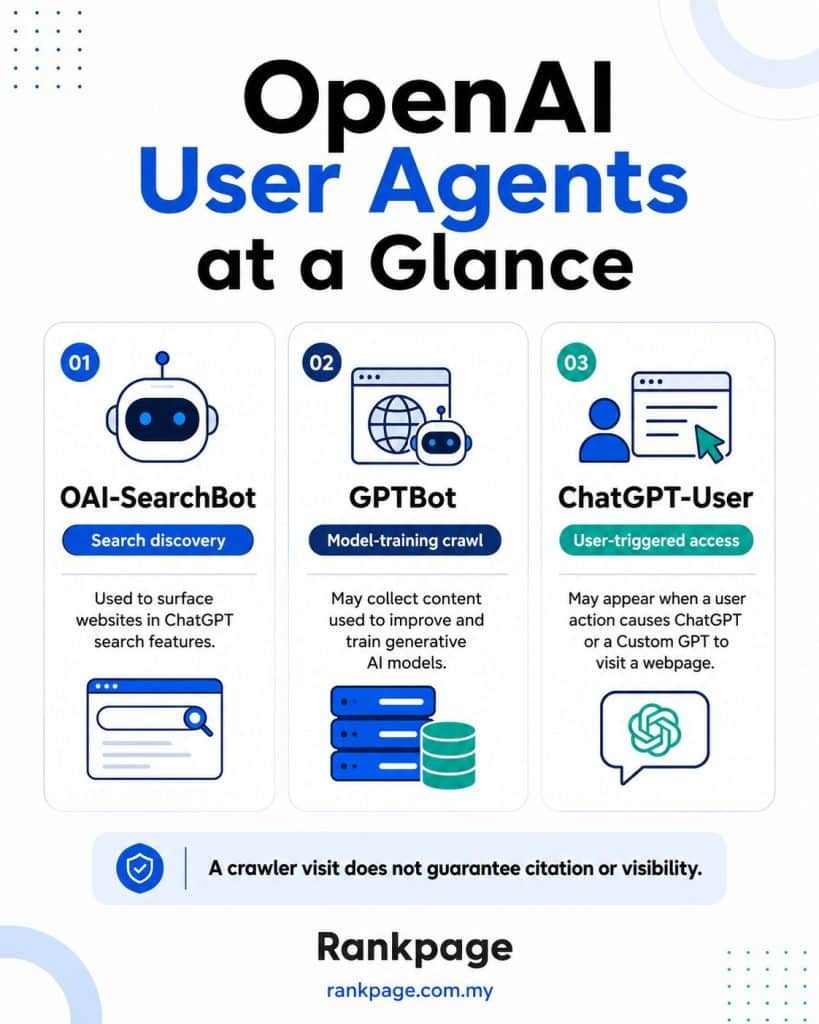
Three OpenAI user agents are especially useful to recognise.
OAI-SearchBot
OAI-SearchBot is most closely connected with ChatGPT Search visibility.
OpenAI states that it is used to surface websites in ChatGPT search features. Businesses that want their content eligible to appear in ChatGPT Search should therefore check whether this crawler can access their pages.
OpenAI’s documented example user-agent string includes:
OAI-SearchBot/1.4
Version numbers can change, so search your logs for OAI-SearchBot rather than an exact version.
You can also review which sections it visits most often. Repeated requests show where crawling activity is concentrated, but they do not prove that OpenAI considers those pages more useful or more likely to appear in an answer.
GPTBot
GPTBot has a different role.
OpenAI describes it as a crawler used to collect content that may help improve and train its generative AI foundation models.
Seeing GPTBot does not mean your site is ranking in ChatGPT Search.
OpenAI treats GPTBot and OAI-SearchBot separately, so website owners can control them independently. A business can therefore allow ChatGPT Search crawling while choosing a different policy for potential model-training use.
ChatGPT-User
ChatGPT-User is not used as a routine automatic web crawler.
It may appear when someone asks ChatGPT, or a Custom GPT, to perform an action that requires visiting a webpage.
The basic distinction is:
OAI-SearchBot: Search discovery
GPTBot: Potential model-training crawl
ChatGPT-User: User-triggered page access
This prevents a common reporting mistake: treating every OpenAI request as proof of AI search visibility.
How Can You Find AI Bots in Server Logs?
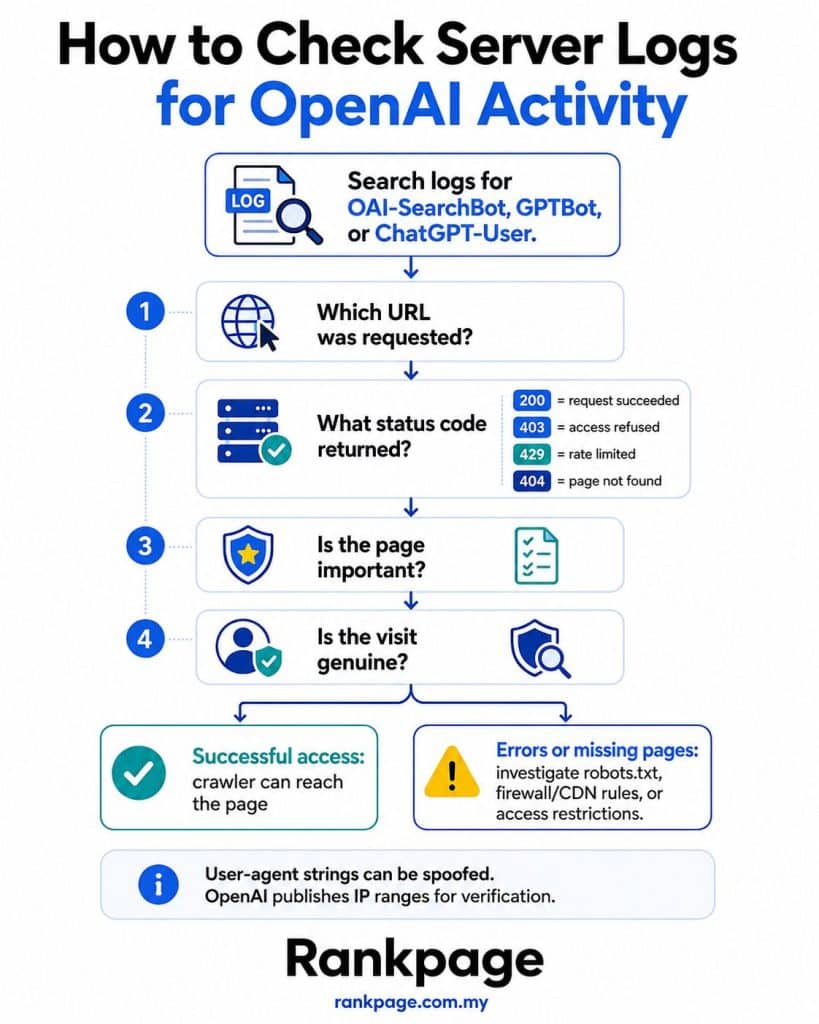
The exact process depends on your hosting setup, but useful fields usually include:
Timestamp: When the request happened
URL: Which page was requested
User agent: Which bot or browser made the request
Status code: Whether it returned 200, 301, 403, 404, 429 or another response
IP address: Where the request originated
Logs may be available through your hosting panel, Apache or Nginx logs, CDN, cloud platform or monitoring tools.
Search for:
OAI-SearchBot
GPTBot
ChatGPT-User
For example:
grep -Ei “OAI-SearchBot|GPTBot|ChatGPT-User” access.log
Do not only count requests. Check:
- Which pages were accessed: Are OpenAI systems reaching important service pages, articles and product categories?
- What status codes were returned: A 200 normally means success. A 403 means access was refused, while a 429 indicates rate limiting.
- Are important sections missing: Check whether key pages are public and easy to discover.
- Are the visits genuine: User-agent strings can be spoofed. OpenAI publishes IP ranges that can help with deeper verification.
Reviewing several weeks of logs is usually more useful than looking at a single day. Larger sites can also export entries into a spreadsheet to group URLs and compare response codes.
Read More: SEO in the Age of ChatGPT: Do Websites Still Matter?
What Do GPTBot and ChatGPT-User Visits Mean?
A GPTBot visit means OpenAI’s automated crawler accessed your page as part of crawling that may support model improvement and training.
It does not confirm ChatGPT Search visibility.
A ChatGPT-User visit is more likely tied to a user-triggered request.
Meanwhile, OAI-SearchBot is the crawler most relevant when your concern is whether your content may appear through ChatGPT’s search features.
For example, 500 GPTBot requests should not be reported as “500 ChatGPT Search visits.” They are crawler requests, not necessarily user visits, referrals or citations.
Can Server Logs Tell You Whether ChatGPT Is Recommending Your Business?
Not by themselves.
Logs show whether OpenAI requested your website. They do not reveal why ChatGPT selected one source over another.
A better AI visibility audit combines several signals:
Crawler access: Can OpenAI reach your important pages?
AI referrals: Are people clicking from ChatGPT to your website?
Brand citations: Does ChatGPT cite your website for useful commercial queries?
Brand mentions: Does ChatGPT accurately recognise and describe your company?
OpenAI states that ChatGPT automatically includes utm_source=chatgpt.com in referral URLs from ChatGPT search results, which can help identify this traffic in analytics.
So, broadly:
Server logs answer “Is OpenAI accessing us?”
Analytics answer “Are ChatGPT users visiting us?”
Manual visibility checks answer “Are we appearing for the queries that matter?”
What Should You Do If No AI Crawlers Appear?
Do not immediately assume something is wrong.
Check Your robots.txt File
Review:
yourdomain.com/robots.txt
Look for rules applying to:
OAI-SearchBot
GPTBot
If you want eligibility for ChatGPT Search, accidentally blocking OAI-SearchBot is worth fixing.
OpenAI states that OAI-SearchBot and GPTBot controls are independent. It also notes that systems may take around 24 hours to adjust after a robots.txt change.
Check Your Firewall and CDN Rules
A site may allow a crawler in robots.txt while blocking it through a firewall, CDN or security plugin.
Look for repeated 403, 429 or other denied requests.
Check Whether Important Pages Are Public
If key pages require authentication or sit behind other access restrictions, crawlers may not be able to retrieve them normally.
For JavaScript-heavy pages, test accessibility directly rather than assuming a crawler sees exactly what a browser user sees.
Improve Internal Linking
Make sure important service pages, categories and articles are linked logically from other relevant pages.
This is good website practice, although OpenAI does not document internal linking as a guaranteed way to trigger an OAI-SearchBot visit.
Avoid Obsessing Over Crawl Frequency
Not every new page will immediately receive crawler visits.
The goal is to make important content accessible and useful, rather than chase the highest possible number of bot requests.
Should Malaysian Businesses Allow OAI-SearchBot?
For Malaysian businesses that want visibility through ChatGPT Search, OAI-SearchBot is the main crawler to examine.
OpenAI recommends allowing it if you want your site eligible to surface through ChatGPT’s search features.
Whether you allow GPTBot is a separate decision.
This gives businesses more control over AI discoverability and potential model-training use.
Does Being Crawled Improve Your Chances of Appearing in ChatGPT?
Being crawlable helps make your content eligible for discovery, but it does not guarantee visibility.
A technically accessible website still needs information that is clear, relevant and useful.
Pages should explain services, answer relevant questions and make important facts such as locations, services, pricing models and expertise easy to understand.
The process is therefore two-part:
First, make sure OpenAI’s search crawler can access your important pages.
Then, make those pages clear and useful for the people and queries you want to reach.
OpenAI does not publicly disclose a complete ranking or citation formula for ChatGPT Search, so crawler access should not be treated as a guaranteed ranking or citation signal.
Understanding How ChatGPT Crawls Your Site
Yes, ChatGPT-related systems can access your website, but the useful question is whether you are seeing OAI-SearchBot, GPTBot or ChatGPT-User, because each means something different.
For Malaysian businesses exploring AI search visibility, server logs provide a practical way to confirm whether OpenAI systems can reach important pages.
Pair that information with analytics and actual ChatGPT visibility checks for a more complete picture.
If you want to understand how your website performs across traditional search and emerging AI discovery, Rankpage SEO agency can help audit technical accessibility, content visibility and broader SEO performance.
The goal is not simply to attract more crawlers, but to make your website easier for search engines and AI platforms to access, understand and potentially surface.
Sources
- OpenAI Developers — Overview of OpenAI Crawlers
- OpenAI Help Center — Publishers and Developers FAQ
- MDN Web Docs — HTTP Response Status Codes
- RFC 6585 — Additional HTTP Status Codes
Frequently Asked Questions About Whether ChatGPT Can Crawl Your Website
Can ChatGPT Crawl Any Website?
ChatGPT-related systems can access publicly available webpages, subject to technical restrictions, access controls and crawler settings.
How Do I Know If ChatGPT Has Crawled My Website?
Check server or CDN logs for OAI-SearchBot, GPTBot and ChatGPT-User. Review the requested URL, timestamp and HTTP status code, and use OpenAI’s published IP ranges for deeper verification.
Is GPTBot The Same As ChatGPT Search?
No. GPTBot is associated with crawling that may support model improvement and training, while OAI-SearchBot is the crawler OpenAI identifies for ChatGPT search features.
What Is OAI-SearchBot?
OAI-SearchBot is OpenAI’s search crawler and the main user agent to watch if you want your content eligible to surface through ChatGPT Search.
Can I Allow ChatGPT Search But Block GPTBot?
Yes. OpenAI treats OAI-SearchBot and GPTBot separately, so website owners can allow one while restricting the other.
Does An OAI-SearchBot Visit Mean My Website Will Be Cited?
No. A visit confirms crawler access, but it does not guarantee that ChatGPT will cite, mention or recommend the page.