If your online store gets traffic but few sales, the problem may be somewhere between traffic quality and checkout. Visitors may be landing on the wrong pages, struggling to understand your products, losing trust or abandoning the purchase because the process feels difficult.
For Malaysian businesses investing in ecommerce SEO, this is an important distinction. More organic traffic is useful, but only if enough of that traffic has the potential to become customers.
A store receiving 20,000 visits from people looking for general information can generate fewer sales than one receiving 5,000 visits from shoppers actively comparing products.
The question is not simply, “How do I get more traffic?”
It is, “What happens after people arrive?”
Are You Attracting the Wrong Kind of Organic Traffic?
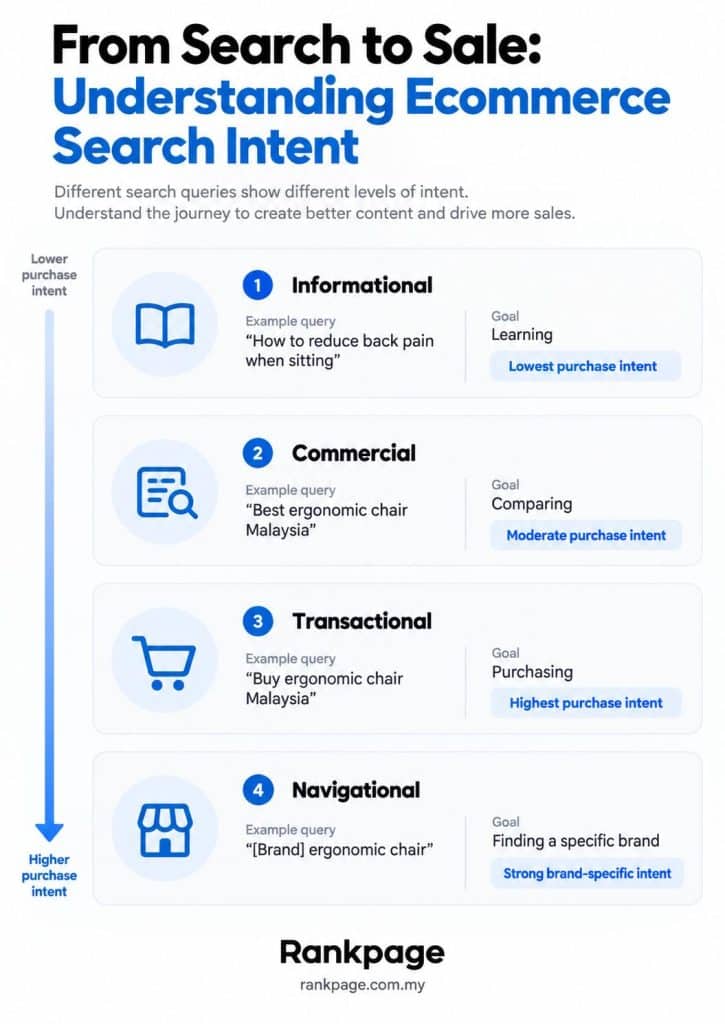
One of the most common problems is targeting keywords that bring visitors without strong purchase intent.
For example, a store selling ergonomic chairs may rank for “why does my back hurt when sitting”. That can generate traffic, but many of those users are likely to be looking for information rather than a product.
A keyword like “buy ergonomic chair Malaysia”, however, generally signals much stronger commercial intent.
| Search Type | Example | Typical Intent |
|---|---|---|
| Informational | How to reduce back pain when sitting | Learning |
| Commercial | Best ergonomic chair Malaysia | Comparing |
| Transactional | Buy ergonomic chair Malaysia | Purchasing |
| Navigational | [Brand] ergonomic chair | Finding a specific brand |
Search intent is not always perfectly clear-cut, and some queries can serve more than one purpose. Informational content still has value. The problem is when nearly all your organic traffic comes from blogs while your product and category pages barely rank.
To improve traffic quality, review which landing pages attract organic users. Make sure your SEO strategy also targets commercial and transactional searches that naturally lead people towards products.
Google recommends using a clear ecommerce site structure that connects categories, subcategories and product pages through navigation and internal links.
Are Your Product Pages Giving Shoppers Enough Information?
Traffic can reach the right product and still fail to convert if the page leaves too many questions unanswered.
Customers usually want to know:
Product Details: What exactly am I buying?
Benefits: Why should I choose this product?
Specifications: What size, material or compatibility details matter?
Delivery: How long will shipping take?
Returns: What happens if the product is unsuitable?
Proof: Have other customers bought and reviewed it?
Strong product pages can reduce uncertainty.
Use clear descriptions, useful specifications, multiple product images, realistic size references and visible delivery information. Avoid relying only on short manufacturer descriptions.
Google recommends using Product and Offer structured data to provide product details such as price and availability. Shipping and return information can also be supplied through structured data, with merchant-wide policies generally defined at the organisation level where appropriate.
Does Your Ecommerce Website Make Customers Trust You?
People may like your product and still hesitate if your store does not feel reliable.
Trust can drop when an ecommerce website has unclear policies, no reviews, limited contact information or a checkout experience that looks inconsistent with the rest of the site.
Useful trust signals include:
- Customer Reviews: Show genuine feedback where possible.
- Clear Policies: Make shipping, returns and refunds easy to find.
- Business Information: Provide accessible contact or company details.
- Payment Options: Display recognised and familiar payment methods.
For Malaysian businesses with physical stores, clear location information may also improve confidence.
The goal is not to cover the site with security badges. Clear information and a professional buying experience often provide stronger reassurance.
Is Your Pricing Creating a Surprise at Checkout?
Unexpected or high additional costs are among the leading reasons surveyed shoppers abandon purchases.
A customer may see a product for RM89, decide it fits their budget, and only discover at checkout that shipping pushes the total to RM104.
The total price may still be reasonable, but the surprise creates friction. Ecommerce research consistently identifies additional costs such as shipping, tax and fees among the major reasons surveyed shoppers abandon checkout.
For Malaysian stores, this is particularly relevant because courier pricing can vary between Peninsular Malaysia, Sabah and Sarawak. Show shipping estimates early, explain regional differences and make free-shipping thresholds easy to understand. Clarity is usually better than last-minute surprises.
Is Your Checkout Process Too Complicated?
Reaching checkout generally indicates stronger purchase intent than simply viewing a product, although not every shopper will complete the purchase.
Do not make the process harder than necessary.
Long forms, forced account creation, unclear errors and too many checkout steps can create unnecessary friction.
A simpler checkout may include:
- Guest checkout where possible.
- Only essential form fields.
- Clear delivery costs before payment.
- Easy-to-understand error messages.
- Mobile-friendly buttons and forms.
- A visible final order total.
Baymard’s checkout research identifies complicated checkout flows and forced account creation as important sources of checkout friction and abandonment among surveyed shoppers.
Test the entire checkout yourself on both desktop and mobile. Small problems are often easier to notice when you experience the process as a customer.
Read More: Ecommerce SEO Malaysia: Complete Guide to Higher Rankings & Sales
Are Your Payment Options and Mobile Experience Good Enough?
Payment and mobile usability can cause customers to leave very late in the buying journey.
Your store does not need every payment method available, but it should support the options your target customers actually use. If people regularly reach the payment stage but do not complete the transaction, payment availability or technical errors may be part of the problem.
Mobile usability also deserves close attention. Test the full journey on a phone, including category browsing, filters, product variants, cart actions and checkout.
Watch for common issues such as:
Slow Pages: Large product images or scripts may make browsing frustrating.
Small Buttons: Add-to-cart and checkout controls should be easy to tap.
Poor Filters: Shoppers should be able to narrow down large product selections quickly.
Broken Forms: Checkout fields should work smoothly on smaller screens.
A homepage that looks good on mobile means very little if the checkout does not work properly.
Are You Measuring the Right Ecommerce Metrics?
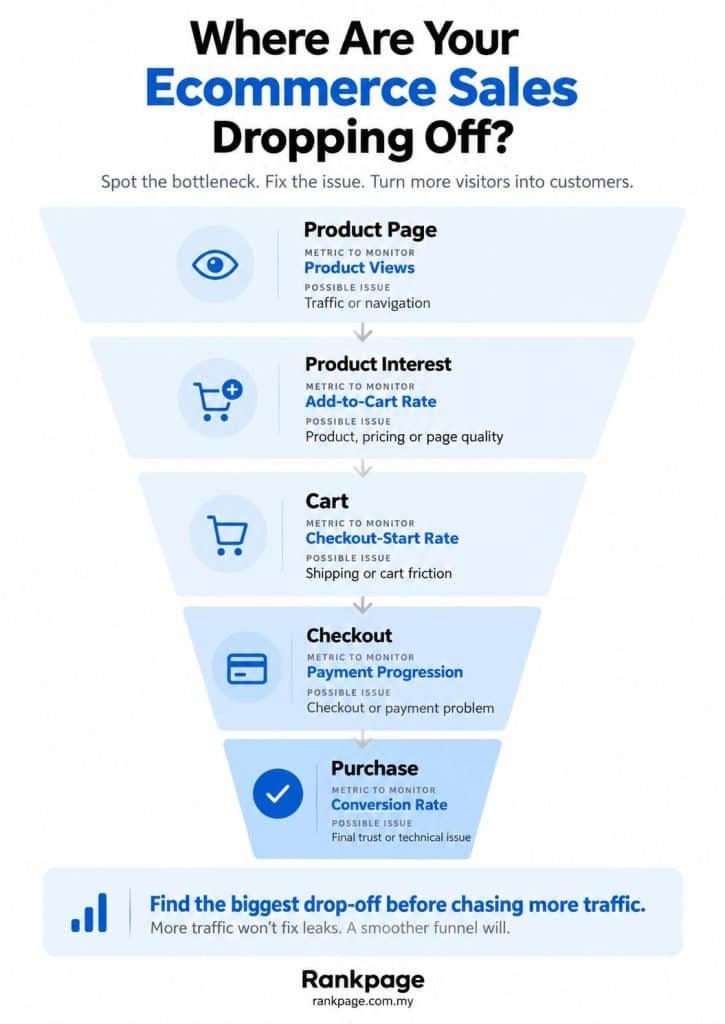
If your report only tracks traffic and keyword rankings, you may not know where sales are being lost.
GA4 supports ecommerce events including view_item, add_to_cart, begin_checkout, add_payment_info and purchase.
When implemented correctly, these events can help identify where users stop progressing through the purchase funnel.
| Stage | Metric | Possible Problem |
|---|---|---|
| Product Page | Product views | Traffic or navigation |
| Product Interest | Add-to-cart rate | Product, pricing or page quality |
| Cart | Checkout-start rate | Shipping or cart friction |
| Checkout | Payment progression | Checkout or payment issue |
| Purchase | Conversion rate | Final trust or technical issue |
For example, if traffic and add-to-cart activity increase but purchases remain flat, SEO may not be the main problem.
The issue may be later in the funnel.
How Can Ecommerce SEO Help Improve Sales?
Good ecommerce SEO should connect search visibility with the buying journey.
That means improving more than blog rankings.
A conversion-focused ecommerce SEO strategy can include commercial keyword targeting, better category pages, stronger product descriptions, internal linking, structured data and improved product visibility across Google.
Google’s ecommerce guidance covers site structure, product data, structured data and product discovery across search surfaces.
The goal should not simply be more organic visitors.
It should be more qualified visitors reaching pages that are capable of turning them into customers.
What Should You Fix First?
Avoid redesigning your entire ecommerce website at once.
Start with the largest leak.
Check Traffic Intent: Determine whether organic visitors are actually searching for products related to what you sell.
Review Product Pages: Make sure your highest-traffic pages clearly explain price, benefits, delivery and returns.
Inspect Funnel Data: Identify whether users disappear before adding to cart, inside the cart or during checkout.
Test Checkout: Look for unnecessary fields, surprise charges, payment problems and mobile issues.
Measure Improvements: Change major elements gradually so you can better understand what affects conversions.
If your conversion funnel is already weak, increasing traffic may simply bring more visitors who leave without buying.
Bridging the Gap Between Traffic and Sales
Getting traffic but no sales does not necessarily mean your SEO has failed. It may mean there is a gap between search intent, product evaluation, trust and checkout.
Before chasing more traffic, make sure the visitors you already attract can move smoothly from search to purchase.
If your organic traffic is growing but customers are not converting, Rankpage is an SEO agency in Malaysia that can help identify where your search strategy and ecommerce funnel may be disconnected.
Its SEO services can help attract more relevant visitors while improving the visibility of product and category pages that support revenue.
Sources
- Google Search Central, SEO Best Practices for Ecommerce Sites
- Google Search Central, Help Google Understand Your Ecommerce Website Structure
- Google Search Central, Merchant Listing Structured Data
- Google Analytics Help, Ecommerce Events and Reporting
- Baymard Institute, Cart Abandonment and Checkout Usability Research
- Pos Malaysia, Domestic Parcel and Delivery Information
Frequently Asked Questions About Why Your Online Store Gets Traffic But No Sales
Why Is My Online Store Getting Traffic But No Sales?
Your store may be attracting visitors with weak purchase intent, or shoppers may be encountering poor product information, unexpected costs, trust issues or checkout friction. Reviewing your ecommerce funnel can help reveal where users stop progressing.
Can Ecommerce SEO Increase Sales?
Ecommerce SEO can contribute to more sales by attracting relevant commercial traffic and directing shoppers to suitable product and category pages, but SEO alone does not guarantee higher sales. Rankings will not fix pricing, trust or checkout problems.
How Can I Improve My Ecommerce Website Conversion Rate?
Improve product information, pricing transparency, trust signals, mobile usability and checkout simplicity. Use analytics to identify where the largest customer drop-off happens first.
Why Do Customers Add Products to Their Cart but Not Buy?
Customers may abandon carts because of unexpected shipping costs, complicated checkout steps, payment limitations or because they are still comparing products.
Should I Focus on More Traffic or Better Conversions?
If your current traffic is relevant but conversion is poor, improve the website and checkout first. If the site converts well but receives too few qualified visitors, focus more heavily on ecommerce SEO.
What Ecommerce Metrics Should I Track?
Track product views, add-to-cart rate, checkout starts, payment progression, purchases and overall conversion rate. When implemented correctly, these metrics can help show where customers stop progressing through the buying journey.