An eligible service area business can rank on Google without displaying a physical storefront address.
Google supports businesses that travel to customers, including aircond technicians, plumbers, electricians, cleaners, renovation contractors, pest control providers and mobile mechanics.
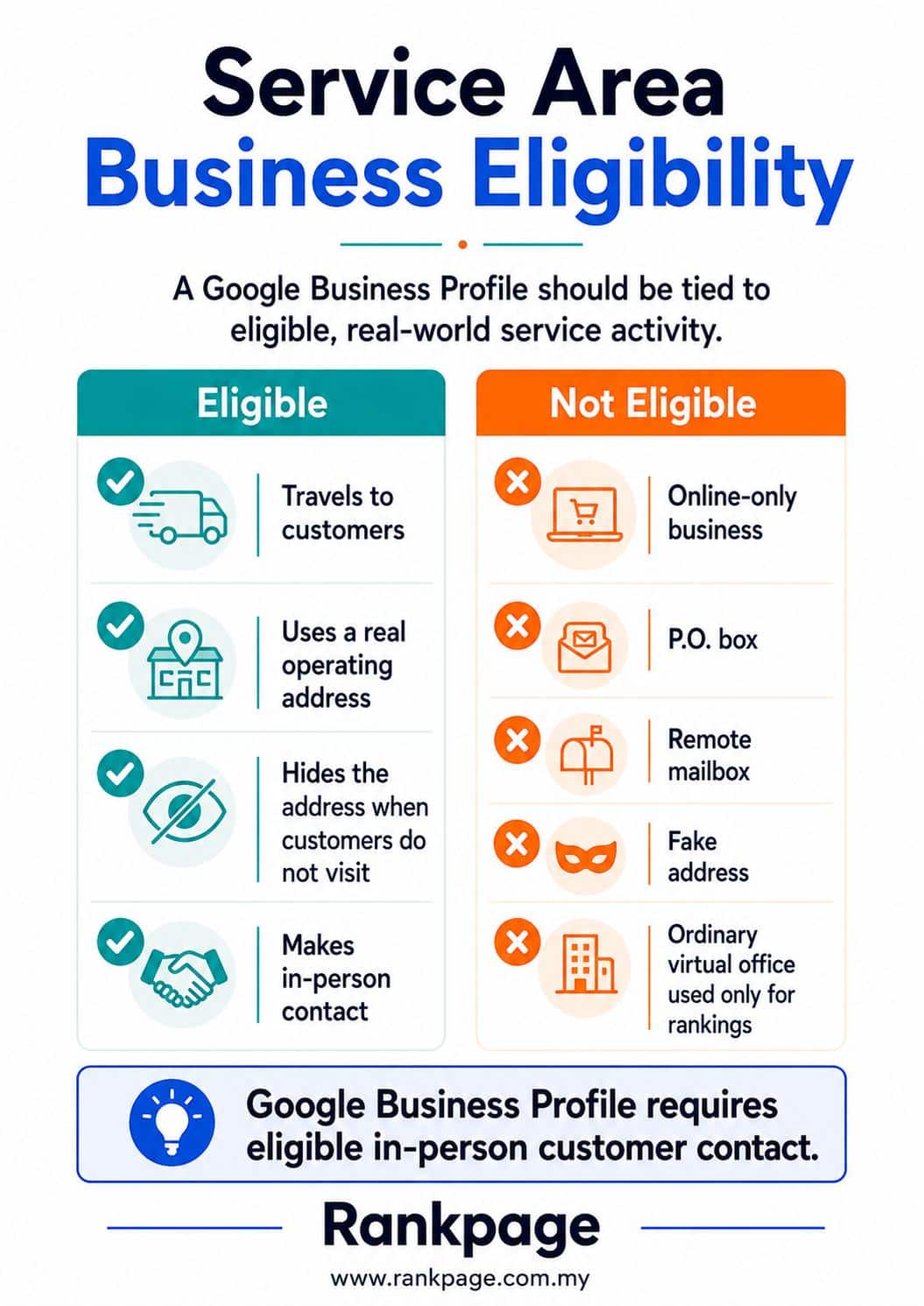
Professional service businesses may also qualify when they meet customers in person at customer locations. However, businesses operating entirely online without in-person customer contact are generally not eligible for a Google Business Profile.
Instead of displaying a public address, an eligible business can hide its address and specify the areas it genuinely serves.
Ranking still requires more than creating a profile. To compete in Malaysia, service area businesses may need accurate profile information, useful website content, genuine reviews, relevant links and a clear local SEO service strategy.
What Is A Service Area Business?
A service area business, or SAB, travels to customers and provides services at their locations rather than receiving them at a customer-facing storefront.
Common examples include:
| Industry | Example Businesses |
|---|---|
| Home Services | Plumbers, Electricians, Aircond Technicians |
| Cleaning Services | Residential and Commercial Cleaners |
| Property Services | Pest Control, Landscaping, Security Installers |
| Construction | Renovation Contractors, Roofing Specialists |
| Professional Services | Accountants and Consultants Who Meet Clients In Person |
| Automotive | Mobile Mechanics, Windscreen Repair Services |
Customers normally do not visit these businesses at their operating address. Instead, the business travels to the customer.
A company that provides services only online or remotely does not usually qualify unless it also makes eligible in-person contact with customers.
Can A Service Area Business Rank Without Showing An Address?
Yes. Google allows eligible service area businesses to hide their address while appearing in Google Search and Maps.
The business should provide an accurate real-world operating address during setup or verification. If customers are not served there, the address should be removed from public view.
Businesses can then enter the areas they genuinely serve. Google currently permits up to 20 service areas and generally recommends keeping the overall coverage area within approximately two hours’ driving time of the business base.
Note that P.O. boxes, remote mailboxes and rented mailing addresses are not eligible.
A virtual or co-working office may qualify only when the business genuinely operates there and the location meets Google’s requirements for staffing, signage and customer access.
Businesses using fake addresses, duplicate profiles or misleading information risk profile restrictions, suspension and lost visibility.
How Does Google Rank Service Area Businesses?
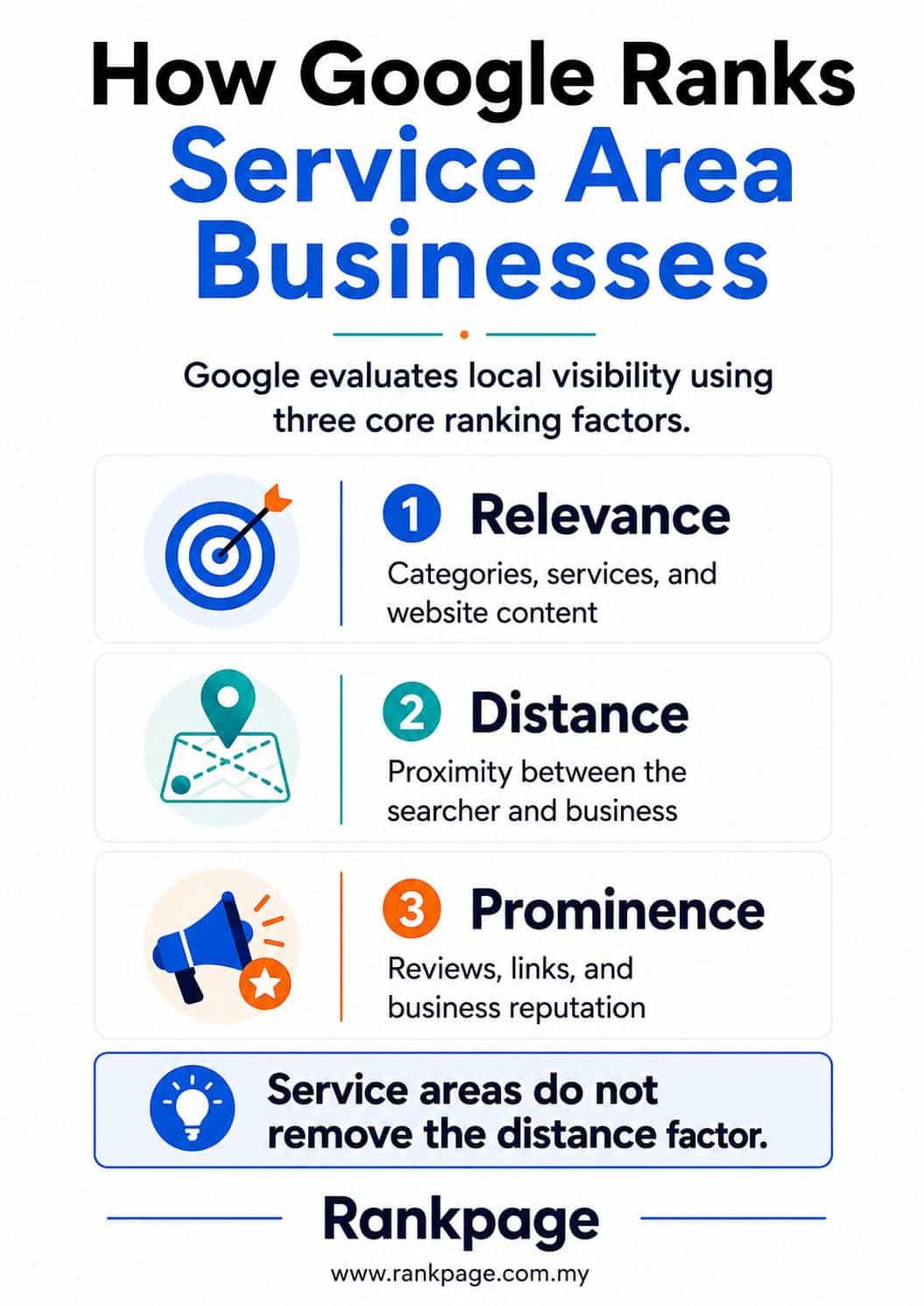
Google says local results are mainly based on relevance, distance and prominence.
| Ranking Factor | What It Means |
|---|---|
| Relevance | How closely the business matches the search |
| Distance | How far the business is from the searcher |
| Prominence | How well-known and trusted the business appears |
Relevance
Relevance measures how closely a business matches what someone is searching for.
For a search such as “aircond servicing Petaling Jaya”, Google may consider:
- The business’s categories
- Services listed in the profile
- Website content
- Dedicated service pages
- Location-specific content
Accurate categories and clear service information help Google and potential customers understand what the business offers. Completing a profile properly can improve its usefulness, but it does not guarantee rankings.
Distance
Distance refers to how far the business is from the person searching.
This factor still applies when a service area business hides its address. The underlying business location continues to influence proximity-based visibility.
Adding Kuala Lumpur, Petaling Jaya, Shah Alam or Klang as service areas tells customers where the business operates. It does not guarantee rankings throughout those locations.
Visibility may vary based on:
- The searcher’s location
- The business’s underlying location
- Nearby competition
- Relevance to the query
- Overall prominence
Service areas describe where a business operates. They do not create additional physical locations or remove the distance factor.
Prominence
Prominence refers to how a business operates. It does not guarantee rankings throughout those locations.
Visibility may vary based on how established and trusted a business appears.
Google states that review quantity, positive ratings and links to the business can help local rankings.
Other useful signals may include:
- Genuine customer reviews
- Relevant backlinks
- Trusted local or industry mentions
- Accurate information across reputable platforms
- Press coverage
- Industry recognition
- A useful and credible website
Not every citation, mention or third-party authority score is a separately confirmed Google ranking factor. These activities are most valuable when they improve real-world reputation, referral traffic and brand trust.
Why Is Service Area Business SEO Different?
Service area businesses face different challenges from customer-facing shops, restaurants and offices.
| Storefront Business | Service Area Business |
|---|---|
| Customers visit the location | The business travels to customers |
| The address is normally displayed | The address is normally hidden |
| Usually markets from one customer-facing location | May serve several nearby cities or districts |
| Visibility depends on relevance, distance and prominence | The same factors apply, including the hidden underlying location |
For example, a restaurant in Subang Jaya benefits from having a customer-facing location there.
An electrician serving Subang Jaya can improve relevance through accurate categories, useful content, genuine reviews and authoritative links. However, SEO cannot completely overcome distance from the person searching.
This is why service area businesses need a broader strategy rather than relying only on Google Business Profile optimisation.
What Does A Service Area SEO Strategy Include?
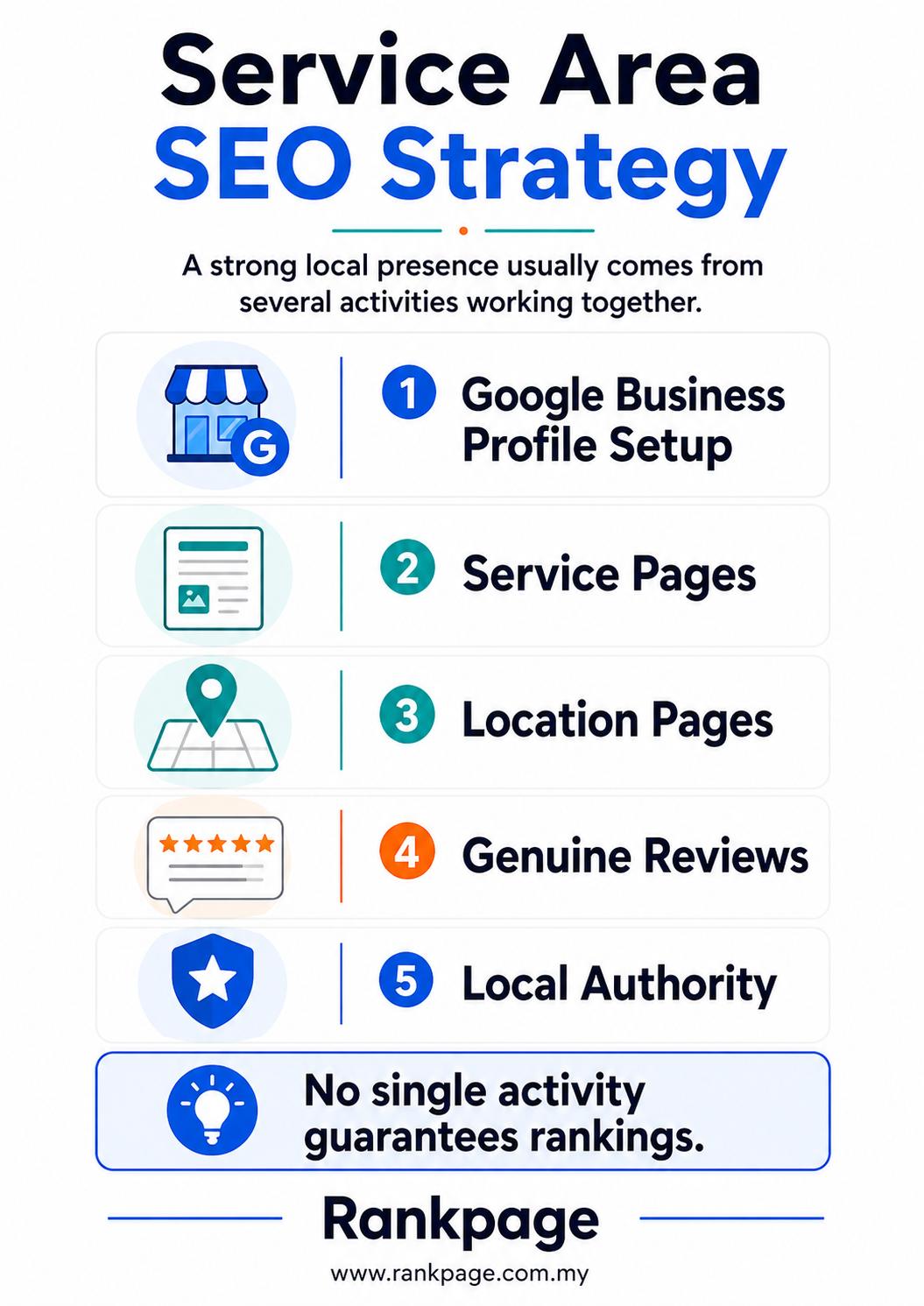
A practical service area SEO strategy usually combines five areas.
Step 1: Configure Your Google Business Profile Properly
Important setup elements include:
Address Settings: Hide the address when customers are not served there.
Primary Category: Choose the category that best represents the business’s main activity.
Secondary Categories: Add only categories that genuinely describe other services.
Service Areas: Include locations the business actually serves.
Services: Add accurate descriptions of the services available.
Business Information: Keep operating hours, contact details and website information current.
Photos: Upload authentic images of staff, vehicles, equipment and completed work.
Categories can affect local rankings, so businesses should not add unrelated categories simply to target more searches.
Adding more service areas also does not automatically increase visibility.
Step 2: Build Useful Service Pages
Many Malaysian SMEs rely on one broad services page for every offering.
Dedicated pages can make it easier for users and search engines to understand individual services.
| Weak Structure | Better Structure |
|---|---|
| Homepage Only | /aircond-servicing/ |
| Generic Services Page | /aircond-installation/ |
| Several Unrelated Services Together | /aircond-repair/ |
| Broad Commercial Content | /commercial-aircond-maintenance/ |
A useful service page may include:
- A clear service description
- Problems the service solves
- Areas where it is available
- Pricing guidance where appropriate
- Project examples
- Frequently asked questions
- A clear enquiry process
Separate pages are not automatically better. Each page should contain enough useful information to justify its existence.
Step 3: Create Helpful Location Pages
Location pages can support organic visibility when they provide useful information for customers in places the business genuinely serves.
An aircond company might create pages for Kuala Lumpur, Petaling Jaya, Shah Alam, Klang and Subang Jaya.
Each page should offer more than a city name inserted into a standard template. Useful elements include:
- Services available in the area
- Neighbourhoods or districts covered
- Genuine nearby project examples
- Relevant customer testimonials
- Local service considerations
- Area-specific FAQs
Avoid creating large numbers of substantially similar pages that only swap one city name for another.
Low-value regional pages produced mainly to capture search traffic may be treated as doorway or scaled-content abuse. The goal should be to help customers confirm that the business serves their area and can meet their needs.
Read More: How to Optimize Your Google Business Profile in Malaysia
Step 4: Build A Policy-Compliant Review Strategy
Reviews are a confirmed local-ranking input. Google says more reviews and positive ratings can help local rankings, although it does not disclose their exact weighting.
A responsible review strategy includes:
Neutral Requests: Invite customers to leave an honest review after the service.
Consistent Requests: Use the same process for eligible customers instead of asking only those expected to leave positive feedback.
No Incentives: Do not offer discounts, gifts or rewards in exchange for reviews.
No Requested Wording: Do not ask customers to mention a particular city, service, employee or rating.
Professional Responses: Reply politely when a response would be useful.
Businesses may request genuine reviews from customers throughout their service area, but they should not influence the content or rating.
Step 5: Build Relevant Local Authority
Authority-building activities may include:
- Industry association memberships
- Local sponsorships
- Supplier or business partnerships
- Digital PR
- Legitimate news coverage
- Relevant directory listings
- Contributions to industry publications
- Links from trusted organisations
These activities do not guarantee rankings. Their value comes from improving brand awareness, earning legitimate links and demonstrating real involvement in the local or professional community.
Businesses should avoid buying large numbers of low-quality links or using irrelevant directories solely for SEO purposes.
Should You Create A Page For Every City You Serve?
Not necessarily.
Location pages are not mandatory, and creating large numbers of repetitive pages can create quality and spam risks.
Focus on locations where:
- The business genuinely provides services
- There is meaningful customer demand
- Original and useful information is available
- The business has relevant experience or project examples
- The page can be maintained over time
Ten useful pages may be more effective than one hundred thin pages, but there is no universal target. The correct number depends on actual coverage, demand and the business’s ability to maintain each page.
What Are The Main Challenges?
Distance Still Matters
A well-optimised website and profile do not remove the distance factor.
A business based in Kuala Lumpur may struggle to rank consistently for searches made in Johor Bahru or Penang, even when those places are entered as service areas.
Businesses should focus on realistic coverage rather than treating service-area settings as a substitute for a genuine local presence.
Competition Can Be Strong
Industries such as aircond servicing, renovation, plumbing, accounting and pest control may include established competitors with:
- Large review profiles
- Strong websites
- Recognised brands
- Years of SEO activity
- Established links and media coverage
Building comparable trust and visibility takes sustained effort.
Multiple Areas Require Ongoing Management
As service coverage grows, businesses may need to manage:
- Service and location pages
- Profile information
- Reviews
- Project examples
- Internal links
- Enquiry tracking
Duplicate content does not automatically result in a penalty. However, repetitive or low-value location pages can reduce usefulness and may breach spam policies when created mainly to manipulate rankings.
Google Enforces Its Policies
Google acts against:
- Fake addresses
- Remote mailbox abuse
- Ineligible virtual offices
- Duplicate profiles
- Misleading business names
- Fake or incentivised reviews
- Inaccurate information
Businesses attempting shortcuts risk suspension and lost visibility.
How Much Does Service Area Business SEO Cost In Malaysia?
Costs vary according to:
- Industry competition
- Number of services and target areas
- Website condition
- Content requirements
- Link and PR activity
- Reporting needs
- Provider experience
Public Malaysian agency prices differ considerably and should be treated as vendor estimates rather than an independent industry benchmark.
| Activity | Pricing Guidance |
|---|---|
| GBP Setup And Optimisation | May be a one-time project or part of a monthly package |
| Service Page Creation | Depends on research, writing and design requirements |
| Location Page Creation | Depends on the amount of original local information available |
| Monthly Local SEO | Depends on competition, coverage and included deliverables |
| Link Acquisition And Digital PR | Usually priced according to campaign scope |
Before appointing a provider, request a clear scope explaining which pages will be improved, how profile work will be handled, how links will be earned and which performance metrics will be reported.
SEO providers should not guarantee first-place rankings or a fixed number of leads.
How Long Does Service Area Business SEO Take?
There is no reliable fixed timeline.
Some Google Business Profile updates may appear relatively quickly. Website crawling, indexing and ranking changes may take longer, and Google does not guarantee when a page will be indexed or where it will rank.
Results depend on factors such as:
- Website condition
- Business location
- Industry competition
- Content quality
- Technical SEO
- Review profile
- Legitimate links
- Brand prominence
- Consistency of the work
Progress should be evaluated using search visibility, profile interactions, website traffic, calls, enquiries and conversions rather than ranking positions alone.
Meeting the Requirements for Visibility
An eligible service area business can appear in Google Search and Maps without publicly displaying its operating address.
However, hiding an address does not remove Google’s eligibility requirements or distance factor. The business must make in-person contact with customers, use accurate information and comply with Google’s profile and review policies.
A sustainable strategy may include:
- A properly configured Google Business Profile
- Accurate service areas and categories
- Useful service pages
- Original location pages where appropriate
- Genuine and policy-compliant reviews
- Legitimate links and authority signals
- Clear performance tracking
No individual activity guarantees higher rankings. The aim is to help Google and potential customers understand what the business offers, where it genuinely operates and why it should be trusted.
Rankpage SEO Agency helps Malaysian businesses develop service area SEO strategies based on their services, target markets and growth objectives. This may include Google Business Profile optimisation, service and location content, technical SEO, authority building and performance measurement across Google Search and Maps.
Sources
- Google Business Profile Help — Business Eligibility and Ownership Guidelines
- Google Business Profile Help — Guidelines for Representing Your Business on Google
- Google Business Profile Help — Manage Your Service Areas
- Google Business Profile Help — Tips to Improve Your Local Ranking
- Google Business Profile Help — Manage Your Business Category
- Google Business Profile Help — Tips to Get More Reviews
- Google Business Profile Help — Prohibited and Restricted Content
- Google Search Central — Search Essentials
- Google Search Central — Spam Policies for Google Web Search
- Google Search Central — Crawling and Indexing FAQ
Frequently Asked Questions About Service Area Business SEO
Can A Service Area Business Rank On Google Maps Without Showing An Address?
Yes. An eligible service area business can hide its address and still appear in Google Search and Maps. The business must make in-person contact with customers, provide accurate verification information and comply with Google’s eligibility requirements.
How Many Service Areas Should I Add To My Google Business Profile?
Add only the locations your business genuinely serves. Google currently allows up to 20 service areas and generally recommends keeping the overall coverage area within approximately two hours’ driving time of the business base. Adding more areas does not automatically improve rankings.
Are Location Pages Necessary For Service Area Business SEO?
No. Location pages can be useful when your business genuinely serves the area and can provide unique, helpful information. Repetitive pages that only replace one city name with another may create quality or spam risks.
Can I Use A Virtual Office For My Google Business Profile?
A rented mailing address or ordinary virtual office is generally not eligible. A shared or co-working location may qualify only when the business genuinely operates there and meets Google’s requirements for staffing, signage and customer access.
Do Service Areas Determine Where My Business Will Rank?
No. Service areas tell customers where your business operates, but they do not create additional locations or guarantee rankings throughout those areas. Your underlying business location, the searcher’s location, relevance and prominence still affect visibility.
How Long Does Service Area Business SEO Take To Work?
There is no fixed timeline. Some profile updates may appear quickly, while meaningful improvements in organic and local visibility can take longer. Results depend on competition, location, website quality, reviews, links and the consistency of the work.