What Does “Ranking But Not Converting” Actually Mean?
Ranking but not converting refers to a situation where your website attracts search traffic but fails to turn visitors into leads, enquiries, or customers.
This usually happens when visibility is disconnected from business outcomes.
A simple example
A blog post may rank on page one for a high-volume keyword like “what is SEO”, but the visitors landing on that page are not looking to hire an agency. They are researching.
From an SEO services standpoint, this is a mismatch between:
- Keyword intent
- Content purpose
- Conversion pathway
The result is traffic that looks impressive on reports but delivers little commercial value.
Why This Problem Matters More in 2026
In modern SEO, traffic without conversion is wasted opportunity, time, and budget.
Search engines increasingly reward content that is helpful, reliable, and aligned with what users are trying to do, not pages that merely match keywords.
At the same time, AI-powered search experiences cite info and answer questions directly on the results page, which can reduce clicks to websites. That means the visits you do get may be more selective, so your content has to do more work once people land.
Why Malaysian businesses feel it even more
- More businesses are investing in digital channels, raising the bar for standing out in search
- Digital ad spend in Malaysia has been growing, making organic conversion more important when attention is costly and competitive
- Many users compare options and look for reassurance (reviews, proof, clear offers) before taking action, especially for higher-consideration services
The real KPI in 2026 is simple: Does your SEO generate actual business results?
Are You Targeting The Wrong Search Intent?
The most common reason content ranks but fails to convert is incorrect search intent targeting.
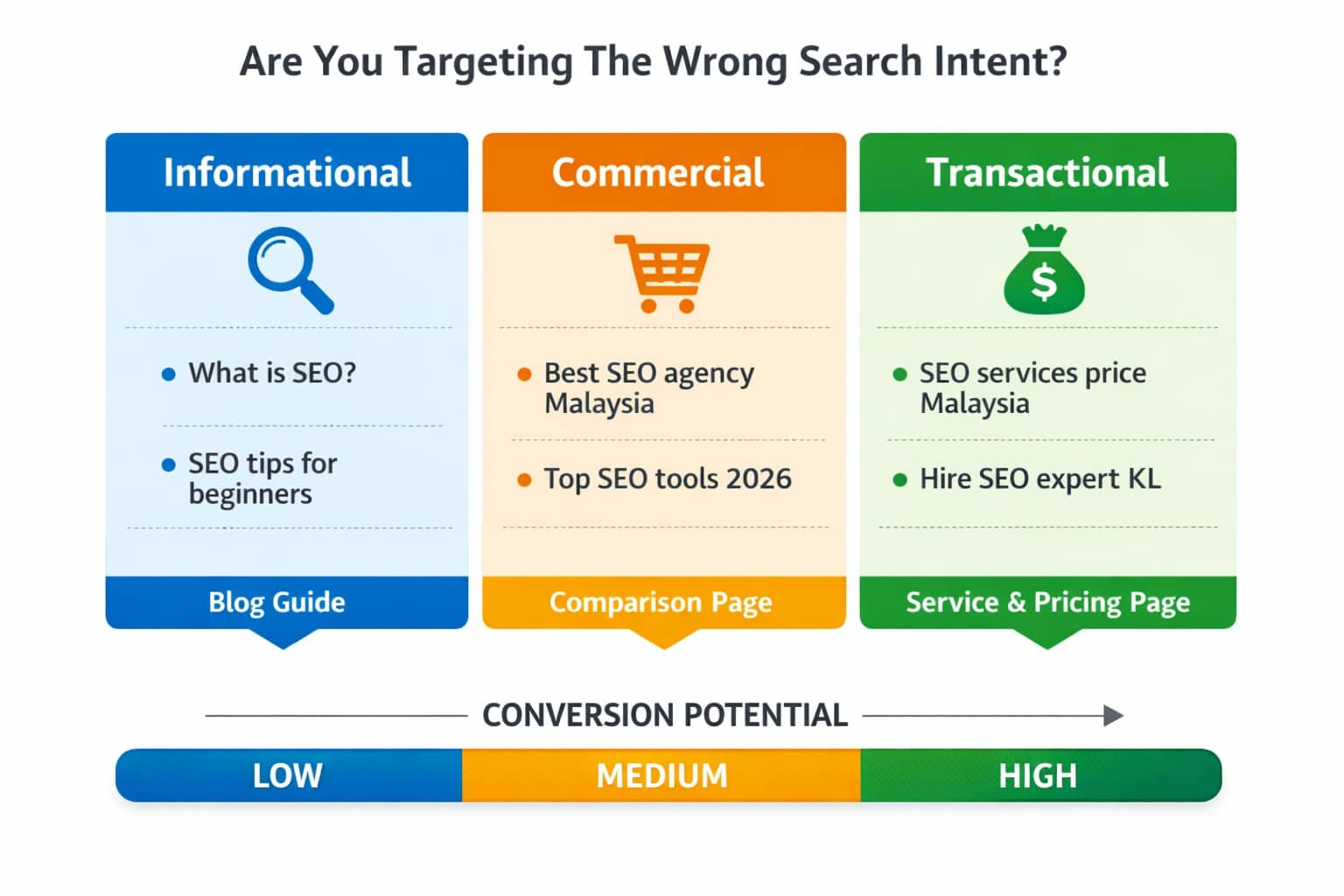
Search intent is what the user is trying to accomplish. If your content does not match that intent, conversion becomes unlikely.
If your website mainly ranks for informational queries, you are attracting users who are still in the learning phase. They are not ready to take action.
Quick diagnostic
If your top queries in Search Console are dominated by:
- “what is…”
- “how to…”
- “tips…”
- “free…”
- “template…”
…you’re likely winning traffic, but losing buyers.
Are You Attracting Traffic That Will Never Convert?
Not all traffic is valuable, and more traffic does not always mean better results.
Many Malaysian websites unknowingly attract the wrong audience due to broad keyword targeting.
Common scenarios include:
- Ranking for global keywords instead of Malaysia-specific keyword searches
- Attracting users looking for free solutions or DIY answers
- Bringing in early-stage researchers with no buying intent
- Ranking for topics that feel commercial but are actually research-heavy (e.g., “SEO checklist”)
This is how “good SEO” turns into bad business outcomes, via high sessions but low sales.
What to do instead
Prioritise keywords that naturally attract decision-makers, such as:
- “SEO agency vs in-house SEO Malaysia”
- “SEO pricing Malaysia”
- “local SEO for [industry] Malaysia”
- “SEO audit service KL”
Are You Stuck In TOFU Content Only?
A heavy reliance on top-of-funnel (TOFU) content is one of the biggest conversion bottlenecks.
TOFU content includes:
- “What is” guides
- Beginner tutorials
- General educational articles
It’s great for traffic, but it rarely drives enquiries on its own.
What’s usually missing
- MOFU content: comparisons, alternatives, “best for”, case-style explainers
- BOFU content: service pages, pricing signals, deliverables, case studies, FAQs that answer buying objections
The funnel balance that actually converts
- TOFU: awareness (education)
- MOFU: consideration (comparison)
- BOFU: conversion (decision)
If you only publish TOFU, your SEO becomes a “learning library”, not a revenue engine.
Why Your Content Ends Instead Of Driving Action
Many high-ranking pages answer the question, then stop.
That creates a dead-end experience: the user gets what they came for and leaves without taking further action.
Common dead-end issues
- No clear call-to-action
- No internal links to relevant services
- No transition from education → solution
- No “what to do next” guidance
A conversion-friendly structure
A high-performing SEO page typically does this in order:
- Answers the query
- Expands the problem (so the user feels understood)
- Introduces solution paths (DIY vs done-for-you)
- Guides to the next step (CTA + links)
Quick fix: add a “Next Step” block
At the end of each article, include:
- If you want to DIY: link to a checklist, template, or guide
- If you want it done: link to a service page with deliverables
- If you want clarity fast: link to an audit/consultation CTA
Malaysia-Specific Missing Trust Signals
Trust plays a critical role in whether Malaysian users convert.
Even if your content ranks well, people may hesitate to take action if they don’t feel confident in your credibility.
Trust signals that move the needle
- Local case studies and results (Malaysia context, not generic)
- Testimonials from Malaysian clients
- Clear business identity (company name, team, contact details)
- Transparent expectations (timeline, deliverables, process)
- Pricing signals (even ranges help)
- Proof of experience (industries served, outcomes, methodology)
If your content feels generic or “copy-paste global,” it can rank but still struggle to convert.
UX And Technical SEO Issues That Kill Conversions
User experience is directly tied to conversion performance.
Even if your page ranks well, poor UI and UX (user interface and user experience) can discourage users from taking action.
Common conversion killers
- Slow mobile loading
- Poor Core Web Vitals performance
- Cluttered layouts and distracting elements
- Hard-to-read text blocks (no spacing, no scannability)
- Weak navigation and buried CTAs
- Forms that are too long
In Malaysia, mobile is effectively universal, so mobile speed and usability directly affect conversions.
A practical mobile-first checklist (fast)
- Can users see what you offer within 5 seconds?
- Is the CTA visible without excessive scrolling?
- Are buttons thumb-friendly?
- Is the page easy to skim (short paragraphs, bullets, subheaders)?
- Is the contact path obvious (WhatsApp, form, call, email)?
Weak Keyword Strategy And Funnel Mapping
Without proper funnel mapping, even strong rankings will not convert effectively.
A structured approach looks like this:
Funnel Stage | Content Type | Goal |
TOFU | Blog guides | Traffic |
MOFU | Comparisons, alternatives, “best for” | Consideration |
BOFU | Service pages, pricing signals, case studies | Conversion |
What happens when BOFU is missing
- People land on your blog
- They understand the concept
- They decide they want help
- They can’t find an offer page quickly
- They leave and contact someone else
Your competitor didn’t “beat” your ranking, they beat your pathway.
Why Malaysian Search Behaviour Affects Conversion
Local behaviour affects what people expect when they land on your site.
What’s different locally
- Malaysia is multilingual, so people may search using a mix of English + Malay phrasing (e.g., “SEO murah”, “harga SEO”)
- Many buyers want quick ways to compare (deliverables, timelines, pricing expectations)
- Local proof matters more than generic claims
If your content doesn’t reflect those expectations, it may fail to resonate, even if it ranks.
Localisation that actually improves conversion
- Add Malaysia examples (KL, PJ, Penang, Johor, etc.) where relevant
- Use local trust elements (case studies, client logos, testimonials)
- Include pricing context carefully (ranges, what affects cost, what’s included)
- Provide clear next-step options (audit, consultation, WhatsApp)
How AI Search Is Making This Worse (2026 Reality)
AI summaries are changing how users interact with content.
When the results page can answer a question instantly, two things happen:
- Some users don’t click at all
- Users who do click expect the page to be clearer, deeper, and more actionable
So SEO can no longer rely on “volume traffic.”
It needs conversion-ready pages that help visitors decide quickly.
What “authority” looks like now
Instead of generic advice, include:
- Real examples and outcomes
- Specific deliverables
- Common pitfalls you’ve seen (and how you solve them)
- Clear differentiation (why your process works)
- Proof (case studies, testimonials, documented results)
Practical SEO Conversion Audit Framework
If your content is ranking but not converting, use this checklist.
Intent & traffic quality
- Are your top keywords aligned with buyer intent?
- Are you ranking mostly for learning queries instead of hiring queries?
- Are you attracting Malaysia-relevant visitors (location, market fit)?
Funnel path
- Does the page clearly guide users to the next step?
- Are there internal links to service pages and proof pages?
- Do you have MOFU and BOFU content to support decisions?
Trust & local proof
- Do you show local case studies or testimonials?
- Is your business identity clear and credible?
- Do you answer buying objections (pricing, timeline, deliverables)?
UX & mobile performance
- Is it fast, readable, and easy to act on mobile?
- Is the CTA obvious and friction-free?
If multiple answers are “no,” your issue is likely strategy and structure, not rankings.
Real-World Scenario Example
Consider a Kuala Lumpur-based service provider ranking highly for an informational keyword.
The page attracts consistent traffic, but enquiries remain low.
What the analysis reveals
- Most visitors are researching, not buying
- The page lacks clear service links
- No pricing signal or value proposition is provided
- No local proof exists (testimonials, results, case studies)
What changes improve conversions
- Add comparison-focused sections (MOFU)
- Introduce stronger calls-to-action (above the fold + end of page)
- Add local proof (case studies, testimonials, outcomes)
- Add a “pricing expectations” section (even a range + what affects cost)
- Link directly to service and audit pages
Result: Traffic stays stable, but conversions increase, because the page finally matches intent and guides action.
Moving Beyond Ranking
Ranking is only one part of the SEO equation. What matters is whether your traffic translates into real business outcomes.
If your content is ranking but not converting, shift your focus from visibility to strategy:
- Target buyer intent (not just volume)
- Build MOFU and BOFU content (not TOFU-only)
- Add trust signals and Malaysia relevance
- Improve mobile UX and reduce friction
- Create content journeys (don’t dead-end the reader)
At Rankpage, your trustworthy Malaysian SEO partner, we help businesses turn rankings into measurable growth through conversion-focused SEO strategies. Partner up with Rankpage today, and don’t miss this chance to boost your rankings plus business growth.
Sources
- Google Search Central — Creating helpful, reliable, people-first content (continuously updated)
- Department of Statistics Malaysia (DOSM) — ICT Use and Access by Individuals and Households Survey Report, 2024 (published 24 Apr 2025)
- Media Specialists Association (MSA) Malaysia — Malaysian Digital Adex Report Q2 2025 (published 2025)
- Pew Research Center — Google users are less likely to click on links when an AI summary appears in the results (22 Jul 2025)
- Seer Interactive — AIO impact on Google CTR (Sept 2025 update) (4 Nov 2025)
- Search Engine Land — AI Overviews drive drop in organic & paid CTR (4 Nov 2025)
- DataReportal — Digital 2025: Malaysia (3 Mar 2025)
- Think with Google / Google Business — consumer insights on researching and comparing before purchase (page date varies)