What Is a Meta Description?
A meta description is a short HTML tag (<meta name=”description”>) that summarises the content of a webpage. It often appears below the page title in search engine results, though Google may choose different text depending on the query.
Think of it as your search result pitch.
Meta descriptions don’t directly improve rankings, but they strongly influence whether users click your result or skip it.
When multiple results look similar, the meta description becomes your opportunity to clearly communicate:
- What the page is about
- Why it’s relevant
- What the user will gain
In competitive topics (like “SEO Malaysia”), your meta description can be the fastest differentiator at a glance.
Why Meta Descriptions Still Matter for SEO in 2026
Meta descriptions matter because they shape user behaviour at the exact moment a searcher decides where to click.
Google doesn’t treat meta descriptions as a ranking factor, and Google doesn’t confirm CTR or engagement metrics as ranking signals, but strong snippets can:
- Increase qualified traffic
- Reduce “mismatch clicks” (people clicking, then leaving because it wasn’t what they expected)
- Improve the clarity of your positioning in the SERP
In Malaysia, snippets matter even more because internet access is near-universal and mobile access is extremely high, so many users scan results quickly on phones and compare multiple options before deciding.
As search interfaces evolve (including more summarised experiences), clear, consistent metadata and on-page wording helps reinforce what your page is about, even if Google rewrites the snippet.
How Meta Descriptions Work
Displayed vs Rewritten Snippets
Google may ignore your meta description if it finds a better match elsewhere on your page for the user’s query.
This is common when:
- The description is too generic
- It doesn’t match the query intent
- It’s vague or missing key context
- The page content itself offers a clearer, more specific answer
To reduce rewrites:
- Align closely with your target query and intent
- Keep the promise consistent with what the page delivers
- Avoid fluffy phrasing that could apply to any page
Character Length & Pixel Limits
Meta descriptions are constrained by pixel width, not a strict character count. Google states there’s no fixed limit, but snippets are truncated to fit the device width.
Practical guideline:
- Many results show roughly 120–156 characters, but it varies
- Mobile often truncates earlier
- Clarity beats “hitting the perfect count”
A practical tip: front-load your value proposition in the first 100–120 characters.
Keywords & Visibility
Keywords can improve relevance and readability when used naturally.
When your description includes query terms:
- Your snippet may look more aligned with what the user typed
- Matching terms are often visually emphasised in results (varies by layout)
The goal isn’t repetition, it’s natural integration.
Search Intent Alignment
Intent is the foundation of a high-performing meta description.
Ask:
- What is the user trying to achieve?
- What outcome are they expecting?
- What would make them choose this result over the others?
Then reflect that directly in your description.
Uniqueness & Scalability
Each page should have a unique meta description.
For larger sites:
- Use dynamic templates
- Combine variables (product name, category, differentiator, benefit)
- Maintain human readability (don’t sound auto-generated)
Advanced Snippet Control (What You Can and Can’t Control)
Google may use your meta description, or it may generate a snippet from your page content. The goal isn’t “perfect control”, it’s making it easy for Google to pick the right text.
1) Match real queries, not just keywords
If your page targets multiple intents (e.g., “SEO audit”, “SEO pricing”, “SEO agency KL”), align the meta description to the primary intent. Then ensure the page contains clear supporting sections for secondary intents (pricing, deliverables, timeline, location).
When the query changes, Google has better on-page text to pull into the snippet.
2) Use snippet controls for sensitive pages (when needed)
If you publish healthcare, legal, or finance content, you might want tighter control over what appears in snippets:
- nosnippet can prevent snippets entirely (use carefully—this can reduce CTR)
- max-snippet suggests a maximum snippet length
- data-nosnippet blocks specific on-page sections from being used in snippets (useful for navigation text, repeated UI labels, or irrelevant content)
3) Improve your on-page “snippet candidates”
Google often pulls snippet text from prominent, descriptive parts of the page. Strengthen these areas:
- A clear intro paragraph that restates the page’s promise in plain language
- Descriptive H2s that mirror common questions (“Pricing”, “What’s Included”, “Timeline”, “Compliance”)
- Short “benefit bullets” that could be reused as snippet text
This helps even when Google rewrites your snippet.
How Malaysians Search (Local Behaviour Insights)
Malaysian search behaviour is layered and context-driven.
Many Malaysians code-switch between English and Bahasa Malaysia in digital communication, and this often carries into how people phrase searches, especially for local services.
Users commonly:
- Include location signals (KL, Selangor, Penang, Johor, “near me”)
- Look for practical outcomes (pricing, compliance, availability, “best”, “trusted”)
Examples:
- “SEO service Malaysia price”
- “Servis SEO murah KL”
- “Software akaun SME Malaysia”
To match this behaviour, your meta descriptions should:
- Reflect local terminology (e.g., SST, SME, RM pricing where relevant)
- Use phrasing that mirrors real intent (“compare”, “pricing”, “how to”, “near”, “best for SMEs”)
- Avoid overly global or generic wording that doesn’t feel Malaysia-specific
Should Meta Descriptions Be Formal or Casual?
Tone should align with industry expectations and user intent.
In Malaysia:
- Professional sectors (legal, finance, B2B services): structured, trust-driven language
- Consumer sectors (food, lifestyle, retail): clear, conversational phrasing
The key is not formality: it’s clarity + relatability.
What Makes a High-CTR Meta Description?
A high-CTR meta description reduces hesitation and increases confidence.
Core elements:
- Clear value proposition
- Relevant keyword placement (natural, not forced)
- Specific benefit or outcome
- A simple call-to-action (CTA)
Advanced layer (often missing in most guides):
- Specificity (numbers, outcomes, timelines, scope)
- Local relevance (Malaysia context like RM pricing, service area, compliance mentions, only if the page supports it)
- Differentiation (what makes your page uniquely useful)
Meta Description Writing Framework
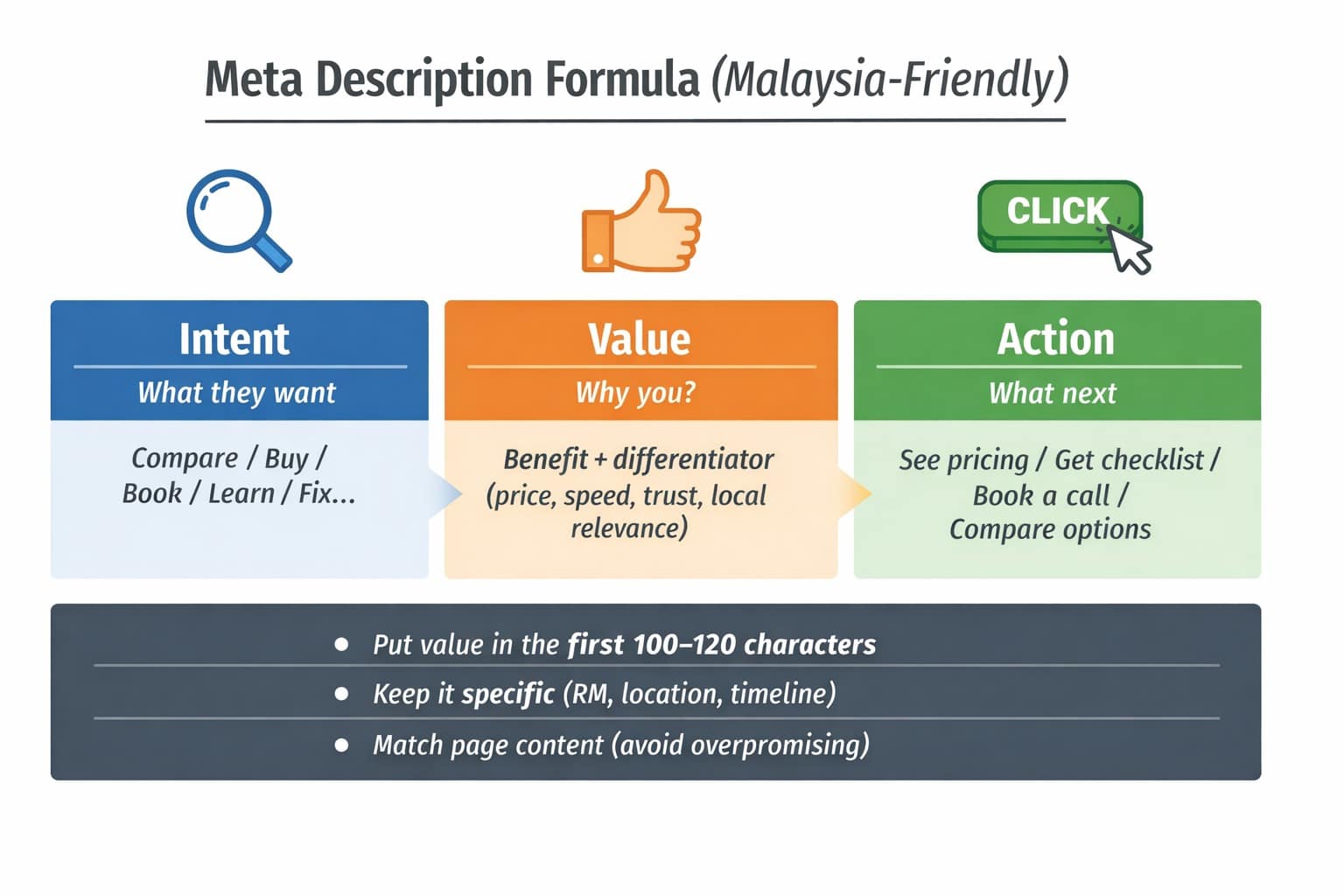
Use this proven structure:
Problem → Solution → Outcome
Example:
“Struggling with low website traffic? Discover SEO strategies tailored for Malaysian businesses to increase visibility and generate leads.”
Alternative Framework (For Competitive SERPs)
Context → Differentiator → Outcome
Example:
“Compare SEO agencies in Malaysia. See pricing, strategies, and what actually drives results in 2026.”
Malaysia-Focused Meta Description Examples
SEO Services
“Looking to improve SEO in Malaysia? Explore strategies to grow qualified traffic and leads, built for local competition in 2026.”
Accounting
“Learn how Malaysian SMEs can plan taxes legally. Practical guidance with Malaysia context: clear steps and common mistakes.”
eCommerce
“Compare payment gateways in Malaysia. Fees, DuitNow support, and key features, so you can choose the right option fast.”
Healthcare
“Looking for a paediatrician in KL? See services, what to prepare, and booking details before your visit.”
Tip: For YMYL topics (health/finance/legal), avoid exaggerated claims. Keep it factual and aligned with what the page actually provides.
Common Meta Description Mistakes to Avoid
Most underperforming pages share the same patterns:
- Writing vague, non-specific descriptions
- Ignoring search intent
- Overusing keywords unnaturally
- Reusing the same description across pages
- Promising something the page doesn’t deliver
These mistakes reduce trust and usually lead to lower CTR.
How to Test & Improve Meta Descriptions
Optimisation is where real gains happen.
Practical workflow:
- Identify pages with high impressions but low CTR in Google Search Console
- Analyse competing snippets in the SERP (titles + descriptions + angle)
- Rewrite descriptions with stronger value + intent alignment + specificity
- Track performance changes over 2–4 weeks (avoid judging too quickly)
What to Look for in Your Data
- High impressions + low CTR → weak snippet or mismatched intent
- Good ranking + low clicks → messaging problem (not necessarily an SEO problem)
- Strong CTR → document the pattern and replicate across similar pages
A Simple “Good Enough” Experiment Method
You can’t run perfect A/B tests in organic search, but you can run practical experiments:
- Pick a page with stable position
- Update the meta description once
- Compare CTR and clicks over the next 14–28 days
- Keep winners, revert losers, and document patterns you can scale
Tools to Optimise Meta Descriptions
The right tools help you scale effectively:
- CMS plugins (e.g., Yoast SEO)
- Crawling tools (e.g., Screaming Frog)
- SERP preview tools (use as guidance, not gospel)
- Google Search Console (Performance report for clicks, impressions, CTR)
The Importance of Meta Descriptions
Meta descriptions may seem small, but they play a critical role in turning search visibility into actual traffic. When written well, they help your business stand out, communicate value clearly, and attract the right audience.
If you’re looking to improve SEO performance holistically, we help businesses build structured strategies that go beyond rankings and focus on real results. At Rankpage, Malaysia’s number one SEO agency, we combine technical SEO, content strategy, and local insights to ensure every element, including your meta descriptions, works as part of a scalable growth system.
Sources
- Google Search Central — “How to write meta descriptions” (Snippet documentation; continuously maintained)
- Google Search Console Help — “Performance report (Search results)”
- Google Search Console Help — “Impressions, position, and clicks explained”
- Department of Statistics Malaysia (DOSM) — “ICT Use and Access by Individuals and Households Survey Report 2024” (Release: 24 April 2025)
- DataReportal (Kepios) — “Digital 2025: Malaysia” (Release: 3 March 2025)
- Yoast — “How to create a good meta description” (Updated: 23 June 2025)