What Are Long Tail Keywords And Why Do They Matter?
Long tail keywords are specific, multi-word search phrases that reflect clearer user intent and are often easier to rank for than broad keywords.
Instead of:
“SEO services”
You target:
“SEO services for ecommerce Malaysia price”
The second query tells you more about the searcher:
- Who they are
- What they want
- Where they are
- How close they may be to taking action
That is why long tail keywords are often described as high-intent keywords.
They also tend to filter out lower-quality traffic. A broad keyword may bring more visits, but a more specific phrase usually brings people with a more defined need. For service businesses, that often means better enquiry quality, better lead fit, and a higher chance of conversion.
(Source: WordStream; Semrush; Yoast)
Long Tail Vs Short Tail Keywords: Upsides And Downsides
Both long tail and short tail keywords play different roles in a strong SEO strategy.
Factor | Short-Tail Keywords | Long Tail Keywords |
Length | 1–2 words | 3+ words |
Intent clarity | Lower | Higher |
Competition | Very high | Usually lower |
Traffic volume | Higher | Lower |
Conversion potential | Lower | Higher |
Ranking difficulty | Harder | Often easier |
Upsides Of Short-Tail Keywords
- High search volume
- Strong brand visibility
- Useful for awareness campaigns
Downsides Of Short-Tail Keywords
- Extremely competitive
- Low intent clarity
- Harder to convert directly
Upsides Of Long Tail Keywords
- Easier to rank for, especially for SMEs
- Higher conversion potential
- Better alignment with real search behaviour
- Strong fit for question-based and intent-driven search
Downsides Of Long Tail Keywords
- Lower individual search volume
- Requires broader content coverage
- Harder to track one by one
Practical Insight
Short-tail keywords help you compete for visibility. Long tail keywords often help you compete for qualified demand.
That distinction matters. A page can attract traffic and still fail commercially if the query is too broad or vague. Long tail keywords narrow the gap between ranking and relevance, which is why they are often more useful for businesses that care about leads, bookings, or sales rather than pageviews alone.
In Malaysia, where many SMEs need efficient results from limited budgets, a long tail-first strategy is often the more practical starting point before expanding toward broader terms.
(Source: WordStream; Semrush; Yoast)
Who Should Focus On Long Tail Keywords In Malaysia?
Any Malaysian business that relies on search traffic can benefit from long tail keywords, especially SMEs and service-based industries.
Best Fit Segments
- Accounting and tax firms
- Clinics and healthcare providers
- Ecommerce brands
- B2B service providers
- Local service businesses
These businesses often face the same challenge: they need traffic that is relevant, local, and commercially useful, not just traffic for its own sake.
Real Malaysian Scenario
A clinic targeting:
“clinic”
vs
“paediatrician Subang Jaya open Sunday”
The second keyword:
- Reflects urgency
- Includes location
- Matches clearer intent
This is why long tail keywords are often closer to revenue than broad traffic.
They are especially useful for businesses that cannot realistically outrank large directories, aggregator sites, or established national brands for generic head terms.
How Do Malaysians Actually Search? (Critical Insight)
Malaysian search behaviour is often multilingual and highly contextual.
Common Patterns
- Mixed-language queries like “accountant KL murah SME”
- Location-based searches like “clinic near me” or “lawyer KL”
- Intent-driven modifiers like “price”, “review”, or “open now”
- Service-specific combinations such as industry + city + urgency + cost
Why This Matters
Many global SEO guides do not fully account for this local layer.
If you only target:
“accounting services Malaysia”
You may miss searches like:
- “akauntan murah KL”
- “SME accountant Malaysia price”
- “tax consultant Penang for startup”
- “klinik kanak kanak buka Ahad Subang”
Key Insight
Long tail keywords in Malaysia are often shaped by a combination of language, location, and intent.
That means local keyword strategy should not rely on direct translation alone. It should reflect how people naturally ask, compare, and decide in the market you serve.
(Source: DOSM; Google Ads Help; local SEO market practice)
Where Do Long Tail Keywords Come From?
Long tail keywords are best discovered and validated through real user behaviour, with tools helping you uncover additional variations.
Primary Sources
- Google autocomplete
- People Also Ask sections
- Customer enquiries
- Internal site search
- Reviews and testimonials
- Keyword research tools
- Sales call notes and chat enquiries
- Google Search Console query data
These sources matter because they reveal the wording customers already use. In many cases, your best keywords are not invented in a planning document. They are pulled directly from repeated commercial questions, recurring objections, and real buying behaviour.
(Source: Semrush; Yoast; Google Ads Help; Google Search Console)
Example
If customers frequently ask:
“How much does SST filing cost?”
That is already a strong long tail keyword signal.
Pricing, timelines, eligibility, comparisons, and process-related questions are often some of the best long tail opportunities because they reflect practical intent.
How To Choose Long Tail Keywords (Step-by-Step)
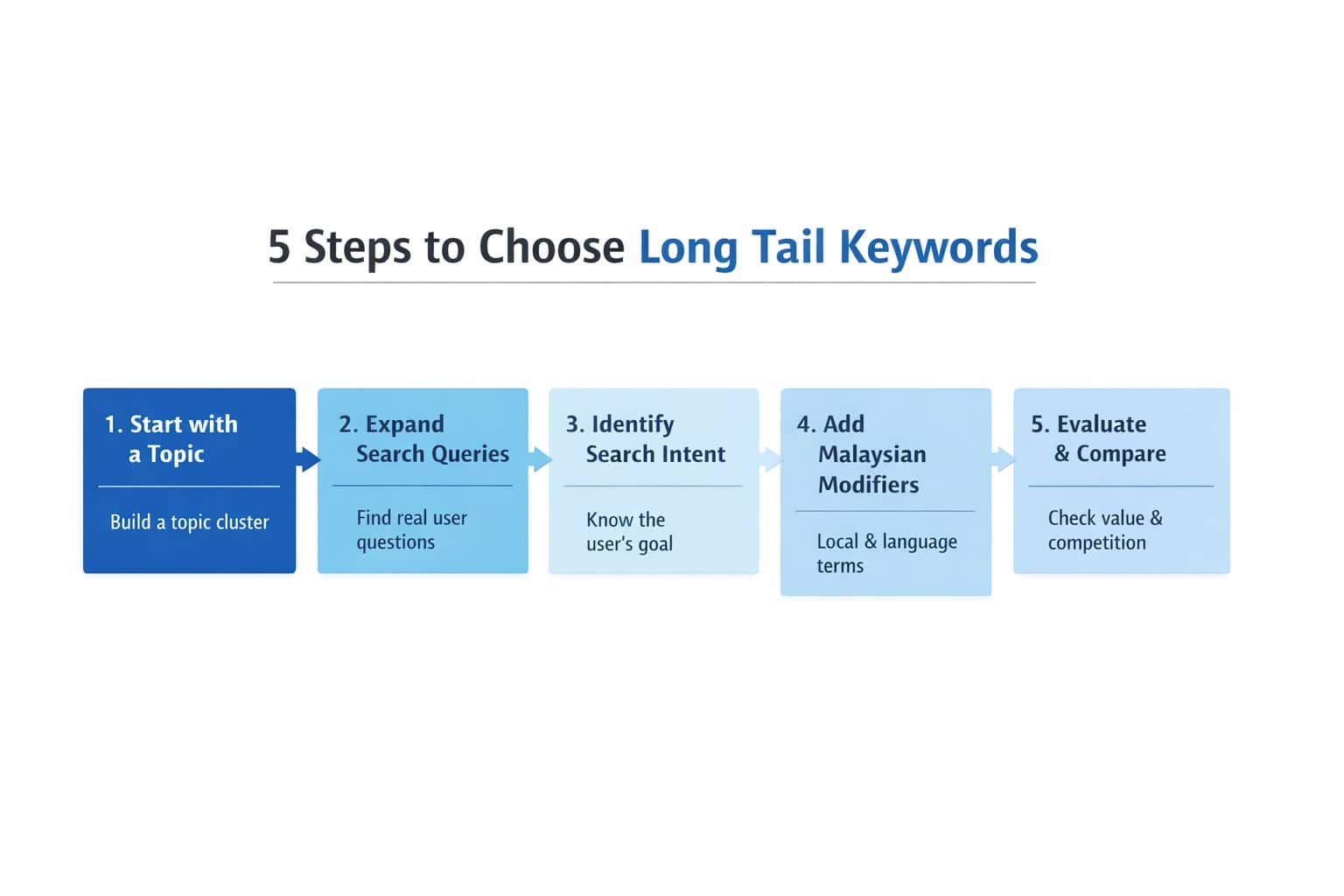
Step 1: Start With A Topic, Not A Keyword
Focus on building a topic cluster instead of chasing isolated keywords.
Example:
Topic: Accounting for SMEs in Malaysia
Coverage areas may include:
- SST
- e-Invoicing
- Compliance
- Pricing
- Filing timelines
- Common mistakes SMEs make
This gives you a stronger base than publishing disconnected pages around tiny keyword variations. It also helps you build authority around a subject instead of scattering relevance across unrelated articles.
Step 2: Expand Into Real Search Queries
Use:
- Google suggestions
- Keyword tools
- Customer conversations
Focus on:
- Questions
- Problems
- Comparisons
Look closely at modifiers that reveal intent. Terms like “cost”, “requirements”, “best”, “for SME”, “near me”, or “open weekend” often tell you more than the core keyword itself.
Step 3: Identify Search Intent
Intent Type | Example |
Informational | “what is SST Malaysia” |
Consideration | “SST registration requirements Malaysia” |
Transactional | “SST filing service Malaysia price” |
The more accurately your page format matches the search intent, the better it tends to perform. Informational keywords usually need explanation and clarity. Transactional keywords usually need trust signals, specifics, and a clear next step.
(Source: Google Search Central)
Step 4: Add Malaysian Modifiers
Local context can turn a generic keyword into a stronger conversion opportunity.
Examples include:
- Location terms like KL, Selangor, Johor
- Pricing indicators like murah or affordable
- Urgency terms like open now
- Business-type modifiers like SME, startup, enterprise
- Regulatory context like SST, LHDN, e-Invoicing
These modifiers matter because they sharpen the query. They also make the page more aligned with what the user is actually trying to solve.
Step 5: Evaluate Value And Competition
Choose keywords that:
- Match your service offering
- Are realistically rankable
- Show clear commercial or problem-solving intent
- Support a broader content cluster rather than standing alone
A keyword is only valuable if it connects search demand with business relevance. Traffic that does not fit your offer usually adds little value.
How To Use Long Tail Keywords Effectively (SEO + AI Search)
Using long tail keywords effectively means structuring content around intent, not just inserting phrases.
1. Use Question-Based Headings
Example:
“How much does SST filing cost in Malaysia?”
This format can align well with:
- AI-generated search summaries
- Voice-style queries
- Chat-based searches
It also makes content easier to scan. In practical terms, good headings improve readability for both users and search systems.
2. Answer Immediately And Clearly
Start with a direct answer. Then follow with explanation.
This helps search systems understand your content more clearly and may improve your eligibility for snippet-style and AI-supported search surfaces.
A good working rule is to answer the question in the first few lines, then expand with context, examples, and detail underneath.
(Source: Google Search Central)
3. Build Topic Clusters
Instead of creating one page for every minor keyword variation, build:
- One pillar page
- Supporting articles around related questions and subtopics
This creates a stronger structure for both users and search engines.
It also helps reduce content cannibalisation, where several pages compete for the same intent without establishing a clear best answer.
(Source: Yoast)
4. Use Keywords Naturally Across Key Areas
Include relevant long tail phrases naturally in:
- Titles
- Headings
- Body content
- FAQ sections
- Internal anchor text where appropriate
Avoid forcing exact matches unnaturally.
Modern search systems are better at understanding context, variations, and topical relevance. Natural usage usually performs better than repetitive phrasing written only for keywords.
(Source: Google Search Central; Yoast)
5. Add Unique Expert Value
Go beyond surface-level answers by adding real value.
For example:
- Reference Malaysian regulations like SST or LHDN requirements
- Include real-world scenarios
- Add practical examples from client questions or industry experience
- Clarify common misconceptions
- Explain what users should do next
This can strengthen:
- Credibility
- Trust
- Overall search visibility, including AI-powered experiences
The more your content helps a reader make a decision, avoid a mistake, or understand a local requirement, the more useful it becomes beyond simply matching a phrase.
(Source: Google Search Central)
When Should You Prioritise Long Tail Keywords?
Long tail keywords should be prioritised when you need traction, relevance, and conversion-focused traffic.
Best Situations
- New or low-authority websites
- Local service targeting
- Niche offerings
- Conversion-focused campaigns
- Pages built around specific questions or pain points
They are also especially useful when your business solves specialised problems. In most cases, the more specific the problem, the more specific the search query will be too.
What Are The Challenges Of Long Tail Keywords?
Common Challenges
- Lower search volume per keyword
- More content planning required
- Harder to track individually
- Risk of fragmented strategy if pages overlap too much
(Source: Semrush; Nightwatch)
Reality Check
Even if a keyword brings only 20 searches per month, it can still be highly valuable if those users are ready to take action.
A small number of qualified visitors often matters more than a large number of vague ones.
The bigger risk is poor organisation. Without a clear topic structure, businesses can end up publishing too many thin pages that overlap, dilute relevance, and underperform.
How Much Does It Cost To Implement A Long Tail Strategy?
The cost is driven more by execution than by keyword selection itself.
Typical Cost Reality In Malaysia
Costs can vary widely depending on:
- Content quality
- Writer or strategist expertise
- SEO tools used
- Whether you work with freelancers, in-house staff, or agencies
- The level of subject-matter expertise required
Treat any quoted pricing as indicative, not as a fixed market standard.
Hidden Cost
Poor keyword targeting can lead to:
- Low conversions
- Wasted content investment
- Misaligned traffic
- Content that ranks but does not drive business results
In many cases, the biggest cost is not content production. It is publishing content that targets the wrong intent or lacks the depth needed to compete.
What Does A Winning Long Tail Strategy Look Like?
It is built on alignment, structure, and localisation.
Winning Framework
- Topic-first approach
- Intent-driven content
- Localised keyword variations
- Clear formatting for readability and search extraction
- Useful, original insights instead of generic filler
- Internal links that connect related pages logically
The strongest long tail strategies do not chase hundreds of random low-volume terms. They build a useful content system that covers a topic properly from awareness to decision stage.
Improving Your Keyword Selection
Long tail keywords are not just an SEO tactic. They reflect how real customers search, especially in a multilingual and locally nuanced market like Malaysia.
If you want your content to rank, convert, and compete in AI-supported search experiences, your strategy should prioritise intent, structure, and local relevance.
Done well, long tail SEO helps you move beyond traffic for its own sake and build content around qualified demand. That is what makes it more sustainable, more practical, and often more commercially valuable over time.
If your business needs help improving SEO around long tail keywords, Rankpage is here to help. Partner with Rankpage, Malaysia’s most trustworthy SEO agency, to get your growth started ASAP!