What Robotic SEO Content Looks Like
Robotic content usually happens when a writer treats the keyword as the main character and the reader as an afterthought. The copy may mention the target phrase often, but it does not flow like natural business writing.
Common Signs Of Robotic Content
- The same keyword appears in nearly every paragraph
- The headings sound like keyword tool exports
- The sentences feel choppy or repetitive
- The copy prioritises phrasing over clarity
- The page feels written for ranking reports, not real readers
Quick Examples
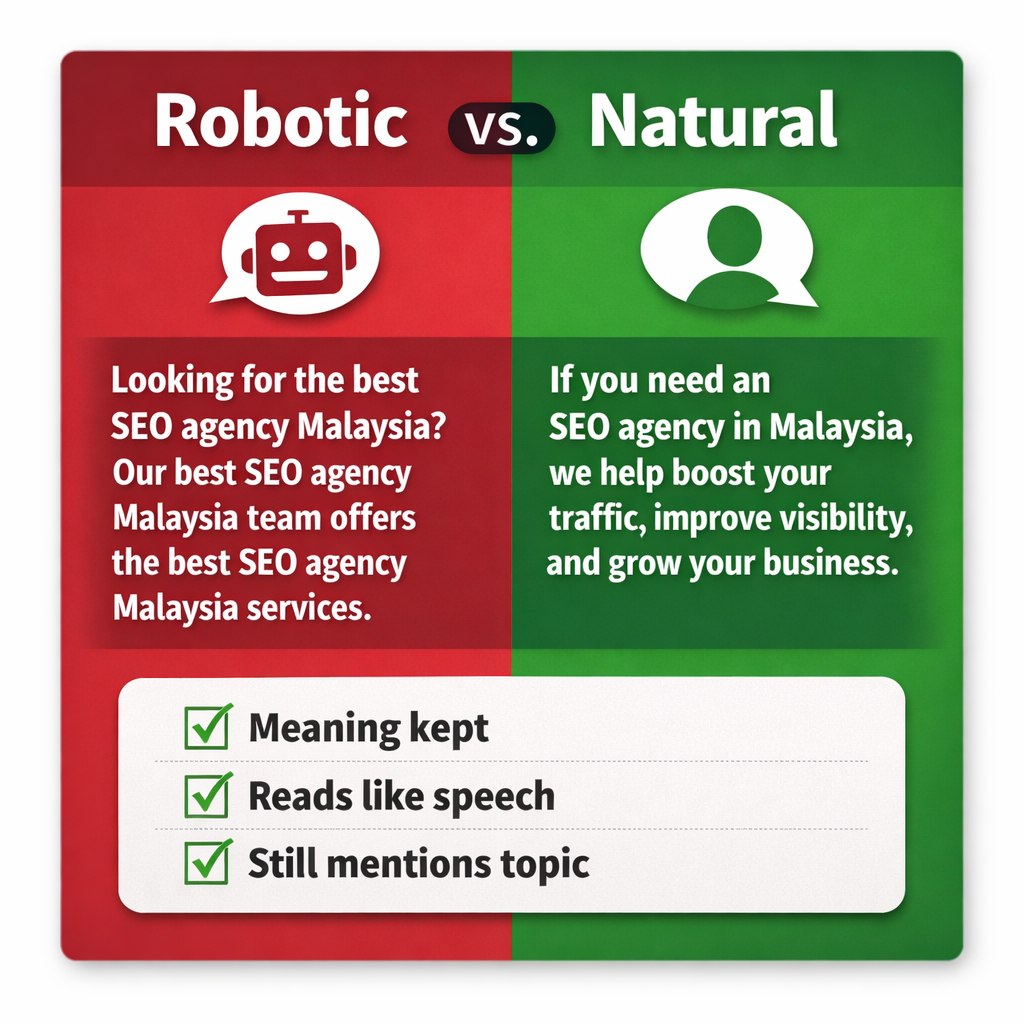
The second version still supports the topic, but it sounds more credible and far less forced.
(Source: Google Search Central, Creating Helpful, Reliable, People-First Content; Google Search Essentials)
Why Readability Still Matters For SEO
Readability is not just a writing preference. It helps a page do its job.
When visitors land on a page, they want to understand it quickly. If the content feels dense, repetitive, or awkward, they are less likely to keep reading. Even if SEO wins the click, the content still has to win the visit.
How Readability Helps
- Easier scanning on mobile
- Faster understanding of the page
- Stronger trust in the brand
- Better engagement with the content
- Higher chance of turning traffic into enquiries or sales
What Readable SEO Content Usually Includes
- Short paragraphs
- Clear headings
- Simple transitions
- Natural phrasing
- Useful examples
- Well-spaced bullets or lists
Readability isn’t a guaranteed ranking factor, but Google does recommend content that is easy to read and well organised. That aligns with what users want: clarity, structure, and a page that feels genuinely helpful. (Source: Google Search Central, SEO Starter Guide; Google Search Central, Creating Helpful, Reliable, People-First Content)
Search Intent Comes Before Keyword Placement
One of the biggest SEO mistakes is starting with the keyword and never moving beyond it. A business sees a target phrase in a tool, then tries to stuff it into the page without first asking what the user actually wants.
That is where robotic content often begins.
What To Check Before Writing
- Is the user trying to learn something?
- Is the user comparing options?
- Is the user looking for a provider?
- Is the user ready to enquire or buy?
- Is the search local, informational, or commercial?
Why This Matters
A person searching “what is local seo” needs a different page from someone searching “local seo agency malaysia”.
- The first query suggests an educational article.
- The second suggests a service or commercial page.
If the intent is wrong, the keyword placement does not really save the content.
Typos, Misspellings, and Search Intent
Typos and misspellings can still signal clear intent, so don’t assume a “wrong” query means a different topic. If someone searches “lokal seo agency malaysia” or “seo agenxy kl”, they’re usually still looking for the same service page you’d build for the correctly spelled version, so focus on satisfying the intent with natural wording, then cover common typo variants subtly in supporting copy (not by stuffing broken spellings into headings).
Simple Rule
Match the page type to the likely intent before worrying about how many times the keyword appears. In many cases, matching the likely search intent matters more for usefulness than repeating an exact phrase over and over.
(Source: Google, How Search Works: Ranking Results; Google Search Central, Creating Helpful, Reliable, People-First Content; Google Search Central, SEO Starter Guide)
Exact-Match Keywords Are Not Always The Best Final Copy
Keyword tools are useful for research, but they often show phrases in a compressed form. That is helpful for analysis, but it does not mean those phrases should be copied word-for-word into finished content.
A phrase like “cheap accounting service kl” may reflect how some people search. It does not mean your final page should sound like that in every heading and paragraph.
Raw Keyword Vs Better Final Copy
- best seo agency malaysia → best SEO agency in Malaysia
- cheap accounting service kl → cheap accounting services in KL
- how choose payroll software malaysia → how to choose payroll software in Malaysia
- website design company penang → website design company in Penang
- best kindergarten pj → best kindergarten in PJ
Key Point
Exact-match keywords are often research signals, not final writing instructions.
Use them to understand demand and phrasing. Then rewrite them into something a real reader would actually want to see. (Source: Google Search Essentials; Google Search Central, SEO Starter Guide)
Why Filler Words Often Make Content Sound Better
This is one of the easiest ways to make SEO content more natural.
Small connective words like in, to, for, with, and near help a sentence sound like normal language. Without them, many keyword strings feel abrupt or mechanical.
Why These Words Matter
- They improve sentence flow
- They make the content easier to read
- They help the copy sound more trustworthy
- They usually preserve the same core intent
- They reduce the “keyword list” feeling
Examples Of Better Phrasing
- best international school penang → the best international schools in Penang
- seo service malaysia price → SEO service pricing in Malaysia
- how register sdn bhd malaysia → how to register a Sdn Bhd in Malaysia
- payroll software for sme malaysia → payroll software for SMEs in Malaysia
- web design agency kl → web design agency in KL
The Real SEO Lesson
Writers sometimes worry that adding filler words will weaken the keyword. In most cases, that is outdated thinking. Google’s guidance focuses on writing naturally and using words people would actually use. If the core meaning stays intact, small connective words usually improve clarity without changing the intent. (Source: Google Search Central, SEO Starter Guide; Google Search Essentials)
How To Use Keywords Naturally Without Sounding Forced
Using keywords naturally does not mean avoiding them. It means placing them where they help, then letting the rest of the copy breathe.
Good Places To Use The Main Keyword
- The meta title
- The H1
- The opening paragraph
- One or two relevant H2s
- Image alt text, when the image meaningfully relates and the text is written for accessibility first
- Internal anchor text, where appropriate
What To Avoid
- Repeating the same phrase in every heading
- Stuffing the keyword into every paragraph
- Using awkward exact match just to “be safe”
- Ignoring synonyms, variants, or related terms
- Forcing the keyword into sentences that already work fine
A Practical Tip
Read the paragraph out loud. If it sounds unnatural in speech, it probably feels unnatural on the page too.
That one habit catches a surprising amount of bad SEO phrasing before it gets published. (Source: Google Search Essentials; Google Search Central, SEO Starter Guide)
What This Looks Like In Malaysia SEO
Malaysia SEO adds another layer because local search phrases are often short, location-heavy, or commercially blunt compared to polished brand copy.
That is normal. The key is knowing how to interpret those phrases without turning your content into a string of raw search queries.
Common Malaysia-Style Keyword Patterns
- Location-heavy searches, such as seo agency kl
- Commercial modifiers, such as murah, best, or price
- Service phrases, such as accounting service malaysia
- SME-focused queries, such as payroll software for sme malaysia
- City modifiers, such as Penang, PJ, or Johor Bahru
Better Rewrites For Natural Copy
- best seo company kl → best SEO company in KL
- web design murah malaysia → affordable web design services in Malaysia
- accounting service for sme malaysia → accounting services for SMEs in Malaysia
- digital marketing agency penang → digital marketing agency in Penang
- best kindergarten pj → best kindergarten in PJ
The Main Principle
Local relevance should feel integrated, not pasted on.
You want the page to reflect how Malaysians search, but it should still sound like polished business communication. That is especially important for service pages, commercial blogs, and lead generation content. (Source: Google Search Essentials; Google Search Central, SEO Starter Guide; Google, How Search Works: Ranking Results)
Common Mistakes That Make Content Sound Robotic
These mistakes are very common, especially when a page is written directly from a keyword list.
The Most Common Problems
- Overusing one exact keyword
- Writing headings for tools instead of people
- Ignoring search intent
- Removing normal filler words
- Stuffing “Malaysia” or “KL” into every paragraph
- Repeating the same commercial modifier too often
- Chasing relevance while sacrificing trust
- Treating SEO copy like data entry instead of communication
Why These Mistakes Hurt
- The content becomes harder to read
- The brand sounds less credible
- The page feels less helpful
- The copy is less persuasive
- The visit is less likely to convert
Most robotic content problems come from the same root issue: the writing is too focused on the keyword and not focused enough on the human reading it. (Source: Google Search Central, Creating Helpful, Reliable, People-First Content; Google Search Essentials; Google Search Central, Spam Policies)
A Simple Framework For Balancing Keywords And Readability
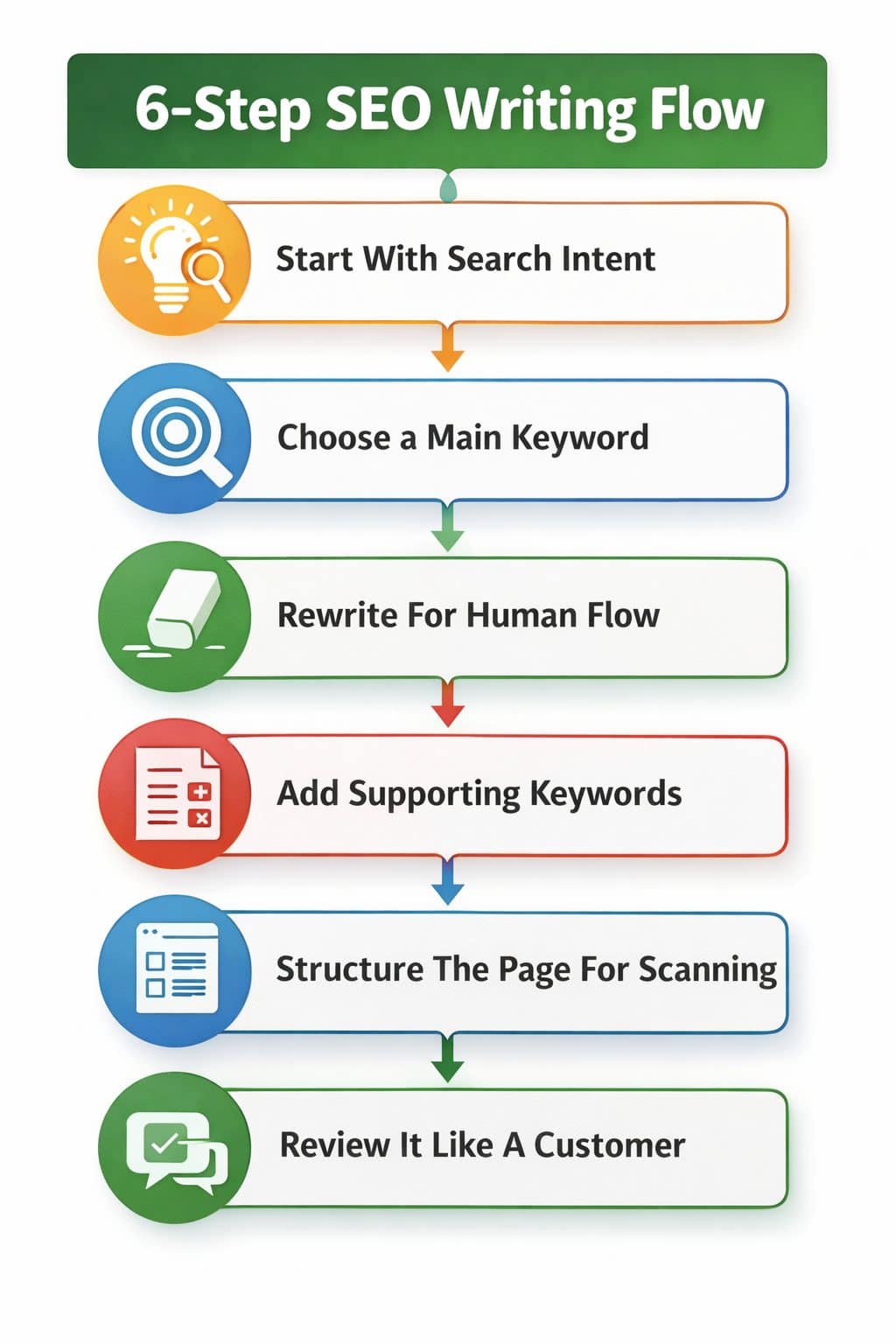
A simple workflow can prevent most of these issues before they appear.
Step 1: Start With Search Intent: Ask what the user wants. Do they need information, comparison, reassurance, or a service provider?
Step 2: Choose A Main Keyword: Pick a phrase that clearly matches the topic and commercial goal, but do not treat it like an untouchable script.
Step 3: Rewrite For Human Flow: Add connective words where needed. Smooth the phrasing. Make the sentence sound normal.
Step 4: Add Supporting Keywords Naturally: Use related terms, subtopics, and local modifiers only where they genuinely fit.
Step 5: Structure The Page For Scanning: Use short paragraphs, headings, bullets, and clear lead sentences.
Step 6: Review It Like A Customer: Check whether the page sounds helpful, trustworthy, and easy to follow.
Quick Pre-Publish Checklist
- Does the page match the likely search intent?
- Is the main keyword included naturally in key areas?
- Do the headings sound helpful instead of forced?
- Have you used filler words where they improve flow?
- Does the copy sound like real business communication?
- Would a customer trust this page after reading it?
That final question is often the best quality check of all. (Source: Google Search Central, Creating Helpful, Reliable, People-First Content; Google Search Essentials; Google Search Central, SEO Starter Guide)
Write For Humans, Optimise For Intent
Balancing readability and SEO is not about choosing one over the other. It is about making them work together. Strong content should align with search intent, use keywords strategically, and still sound natural enough to build confidence.
If your content is getting impressions but still feels too stiff to engage readers, the issue may not be visibility alone. At Rankpage, your trustworthy SEO agency, we help businesses create SEO content that is built for rankings, readability, and real-world results, so your pages can perform without sounding robotic.
Get in touch with Rankpage today, and boost your website’s performance!