What Is The Skyscraper Technique In SEO?
The skyscraper technique is an SEO strategy where you:
- Find content that already performs well
- Create a significantly better version
- Promote the improved version to relevant websites and audiences
The idea comes from a simple analogy. In a skyline full of buildings, the tallest skyscraper gets the most attention.
In SEO, the principle is similar. When several pages cover the same topic, the page that is more useful, more current, and easier to understand is often in a stronger position to earn attention and links.
In practical terms, skyscraper content usually improves on an existing article by offering:
- Better explanations
- More complete coverage
- Updated data
- Stronger formatting
- Clearer examples
- More relevant local context
(Source: Backlinko; Semrush)
Why The Skyscraper Technique Matters For SEO
The skyscraper technique remains useful because it aligns with how SEO works in practice: businesses are more likely to perform well when they create content that is relevant, helpful, well structured, and worth referencing.
It Helps Reduce Content Guesswork
- Many businesses write blog posts without knowing whether the topic has real demand.
- The skyscraper method reduces that uncertainty. By studying content that already ranks or attracts links, you begin with a topic that has already shown signs of interest and relevance.
That makes content planning more strategic and less speculative.
(Source: Ahrefs; Semrush)
Backlinks Still Matter
- Backlinks remain an important SEO signal, even though Google uses many factors and systems to rank content.
- When reputable websites link to or reference a page, it can help search engines understand that the content is useful and worth surfacing.
- At the same time, links work best when the page itself is also relevant, well structured, and genuinely helpful.
(Source: Google Search Central; Google Search)
It Supports Topical Authority
- When a business consistently publishes strong content around a subject area, it becomes easier for search engines and readers to associate that site with the topic.
- Over time, this can improve visibility across related searches and strengthen the site’s perceived authority in that niche.
(Source: Google Search; Google Search Central)
It Encourages Better Content Quality
A good skyscraper strategy pushes content beyond thin, generic blogging.
Instead of publishing surface-level articles, businesses are encouraged to produce resources that are:
- Clearer
- More accurate
- More complete
- More useful
- Easier to navigate
That makes the content better for SEO and better for readers.
(Source: Google Search Central; Semrush)
How To Choose The Right Topic For Skyscraper SEO
Not every keyword deserves skyscraper treatment.
The best opportunities usually sit at the intersection of:
- Search demand
- Backlink potential
- Business relevance
A strong skyscraper topic often has these characteristics:
- People already search for it regularly
- Existing articles have earned backlinks or references
- Top-ranking pages are outdated, too general, or poorly explained
- The topic connects naturally to your services or expertise
For Malaysian businesses, the strongest opportunities are often not broad global keywords, but local, practical topics where users need clear guidance.
Examples include compliance topics, licensing processes, tax procedures, market explainers, and industry-specific how-to guides.
(Source: Ahrefs; Semrush)
Core Parts Of The Skyscraper Technique
Although the concept sounds simple, effective execution still depends on research, analysis, and smart promotion.
Content Research
The first step is finding content that already performs well.
Look for pages that:
- Rank strongly in search results
- Attract backlinks
- Are frequently referenced
- Still have obvious gaps or weaknesses
The goal is to identify a proven topic where improvement is possible.
(Source: Ahrefs; Semrush)
Content Gap Analysis
Once you find a strong existing page, review what it is missing.
Common weaknesses include:
- Outdated statistics
- Shallow explanations
- Weak structure
- Poor formatting
- No local context
- Limited examples
- Unclear definitions
These gaps become your opportunity.
(Source: Semrush)
Content Improvement
Next, build a better version. “Better” does not mean longer for the sake of it. A stronger article is usually one that is more useful.
That could mean:
- Adding current data
- Simplifying complex points
- Including local examples
- Improving readability
- Adding visuals, tables, or checklists
- Covering questions competitors missed
(Source: Google Search Central; Semrush)
Promotion And Outreach
Once the content is published, promotion matters.
Even a strong page may not attract attention immediately without active distribution.
Useful channels include:
- Outreach to relevant publishers
- Digital PR
- Industry newsletters
- Communities and forums
- Social media distribution
- Internal linking from related pages
Outreach results vary, but even a small number of relevant links or references can make a meaningful difference.
(Source: Google Search Central; Semrush)
What Makes A Skyscraper Article Actually Better?
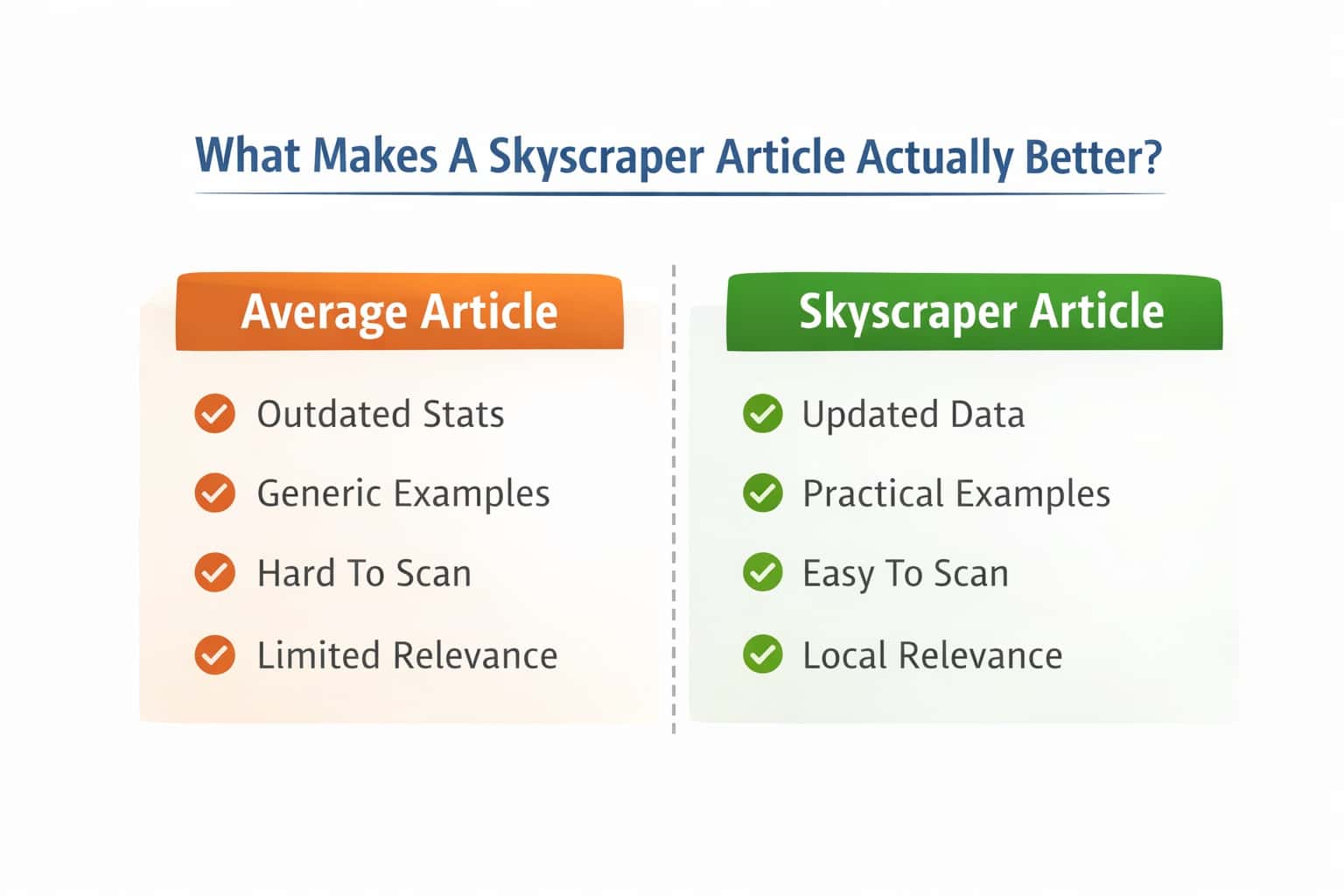
A better article is not just a longer article. In most cases, a stronger skyscraper page is one that is easier to use and more valuable to the reader.
That improvement often comes from:
- More recent statistics
- Clearer formatting
- Better sequencing of ideas
- Stronger examples
- More precise explanations
- Expert quotes or cited sources
- Practical tools like templates, checklists, or comparison tables
This is especially important in competitive SERPs where many articles already cover the same broad topic. The winning page is often the one that removes friction and gives readers a more complete answer.
(Source: Google Search Central; Semrush)
How The Skyscraper Technique Works In Practice
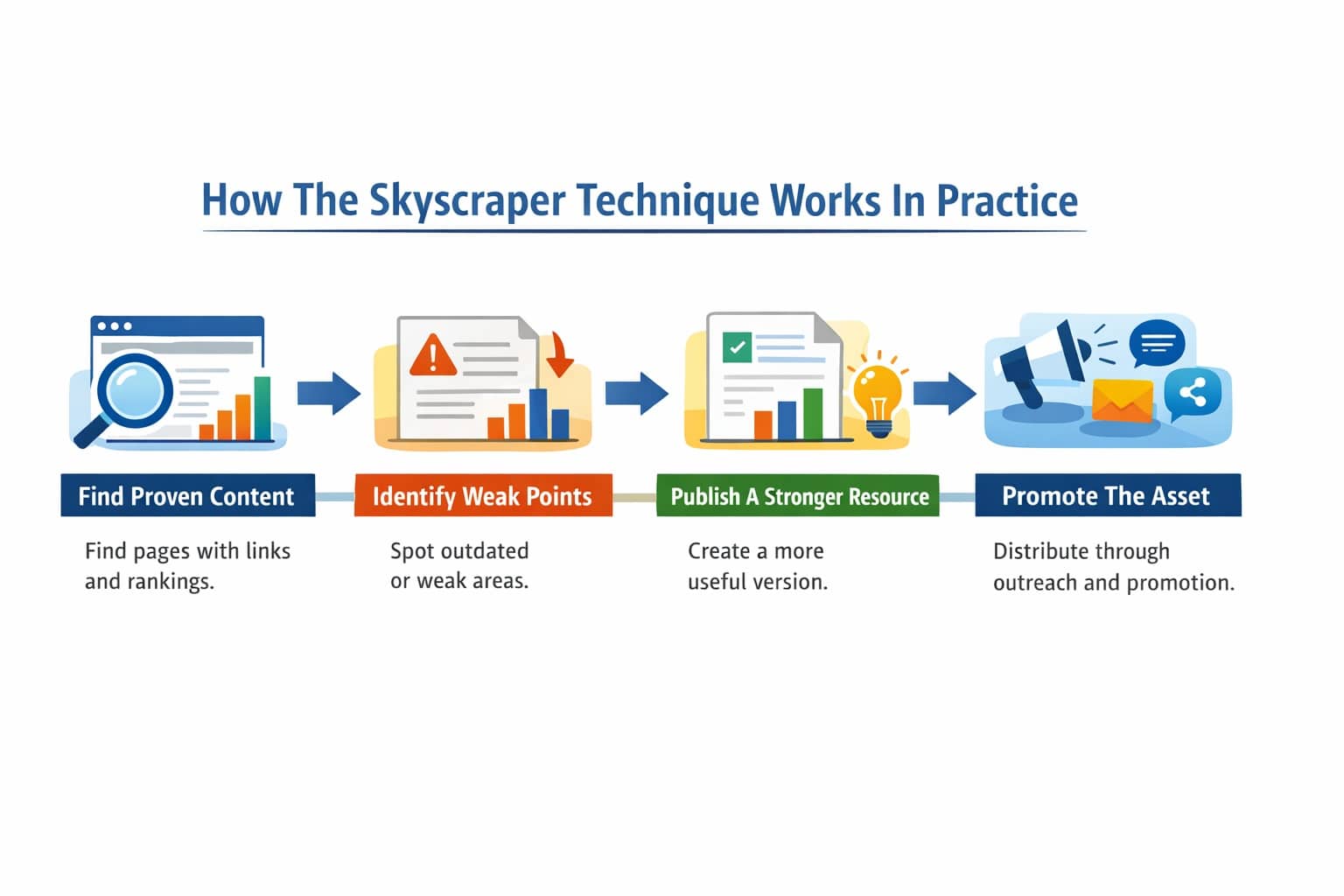
To see how the strategy works more clearly, it helps to break the workflow into simple stages.
Step 1: Find Proven Content
Search your target keyword and review the pages already ranking.
Check:
- Who ranks
- What format they use
- What angles they cover
- How detailed the pages are
- Whether the content looks dated or generic
These details help you spot where existing articles succeed and where they leave room for improvement.
Step 2: Identify Weak Points
Look for areas where the current results fall short.
For example:
- Statistics are old
- No Malaysia-specific information
- Explanations are too technical
- No visuals or examples
- Poor user experience on mobile
- Missing FAQ-style questions
These weaknesses show you exactly where a stronger article can stand out.
Step 3: Publish A Stronger Resource
Create a page that improves meaningfully on those weaknesses.
You might:
- Update all data points
- Include a step-by-step process
- Add local laws or market context
- Include case studies
- Simplify the layout
- Answer related sub-questions more clearly
The goal is not to copy the top-ranking content. It is to produce something more useful and easier to trust.
Step 4: Promote The Asset
After publishing, distribute it intentionally.
Promotion can include:
- Emailing sites that reference weaker resources
- Sharing with journalists or industry writers
- Posting in niche communities
- Linking from your own related pages
- Using newsletters or social channels to increase early visibility
(Source: Semrush; Google Search Central)
Examples Of Skyscraper Content Opportunities In Malaysia
For Malaysian businesses, skyscraper SEO works especially well when there is a local information gap.
Many search results still rely on broad international content even when readers need Malaysia-specific guidance.
SME Compliance Guides
This is one of the strongest local opportunities because the information must be clear, practical, and regularly updated.
Examples include:
- SST registration guides
- Payroll compliance for SMEs
- HR policy basics for employers
- Company incorporation steps
- Statutory contribution explainers
These topics are practical, high intent, and often useful enough to attract links from business portals, consultants, and publishers.
(Source: Royal Malaysian Customs; SSM; KWSP)
Industry Education Content
Some Malaysian industries still have limited high-quality educational resources online.
Examples include:
- Construction claims documentation
- Childcare licensing requirements
- Payment gateway compliance
- Import and export procedures
- Manufacturing permit processes
When these topics are explained clearly, they can attract references from business portals, consultants, associations, and niche industry websites.
(Source: MITI; CIDB Malaysia)
Data-Driven Market Insights
Content backed by local data often performs especially well.
Useful sources may include:
- Department of Statistics Malaysia
- Bank Negara Malaysia
- MDEC
- SME Corp Malaysia
- MITI
- SSM
- Royal Malaysian Customs
Local data makes content more credible and more relevant to Malaysian readers.
(Source: DOSM; Bank Negara Malaysia; MDEC; SME Corp Malaysia)
Why Local Data Gives Malaysian Businesses An Edge
One of the easiest ways to improve skyscraper content is to make it more locally relevant.
A lot of existing SEO content is written for a global audience. That often means it misses the legal, commercial, or operational details Malaysian readers actually need.
Using local references can make an article stronger in several ways:
- It improves trust signals
- It makes the advice more practical
- It differentiates the page from generic international posts
- It gives local websites more reason to reference the content
For service businesses, that can turn a basic blog article into a genuinely useful local resource.
(Source: DOSM; Bank Negara Malaysia; MITI; MDEC)
Common Mistakes In Skyscraper SEO
Even though the strategy is widely discussed, many businesses still apply it too narrowly.
Focusing Only On Word Count
- Longer content is not automatically better.
- If the article is repetitive, bloated, or hard to navigate, added length can make it weaker rather than stronger.
Ignoring Search Intent
- A page must match what the user actually wants.
- If a query suggests the reader wants a quick definition, an overly long article may underperform.
- If the query suggests they want a detailed guide, a shallow summary may not be enough.
Copying Competitors Too Closely
- The goal is to improve on what exists, not reword it.
- A good skyscraper page adds something new, whether that is clearer structure, fresher data, local context, or better examples.
Publishing Without Promotion
- Even strong content can be overlooked.
- Skyscraper SEO works best when content quality is paired with deliberate distribution and outreach.
Choosing Topics That Do Not Fit The Business
- A topic may have traffic potential but still be a poor choice if it has little connection to your expertise or services.
- The best skyscraper content usually sits close to your commercial relevance.
(Source: Ahrefs; Semrush; Google Search Central)
Skyscraper SEO In The AI Search Era
Search has changed with AI-powered features, but the fundamentals of good SEO still matter.
Google’s guidance makes it clear that there are no special SEO rules just for AI features. Strong content still needs to be relevant, helpful, reliable, and accessible in search. That means businesses should not focus on “writing for AI” as a separate task.
Instead, skyscraper content should aim to be:
- Clearly structured
- Easy to scan
- Well sourced
- Accurate
- Current
- Genuinely helpful
Pages that explain topics clearly, use strong headings, and include credible supporting information are better positioned to perform well across both traditional search results and newer search experiences.
(Source: Google Search Central)
Tools That Help With Skyscraper SEO
Several tools can make the process faster and more reliable.
Common options include:
- Ahrefs for backlink analysis
- Semrush for keyword and competitor research
- BuzzSumo for popular content discovery
- Google Search for SERP analysis
- Google Search Console for performance insights
- Google Trends for topic interest comparisons
These tools help marketers identify what already works, where content gaps exist, and which opportunities are worth prioritising.
(Source: Ahrefs; Semrush; BuzzSumo; Google Search Console; Google Trends)
Doing Skyscraper the Right Way
The skyscraper technique remains one of the most practical ways to create SEO content with stronger ranking and link potential.
Instead of publishing articles based on guesswork, the strategy helps businesses start with proven demand and then improve meaningfully on what already exists.
For Malaysian businesses, the opportunity becomes even stronger when skyscraper content includes:
- Local market context
- Updated data
- Clear structure
- Search intent alignment
- Useful, well-explained information
When done properly, skyscraper SEO does not just create longer articles. It creates better resources — and better resources are more likely to earn visibility, trust, and long-term value.
For businesses that want stronger results from content, the key is not simply publishing more. It is publishing content that is more complete, more relevant, and more useful than what already exists in search.