Understanding SEO Penalties
Manual vs Algorithmic
- Manual actions are issued by a human reviewer at Google. You’ll find them flagged under the Manual Actions tab in Google Search Console.
- Algorithmic penalties are automatic and triggered when your site violates a rule embedded in core updates (like Panda, Penguin, Helpful Content Update). These don’t show any alert, only a sudden traffic or ranking drop.
What Typically Triggers a Penalty?
Common issues that raise red flags with Google:
- Spammy or toxic backlinks
- Thin, duplicate, or low-value auto-generated content
- Cloaking or hidden content (showing different content to bots and users)
- User-generated spam (in comments, forums)
- Hacked site or injected malicious content
- Keyword stuffing or unnatural internal links (over-optimised)
- Doorway pages or manipulative aggressive redirection schemes
Phase 1: Audit & Diagnosis
Identify the Root Cause Before any recovery begins, you need a clear diagnosis of what’s hurting your rankings.
Check Google Search Console
- Go to the Manual Actions tab, if there is a listed penalty, fix it and submit a reconsideration request.
- In Performance reports, see which pages or keywords lost ranking sharply (drops in impressions or clicks).
Timeline & Traffic Drop Analysis
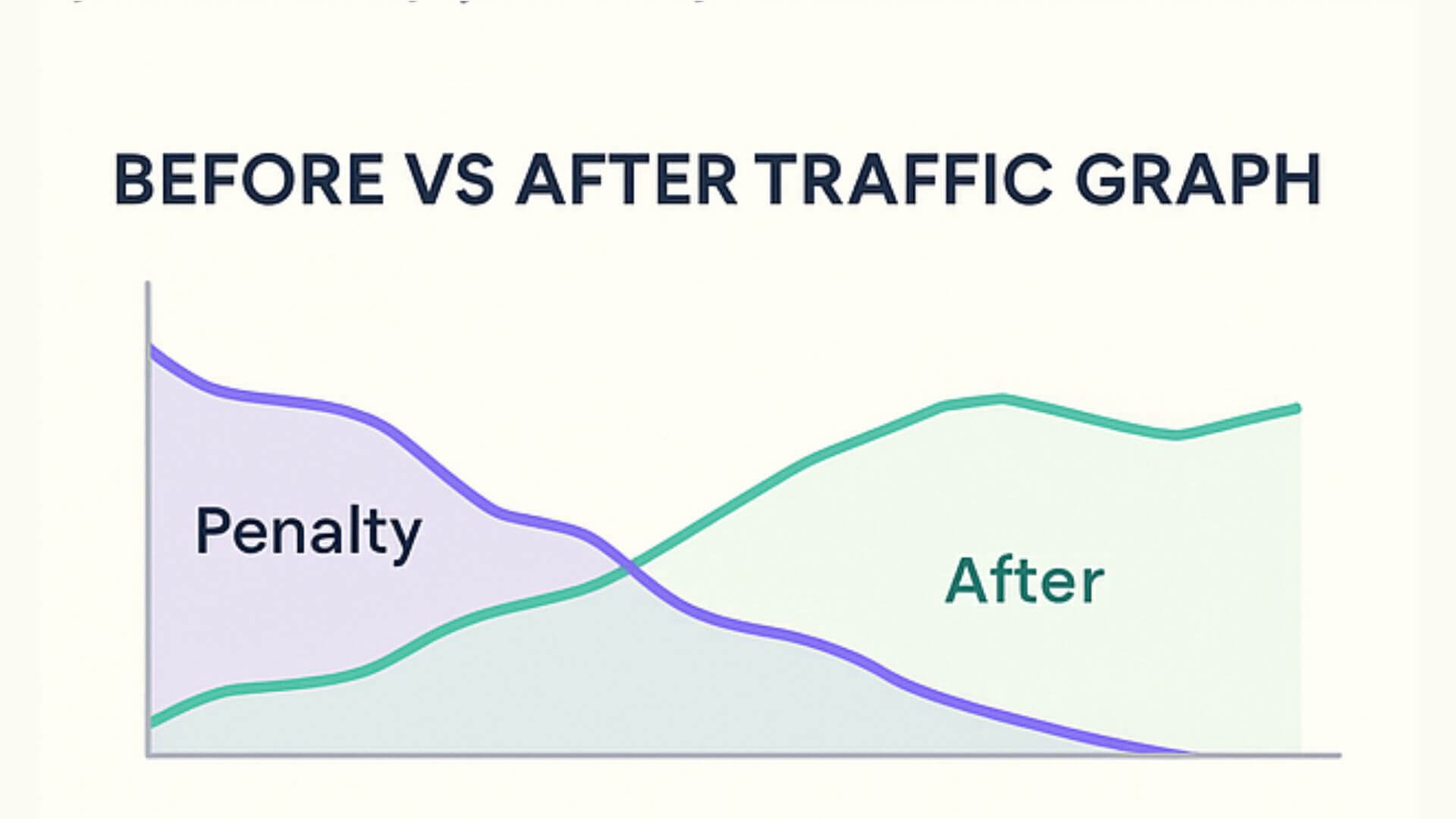
- Compare your traffic drop against known Google algorithm updates (via tools like Moz, SEMrush, or RankRanger).
- Sudden drops after recent SEO changes may indicate an algorithmic penalty.
Comprehensive Site Audit
Use tools like Screaming Frog, Ahrefs, SEMrush to crawl your site and flag issues:
- Broken links, redirect loops
- Duplicate content or conflicting canonicals
- Thin pages (low word count, shallow content)
- Hidden or cloaked content
- Malware, hacks, or injected code
- Mobile usability and site speed issues
Backlink Profile Audit
- Export backlinks from Google Search Console and third-party tools.
- Identify toxic, low-quality irrelevant domains
- Create a list of toxic links to request removal or disavow.
At the end of this phase, you should have a list of all “issues to fix” grouped by category (content, links, technical, security).
Phase 2: Clean-up & Recovery Steps
Bad Link Removal & Disavow
- First, reach out to webmasters requesting removal of bad links.
- If they don’t comply, compile a disavow file (disavow.txt) and submit in Google Search Console.
- Keep records of your outreach for transparency.
Content Rescue & Quality Improvements
- Remove or combine low-performing or duplicated pages.
- Expand thin content with deeper information, examples, visuals, and internal links.
- Add E-E-A-T signals like author bios, external citations, and last updated dates.
- Recheck for keyword stuffing and unnatural links.
Security & Clean-Up
- If your site was hacked: clean infected files and update CMS/plugins.
- Reinforce protection: SSL, strong passwords, two-factor login, and firewall.
Technical Fixes
- Correct redirect chains, fix broken links, and check canonical tags.
- Optimise site speed (compress images, minify code, use CDN).
- Ensure full mobile responsiveness and remove intrusive interstitials.
Submit Reconsideration (Only for Manual Actions)
When all fixes are done:
- Draft a transparent, concise explanation of what was fixed.
- Highlight the steps taken, tools used, and learnings.
- Submit via Search Console > Manual Actions > Request Review.
- Wait for response (typically within 2–6 weeks).
Phase 3: Monitor, Learn & Prevent
Monitor Recovery Progress
- Monitor traffic, impressions, and rankings over weeks and months.
- Use Google Analytics 4 and Search Console to compare pre- and post-recovery.
- Set alerts for sudden drops or spikes in performance.
SEO Hygiene: Prevention Plan
- Schedule monthly audits (content, links, and technical health).
- Use backlink monitoring tools to auto-flag toxic domains.
- Avoid black-hat tactics like link buying or AI content spinning.
- Stay updated with Google algorithm changes.
Use a Recovery Roadmap
Below is a suggested timeline.
Period | Key Focus |
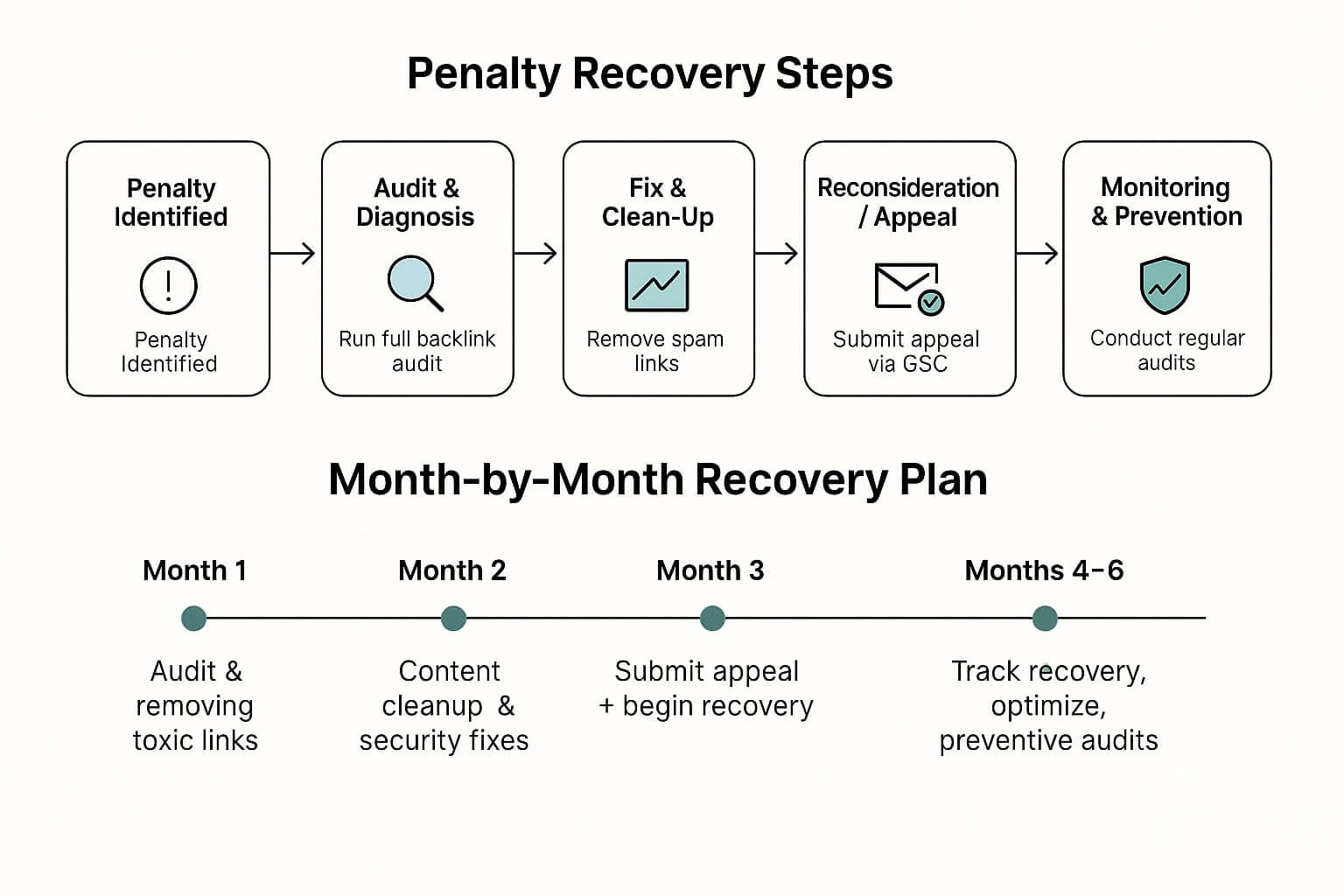
Weeks 1–2 | Full audit & issue diagnosis |
Weeks 3–6 | Execute fix actions (links, content, technical) |
Week 7 | Reconsideration request (if applicable) |
Months 3–6 | Track recovery, adjust, and reinforce SEO weakest spots |
 Localised Examples & Caution Notes
Google penalties are not just a global issue, they happen right here in Malaysia too. Many local websites have faced drops in traffic, rankings, and visibility due to overlooked SEO risks. Here’s what to watch out for.
Common SEO Penalty Triggers in Malaysia
Fake Product Reviews
Some eCommerce and affiliate sites in Malaysia were hit by manual actions due to publishing generic or AI-generated reviews without real product testing or author transparency. Google’s algorithm now prioritises first-hand experience and E‑E‑A‑T signals in review content.
Spammy Directory Backlinks
Low-quality backlinks from mass Malaysian business directories (especially those with duplicate or outdated listings) triggered link-related penalties. These directories often lack editorial oversight and dilute trust signals.
Content Cloning Across Regions
Businesses operating across ASEAN sometimes copy-paste the same content across their .my, .sg, or .id domains without hreflang or canonical setup. This creates duplicate content flags, weakening SEO performance for all regional sites.
Local SEO Caution Tips
Maintain Documentation
Always keep a record of link removal requests, content rewrites, disavow files, and appeal submissions. If Google requests a follow-up, these logs serve as evidence of your effort and good faith.
Don’t Reuse Black Hat Tactics
Avoid the temptation to “fix penalties” by using similarly risky shortcuts — like replacing one spammy link with another, or spinning content instead of rewriting. Google tracks patterns, and repeated offenses often lead to harsher penalties or long-term suppression.
Work With Trusted Local Partners
If outsourcing SEO work, always verify that your vendor follows white-hat best practices. Many Malaysian SMEs unknowingly get penalised because their SEO provider prioritised volume over quality.
Tools to Include in Recovery
Tool | Purpose | Notable Use |
Google Search Console | Detect penalties, submit reconsideration requests | Manual Actions, Indexing, Coverage |
Ahrefs / SEMrush | Backlink audit, keyword tracking | Toxic links, anchor text analysis |
Screaming Frog SEO Spider | Full site crawl | Technical SEO, duplicate content, canonical issues |
Disavow File Generator | Compile & format links to disavow | Quick export in .txt format |
MalCare / Sucuri | Malware & security scanning | Useful for hacked sites |
Sitebulb / PageSpeed Insights | Performance and accessibility check | Core Web Vitals & mobile speed |
Wayback Machine | View old versions of your site | Useful to detect cloaking or hidden changes |
Conclusion
While SEO penalties can significantly hurt your rankings and traffic, recovery is entirely possible with a structured, data-driven approach. A full audit, transparent clean-up, and consistent monitoring are key to rebuilding trust with Google and restoring long-term site health.
If you’d rather skip the trial-and-error, Rankpage SEO expert in Malaysia can help you diagnose issues, implement clean-up actions, and accelerate recovery with proven white-hat strategies, so your website not only bounces back but grows stronger than before.