Many Sales as a Service (SaaS) companies invest heavily into product development, paid ads, and outbound sales, yet still struggle to generate sustainable inbound traffic.
The issue is rarely that SEO “doesn’t work.” More often, SaaS companies approach SEO using outdated strategies that no longer match how modern software buyers search, compare, and make decisions.
In 2026, SaaS SEO services are no longer just about ranking blog articles. Many B2B buyers do extensive self-research before requesting a demo or starting a free trial, across search, communities, review platforms, social content, and AI-powered search experiences.
This means SaaS SEO has evolved into a broader visibility strategy involving:
- Search intent alignment
- Product-led SEO
- AI visibility
- Conversion-focused landing pages
- Entity authority
- Industry-specific search targeting
Why Malaysia Needs a Different SaaS SEO Approach
For SaaS companies in Malaysia, the landscape is more localised because buyer priorities can differ from market to market, especially for SMEs.
Many Malaysian SMEs evaluating SaaS weigh pricing transparency and hands-on onboarding/support very heavily. Compliance questions also come up more often, including PDPA obligations and whether your workflows are e-Invoice ready under Malaysia’s phased rollout.
A company searching for CRM software in the United States may focus heavily on integrations and scalability. A Malaysian SME may care more about onboarding support, implementation timelines, responsiveness on channels like WhatsApp, and monthly subscription affordability.
That difference matters, but you should validate your exact buyer priorities using your own sales notes, support tickets, and CRM data.
What Is SaaS SEO?
SaaS SEO refers to search engine optimisation strategies specifically designed for software-as-a-service businesses.
Unlike traditional SEO campaigns that focus mainly on traffic growth, SaaS SEO aims to attract users who are actively researching software solutions and guide them toward:
- Demo signups
- Free trials
- Sales consultations
- Subscription purchases
- Product adoption
The customer journey is often longer and more research-heavy than traditional ecommerce or local business SEO.
For example, someone buying a T-shirt may convert in minutes. A business investing in ERP software may spend weeks comparing:
- Features
- Integrations
- Pricing
- Support
- Compliance readiness
- Migration difficulty
- Vendor reputation
This creates a very different SEO environment.
Why SaaS SEO Is Different From Traditional SEO
Many businesses assume SEO works similarly across all industries.
It does not.
SaaS SEO usually involves:
- Longer sales cycles
- Multiple stakeholders
- Higher competition
- More educational content
- More comparison-based intent
- More technical queries
A software buyer may involve:
- Founders
- IT departments
- Finance teams
- HR departments
- Procurement staff
Each stakeholder searches differently.
Example of SaaS Search Intent Layers
| Buyer Stage | Search Example | Intent |
|---|---|---|
| Awareness | What is CRM software | Learning |
| Consideration | Best CRM software Malaysia | Evaluation |
| Decision | HubSpot vs Zoho CRM | Comparison |
| Purchase | CRM software pricing Malaysia | Transactional |
This is why SaaS SEO often requires:
- Blog content
- Comparison pages
- Alternatives pages
- Feature pages
- Industry landing pages
- Pricing explainers
- Integration pages
rather than relying only on educational articles.
Why SaaS SEO Matters More in 2026
SEO has become increasingly important for SaaS companies because many teams are seeing higher paid acquisition benchmarks and tighter competition for attention, which increases the value of compounding organic demand capture.
Many SaaS brands now face:
- More expensive Google Ads
- Higher LinkedIn ad costs
- Lower cold outreach effectiveness
- More crowded software marketplaces
At the same time, software buyers are researching more independently before speaking to sales teams. B2B buyers increasingly prefer self-research before vendor engagement, which means search visibility influences:
- Brand trust
- Awareness
- Consideration
- Conversion readiness
Organic search also compounds over time.
Unlike paid ads that stop generating traffic once budgets pause, strong SaaS SEO assets can continue generating:
- Organic traffic
- Qualified leads
- Demo requests
- Brand awareness
for months or years.
How SaaS Buyers Search in Malaysia
One of the biggest weaknesses in most SaaS SEO articles is the lack of regional context.
Most global SaaS SEO guides assume:
- US-based buyers
- Enterprise-level budgets
- Mature SaaS adoption
- English-only search behaviour
Malaysia behaves differently.
Common Malaysian SaaS Buyer Priorities
| Priority | Why It Matters |
|---|---|
| Pricing transparency | SMEs often manage tight budgets |
| Local support | Faster onboarding builds trust |
| Compliance | PDPA obligations and phased e-Invoicing rollout (“e-Invoice ready”) |
| WhatsApp accessibility | Faster communication and reassurance |
| Industry fit | SMEs prefer solutions tailored to their workflows |
| Payment flexibility | Cashflow and budget planning |
This creates strong opportunities for localised SEO targeting.
Common Local SaaS Searches
| Search Intent | Example |
|---|---|
| Geo-based | CRM software Malaysia |
| SME-focused | Accounting software for SMEs |
| Compliance-driven | e-Invoice software Malaysia |
| Industry-specific | POS system for restaurants |
| Comparison intent | SQL vs AutoCount |
| Pricing searches | HR software pricing Malaysia |
These keywords often have:
- Higher conversion intent
- Stronger local relevance
- Better lead quality
compared to generic global keywords.
The Most Important SaaS SEO Pages
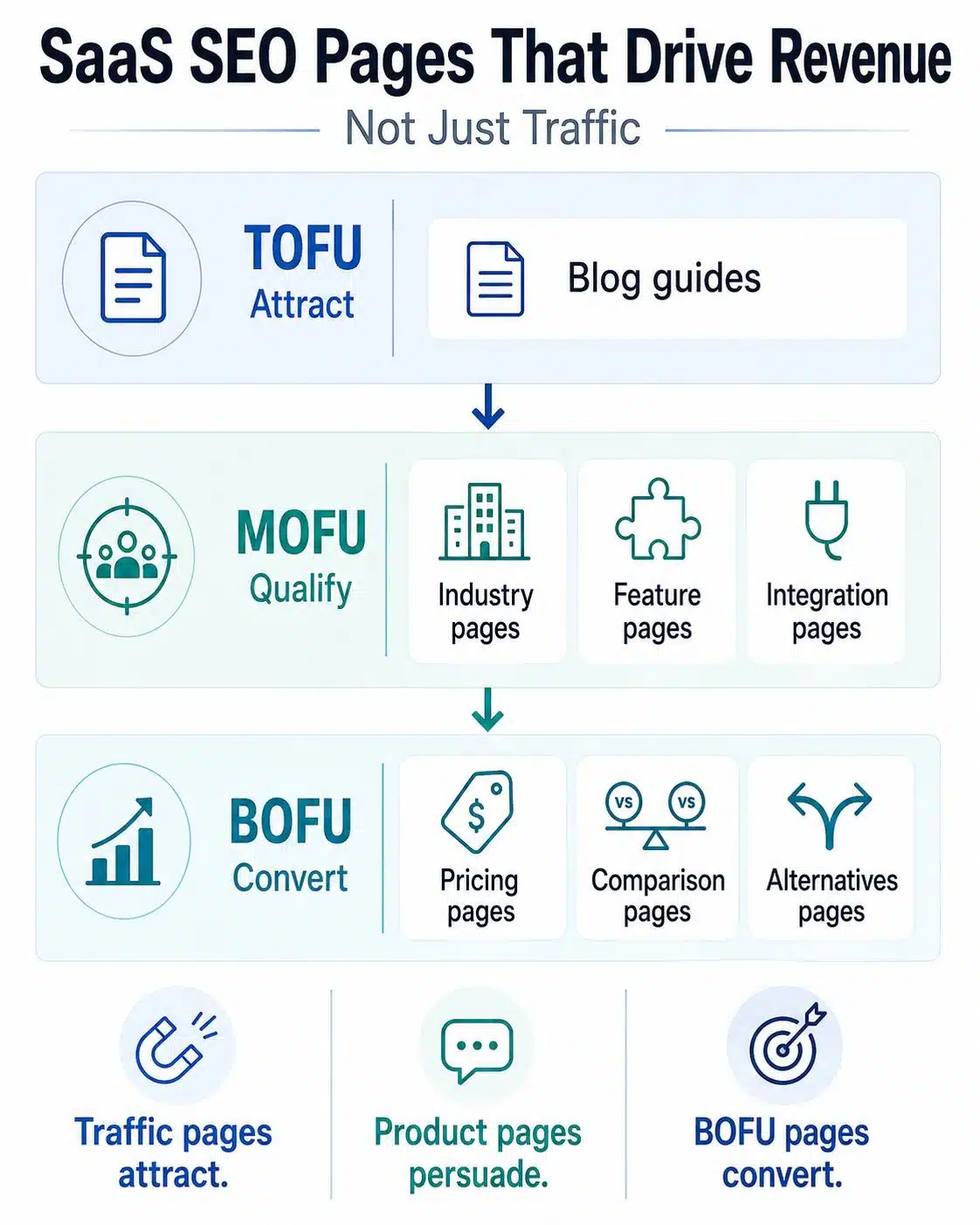
Many SaaS companies focus too heavily on blogs while ignoring their highest-converting SEO assets.
Traffic alone does not generate recurring revenue.
High-performing SaaS SEO strategies usually rely heavily on commercial-intent pages.
High-Converting SaaS SEO Page Types
| Page Type | Main Purpose |
|---|---|
| Comparison pages | Convert evaluating buyers |
| Alternatives pages | Capture competitor traffic |
| Pricing pages | Support BOFU intent |
| Industry pages | Improve niche targeting |
| Feature pages | Match product-specific searches |
| Integration pages | Capture ecosystem searches |
| Blog guides | Build awareness and authority |
A SaaS company with 300 blog articles but weak pricing and comparison pages may still struggle to convert traffic effectively.
Why Comparison Pages Work So Well
Comparison searches are often some of the highest-intent SaaS keywords.
When users search:
- Salesforce vs HubSpot
- AutoCount vs SQL
- Best payroll software Malaysia
they are usually already evaluating solutions seriously.
Comparison pages work because they:
- Match buyer intent directly
- Reduce decision friction
- Build authority
- Improve trust
- Support conversion readiness
Strong comparison pages should include:
- Pricing context (clear ranges or tiers if possible)
- Feature breakdowns
- Industry suitability
- Support model and onboarding expectations
- Integration differences
- Ideal business sizes
This is where many SaaS companies can outperform larger competitors through localisation and clarity.
SaaS Keyword Research Strategy
Keyword research for SaaS companies should focus heavily on intent mapping.
Many SaaS websites make the mistake of targeting broad vanity keywords with weak conversion potential.
A keyword with 500 monthly searches but strong demo intent may outperform a 10,000-search informational keyword.
Top-of-Funnel Keywords
These searches focus on awareness and education.
Examples include:
- What is ERP software
- Benefits of CRM systems
- How payroll automation works
These articles help:
- Build topical authority
- Attract awareness traffic
- Support internal linking
Middle-of-Funnel Keywords
These users are evaluating options.
Examples include:
- Best CRM software Malaysia
- Payroll software comparison
- SaaS software for SMEs
These keywords often generate stronger lead quality.
Bottom-of-Funnel Keywords
These are often the highest-value SaaS SEO keywords.
Examples include:
- CRM software pricing
- HR software demo
- Accounting software free trial
These users are close to making decisions.
Product-Led SEO for SaaS Companies
One of the fastest-growing SaaS SEO strategies is product-led SEO.
Instead of relying entirely on blogs, product-led SEO creates scalable pages tied directly to the software experience.
Examples of Product-Led SEO
| Strategy | Example |
|---|---|
| Template pages | Invoice templates |
| Free tools | ROI calculators |
| Integration pages | Slack + CRM integrations |
| Industry pages | HR software for clinics |
| Programmatic SEO | City or niche landing pages |
Companies like Canva and Zapier scaled heavily using product-led SEO because their products naturally generate searchable pages.
This strategy works well because it:
- Targets long-tail searches
- Improves scalability
- Increases relevance
- Creates natural internal linking
- Supports user engagement
Technical SEO for SaaS Websites
Technical SEO becomes especially important for SaaS websites because software platforms often contain:
- JavaScript-heavy interfaces
- Dynamic rendering
- Complex site structures
- Large documentation hubs
- Multiple integrations
Common SaaS Technical SEO Issues
| Issue | SEO Impact |
|---|---|
| Slow loading pages | Higher bounce rates |
| Crawl issues | Indexing problems |
| Duplicate pages | Keyword cannibalisation |
| Weak internal linking | Poor authority flow |
| Thin landing pages | Lower relevance |
Many SaaS companies accidentally block search visibility through:
- Poor rendering
- Overcomplicated navigation
- Weak information architecture
Technical SEO improvements often generate faster SEO gains compared to publishing more content.
SaaS SEO and AI Search Visibility
AI search is changing how software buyers discover SaaS companies.
Users increasingly ask tools like ChatGPT questions such as:
- “Best payroll software for Malaysian SMEs”
- “Affordable CRM software in Malaysia”
- “Top HR software with e-Invoice support”
This means SEO is no longer just about traditional Google rankings.
SaaS companies increasingly need:
- Answer Engine Optimisation (AEO)
- Entity SEO
- AI-friendly formatting
- Structured information architecture
Google’s AI Overviews and other AI search experiences are evolving quickly, which increases the payoff of clear structure, strong entities, and content that’s easy for systems to extract and cite.
Ways To Improve AI Visibility
| Strategy | Purpose |
|---|---|
| Clear summaries | Easier AI extraction |
| FAQ sections | Conversational matching |
| Comparison tables | Better machine readability |
| Entity consistency | Stronger authority signals |
| Structured data | Improved indexing |
Content written clearly and conversationally often performs better in AI-driven search environments.
Common SaaS SEO Mistakes
Many SaaS companies unknowingly weaken their SEO potential.
Over-Focusing on Traffic
Traffic without conversions creates misleading success metrics.
A SaaS company should care about:
- Demo requests
- Trial signups
- Lead quality
- Revenue attribution
not just rankings alone.
Publishing Generic AI Content
Many SaaS blogs now sound identical because they rely heavily on low-quality AI generation.
This creates:
- Weak differentiation
- Lower EEAT signals
- Poor engagement
- Thin topical value
Strong SaaS SEO still requires:
- Real product understanding
- Industry context
- Practical examples
- Editorial judgement
Ignoring BOFU Intent
Some SaaS websites publish dozens of educational blogs but neglect:
- Pricing pages
- Comparison pages
- Alternatives pages
- Industry landing pages
These are often the pages that drive conversions.
How Long Does SaaS SEO Take?
SaaS SEO is usually a medium-to-long-term strategy.
Typical SEO Timeline
| Timeline | Expected Outcome |
|---|---|
| 1–3 months | Technical improvements |
| 3–6 months | Early ranking growth |
| 6–12 months | Stronger lead generation |
| 12+ months | Compounding authority growth |
Highly competitive SaaS niches may require:
- Consistent publishing
- Strong backlinks
- Technical optimisation
- Product-led SEO
- Ongoing refinement
SEO is usually slower initially but more sustainable long term compared to pure paid acquisition.
SaaS SEO Costs in Malaysia
SEO costs vary significantly depending on:
- Competition
- Technical complexity
- Content volume
- Industry niche
- SEO goals
Common SaaS SEO Cost Areas
| SEO Area | Investment Level |
|---|---|
| Technical SEO | Medium to high |
| Content creation | Ongoing |
| Link building | Ongoing |
| AI SEO optimisation | Emerging |
| Programmatic SEO | Higher setup cost |
Many SaaS companies view SEO as expensive initially but cost-efficient over time due to compounding traffic growth.
Challenges SaaS Companies Face With SEO
Competing Against Large Global Brands
Many SaaS keywords are dominated by:
- HubSpot
- Salesforce
- Monday.com
- Zoho
- Asana
Competing broadly can become difficult.
Smaller SaaS companies often perform better by targeting:
- Long-tail searches
- Industry niches
- Localised keywords
- Compliance-related intent
Balancing Product and Marketing
SEO content sometimes becomes disconnected from actual buyer pain points.
The strongest SaaS SEO strategies align:
- Product positioning
- Search intent
- Customer concerns
- Sales objections
- Onboarding realities
Scaling Content Without Losing Quality
Many SaaS brands publish excessive low-quality content to chase traffic.
This creates:
- Weak engagement
- Template-like articles
- Poor differentiation
Quality usually matters more than raw publishing volume.
Why SaaS SEO is Vital For Your Company
SaaS SEO in 2026 is increasingly tied to visibility, trust, AI discoverability, and conversion intent rather than simple traffic growth alone. The companies that perform best are usually the ones that combine technical SEO, product-led SEO, localisation, BOFU targeting, and AI-friendly content structures into a long-term organic growth strategy.
For SaaS companies in Malaysia, localisation can become a major competitive advantage. Pricing transparency, onboarding support, compliance readiness, and industry-specific positioning often matter just as much as rankings themselves, especially when they’re reflected clearly in BOFU pages like pricing, comparisons, and industry landing pages.
If your SaaS company wants to improve organic visibility, demo signups, and long-term inbound growth, partnering with an experienced SEO agency can help build a stronger strategy foundation. At Rankpage, Malaysia’s number one SEO agency, we help businesses develop scalable SEO strategies tailored for modern search behaviour, AI visibility, and conversion-focused growth. Don’t miss your chance, contact Rankpage today!
Sources
- Semrush
- Marketer Milk
- Directive Consulting
- SEOptimer
- Design Revision
- Google Search Central
- Ahrefs
- HubSpot
- Gartner
- Statista
FAQs
What Is SaaS SEO?
SaaS SEO refers to search engine optimisation strategies designed specifically for software-as-a-service businesses. The goal is to improve visibility for software-related searches that can lead to demos, free trials, and recurring subscriptions.
Why Is SaaS SEO Different From Traditional SEO?
SaaS SEO usually involves longer sales cycles, more educational searches, comparison intent, and multiple stakeholders. Buyers often research software extensively before making purchasing decisions.
How Long Does SaaS SEO Usually Take?
Most SaaS SEO campaigns require several months before meaningful results appear. Technical improvements may create early gains, while stronger rankings and lead generation often take 6 to 12 months or longer.
What Are The Best Keywords For SaaS SEO?
The best SaaS SEO keywords usually include comparison searches, pricing intent, alternatives pages, industry-specific searches, and localised keywords such as “CRM software Malaysia” or “HR software pricing Malaysia.”
Does AI Search Affect SaaS SEO?
Yes. AI-driven search experiences such as ChatGPT and Google AI Overviews are changing how users discover software solutions. SaaS companies increasingly need AI-friendly content structures and AEO strategies to remain visible.
Is SEO Worth It For SaaS Companies In Malaysia?
Yes. SEO can help SaaS companies improve long-term visibility, reduce reliance on paid acquisition, and attract businesses actively searching for software solutions in Malaysia.