What is Traditional SEO?
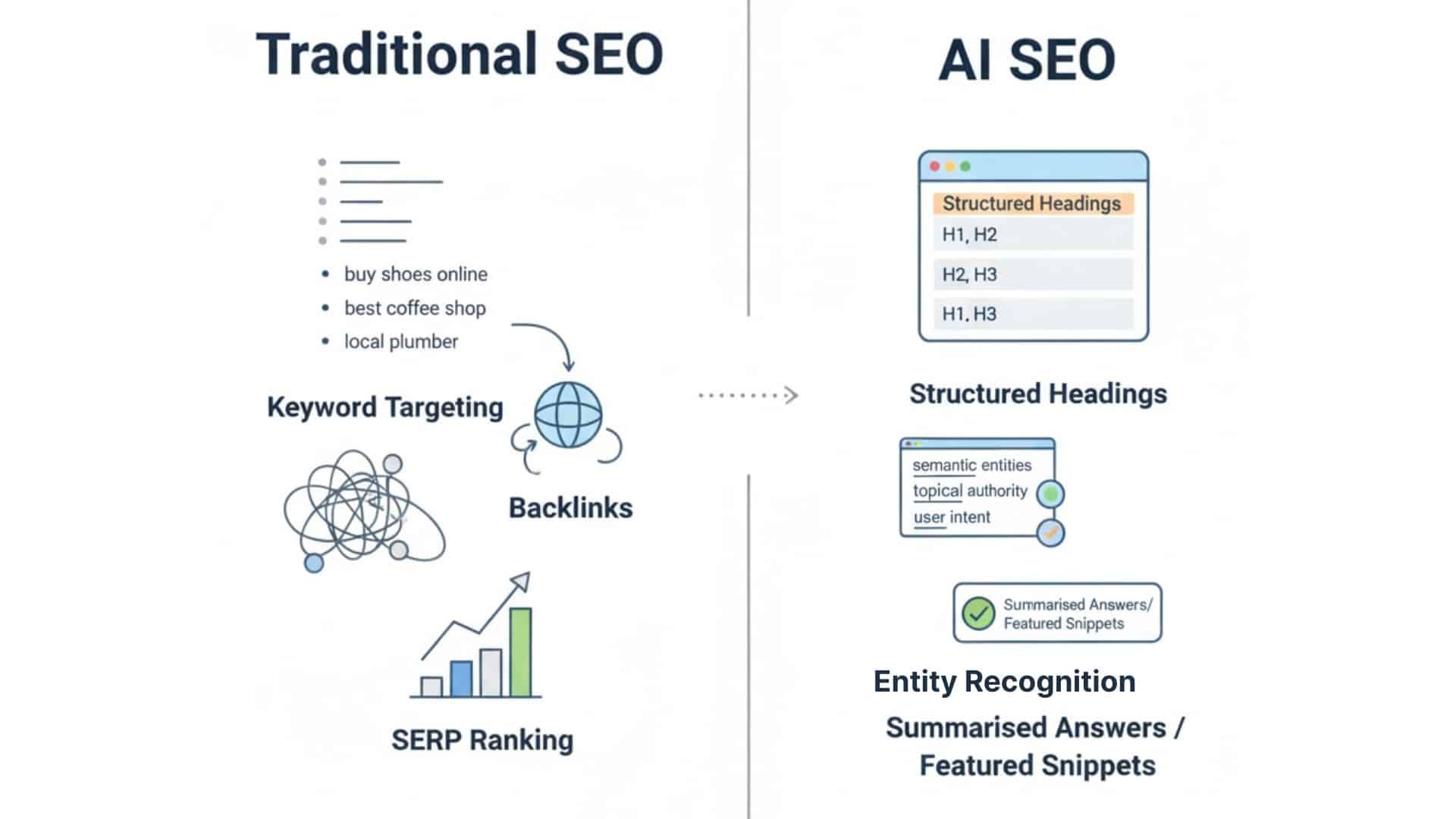
Traditional SEO optimises websites to rank in classic search results based on relevance and authority signals.
It typically focuses on:
- Keyword research and placement
- Backlink acquisition
- Page speed and mobile usability
- Meta tags and on-page optimisation
- Ranking positions in blue-link search results
At its core, traditional SEO answers one question:
“Which page deserves to rank highest for this keyword?”
Success is measured by impressions, clicks, and ranking positions.
What is AI SEO?
AI SEO optimises content so generative engines can confidently extract, summarise, and reuse accurate information from your website.
Instead of focusing on keyword density, AI SEO emphasises:
- Clear definitions and direct-answer sections
- Structured headings with predictable formatting
- Short, self-contained paragraphs
- Strong entity clarity around brands, services, and topics
- EEAT signals spread consistently across related pages
- Schema that supports machine understanding
AI SEO answers a different question:
“Which content can an AI model confidently quote or summarise?”
Visibility here is not limited to rankings. It includes appearing inside AI-generated answers.
How AI Search Engines Change Optimisation Logic
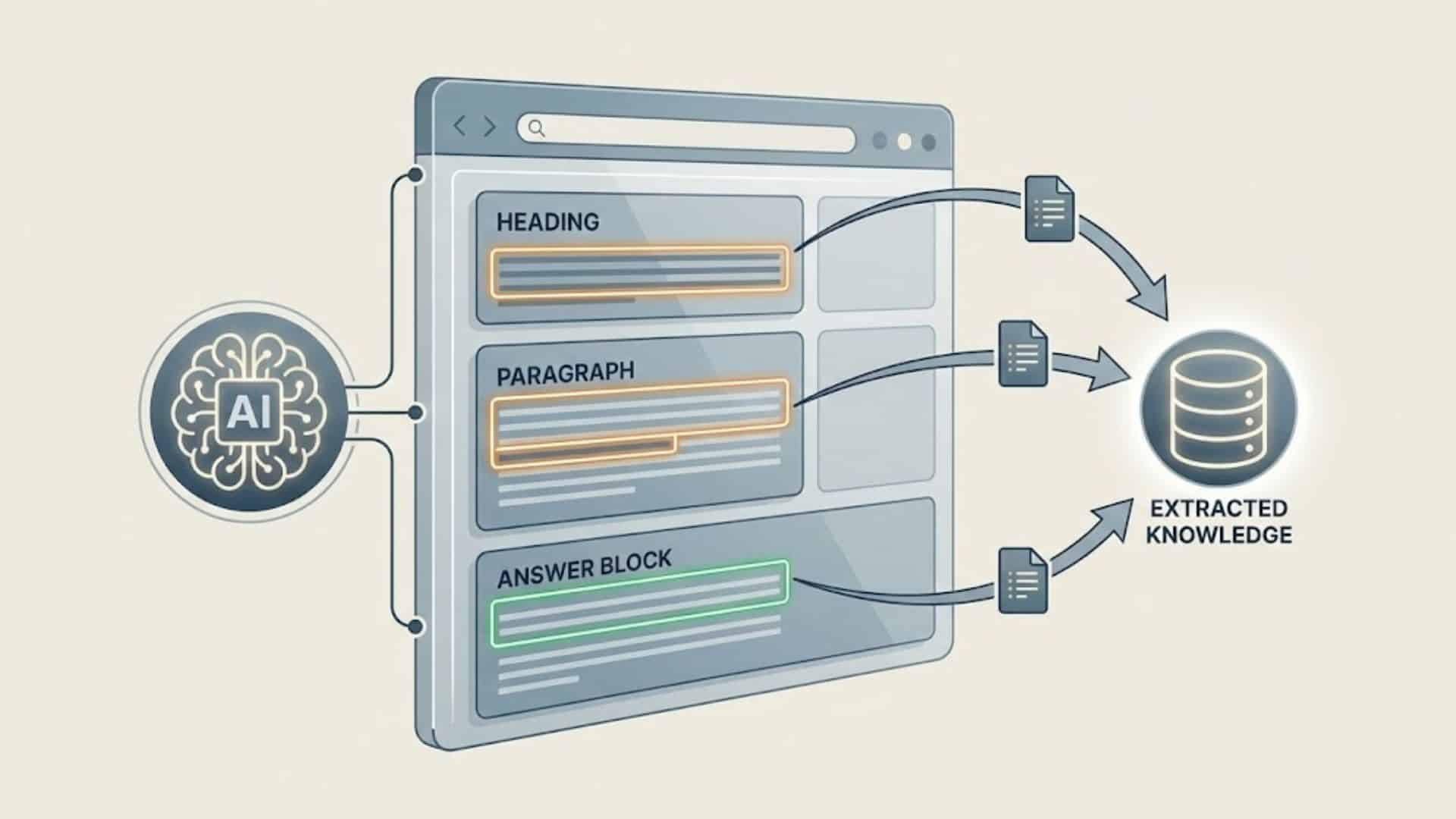
Generative engines such as Google SGE, ChatGPT, and Bing Copilot do not process content the same way traditional search engines do.
Instead, they:
- Break pages into meaning-based sections
- Identify answer-ready paragraphs
- Cross-check claims against known sources
- Evaluate consistency across related content
- Generate responses that may quote or paraphrase your site
This means a page can perform well in traditional rankings but still remain invisible in AI-generated answers if the content is not structured clearly.
AI SEO vs Traditional SEO: Side-by-Side Comparison
Area | Traditional SEO | AI SEO |
Primary Goal | Rank pages | Be quoted or summarised |
Main Focus | Keywords and backlinks | Meaning and clarity |
Content Style | Long-form, keyword-focused | Structured, answer-based |
Authority Signal | Backlinks | Topical consistency and EEAT |
Success Metric | SERP position | AI visibility and recall |
 Why Keyword Optimisation Alone Is No Longer Enough
Traditional SEO often asks:
“Does this page mention the keyword often enough?”
AI SEO asks:
“Can an AI model extract a clean, accurate answer from this section?”
Pages with dense paragraphs, mixed topics, or vague phrasing are difficult for AI to summarise, even if they rank well.
In contrast, pages that use:
- Clear headings
- Direct answers
- Predictable formatting
are easier for AI systems to understand and reuse.
How EEAT Differs Between AI SEO and Traditional SEO
In traditional SEO, EEAT is often treated as a supporting signal.
In AI SEO, EEAT becomes a validation requirement.
Generative engines evaluate:
- Whether claims remain consistent across multiple pages
- Whether authors demonstrate real experience
- Whether information aligns with widely accepted knowledge
- Whether the site shows depth rather than isolated coverage
This is why pillar-and-cluster content structures outperform standalone pages in AI-driven search environments.
Does AI SEO Replace Traditional SEO?
No. AI SEO extends traditional SEO rather than replacing it.
Traditional SEO still provides:
- Crawlability
- Indexation
- Technical foundations
- Baseline rankings
AI SEO builds on this foundation by:
- Improving answer extraction
- Increasing visibility in AI summaries
- Strengthening contextual authority
Websites that apply both approaches achieve wider coverage across classic search results and AI-generated responses.
When Businesses Need AI SEO Most
AI SEO becomes increasingly important when:
- Users search with full questions instead of short keywords
- AI summaries appear above organic results
- Visibility matters beyond first-page rankings
- Brand mentions inside AI answers influence decisions
In markets like Malaysia, where mobile and conversational search are common, AI SEO helps ensure content remains discoverable across evolving search surfaces.
Conclusion: Why AI SEO Now Sits Alongside Traditional SEO
Search behaviour has shifted from finding pages to extracting answers. Traditional SEO still matters for visibility and technical foundations, but it no longer tells the full story. AI SEO fills that gap by ensuring your content is structured, credible, and clear enough for generative engines to understand and reuse with confidence.
For businesses that want to stay visible across both classic search results and AI-generated answers, the focus is no longer just rankings, but recall, trust, and clarity at scale. That is where execution matters more than theory.
At Rankpage, optimising for AI search engines is approached as a practical extension of proven SEO foundations, aligning structure, entities, and EEAT signals so content performs across modern search surfaces. If your goal is not just to rank, but to be referenced, summarised, and remembered, AI SEO becomes a natural next step.