Cybersecurity SEO is not just about rankings, it is about trust, risk, and real-world consequences.
Unlike most industries, cybersecurity operates in a high-stakes environment. A single breach can result in financial loss, reputational damage, and regulatory penalties. Because of this, buyers do not simply search and convert. They research, compare, and validate extensively before making a decision.
In Malaysia, this dynamic is becoming even more pronounced. Digital adoption across SMEs, financial institutions, and government-linked sectors has accelerated, but so have cyber threats. Businesses are actively searching for trusted cybersecurity partners, not just vendors.
That is where cybersecurity SEO services come in. Done correctly, it transforms your firm from just another service provider into a trusted authority that appears at the exact moment buyers are looking for solutions.
Cybersecurity in Malaysia: Why the Stakes Are Rising
Malaysia’s rapid digitalisation is driving both opportunity and cyber risk at an unprecedented scale.
Malaysia is no longer an emerging digital economy. It is deeply embedded in digital infrastructure, e-commerce, and cloud-based operations. This expansion increases both the attack surface and the urgency for cybersecurity solutions.
Key statistics shaping the landscape
- ICT and e-commerce contributed 23.5% of Malaysia’s economy (RM427.7 billion)
- According to Kaspersky, businesses and organisations in Malaysia faced 19.62 million web-based attacks in 1H 2024, one of the highest totals in Southeast Asia.
- Official data from Cyber999 (CyberSecurity Malaysia) recorded 5,735 cyber incident reports as of September 2025 (the first nine months), continuing an upward trend.
- Media reports cited scam-related losses of approximately RM2.7 billion in 2025 (as reported by Fortinet Malaysia), highlighting the rising financial impact of online fraud.
- In Cyber999’s Q3 2025 reporting, phishing made up about 75% of reported fraud incidents, showing how dominant phishing remains in Malaysia’s fraud landscape.
What this means for cybersecurity firms
- Demand for cybersecurity is no longer optional, it is structural.
- Businesses are actively searching for protection, not just information.
- Compliance pressure is increasing across industries.
- Cybersecurity is now a board-level priority.
When companies search:
- “cybersecurity Malaysia”
- “cybersecurity services Malaysia”
- “data protection compliance Malaysia”
They are not browsing. They are evaluating vendors under urgency and risk.
What Is Cybersecurity SEO (And Why It Matters More Than Ever)?
Cybersecurity SEO is the process of optimising your online presence to rank for high-intent cybersecurity searches while building authority, trust, and compliance credibility.
What makes cybersecurity SEO different
- Requires strong E-E-A-T signals (experience, expertise, authoritativeness, trust)
- Must align with regulatory expectations and privacy practices
- Targets risk-aware buyers with longer evaluation cycles
Traditional SEO vs Cybersecurity SEO
Focus
- Traditional SEO: Traffic
- Cybersecurity SEO: Trust and authority
Content
- Traditional SEO: Informational
- Cybersecurity SEO: Risk and compliance driven
Conversion
- Traditional SEO: Faster decisions
- Cybersecurity SEO: Long B2B cycles
Ranking signals
- Traditional SEO: Backlinks
- Cybersecurity SEO: Backlinks plus proof (certifications, case studies, expert authorship)
In this industry, ranking alone is not enough. Trust determines whether a lead converts.
Why Cybersecurity Firms in Malaysia Need SEO Now
The market is growing fast, but visibility is becoming harder to earn.
Malaysia’s digital economy contributes over 23% of the economy, while online scams and fraud continue to generate major losses. This makes cybersecurity one of the most trust-driven industries in search today.
In the financial sector, Bank Negara Malaysia has strengthened expectations around technology and cyber risk through updates to its Risk Management in Technology (RMiT) policy requirements.
Without SEO
- Leads depend on referrals
- Growth is unpredictable
With SEO
- You capture high-intent demand consistently
- You build authority before first contact
- You reduce reliance on paid channels
Who Needs Cybersecurity SEO the Most?
Cybersecurity SEO is essential for firms operating in competitive or regulated sectors.
Key segments
- Managed security service providers (MSSP)
- SOC-as-a-service providers
- Penetration testing firms
- Compliance and advisory firms
High-value industries
- Finance
- Healthcare
- Government-linked organisations
- SMEs undergoing digital transformation
Each segment requires tailored messaging based on risk, compliance, and decision-making processes.
What Do Malaysian Buyers Actually Search For?
Cybersecurity searches are driven by urgency, compliance, and risk mitigation.
Keyword intent breakdown
- Commercial: cybersecurity services Malaysia
- Informational: what is ransomware
- Compliance: PDPA requirements Malaysia
- Transactional: cybersecurity company KL
Insights
- Long-tail keywords often convert better.
- Compliance-related queries can indicate strong purchase intent.
Malaysian buyers often include location modifiers and industry context in their searches, for example:
- “cybersecurity for fintech Malaysia”
- “SOC services for SME KL”
This creates an opportunity for hyper-targeted landing pages that directly address niche needs.
The Role of Compliance in Cybersecurity SEO
Compliance is a major conversion factor in cybersecurity SEO, and it can strengthen trust signals when handled correctly.
Important frameworks and expectations to reference responsibly
- Personal Data Protection Act 2010 (PDPA): relevant to how you collect, store, and process personal data (and how you communicate privacy practices)
- CyberSecurity Malaysia / MyCERT guidance: useful for awareness content and incident trends
- Bank Negara Malaysia (RMiT) ): important for financial-sector cybersecurity expectations
How to leverage compliance in content
- Publish regulatory explainers in plain English
- Provide practical checklists (with disclaimers that it’s informational)
- Address industry-specific requirements
Instead of generic compliance pages, build sector-specific compliance hubs, for example:
- PDPA-aligned privacy practices for healthcare providers
- RMiT-aligned cybersecurity readiness for financial institutions
This improves both relevance and conversion rates.
How to Build Trust (E-E-A-T for Cybersecurity)
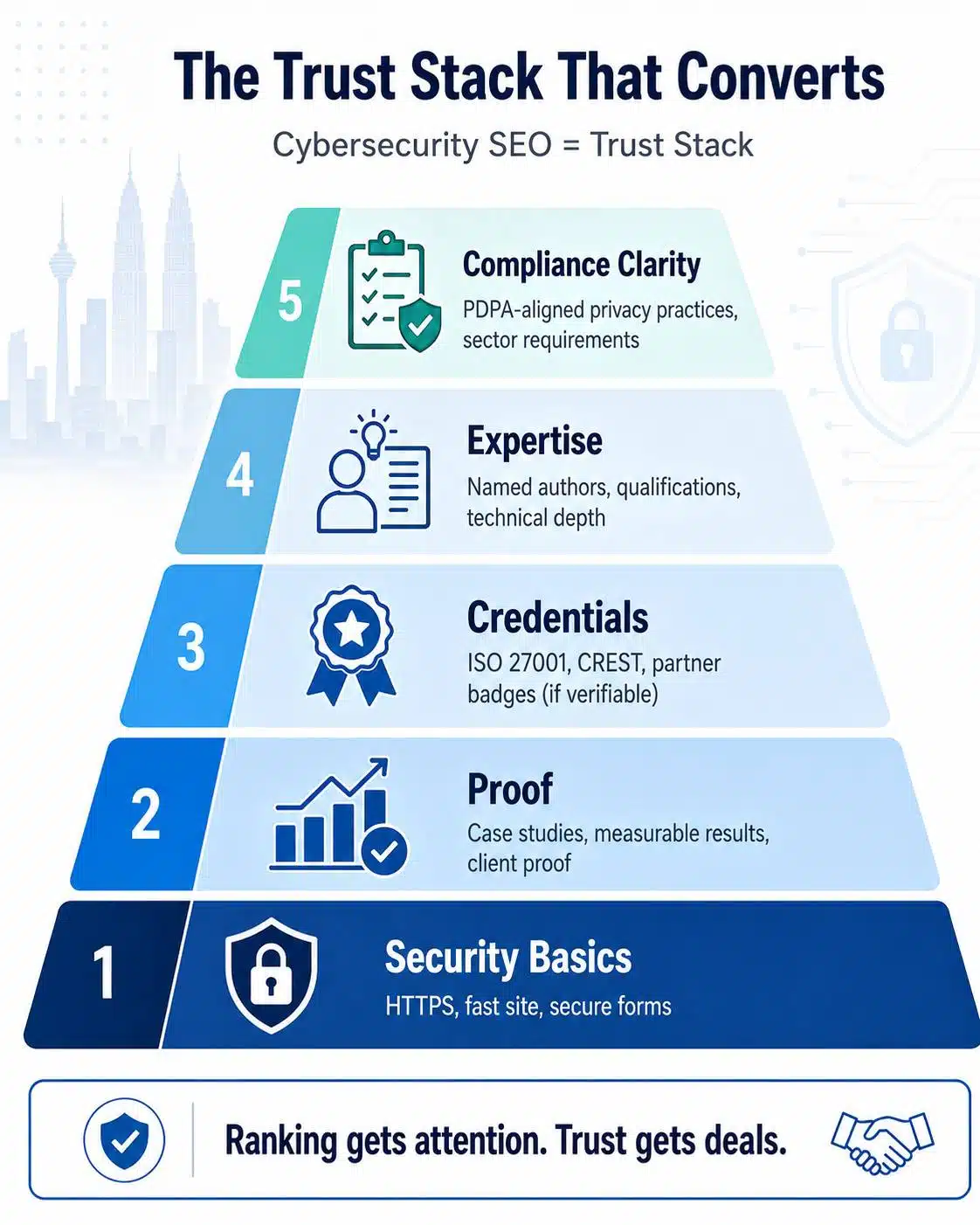
Trust is one of the strongest conversion signals in cybersecurity.
Trust signals
- Certifications: ISO 27001, CREST (where applicable)
- Experience: case studies with clear scope and outcomes
- Authority: media mentions, speaking engagements, community contributions
- Transparency: clear methodologies, pricing approach, and data handling statements
Must-have elements
- Real case studies
- Technical depth without fluff
- Expert authorship (named SMEs with credentials)
- Measurable outcomes (what improved, by how much)
Advanced tip: Include before-and-after metrics in case studies, for example:
- Reduced incident response time by 40%
- Improved patch compliance from X% to Y%
- Reduced successful phishing click-through rates after training
Content Strategy That Actually Converts
Cybersecurity content must connect risk to solutions.
High-performing content types
- Threat breakdowns (with defensive best practices)
- Compliance explainers
- Industry-specific solution pages
- Case studies and incident learnings
Effective structure
Problem → Risk → Impact → Solution → Proof
What most firms miss: they explain threats but do not quantify impact. Strong content includes:
- Financial implications
- Operational downtime
- Regulatory consequences
This aligns directly with buyer concerns.
Technical SEO for Cybersecurity Websites
Your website must reflect security credibility.
Essentials
- HTTPS
- Fast loading speed
- Mobile optimisation
- Clean site architecture
Additional credibility layer for cybersecurity firms
- Security badges and trust seals (only if legitimate and verifiable)
- Clear privacy policy and cookie notices
- Secure contact forms (and visible statements on how submissions are handled)
A poorly secured or slow website contradicts your core service offering.
Local SEO for Cybersecurity Firms in Malaysia
Local search plays a key role in vendor discovery.
Optimisation steps
- Google Business Profile
- Location pages (Kuala Lumpur, Penang, Johor, etc.)
- Local keywords and industry modifiers
Example:
- cybersecurity company Kuala Lumpur
Local advantage: Many global competitors lack local relevance. Malaysian firms can outperform them by focusing on:
- Local compliance context
- Local case studies
- Local partnerships
AI SEO for Cybersecurity (2026 Strategy)
Search visibility increasingly favors content that is helpful, credible, and easy to extract into clear answers.
Key tactics
- Structured content (clear headings, bullets, tables where helpful)
- Entity clarity (define services, industries, certifications, standards)
- Direct answers (FAQ sections that don’t dodge the question)
What this means in practice
- Use FAQ-style sections for buyer questions
- Answer questions directly in the first 2–3 lines
- Build topical authority with interconnected topic clusters
- Add structured data where it fits (FAQ, Organization, Service)
This helps search engines understand your pages and present them more effectively.
Step-by-Step: How to Implement Cybersecurity SEO
A structured approach delivers consistent results.
Framework
- Define target industries
- Map high-intent keywords
- Build compliance and trust pages
- Create authority content (case studies, guides, threat explainers)
- Optimise technical SEO
- Build relevant backlinks (partners, associations, credible publications)
- Track performance and iterate
Execution tip: Focus on one industry vertical first instead of targeting everyone at once. This accelerates authority building.
Common Challenges in Cybersecurity SEO
Cybersecurity SEO is complex and competitive.
Challenges
- Global competition
- Long sales cycles
- High trust barriers
- Technical complexity
How to overcome them
- Specialise in niches
- Build authority over time
- Invest in high-quality, expert-led content
- Use proof-heavy pages (case studies, certifications, methodology)
Costs of Cybersecurity SEO in Malaysia
SEO investment depends on scale, competition, and how much proof-heavy content you need.
Indicative monthly ranges (varies by scope)
Malaysia retainers vary widely; many agency guides cite roughly ~RM1,500 to RM10,000+ per month, with higher budgets common for enterprise, multi-location, or heavily regulated industries.
Cost drivers
- Expert content production (technical + compliance)
- Technical optimisation (performance, architecture)
- Link building and digital PR
- Case study development and proof assets
Reality check: Cybersecurity SEO often costs more than average SEO because of the expertise required and the trust barrier buyers have.
Cybersecurity SEO Is a Trust Engine
Cybersecurity SEO is not just about ranking higher. It is about becoming the provider businesses trust when risk is high and decisions matter.
Firms that invest in authority, proof, and well-structured, buyer-focused content will consistently outperform competitors in both traditional search and AI-driven discovery experiences.
At Rankpage, Malaysia’s number one SEO agency, we help cybersecurity companies build search strategies that generate trust, authority, and consistent inbound leads. If you are ready to turn your expertise into a scalable growth engine, our SEO team is ready to support your journey.
Sources
- Department of Statistics Malaysia (DOSM)
- CyberSecurity Malaysia / MyCERT (Cyber999)
- Bank Negara Malaysia (RMiT)
- Personal Data Protection Act 2010 (Malaysia PDPA)
- Malaysia Digital Economy Corporation (MDEC)
Frequently Asked Questions About Cybersecurity SEO in Malaysia
What Is Cybersecurity SEO?
Cybersecurity SEO is the process of optimising a cybersecurity company’s website to rank for relevant searches while building trust, authority, and compliance credibility.
Why Is SEO Important for Cybersecurity Companies?
SEO helps firms capture high-intent demand, build trust before first contact, and generate consistent B2B leads.
How Long Does Cybersecurity SEO Take to Work?
Many firms see early traction in around 3–6 months, but timelines vary by competition, site history, and implementation speed. Some changes can take weeks to months to reflect.
What Keywords Should Cybersecurity Firms Target?
Focus on high-intent terms like cybersecurity Malaysia, cybersecurity services Malaysia, and compliance-related searches (e.g., PDPA requirements Malaysia), plus industry/location modifiers.
Is Compliance Important for SEO in Cybersecurity?
Compliance strengthens trust and conversion. It’s especially powerful when you publish clear explainers, checklists, and sector-specific guidance (while keeping it informational, not legal advice).
How Does AI Search Affect Cybersecurity SEO?
AI-driven discovery tends to surface content that is clear, credible, and well-structured. Strong E-E-A-T signals, direct answers, and structured data can help your content be understood and presented effectively.