Structuring website content for direct AI answers means making each page easy to understand, retrieve and reference. For Malaysian businesses, this matters because search now includes AI-generated experiences such as Google AI Overviews and AI Mode, Microsoft Copilot, Bing and ChatGPT Search.
That does not mean abandoning SEO or writing robotic content. In fact, AI SEO complements traditional SEO.
Google continues to emphasise established SEO fundamentals for generative search, while Microsoft recommends clear, structured and useful content for AI-powered search experiences.
The goal is simple: create content that works well for people while making each section easy for search systems to interpret.
What Is a Direct AI Answer?
A direct AI answer is a generated response that answers a user’s question using information retrieved or synthesised from one or more sources.
Depending on the platform, it may include citations or links to the websites supporting the answer.
For example, someone searching:
“How much does SEO cost in Malaysia?”
may see an AI-generated summary explaining pricing models and influencing factors alongside links to supporting sources.
These answers can appear in:
- Google AI Overviews
- Google AI Mode
- Microsoft Copilot and Bing
- ChatGPT Search
This creates another visibility question for businesses.
Traditionally:
“Can my page rank?”
Now it is also useful to ask:
“Can a search system clearly understand and reference the answer on my page?”
The two are closely connected because pages still need to be discoverable and eligible for normal search visibility.
Read More: Google AI Mode: How It Works and What It Means for SEO
How Should You Structure the Opening Answer?
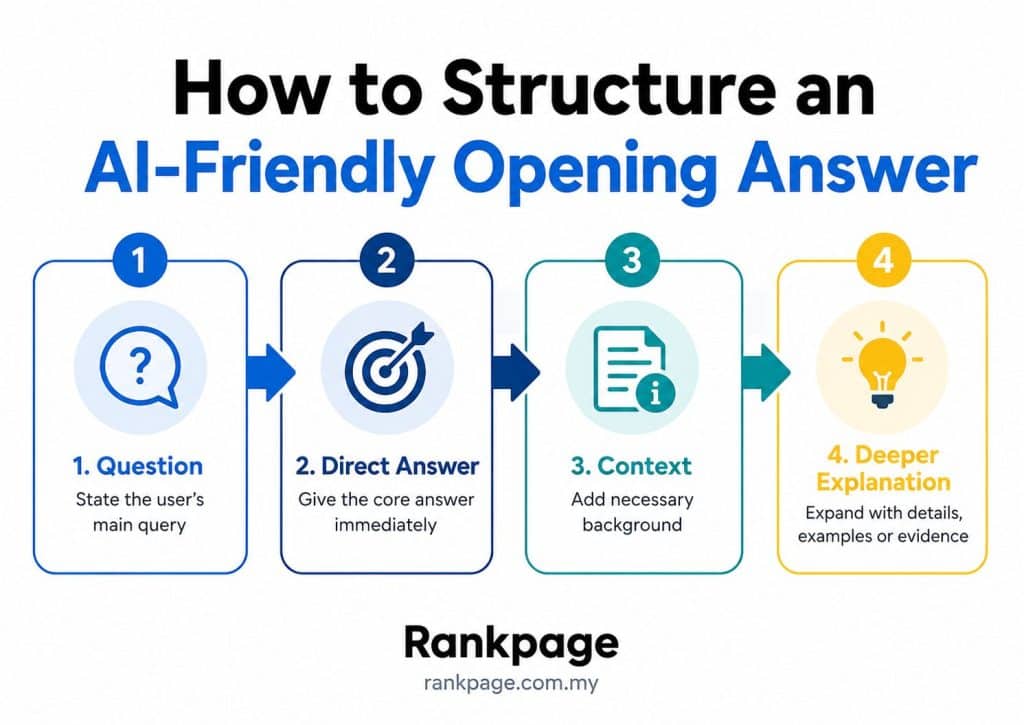
Give readers a clear answer to the primary question before moving into background information.
A useful structure is:
Question → Direct Answer → Context → Detail
For example, a page titled:
What Is E-Invoicing in Malaysia?
could begin:
E-Invoicing in Malaysia is a digital invoicing framework administered by HASiL or LHDN. Businesses covered by the applicable implementation requirements need to prepare their systems and processes according to the current e-Invoice rules and timeline.
The main idea is clear immediately.
The page can then explain implementation dates, processes, software requirements and exemptions.
For topics such as Malaysian e-Invoicing, always link to current official guidance because requirements can change.
How Long Should the Opening Answer Be?
There is no official word count that guarantees inclusion in an AI answer.
For a simple definition, one or two sentences may be enough. More complex questions may need a short paragraph.
Do not force every answer into a 40-word or 60-word formula.
Clarity matters more than hitting a fixed word count.
Which Heading Format Helps AI Understand the Page?
Clear headings make page structure easier for both readers and search systems to follow.
Microsoft’s current AI-search guidance recommends well-structured content and clear headings. Google similarly encourages organising pages into clear sections and headings.
Question-based H2s can be useful when they reflect genuine user questions.
| Less Clear | More Descriptive |
|---|---|
| Pricing | How Much Does SEO Cost in Malaysia? |
| Benefits | What Are the Benefits of Local SEO? |
| Process | How Does E-Invoicing Work in Malaysia? |
| Timeline | How Long Does Website Development Take? |
However, not every heading needs to be a question.
Headings such as SEO Pricing Factors, Documents You Will Need or Example Calculation may be more natural in some sections.
The goal is not to create an oversized FAQ. It is to make the information hierarchy obvious.
Should Keywords Appear in Every Heading?
No.
Use important terms where they naturally describe the section.
Google recommends using words people would search for in prominent places such as titles and main headings. That does not mean repeating the same keyword in every H2.
When Should You Use Lists, Tables and Definitions?
Use the format that presents the information most clearly.
Use Lists for Steps or Requirements
Lists work well when information contains distinct items or a sequence.
For example:
- Choose the business structure.
- Prepare the required information.
- Complete the registration.
- Pay the relevant fees.
- Keep the registration records.
This is easier to scan than burying the same steps inside a paragraph.
Use Tables for Comparisons
Tables are useful when readers need to compare several attributes.
| Factor | SEO | Paid Search |
|---|---|---|
| Traffic Source | Organic visibility | Paid advertising |
| Payment Per Click | No | Usually yes |
| Speed | Usually gradual | Potentially immediate |
| Long-Term Value | Can continue after optimisation | Usually depends on ad spend |
Use tables when the comparison itself matters, not simply because tables look structured.
Use Definitions for Important Terms
If a page introduces an unfamiliar concept, define it directly.
For example:
Answer Engine Optimisation (AEO) is the practice of improving content so search and AI-powered systems can more easily understand, retrieve and present it when answering relevant questions.
Clear definitions reduce ambiguity and make the content easier to interpret.
How Can You Make Sections Easier to Extract?
Important sections should make sense even when read independently.
Imagine a system retrieves only the paragraph below:
How Long Does SEO Take?
A weak answer would be:
“As mentioned earlier, several factors affect this.”
A stronger answer would be:
“SEO improvements can take time to appear, and the timeframe varies according to competition, the website’s existing condition, technical issues, content quality and target keywords.”
The second version makes sense without requiring the reader to find earlier paragraphs.
Avoid vague references such as:
- “As explained above…”
- “This depends on the factors mentioned earlier…”
- “The same process applies here…”
Where practical, name the actual concept instead.
This does not mean repeating the article in every section. It simply means giving each important passage enough context to stand on its own.
How Should You Organise Each Section?
A useful pattern is:
Answer First. Explain Second. Support Third.
For example:
Why Is Local SEO Important for Malaysian Businesses?
Start with:
“Local SEO helps Malaysian businesses become more visible when customers search for nearby products, services or companies.”
Then explain where those searches happen and support the point with examples, evidence or practical advice.
This gives readers a fast answer without removing useful detail.
Does Every Page Need an FAQ Section?
No.
Use FAQs when they answer genuine secondary questions that are not already covered clearly.
Good FAQ topics include:
- Clarifications
- Comparisons
- Follow-up questions
- Short questions that do not need a full section
Microsoft’s current AI-search guidance identifies FAQ sections as one format that can make information easier for AI systems to reference.
However, adding weak FAQs simply to increase word count is unlikely to help.
Does Structured Data Help With AI Answers?
Structured data can help search engines understand information and entities on a page, but it does not guarantee inclusion in AI-generated answers.
Google also does not require special AI-specific schema for its generative search features.
Useful schema may include:
- Organization
- LocalBusiness
- Product
- Article
- BreadcrumbList
Use schema only when it accurately reflects visible page content.
Structured data should reinforce a well-written page, not compensate for a poor one.
Why Do Original Information and Evidence Matter?
Because clear formatting cannot make generic content valuable.
Google’s current generative AI search guidance encourages valuable, distinctive and non-commodity content, including original viewpoints, first-hand experience and unique expertise.
For Malaysian businesses, useful original material could include:
- Local client experience
- Internal statistics or survey findings
- Malaysian examples and calculations
- Expert commentary
- Screenshots, tests or documented results
For example, this statement is generic:
“Website redesigns can improve user experience.”
A stronger version might explain a recurring problem found during actual Malaysian SME redesign projects and what changed after the navigation was improved.
Original information gives users a reason to trust and reference your page rather than another generic summary.
What Technical Factors Can Stop Good Content From Appearing in AI Search?
Strong content still needs to be discoverable.
For Google’s generative AI search features, normal Search requirements continue to matter. Pages need to be indexed and eligible to appear with snippets.
In May 2026, Google updated its guidance on generative AI optimization, confirming that standard indexing and snippet eligibility apply, while introducing Search Console controls to manage and track participation in its generative AI features.
ChatGPT Search has separate crawler considerations. OpenAI says publishers that want their content eligible for summaries and snippets should allow OAI-SearchBot and ensure hosting or CDN rules do not block its published SearchBot IP addresses.
Common checks include:
- Keep important pages crawlable and indexable.
- Use sensible canonical URLs.
- Maintain working internal links.
- Submit accurate XML sitemaps.
- Avoid restricting snippets accidentally.
- Check that firewalls or CDNs do not block relevant crawlers.
- Monitor Search Console and Bing Webmaster Tools.
Content structure and technical SEO still work together.
What Does a Strong AI-Answer-Friendly Page Look Like?
There is no universal template, but a strong informational page may include:
| Page Element | Purpose |
|---|---|
| H1 | States the main topic |
| Opening Answer | Answers the primary query |
| Key Takeaways | Summarises important points |
| H2s | Introduce major questions or topics |
| Direct Response | Gives the answer immediately |
| Supporting Explanation | Adds context |
| Evidence or Example | Strengthens credibility |
| Table or List | Organises suitable information |
| FAQ | Covers useful secondary questions |
| Sources | Supports factual claims |
None of these elements exist purely for AI.
A human reader benefits from the same structure.
That is the point.
How Should Malaysian Businesses Approach AI Search Content?
Treat AI visibility as an extension of good SEO rather than a replacement for it.
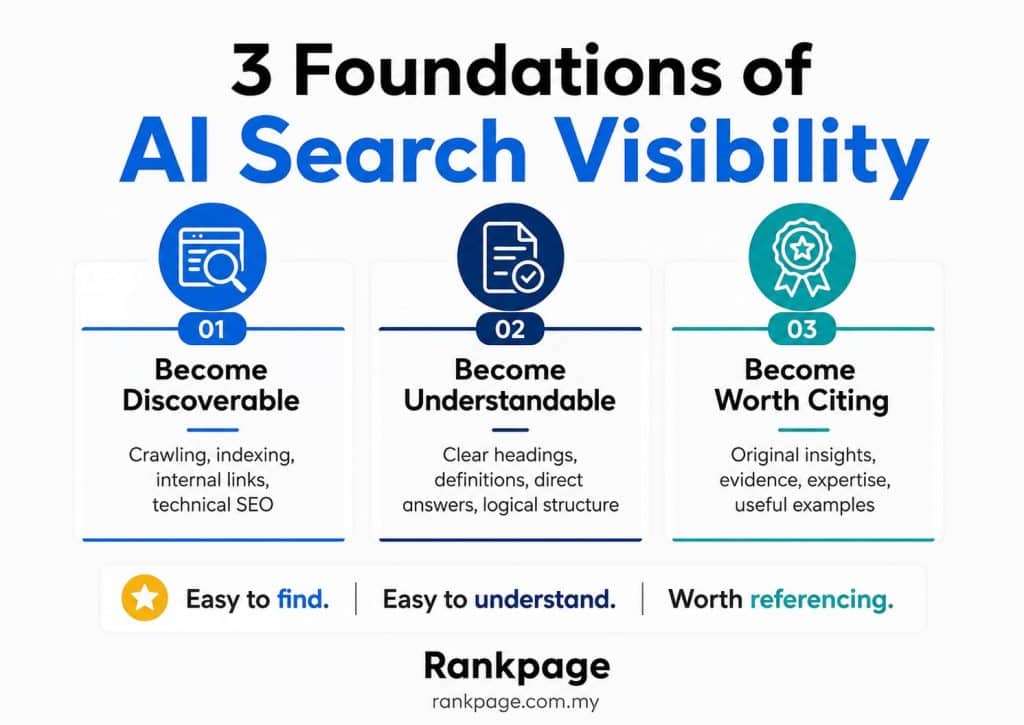
For most Malaysian businesses, focus on three areas:
Become Discoverable: Maintain solid crawling, indexing, internal linking and technical SEO.
Become Understandable: Use clear headings, definitions, answers and information hierarchy.
Become Worth Citing: Add evidence, expertise, examples and original information.
Being easy to extract is useful.
Being worth extracting is more important.
Adjusting Your Content for AI Search
Structuring content for direct AI answers is mainly about reducing ambiguity.
Answer questions early, use descriptive headings, choose formats that suit the information, make important sections self-contained and support claims with useful evidence.
Search platforms continue to emphasise familiar fundamentals such as useful content, clear structure, crawlability and accurate information.
Businesses that combine those fundamentals with content that is easier to understand and reference will be better positioned for both conventional search and AI-powered search experiences.
If your website content needs to become easier for search engines and AI-powered search systems to understand, Rankpage is a trusted SEO agency in Malaysia that can help strengthen the technical, content and search foundations behind that visibility.
Sources
- Google Search Central: Optimizing Your Website for Generative AI Features on Google Search, updated July 2026.
- Google Search Central: AI Features and Your Website.
- Google Search Central: Google Search Essentials.
- Microsoft Bing Webmaster Blog: Introducing AI Performance in Bing Webmaster Tools, February 2026.
- Microsoft Bing Webmaster Blog: AI search and structured-content guidance, November 2025.
- OpenAI Help Center: Searching the Web With ChatGPT, updated August 2026.
- OpenAI Help Center: Publishers and Developers FAQ, updated August 2026.
- HASiL / LHDN: E-Invoice Implementation Timeline in Malaysia.
Frequently Asked Questions About How to Structure Website Content for Direct AI Answers
What Is an AI Answer?
An AI answer is a generated response that retrieves, summarises or combines information to answer a user’s question. It may also cite or link to supporting websites.
How Do I Optimise Website Content for AI Answers?
Answer the primary question clearly, use descriptive headings, keep sections focused and provide useful supporting evidence. Strong SEO and crawlability still matter.
Should Every H2 Be Written as a Question?
No. Use question-based headings when they reflect genuine queries, but use descriptive headings when they communicate the section more naturally.
Are Short Answers Better for AI Search?
Not necessarily. Simple questions may need only one or two sentences, while complex topics need more context. Focus on accuracy and usefulness rather than a fixed word count.
Do Tables Help Content Appear in AI Answers?
Tables can make comparisons easier to understand, but they do not guarantee AI visibility.
Is SEO Still Important for AI Search?
Yes. Crawling, indexing, relevance, page quality, internal linking and clear content structure remain important for AI-powered search visibility.