
Rankpage asked ChatGPT a fairly straightforward question: Can you recommend men’s running shoes under RM150 for a 5 km run?
We expected affordable men’s running shoes, and ChatGPT gave us several reasonable recommendations.
But then something caught our attention, a sponsored advertisement appeared for women’s footwear.
Not men’s running shoes, not even women’s running shoes, as far as we could establish from the advertiser’s website.
So this raises an interesting question: How exactly does ChatGPT decide which advertisements to show?
Rather than relying entirely on OpenAI’s explanation, we decided to investigate our own and try to piece together the puzzle.
And like the brilliant detectives we are, we compared prompts between testers, examined sponsored placements, followed advertisements to their landing pages and observed what happened when the conversation moved into entirely different topics.
Note that these experiments were conducted in September 2026, during the early stages of ChatGPT Ads’ rollout in our testing environment.
Some of the results were surprising, while others raised more questions than answers. Nevertheless, our SEO Agency decided to open the gates of knowledge so that everyone can learn from it.
How Did Rankpage Test ChatGPT Ads?
Our testing began with a simple objective, to understand what kinds of conversations resulted in sponsored advertisements appearing.
We were most interested in whether specific requirements, such as budget, product category and intended use, affected the relevance of the advertisements shown.
For our initial experiment, we used a shopping-related prompt with three clear conditions.
| Requirement | What We Asked For |
|---|---|
| Product | Men’s running shoes |
| Budget | Under RM150 |
| Intended Use | Running approximately 5 km |
We then examined ChatGPT’s response and any advertisements displayed beneath it.
Another tester entered the same query, allowing us to compare advertising experiences between accounts.
As the investigation continued, we asked follow-up questions about advertising relevance, how ChatGPT Ads work and how businesses might improve campaign performance.
We also inspected advertisers’ websites to see whether the products and landing pages matched the original conversations.
A note about our methodology: These were exploratory tests, not a large-scale statistical study. We did not control every possible variable, including account history, ad personalisation, advertiser inventory or auction conditions.
Our findings therefore describe what we observed, rather than establishing how ChatGPT’s advertising algorithm works internally.
Finding 1: Why Did an Advertisement for Women’s Shoes Appear When We Asked for Men’s Running Shoes?
Our first experiment produced something we hadn’t expected.
ChatGPT’s main response understood our requirements reasonably well, main response as in NOT SPONSORED ADVERTISEMENTS
It recommended several men’s running shoes from Decathlon, including models priced between RM79 and RM149.
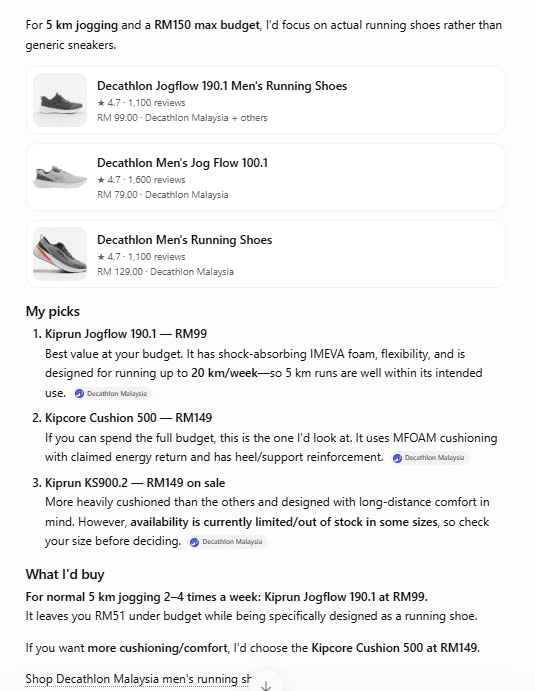
It even considered details such as cushioning, running distance and suitability for regular 5 km jogging.
In other words, the main recommendation was fairly specific.
But the sponsored advertisement was a different story.

The advertisement came from Machino, promoting a footwear sale with prices starting from RM46.
At first glance, the advertisement wasn’t completely unrelated. After all, we were discussing shoes.
But there was an important mismatch.
We had specifically asked for men’s running shoes, whereas the advertised brand primarily featured women’s footwear.
To investigate further, we visited the advertiser’s website.

This was not simply a case of ChatGPT recommending a different running shoe brand.
The advertisement matched the broader footwear category but did not appear to satisfy our original product requirements.
Could Limited Advertiser Inventory Explain the Mismatch?
Our initial suspicion was that there may not have been enough suitable advertisements available during the early rollout which makes sense, ChatGPT just launched in MY.
If few advertisers were promoting men’s running shoes in the relevant campaign inventory, a broader footwear advertisement might have been eligible for selection.
Another possibility was that the matching system placed substantial weight on the general footwear topic rather than every detail of our request.
Both explanations are plausible, but neither is confirmed.
As more advertisers join the platform and create more specific campaigns, more suitable advertisements could become available.
However, we would need to repeat the experiment under comparable conditions to know whether targeting precision has actually improved. So stay tuned for that.
Finding 2: Why Didn’t Both Testers Receive the Same Advertisement?
Another interesting result emerged when a second tester entered the same running shoe query.
Unlike the first tester, the second tester did not receive a sponsored advertisement.
That immediately challenged our initial expectation that similar prompts would produce similar advertising experiences.
If a specific phrase reliably triggered an advertisement, we might have expected both testers to see comparable placements.
Instead, their experiences differed.
Why?

Not even ChatGPT knows the reasons. ╚(•⌂•)╝
From our end, we had specifically used incognito mode to test this so in theory, there should be no external influence or changes.
What we can say is that the same prompt was not sufficient to reproduce the same ad delivery outcome in our tests.
This is important for advertisers attempting to check their own campaigns.
Typing a target customer’s question into ChatGPT and failing to see your advertisement does not automatically mean your campaign is incorrectly configured.
Similarly, seeing your advertisement once does not mean it will consistently appear whenever someone asks that question.
Repeat the prompts across eligible accounts with relevant variables recorded, that’s what’s needed.
Finding 3: What Happened When We Asked ChatGPT Why the Advertisement Appeared?
Naturally, we wanted an explanation.
So we opened the advertisement’s information menu.
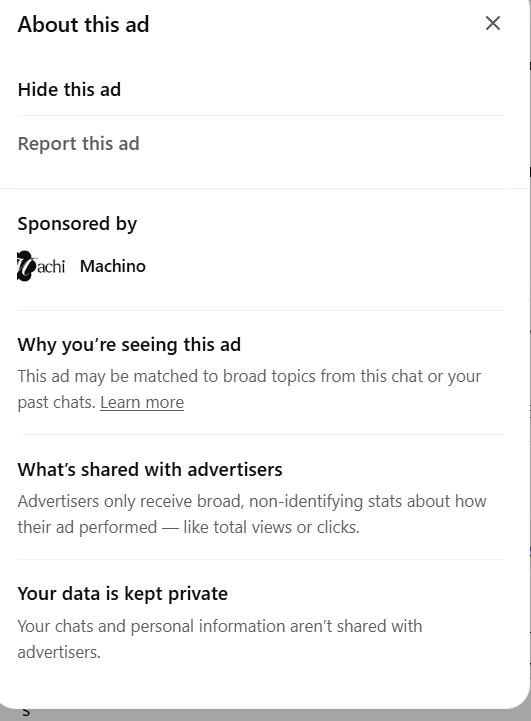
One detail stood out immediately, the information panel indicated that the advertisement might be matched to broad topics from the current conversation or previous conversations.
So a good clue!
Rather than interpreting ChatGPT Ads as a simple keyword-matching system, it made more sense to consider the wider context in which an advertisement appeared.
OpenAI’s documentation supports this broader understanding.
However, the information panel did not reveal which specific factor caused the Machino advertisement to appear. Is it the running shoes? Shoes? For men? We don’t know.
Nor could ChatGPT’s conversational response independently verify the internal decision behind that particular placement.
But we could at least tell that the advertising is related to apparels.
Finding 4: Could Changing the Conversation Topic Change the Advertisements?
Our original conversation started with a request for affordable running shoes.
But as we continued asking questions about why certain advertisements appeared, the discussion gradually shifted towards digital advertising.
We began exploring topics such as improving advertising relevance, creating effective ChatGPT Ads and optimising click-through rates, naturally right?
During these later stages, we encountered advertisements for digital services and marketing-related businesses.
One example was a website-service advertisement from panoRazzi.

Later, while discussing advertising strategies, we also encountered sponsored placements from marketing agencies.
The subject of the conversation had changed considerably.
We were no longer shopping for running shoes, we were discussing advertising and how businesses could use ChatGPT to attract customers.
What we observed was a change in the categories of advertisements appearing as the conversation evolved.
That is consistent with OpenAI’s description of using current conversational context in ad selection.
So if you start by asking “why shoe should I buy UK9” then later ask “best sock for those running shoes” you might get two different advertisements based on the questions you ask!
Why Is This Different From Traditional Search Advertising?
In conventional search advertising, marketers frequently organise campaigns around keyword themes and explicit search queries.
But as we have shown and discussed, ChatGPT is reactive to the questions.
- A user may begin by researching a product
- Ask about alternatives
- Discuss a budget
- Question why this recommendation works
- Explore a related service.
All of this can happen within one conversation.
For advertisers, the implication is that customer intent may evolve throughout the interaction.
Which makes sense, because without AI, that multiple question in a single chat window might have been 5 different Google searches.
Finding 5: One Advertiser Took Us to a Landing Page Designed Around the Click
One of the more memorable discoveries came when we encountered an advertisement from Malaysian digital marketing agency ClickTRUE.
Its sponsored placement promoted a free consultation for businesses struggling to generate leads from paid advertising.
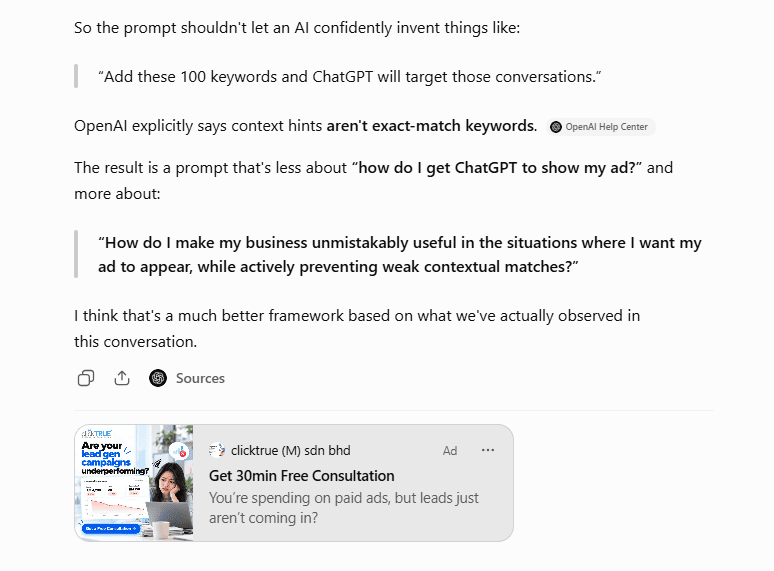
The advertisement itself was relevant to our discussion.
But what interested us most was what happened when we followed it.
Rather than simply arriving at a conventional agency homepage, we encountered a landing page with copy that directly acknowledged the experience of clicking an advertisement.

The page opened with the headline: “You Didn’t End Up Here by Accident.”
It then explained that the visitor had clicked an advertisement and arrived on a page designed to address their needs.
The message was effective because it demonstrated the agency’s marketing proposition through the visitor’s own experience.
What Can Malaysian Advertisers Learn From This?
A strong landing page should make it easy for visitors to understand:
- What the advertiser offers.
- Why the offer is relevant to their needs.
- What makes the business worth considering.
- What action they should take next.
For conversational advertising, this can be very valuable because users may arrive with detailed questions, comparisons and expectations already in mind.
A generic homepage may not address those expectations as directly as a focused landing page.
So, What Do Our Findings Actually Tell Us About ChatGPT Ads?
After reviewing the experiments, we found it useful to separate observed behaviour from possible explanations.
| What We Observed | What We Can Reasonably Conclude |
|---|---|
| A women’s footwear ad appeared for a men’s running shoe query. | Sponsored placements may not satisfy every stated shopping requirement. |
| Two testers received different advertising experiences. | Identical prompts do not guarantee identical ad delivery. |
| Marketing-related ads appeared later in the conversation. | The observations are consistent with context-sensitive ad selection. |
| ChatGPT’s ad information panel referenced broad conversational topics. | Conversation context can contribute to ad relevance. |
| A marketing agency used a dedicated landing page. | Advertisers can tailor the post-click experience to specific offers and customer needs. |
There are also several things our experiments cannot establish.
We cannot determine how much weight the platform assigned to each relevance signal, or if specific bids affected the placements.
OpenAI describes its auction as relevance-weighted, with advertiser bids also contributing to selection among eligible advertisements (but we really don’t believe that)
So more A/B testing for us, yay.
What Should Malaysian Businesses Do Differently When Running ChatGPT Ads?
Our tests suggest that advertisers should approach ChatGPT Ads as an environment that requires observation, experimentation and ongoing optimisation.
1) Describe customer needs clearly
Instead of focusing only on broad product categories, consider the situations where your offer is genuinely useful.
A running shoe brand, for example, could distinguish between beginner jogging, long-distance training and everyday casual footwear.
2) Evaluate relevance, not just impressions
An advertisement may appear in a conversation related to your industry without necessarily matching the customer’s requirements.
Pay attention to the traffic generated that represents the people your business actually wants to reach.
3) Test different creative messages and landing pages
Clear, specific copy may help communicate the value of an offer more effectively than generic advertising claims.
The landing page should reinforce that promise rather than forcing visitors to start their research again.
4) Avoid treating individual prompts as reliable placement tests
Our two-tester comparison showed that the same query did not necessarily produce the same experience.
Use broader testing and available campaign reporting to evaluate performance instead of relying on isolated screenshots.
5) Expect the platform to evolve.
Our observations came from an early period of ChatGPT Ads development.
Advertiser participation, campaign features and delivery systems may change, so let’s see if future updates make our article utterly redundant, we can feel it.
Conclusion: ChatGPT Ads Are Worth Testing, Not Guessing
Our experiments started with a simple request for affordable men’s running shoes.
They eventually took us through mismatched footwear advertisements, inconsistent delivery between testers, changing conversation topics and a marketing agency’s dedicated landing page.
We did not uncover a secret formula for triggering ChatGPT Ads.
But we did learn something valuable: advertising relevance in a conversational environment is more complicated than matching an advertisement to a few words in a prompt.
As ChatGPT Ads continue developing, Malaysian businesses should avoid assuming that early observations represent permanent platform behaviour.
The more useful approach is to test real customer scenarios, examine actual results and adjust campaigns based on evidence.
At Rankpage, our ChatGPT Ads services help Malaysian businesses explore conversational advertising through structured experimentation, relevant messaging and performance measurement.
Combined with our GEO services, we help brands develop a broader presence across paid and organic AI-driven discovery.
Disclaimer: These findings are based on exploratory testing conducted in September 2026. They represent observed advertising behaviour rather than a comprehensive technical analysis of OpenAI’s ad delivery systems. OpenAI may update its advertising policies, campaign features and delivery mechanisms over time. Readers should consult OpenAI’s latest official documentation for current information.
Frequently Asked Questions About ChatGPT ads
What Triggers ChatGPT Ads?
According to OpenAI, advertisement selection considers factors including conversation context, user intent, ad content, landing pages and advertiser-provided context hints. Ads are not triggered solely by exact-match keywords.
Why Do Different Users See Different ChatGPT Ads?
Different users may see different advertisements because of account eligibility, personalisation settings, available campaigns and other delivery factors. The same prompt does not guarantee identical results.
Can ChatGPT Show Irrelevant Advertisements?
Yes. During our September 2026 testing, a sponsored advertisement for women’s footwear appeared in response to a query about men’s running shoes. This was an observed mismatch, not proof of a systematic platform issue.
Does Changing the ChatGPT Conversation Affect Advertisements?
Conversation context can influence ad relevance. In our tests, different advertising categories appeared as the discussion shifted from footwear shopping to digital marketing. However, the tests did not establish the exact cause of those changes.
Do ChatGPT Ads Use Keywords Like Google Ads?
Not in the same way as conventional keyword-based search advertising. ChatGPT Ads uses conversational relevance signals, and advertisers can supply context hints to describe relevant needs and situations. These hints do not operate as exact-match targeting rules.