AI share of voice measures how much visibility your brand receives in AI-generated answers compared with competing brands.
For Malaysian businesses, it can help show whether a brand is appearing when potential customers ask ChatGPT, Google AI and other AI platforms for recommendations, comparisons or information.
At Rankpage, we see AI share of voice as an addition to existing search measurement rather than a replacement for SEO rankings, traffic or conversion data.
AI-generated answers are dynamic. A response can mention several companies, cite different websites and change depending on the prompt, platform and testing conditions. That means measuring AI visibility properly requires more than simply asking ChatGPT whether your company appears.
What Is AI Share of Voice?
AI share of voice, or AI SoV, generally describes your brand’s visibility relative to competitors across a defined set of AI prompts or observations.
There is no single industry-standard way to calculate it. Different measurement tools may use brand mentions, estimated impressions, recommendation position or other signals.
Depending on your framework, you may want to measure:
| Metric | What It Measures |
|---|---|
| Brand Mention | Whether your brand appears in an AI answer |
| Citation | Whether your website is used as a supporting source |
| Recommendation | Whether your brand is actively suggested |
| Mention Position | How prominently your brand appears |
| Competitor Share | How frequently competing brands appear |
The distinction matters. An AI platform can cite your website without recommending your company, while your brand can also appear in a recommendation without your website being cited.
We therefore recommend keeping these outcomes separate rather than combining everything into one vague visibility score.
How Is AI Share of Voice Calculated?
There is no universal AI share-of-voice formula.
One simple mentions-based formula is:
AI Share of Voice = Your Brand Mentions ÷ Total Mentions of Tracked Brands × 100
For example:
| Brand | Mentions |
|---|---|
| Your Brand | 30 |
| Competitor A | 25 |
| Competitor B | 20 |
| Competitor C | 15 |
| Competitor D | 10 |
| Total | 100 |
Using this formula, your AI share of voice would be 30%.
This tells you what portion of tracked brand mentions belongs to your company.
The formula is useful because it is simple and transparent, but it should be treated as one measurement method rather than an industry-wide standard.
What Is Mention Rate?
Mention rate measures how frequently your brand appears across the AI responses you test.
If each prompt is tested once:
Mention Rate = Prompts Where Your Brand Appears ÷ Total Prompts × 100
If your brand appears in 40 out of 100 prompts, your mention rate is 40%.
If prompts are tested several times, make the unit of measurement clear and keep the same approach between reporting periods.
What Is Citation Share?
In this framework, citation share measures what percentage of recorded citations point to your domain.
Citation Share = Citations to Your Domain ÷ Total Citations Recorded × 100
If 50 out of 500 tracked citations point to your website, your citation share is 10%.
Again, this should be treated as a defined reporting metric rather than a universal formula.
Which Prompts Should You Measure?
Your AI share of voice can only be as useful as the prompts behind it.
Testing questions where your company is already likely to appear may produce an impressive score, but it will not provide a balanced picture of customer visibility.
At Rankpage, we prefer prompt sets that cover different stages of intent.
| Prompt Type | Example |
|---|---|
| Broad | What does an SEO agency do? |
| Discovery | What are good SEO agencies in Malaysia? |
| Service | Which agencies offer enterprise SEO in Selangor? |
| Comparison | Which Kuala Lumpur SEO agencies specialise in AI search? |
| Local | What are good SEO companies in Kuching? |
| Commercial | Which SEO agency should I hire for ecommerce? |
You can also include variations involving location, industry, budget and customer needs.
Where possible, build prompts from real evidence such as Search Console queries, sales conversations, customer-support questions, keyword research and recurring customer objections.
This helps prevent the prompt set from becoming a hand-picked sample designed to make visibility look stronger.
Which AI Platforms Should You Include?
Track the platforms your customers are most likely to use, such as:
- ChatGPT
- Google AI Overviews
- Google AI Mode
- Gemini
- Perplexity
Google says (as of 2025) that AI Overviews are available in more than 200 countries and territories and support more than 40 languages, including Malay.
Different AI products can also produce different answers and supporting links. Google itself says AI Overviews and AI Mode may use different models and techniques.
For that reason, avoid combining every platform into one overall score too early.
A brand may perform strongly in ChatGPT but have limited visibility in Google AI Mode. Reporting platforms separately makes it easier to see where visibility is actually changing.
Use First-Party Data Where Available
Prompt testing should not be your only source of evidence.
As of August 31, 2026, Google has rolled out dedicated Generative AI performance reporting in Search Console worldwide, including impressions from features such as AI Overviews and AI Mode.
At Rankpage, we would use the two approaches for different purposes:
Prompt testing helps measure competitor visibility, recommendations and brand mentions.
First-party platform data helps confirm whether your own website is actually being surfaced in AI search experiences.
Neither gives the complete picture on its own.
What Is the Difference Between a Mention and a Citation?
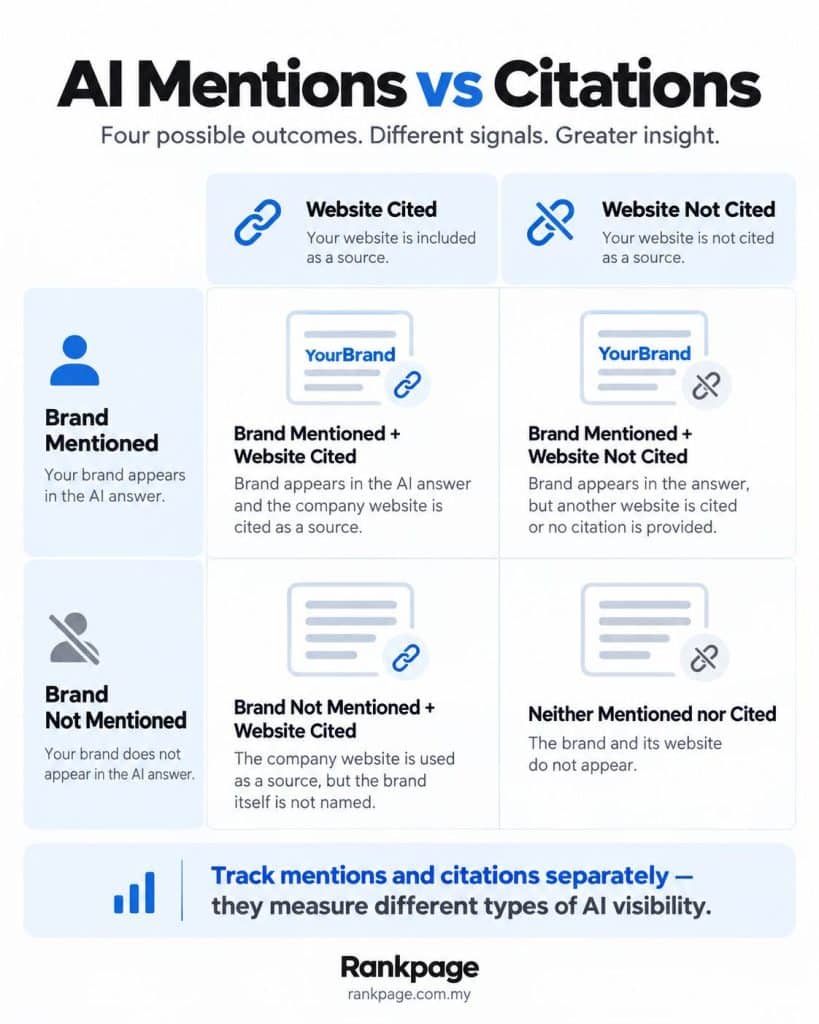
A mention means the AI answer names your company or brand.
A citation means the AI platform links to your website as a supporting source.
They are not the same.
An AI answer might cite your website without naming your company, or recommend your company while citing another source.
For cleaner reporting, track four outcomes:
- Brand mentioned
- Website cited
- Brand mentioned and website cited
- Neither mentioned nor cited
ChatGPT Search can provide citations and a Sources view. OpenAI also warns that citations can sometimes be incomplete, outdated or incorrect, so important citations should be checked rather than simply counted.
Google’s AI search features also surface supporting links to websites.
Look at Citation Quality, Not Just Quantity
A higher citation count is not automatically better.
For important prompts, check whether the cited page is relevant, current and actually supports what the AI response says.
You may also want to distinguish between:
Citation volume — total citation occurrences
Unique cited pages — number of different URLs receiving citations
Citation quality — whether those citations are relevant and accurate
How Can You Improve Measurement Accuracy Over Time?
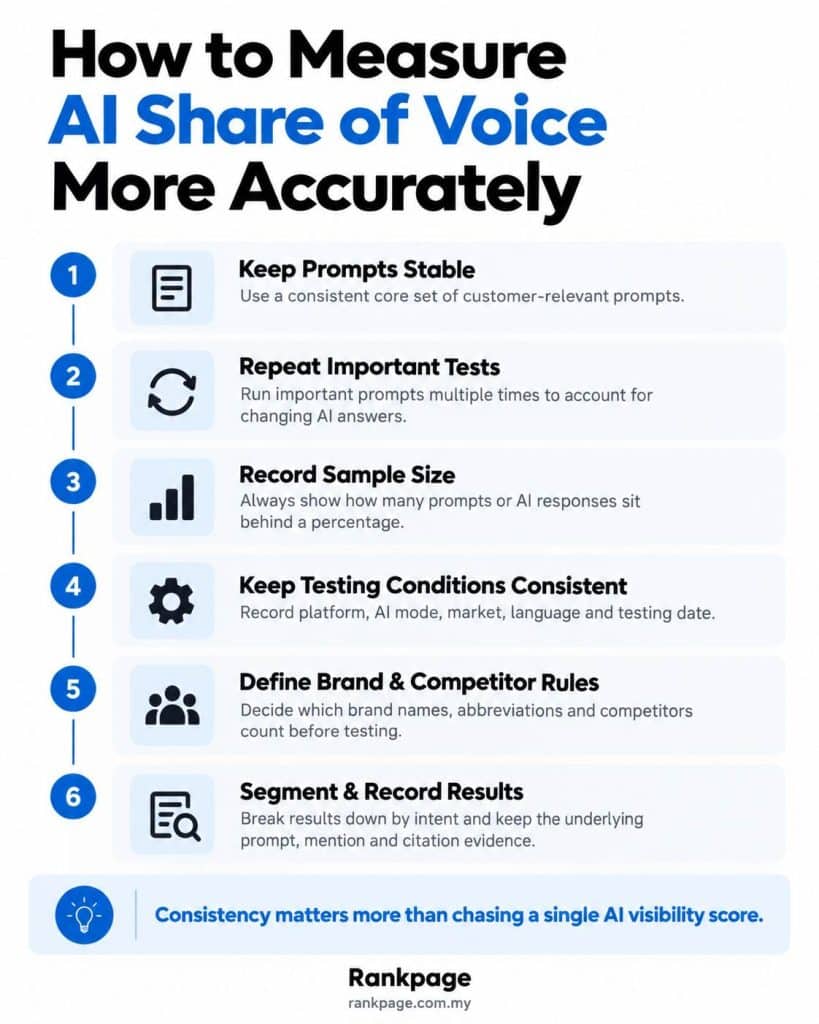
AI answers can change between tests, so individual results should not be treated like fixed search rankings.
The goal is to create a repeatable process.
Keep Your Core Prompt Set Stable
If you test 100 prompts this month and a completely different 100 next month, it becomes difficult to tell whether visibility genuinely changed.
Keep a stable core group and document any major methodology changes.
Repeat Important Prompts
Some AI answers vary between runs.
If your company appears in three out of five tests for the same question, recording it as simply “visible” or “not visible” loses useful information.
Repeated testing gives you a better view of consistency.
Report the Sample Size
Percentages are easier to interpret when the amount of data behind them is visible.
Instead of reporting:
Mention rate: 40%
report:
Mention rate: 40% across 500 AI responses
A percentage based on 20 responses should not carry the same weight as the same percentage across several hundred observations.
Control the Testing Environment
Where practical, record:
- Exact prompt;
- Platform and AI mode;
- Country or market;
- Language;
- Date;
- Number of runs.
The aim is not to eliminate every variable, but to reduce unnecessary changes that make one reporting period difficult to compare with another.
Define What Counts as Your Brand
Before testing, decide which names count as a valid match.
That may include abbreviations, product names, parent companies or common alternative spellings.
Apply the same rules to competitors.
Otherwise, changes in naming rules can distort your results.
Keep the Competitor Set Consistent
Your competitor list directly affects the calculation.
Removing a major competitor can make your percentage rise even if your own visibility has not improved.
Use a stable competitor set for trend reporting.
Segment Results by Intent
Overall AI share of voice is useful, but segmented data is usually more actionable.
| Prompt Cluster | AI Share of Voice |
|---|---|
| General | 28% |
| Service | 25% |
| Comparison | 20% |
| Local | 16% |
| Purchase Intent | 9% |
In this example, visibility is strongest during early research but weaker as users move closer to a purchase decision.
That tells you more than one overall percentage.
Record the Evidence
Each result should ideally record the prompt, platform, date, run number, competitors mentioned, brand mention status and citation URL.
If your AI share of voice rises from 15% to 24%, you should be able to see what actually changed.
Should Every Prompt Count Equally?
For a simple framework, equal weighting is easier to understand and audit.
However, not every prompt has the same business value.
For example, “What is SEO?” may matter less commercially than “Which SEO agency should I hire for ecommerce in Malaysia?”
More advanced reporting can assign greater weight to commercially important prompt groups.
If you use weighting, document the rules and keep an unweighted result as well so that changes in the scoring model do not look like changes in visibility.
What Is a Good AI Share of Voice?
There is no universal benchmark.
A 10% share of voice could be strong in a category with many established competitors but weak in a market dominated by only three brands.
Your own baseline is usually more useful.
Instead of asking whether 20% is “good”, ask whether visibility is improving across the same prompts, competitors and platforms.
Also look at where the gains are happening. Stronger visibility in comparison and purchase-intent searches may matter more than gains in broad informational prompts.
AI Share of Voice Is Not a Revenue Metric
AI share of voice measures visibility, not business performance.
A higher score does not automatically mean more traffic, leads, sales or conversions.
Likewise, a brand with lower overall visibility may still perform well if it appears strongly for a smaller number of high-value prompts.
At Rankpage, we believe AI visibility should sit alongside broader performance data rather than become a standalone success metric.
Where possible, compare it with first-party AI-search impressions, referral traffic, leads and conversions.
Can SEO Improve AI Share of Voice?
SEO can support visibility in AI search by improving technical accessibility and producing helpful, relevant and reliable content.
Google says its existing SEO best practices remain relevant for AI SEO, because AI Overviews and AI Mode are rooted in its core Search ranking and quality systems.
Google also says there are no special technical requirements or special schema needed specifically to appear in AI Overviews or AI Mode. Pages still need to be indexable, eligible to appear in Search and useful to users.
That means AI visibility should not be treated as a completely separate optimisation discipline.
Strong SEO foundations can support discoverability, but appearing in AI-generated answers cannot be guaranteed.
What About AI Visibility Tracking Tools?
Third-party platforms can make large-scale AI tracking much easier.
However, different tools may use different prompt databases, sampling methods, competitor definitions and scoring formulas.
That is another reason why tracking your own trend within one documented methodology is often more useful than comparing headline scores across different tools.
Understanding How AI Share of Voice Can Be Used Well
AI share of voice can help businesses understand how visible their brand is when customers use AI to research products, services and companies. But the value of the metric depends heavily on how it is measured.
At Rankpage, we believe a useful framework should keep the prompt set relatively stable, define brand and competitor rules clearly, separate mentions from citations, record sample sizes, repeat important prompts and report AI platforms separately.
Where first-party data is available, use it alongside prompt testing. Most importantly, treat AI share of voice as a visibility signal rather than an end business result.
For businesses already investing in organic search, AI visibility is best viewed as an extension of a wider search strategy. A SEO agency in Malaysia can help strengthen the technical, content and search foundations that support visibility across traditional search and emerging AI discovery experiences.
Sources
- OpenAI, Searching the web with ChatGPT – ChatGPT Search citations, source links and citation limitations.
- Google, AI Overviews expand to over 200 countries and territories, more than 40 languages – availability and Malay-language support.
- Google Search Central, Introducing Search Generative AI performance reports in Search Console – dedicated AI Overview and AI Mode impression reporting.
- Google Search Central, Optimizing your website for generative AI features on Google Search – SEO best practices for AI search experiences.
- Google Search Central, AI Features and Your Website – Supporting links, eligibility and differences between AI Overviews and AI Mode.
Frequently Asked Questions About AI Share of Voice and How to Measure It Properly
What Is AI Share of Voice?
AI share of voice measures your brand’s visibility relative to competitors across a defined set of AI prompts or observations.
There is no single industry-standard calculation, so the methodology should always be documented.
How Do You Calculate AI Share of Voice?
One simple method is to divide your brand’s mentions by the total mentions of all tracked brands, then multiply by 100.
Other tools may use different scoring methods.
Is AI Share of Voice the Same as Citation Rate?
No. AI share of voice measures competitive brand visibility, while citation metrics measure how often your website is used as a supporting source.
How Many Prompts Should You Track?
There is no fixed minimum. Your prompt set should be large and varied enough to cover the customer questions that matter to your business. When reporting percentages, include the sample size.
How Often Should AI Share of Voice Be Measured?
There is no universal tracking frequency. Monthly reporting can provide a practical baseline for many businesses. More frequent testing may be useful when shorter-term changes matter, provided the methodology stays consistent.
Can SEO Improve AI Share of Voice?
SEO can support AI-search visibility by improving technical accessibility and creating useful, relevant and reliable content. Google says its existing SEO best practices remain relevant to AI Overviews and AI Mode. However, visibility in AI-generated answers cannot be guaranteed by SEO alone.