For many Malaysian businesses, WordPress is a strong default choice of CMS for SEO, while Shopify is often more practical when online selling is the website’s main purpose.
However, no CMS automatically guarantees higher rankings. It simply determines how easily your team can publish content, manage metadata, create redirects, add structured data and fix technical issues.
Google’s published guidance does not identify a preferred CMS. It focuses on whether pages are useful, accessible, crawlable, indexable and relevant.
The right platform is therefore the one that best supports your business model, technical needs and internal resources.
What Makes a CMS Good for SEO?
A good CMS should give your team control over the elements that affect how search engines crawl, understand and display your pages.
These include:
- Editable page titles and meta descriptions
- Clean URLs and redirects
- Canonical tags and indexing controls
- XML sitemaps
- Structured data
- Image and script optimisation
- Scalable publishing workflows
- Multilingual support where needed
Ease of use also matters. A technically powerful CMS can still be a poor business choice if employees find it too difficult to update.
How Do the Leading CMS Platforms Compare?
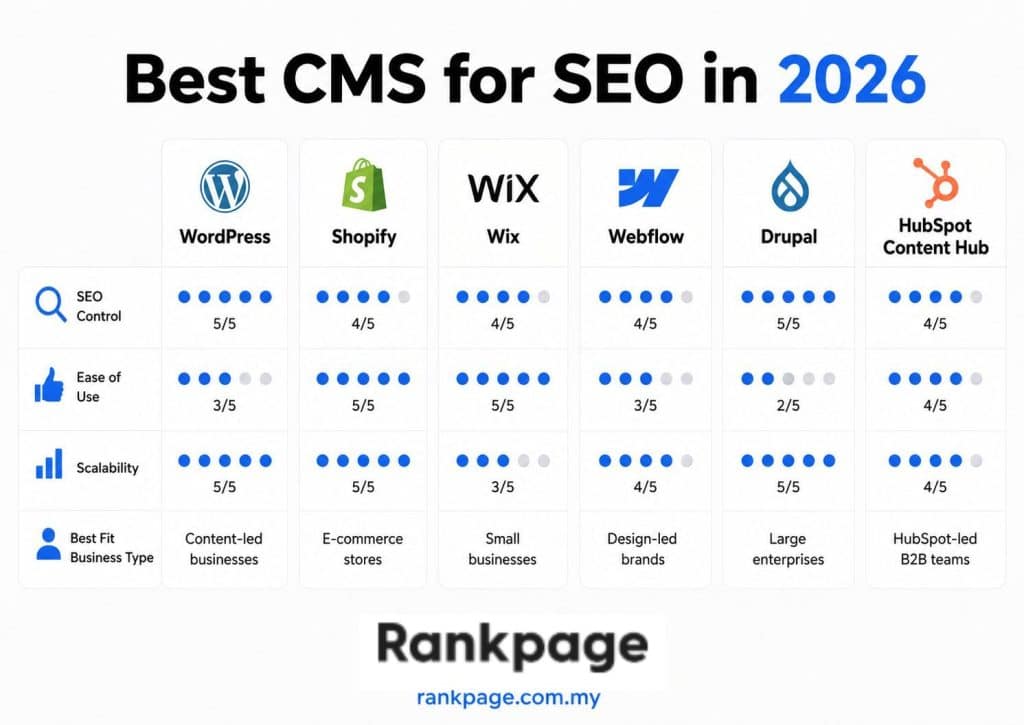
Configuration often matters more than the platform itself. A lightweight WordPress site can perform well, while a poorly managed installation with heavy plugins may become slow and difficult to maintain.
The same principle applies to every CMS.
Is WordPress Still the Best CMS for SEO?
WordPress remains one of the strongest overall options because it provides extensive control over content, templates, URLs and technical settings.
WordPress SEO Strengths
WordPress can support custom page titles, canonical tags, XML sitemaps, redirects, schema markup, internal linking and multilingual page structures.
It is particularly suitable for websites that publish:
- Service pages
- Industry guides
- Blog articles
- Location pages
- Case studies
- Large content libraries
This makes it a strong choice for professional services, healthcare providers, property companies, agencies, publishers and B2B businesses.
WordPress Limitations
WordPress requires regular maintenance. Themes, plugins, hosting quality and page builders can all affect speed, security and reliability.
A poorly configured site may suffer from bloated code, duplicate metadata, plugin conflicts or slow loading times.
Is Shopify Best for E-Commerce SEO?
Shopify is often the most practical CMS for businesses that primarily sell products online.
Shopify SEO Strengths
Shopify automatically provides SSL, canonical tags, XML sitemaps and a default robots.txt file. Merchants can also customise robots.txt rules when needed.
Its main advantage is operational simplicity. Product management, payments, inventory, discounts and order processing sit within one platform.
Shopify is particularly suitable for:
- Fashion and beauty brands
- Food and beverage retailers
- Consumer product companies
- Speciality stores
- Regional e-commerce businesses
Shopify Limitations
Shopify provides less technical freedom than open-source platforms.
Some URL paths and platform-generated pages cannot be fully customised. Installing too many apps may also add scripts and slow down the site.
Read More: WooCommerce vs Shopify: Which Platform Is Better for Ecommerce?
Is Wix Good Enough for SEO?
Yes. Wix is suitable for many small Malaysian businesses, especially when the website has a straightforward structure.
Wix SEO Strengths
Wix provides editable metadata, XML sitemaps, redirects, canonical controls, indexing settings and structured data options.
Hosting, design and basic technical management are handled within the platform, reducing the need for separate plugins or frequent developer support.
Wix works well for:
- Restaurants
- Salons
- Tuition centres
- Consultants
- Tradespeople
- Local service businesses
Wix Limitations
Wix becomes less suitable when a project needs highly customised technical behaviour, complex data relationships or advanced publishing workflows.
However, its CMS can generate many unique URLs through reusable dynamic pages, so it can still support substantial content collections.
Read More: WordPress vs Wix: Which Website Builder Should You Choose?
Is Webflow Better for Design-Focused Businesses?
Webflow is a strong option for companies that want precise visual design together with solid technical SEO controls.
Webflow SEO Strengths
Webflow allows users to manage metadata, redirects, indexing settings, XML sitemaps, canonical tags and schema markup.
It also supports localisation features such as multilingual URLs, hreflang annotations and localised sitemap entries.
Its visual development system gives designers more layout control than many traditional website builders.
It is particularly attractive to:
- Technology companies
- SaaS businesses
- Creative agencies
- B2B brands
- Start-ups
Webflow Limitations
The main challenge is its learning curve. Content editors may find it more technical than Wix, Shopify or a standard WordPress editor.
Major layout changes may still require an experienced designer or developer.
When Should a Business Choose Drupal?
Drupal is better suited to large organisations with complex content structures, permissions, workflows and integrations.
Drupal SEO Strengths
Drupal can support large, highly structured websites with multiple departments, publishing roles and content types.
It is especially useful when a website needs:
- Detailed user permissions
- Complex approval workflows
- Multilingual content
- Custom integrations
- Large content databases
- Enterprise-level scalability
Drupal Limitations
Drupal usually requires specialist developers and a larger maintenance budget.
It may be more complex than necessary for an SME that only needs a straightforward corporate or service website.
Is HubSpot Content Hub Worth Considering?
HubSpot Content Hub suits companies already using HubSpot for CRM, lead generation, automation and sales management.
Hubspot SEO Strengths
Its biggest advantage is integration.
A B2B company can connect blog traffic, landing pages, forms, contact records and sales opportunities within the same ecosystem.
This makes it easier to measure whether organic traffic is generating leads and contributing to the sales pipeline.
Hubspot Limitations
HubSpot Content Hub may have a higher total cost than some WordPress, Wix or Shopify setups, particularly when a company needs professional or enterprise features.
Using HubSpot for the website, CRM, forms and automation can also make migrations more complex because several connected assets and workflows may need to be recreated.
However, HubSpot provides export options for pages, posts, templates, files, SEO data and redirects.
Which CMS Should Malaysian Businesses Choose?
| Business Type | Recommended CMS | Why |
|---|---|---|
| Local service business | WordPress or Wix | Easy content and local SEO management |
| E-commerce retailer | Shopify | Strong store and product management |
| Content-heavy company | WordPress | Flexible publishing and internal linking |
| Design-focused B2B brand | Webflow | Strong design and technical controls |
| Large enterprise | Drupal | Complex workflows and integrations |
| HubSpot-driven sales team | HubSpot Content Hub | Content, leads and CRM in one ecosystem |
For many Malaysian SMEs, the realistic shortlist will be WordPress, Shopify, Wix or Webflow.
WordPress offers flexibility. Shopify simplifies e-commerce. Wix is easy for small teams. Webflow provides stronger visual control.
These are general recommendations rather than fixed rules. The final decision should be based on the website’s purpose, content needs, integrations, maintenance resources and growth plans.
Can the Wrong CMS Hurt Your SEO?
The wrong CMS can make SEO slower, more expensive or harder to manage, but it does not automatically prevent a website from ranking.
Common CMS-related SEO problems include:
Slow templates: Large scripts, animations and uncompressed images can reduce performance.
Limited URL control: Fixed URL conventions can make some content structures harder to manage.
Duplicate pages: Tags, filters, categories and product variants can create overlapping content.
Weak redirect management: Incorrectly handled deleted or changed URLs can disrupt links and search signals.
Poor publishing workflows: Employees may omit titles, headings, alt text or internal links when optimisation is inconvenient.
A visually complex website can also create problems when important content is missing from the rendered HTML, blocked from crawling or loaded only after user interaction.
What Should You Check Before Choosing a CMS?
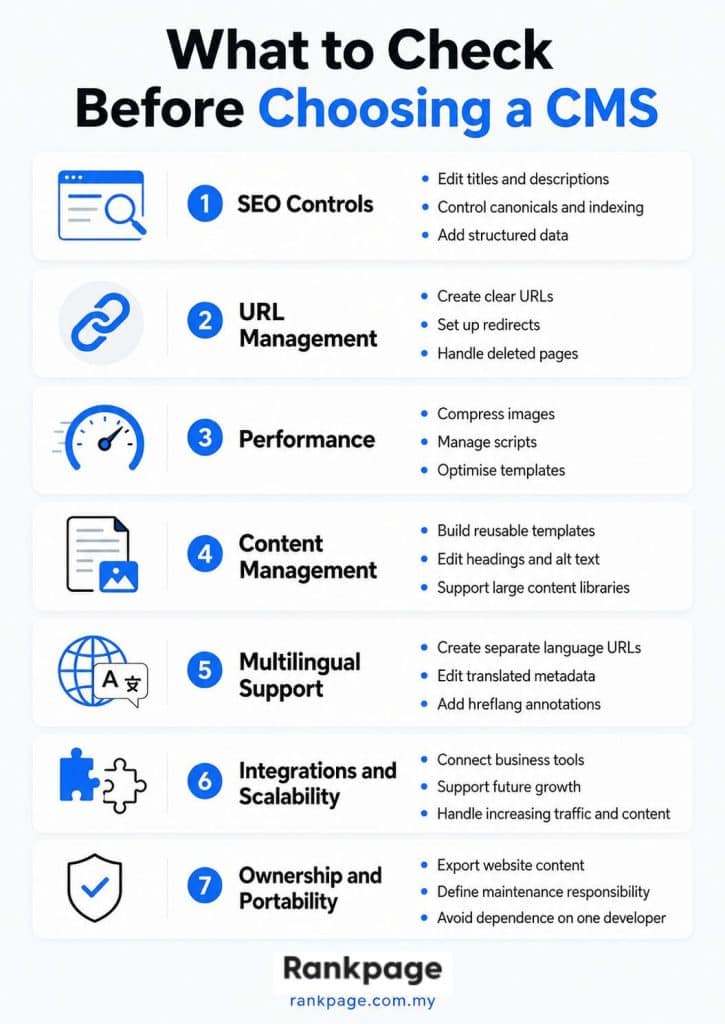
Before selecting a platform, ask your developer or SEO agency to demonstrate how it handles real publishing tasks.
Your team should be able to:
- Edit titles, descriptions and headings
- Create clear URLs
- Add image alt text
- Set up redirects
- Control canonical tags and indexing
- Add structured data
- Manage multilingual pages
- Compress or replace images
- Build reusable templates
- Export content
You should also consider who will manage the website after launch.
A CMS that only one external developer understands may become an operational risk.
Which CMS Is Best for SEO in 2026?
Choose WordPress when SEO, content publishing and long-term flexibility are major priorities.
Choose Shopify when online selling is the main purpose of the website.
Choose Wix when a small team needs a straightforward website it can manage independently.
Choose Webflow when premium design and layout control matter most.
Choose Drupal when the website requires enterprise-level workflows, integrations and permissions.
Choose HubSpot Content Hub when the website forms part of a wider HubSpot marketing and sales system.
The best CMS is not necessarily the platform with the longest feature list. It is the one that best matches the company’s business model, technical requirements, resources and future growth plans.
Picking the Right CMS For Your Business
WordPress remains a strong all-round CMS for SEO in 2026, but it is not right for every Malaysian business.
Shopify may be more practical for e-commerce, Wix may be sufficient for a small local company, and Webflow, Drupal or HubSpot may better support specialised requirements.
Before building or migrating a website, Rankpage, Malaysia’s trusted SEO agency, can help you assess whether the current CMS supports the company’s content, technical and organic search goals.
Our SEO services can also identify platform limitations and create a practical optimisation roadmap around the existing website.
Sources
- Google Search Central: SEO Starter Guide, JavaScript SEO, international SEO and canonical URL guidance
- WordPress.org: Official WordPress SEO, sitemap and maintenance documentation
- Shopify Help Center: Official SEO, sitemap, robots.txt and redirect documentation
- Wix Help Center: Official SEO, dynamic page, sitemap and redirect documentation
- Webflow Help Center: Official metadata, schema, sitemap and localisation guidance
- Drupal.org: Official content, permission, scalability and multilingual documentation
- HubSpot Knowledge Base: Official SEO, content management and export documentation
Frequently Asked Questions About Choosing a Suitable CMS for SEO in Malaysia
Which CMS Is Best for SEO in Malaysia?
WordPress is a strong overall choice for many Malaysian businesses because it provides extensive control over content and technical SEO.
Shopify is often the better choice for businesses focused primarily on e-commerce SEO.
Does Google Prefer WordPress?
Google’s published guidance does not identify WordPress or any other CMS as a preferred platform.
Search visibility depends on content relevance, crawlability, accessibility, site structure and other signals rather than the CMS name alone.
Is Shopify or WordPress Better for SEO?
WordPress generally offers greater content and technical flexibility, while Shopify is easier to manage for dedicated e-commerce operations.
A content-heavy service business may prefer WordPress, while an online retailer may benefit more from Shopify.
Is Wix Bad for SEO?
No. Wix provides editable metadata, sitemaps, redirects, canonical controls, indexing settings and structured data options.
Projects with unusually complex technical requirements may still benefit from a more customisable platform.
Should I Change CMS to Improve My Rankings?
Not necessarily.
A migration should normally be considered only when the current platform creates serious technical, publishing or scalability problems.
Improving the existing site may be less risky than moving to another platform.
Can a CMS Help My Website Appear in AI Search Results?
A CMS can make it easier to publish accessible, well-structured and evidence-rich content, but it cannot guarantee inclusion or citation in AI search results.
Clear answers, original information and strong SEO foundations remain important.