SEO, AEO and GEO are connected approaches to improving how a business appears when people search online. SEO is the established discipline for improving organic search visibility. AEO and GEO are newer industry terms that describe answer-focused and generative-search applications of many of the same principles.
SEO focuses on rankings and organic visibility. AEO helps content provide a clear answer. GEO extends that work into generative AI platforms and AI-powered search experiences.
The boundaries are not always clear. One well-optimised page may rank in Google, appear as a featured answer and receive a citation in an AI-generated response. For Malaysian businesses, the practical question is how these approaches can work together as search becomes more conversational and influenced by AI.
What Is SEO and How Does It Work?
Search engine optimisation, or SEO, is the process of improving a website so search engines can discover, understand, index and rank its content for relevant searches.
For example, a logistics provider may want to appear for “cold chain logistics Malaysia”, while an accounting firm may target “company tax services Kuala Lumpur”.
SEO services normally covers several areas:
- Technical SEO: Helping search engines crawl, render and index the website. This includes site structure, mobile usability, page speed, canonical tags and crawl controls.
- On-page SEO: Improving titles, headings, page copy, images and internal links.
- Content SEO: Publishing useful service pages, guides, comparisons and resources that match search intent.
- Off-page SEO: Building credibility through backlinks, media coverage, reviews and third-party mentions.
- Local SEO: Improving visibility for location-based searches through accurate business information, local pages and a complete Google Business Profile.
Modern SEO is not simply about repeating keywords. Search engines use multiple systems and signals to assess relevance, usefulness and reliability.
The word “authority” is often used in SEO, but it should not be treated as one universal score. It is better understood as the credibility a website develops through useful content, expertise and reputable references.
For Malaysian businesses, SEO remains especially important for commercial searches. Someone looking for an accountant, software provider or agency will often compare websites and credibility before making contact.
What Is AEO and How Does It Work?
Answer engine optimisation, or AEO, is an industry term for making information easier for search systems to identify and present as a direct answer.
Traditional SEO asks whether a page can rank. AEO adds another question: can the system quickly identify a useful answer within it?
Consider a search such as “How long does SSM company registration take in Malaysia?” A page designed with AEO principles would answer the question clearly near the start of the section, then explain the conditions and exceptions.
AEO service may support visibility in:
- Featured snippets
- People Also Ask results
- Some voice search responses
- AI-generated search summaries
- Conversational search interfaces
Knowledge panels are better treated separately because they are mainly associated with recognised entities and knowledge systems.
Common AEO practices include:
- Using clear or question-based headings
- Placing a concise answer early
- Writing in natural language
- Supporting the answer with useful context
- Adding structured data where relevant
These practices can make content easier to understand and extract, but they do not guarantee a featured snippet, voice response or AI citation.
Structured data may also help search engines understand supported page elements, although it does not guarantee an enhanced result.
For example, a page about e-Invoicing in Malaysia could explain that the requirement depends on turnover or revenue, implementation phase and exemptions. Because official guidance may change, the page should cite the latest HASiL information and state when it was reviewed.
What Is GEO and How Does It Work?
Generative engine optimisation, or GEO, is an emerging industry term for work intended to increase a brand’s visibility, inclusion or citation within generative AI responses.
These systems may retrieve information from several sources before combining it into one answer. Their retrieval and citation methods vary by platform.
A business may rank well in traditional search but remain absent when someone asks:
- Which digital marketing agencies operate in Malaysia?
- What payroll providers suit Malaysian SMEs?
- Which warehouse management systems support local eCommerce businesses?
GEO service aims to make the business or its content more useful and discoverable in those experiences.
Potential GEO-supporting practices include:
- Publishing useful expertise: Creating accurate, detailed and original content.
- Improving entity consistency: Keeping the company name, services, location and contact information accurate across the website and reputable third-party profiles.
- Creating citable information: Publishing original statistics, frameworks, comparisons and expert commentary.
- Earning credible references: Securing legitimate mentions from publications, industry associations and relevant directories.
- Maintaining accessible pages: Ensuring important content can be crawled and indexed by the systems that generative features may use.
Access by one search engine does not guarantee retrieval or citation by every AI platform. Some platforms may also learn about a business through third-party sources.
GEO is still evolving, and no universal list of ranking or citation factors applies to every platform.
It also remains closely tied to SEO. Google has explained that its AI-powered search features continue to rely on established search systems and quality signals.
Businesses should therefore be cautious about services promising guaranteed AI citations. Accessible, useful and trustworthy content provides a strong foundation, but no tactic can guarantee inclusion.
Businesses that want to improve visibility across both search engines and generative platforms may also benefit from dedicated AI SEO services that combine technical SEO, answer optimisation and AI visibility tracking.
What Are the Main Differences Between SEO, AEO and GEO?
One piece of content can support all three.
Imagine a Malaysian HR consultancy publishes a guide titled “How to Calculate Overtime Pay in Malaysia”.
- SEO can help the guide rank.
- AEO can help one section answer a specific question.
- GEO may help the guide receive a citation when an AI platform explains Malaysian overtime rules.
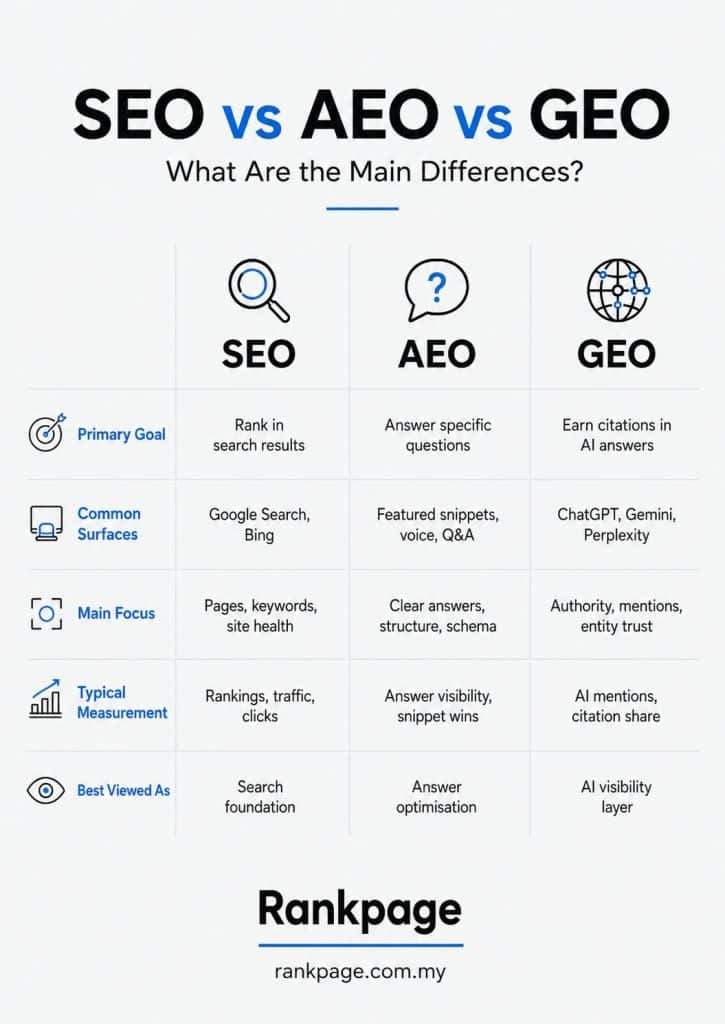
The page does not need three versions. It needs to be accurate, accessible, clearly structured and useful across several search environments.
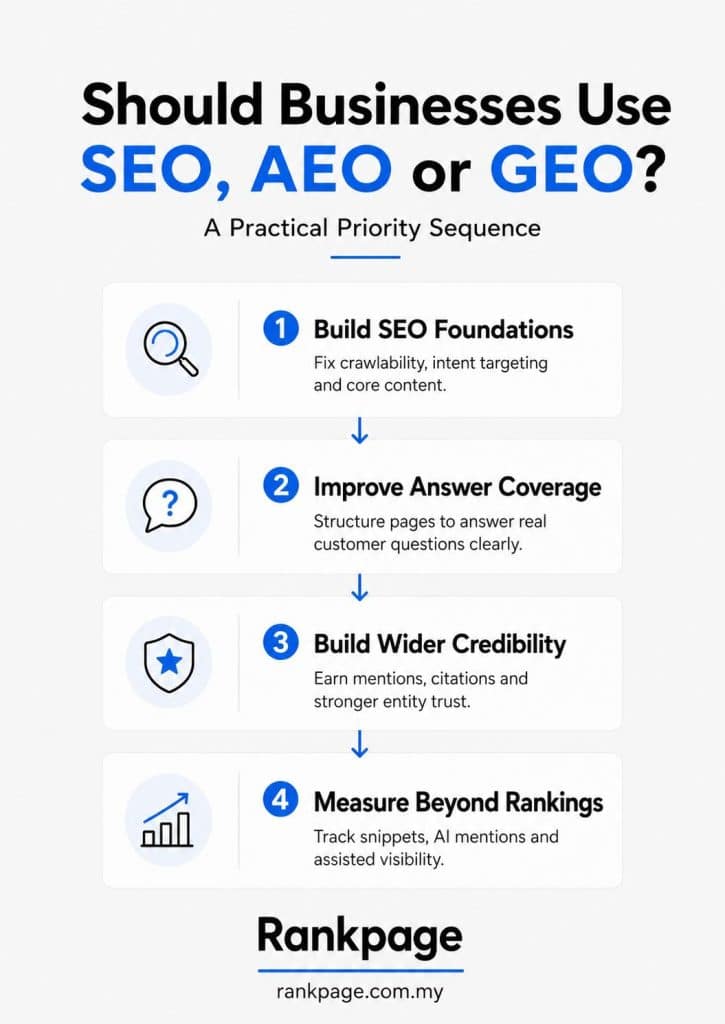
Should Businesses Use SEO, AEO or GEO?
Most Malaysian businesses can apply principles from all three, but they do not need to invest in each one equally from the beginning.
SEO should normally provide the foundation because technical accessibility, useful content and clear site structure support both conventional and AI-powered search.
A practical sequence would be:
- Establish the SEO foundation. Fix indexing problems, improve the site structure and strengthen important product or service pages.
- Improve answer coverage. Identify the questions customers ask, then answer them clearly within relevant pages.
- Build wider credibility. Publish original insights and earn legitimate references from publications, directories and industry associations.
- Measure more than rankings. Track traffic and conversions alongside branded searches, AI mentions and referral activity where reliable data is available.
The right balance depends on the business model:
- A local repair company may gain more from local SEO and reviews.
- A B2B software provider may benefit from comparison pages, documentation and original research.
- Legal, medical and financial businesses will need especially strong sourcing and clear terminology.
What Should Malaysian Businesses Consider?
Malaysian businesses should consider the language and phrases their customers actually use.
Depending on the audience, searches may be written in English, Bahasa Malaysia, Mandarin or a mixture of languages.
Examples include:
- “cara daftar SSM online”
- “e-Invoice Malaysia deadline”
- “best HR software Malaysia SME”
These queries may express related needs but produce different results.
Actual priorities should be based on Search Console data, customer enquiries and credible keyword research rather than assumptions alone.
Good SEO, AEO and GEO strategies begin with the language customers genuinely use.
Understanding the Differences and How They Can Each Benefit Your Business
SEO, AEO and GEO are best understood as connected layers of the same visibility strategy.
- SEO builds the technical and content foundation.
- AEO helps information become a clear answer.
- GEO applies similar principles to generative AI platforms and AI-powered search.
AEO and GEO are useful industry terms, but they are not completely separate from SEO. They rely heavily on the same foundations: accessible pages, useful content, accurate information and strong credibility.
Malaysian businesses should not abandon SEO for the latest trend. A more practical approach is to strengthen search fundamentals, answer customer questions clearly and build the credibility needed to appear across traditional and AI-powered search.
As a reliable SEO agency in Malaysia, Rankpage helps businesses improve technical performance, content quality and long-term organic visibility. Explore our SEO services to build a stronger foundation for both search engines and AI-driven discovery.
Sources
- Google Search Central, SEO Starter Guide
- Google Search Central, How Google Search Works
- Google Search Central, AI Features and Your Website
- Google Search Central, Optimising for Generative AI Features
- Google Search Central, Creating Helpful, Reliable, People-First Content
- Google Search Central, Structured Data Guidelines
- Microsoft Bing Webmaster Blog, AI Performance in Bing Webmaster Tools
- Aggarwal et al., GEO: Generative Engine Optimization
- Lembaga Hasil Dalam Negeri Malaysia, e-Invoice Implementation Timeline and Guidelines
Frequently Asked Questions About AEO vs SEO vs GEO
Is AEO Replacing SEO?
No. AEO is best understood as an answer-focused application of SEO principles. Websites still need strong technical foundations, useful content and credibility.
Is GEO the Same as SEO?
Not exactly, although the two overlap heavily. SEO focuses mainly on organic visibility, while GEO describes work intended to improve mentions and citations within generative AI responses.
Does My Business Need a Separate GEO Strategy?
Not always. Most businesses can begin by applying GEO principles to their existing SEO, content, PR and branding work.
How Can Content Be Optimised for AEO?
Use clear headings, answer the main question early and support the answer with useful context and reliable sources.
How Can Malaysian Businesses Improve GEO Visibility?
Publish useful local insights, maintain accurate business information and earn credible mentions from reputable third-party websites.
Should Small Businesses Focus on SEO, AEO or GEO First?
Small businesses should usually prioritise SEO first, then improve answer-focused content and gradually build stronger generative-search visibility.