Quick Comparison Table: What Good vs Weak SEO Agencies Say
Question Area | Strong Agency Answer | Weak Agency Answer |
Strategy | Tailored to industry, goals, and market | Generic “we optimise keywords” |
Results | Focus on leads, conversions, ROI | Focus only on rankings |
Timeline | Phased growth over 3–6 months | “Guaranteed results in 30 days” |
Content | Custom, research-backed, localised | AI-only or templated content |
AI Search | Mentions AI Overviews/SGE, AEO, entity SEO | No awareness of AI search |
Reporting | Clear KPIs and monthly insights | Basic traffic reports only |
Local SEO | Strong Google Business Profile strategy | No local optimisation plan |
Pricing | Transparent scope-based pricing | Vague or unusually cheap |
Selection Criteria: What Malaysian Businesses Should Prioritise
Before evaluating any SEO agency, it helps to define what “good SEO” actually looks like in Malaysia today.
Choosing a strong SEO agency (instead of a poorly performing one) should improve how your business is discovered, understood, and chosen, not just how it ranks. This distinction matters more than ever as search evolves into AI-driven answer systems.
When evaluating agencies, Malaysian businesses should prioritise:
- Business alignment, where SEO supports real revenue or lead generation
- Local SEO strength, including Google Business Profile and location-based searches
- Multilingual capability to capture English, Bahasa Malaysia, and Chinese queries
- Content quality with local examples, regulations, and context
- Technical SEO that improves site performance and user experience
- AI search readiness, including optimisation for AI Overviews and “answer-style” queries
- Clear reporting tied to outcomes, not vanity metrics
A useful way to think about it is this: good SEO helps people find you, but great SEO helps people choose you.
Authority Check (Skimmable “Safe SEO” Signals)
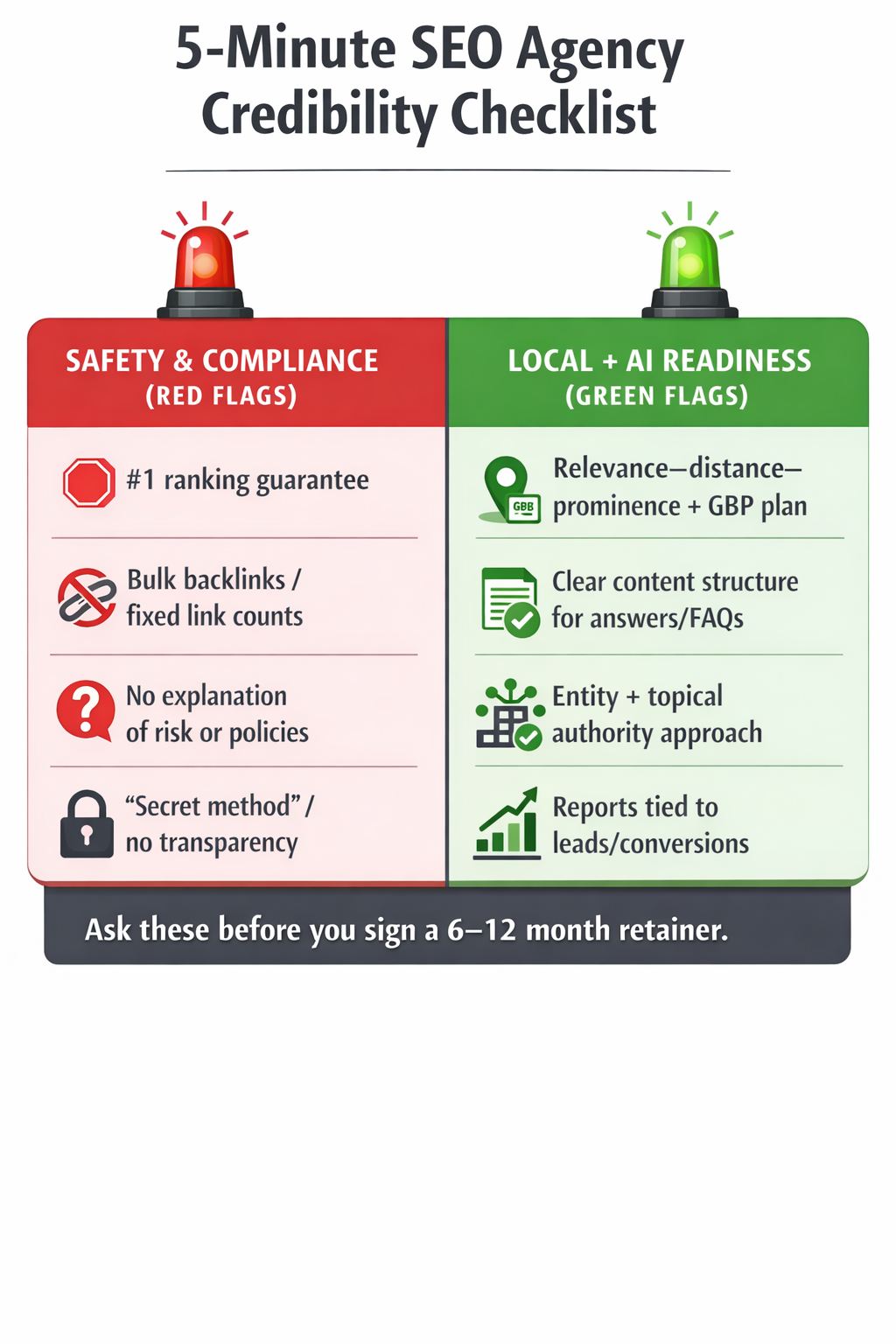
Use this as a quick credibility filter during your agency evaluation.
1) Safety and compliance
- If an agency guarantees #1 rankings, treat it as a red flag. Legit SEO can’t promise specific positions because rankings depend on many factors outside an agency’s control.
- Ask how they avoid risky tactics (spammy links, doorway pages, thin pages, fake reviews). If they can’t explain risk clearly, that’s a warning sign.
2) Local + AI visibility reality
- For local SEO, agencies should know that map visibility is heavily tied to relevance, distance, and prominence, so your Google Business Profile and local signals matter.
- For AI search, the goal isn’t “gaming ChatGPT.” It’s publishing content that’s clear, structured, and genuinely helpful so it can be surfaced or linked in AI-driven summaries (availability varies by query and country).
1. What Is Your SEO Strategy for My Business?
A real SEO strategy should feel specific to your business, not reusable across clients.
Many agencies start by listing services such as keyword research, content writing, and link building. While these are important, they are not a strategy. A strategy explains why certain actions are prioritised and how they connect to business outcomes.
In Malaysia, strategy must account for local competition, search intent, and customer behaviour. A legal firm targeting corporate clients will need a different content structure than a tuition centre targeting parents near a specific neighbourhood.
What a strong answer includes:
- Industry-specific insights and positioning
- Competitor benchmarking within Malaysia
- Clear prioritisation of actions based on impact (not “everything at once”)
- A phased roadmap covering technical, content, and authority
Real scenario:
A business ranking for broad keywords but not converting may need intent-focused pages and stronger landing-page clarity, not “more traffic.”
Red flag:
Generic responses like “we optimise keywords and build backlinks.”
2. How Do You Adapt SEO for the Malaysian Market?
Malaysia’s search landscape is multilingual, localised, and intent-driven.
Unlike more uniform markets, Malaysian users frequently mix languages and rely heavily on location-based searches. This creates both complexity and opportunity. Agencies that understand this will capture higher-intent traffic, not just higher volume.
What a strong answer includes:
- Local keyword targeting (KL, PJ, Penang, Johor, etc.)
- Multilingual content planning (English + BM + Chinese, when relevant)
- Google Business Profile optimisation (categories, services, photos, reviews, Q&A)
- Local citations and directory listings (consistent NAP: name, address, phone)
Example:
A user searching “klinik gigi murah KL” is often closer to booking than someone searching “dental clinic Malaysia.”
Red flag:
No mention of localisation or language strategy.
3. Can You Show Case Studies or Proven Results?
SEO without proof is just positioning.
Case studies help you understand whether an agency can deliver outcomes, not just explain concepts. But not all case studies are equal; the best ones show context, strategy, and business impact.
What a strong answer includes:
- Before-and-after performance comparisons
- Traffic growth tied to relevant keywords (not unrelated vanity terms)
- Lead or revenue improvements (or at least qualified enquiry growth)
- Industry-specific examples or examples with similar constraints
What to watch for:
Look for consistency over time, not just one standout spike.
Red flag:
Vague claims without data, timelines, or clear attribution.
4. What KPIs Do You Track and Report On?
Not all SEO metrics are created equal.
Many agencies still focus on rankings and impressions because they’re easy to report. However, these metrics don’t always translate into business value. A strong agency connects SEO performance to outcomes that matter.
What a strong answer includes:
- Leads, enquiries, or sales (aligned to your funnel)
- Organic traffic quality (engaged sessions, scroll depth, return visits)
- Conversion rates per landing page (not just site-wide averages)
- ROI signals or attribution approach (even if imperfect)
Example:
Traffic growth with flat conversions often indicates misaligned targeting or weak landing-page intent match.
Red flag:
Reporting only keyword rankings or impressions with no business tie-in.
5. How Do You Approach Content Creation?
Content is the foundation of modern SEO, especially in AI-driven search.
Malaysian audiences respond better to content that reflects local realities: pricing ranges, regulations, cultural context, and real-life scenarios. Generic content may rank temporarily, but it rarely builds trust or authority.
What a strong answer includes:
- Research-driven content strategy based on search intent
- Malaysian examples, terminology, and context (not copy-paste “global” advice)
- Structured formatting for readability and AI extraction (headings, FAQs, clear answers)
- Human editing layered over AI tools (if used), not “publish and pray”
Insight:
Content that explains Malaysia’s phased e-Invoice rollout (key dates by turnover band, readiness steps, and common pitfalls) will often outperform generic accounting content because it answers a local, time-sensitive need.
Red flag:
Mass-produced AI content with little depth, no local proof points, and no editorial QA.
6. How Do You Build Links and Authority?
Authority determines whether your content can compete.
Backlinks still matter, but how they’re acquired matters more than ever. Poor link practices can do more harm than good, especially if links are irrelevant, paid in bulk, or obviously manipulated.
What a strong answer includes:
- Digital PR campaigns and “earned” placements
- Outreach to relevant industry sites (not random blogs)
- Brand mentions and authority building beyond links
- Natural link acquisition through genuinely useful assets (guides, data, tools)
Example:
A feature on a reputable Malaysian publication can carry more weight than multiple low-quality links.
Red flag:
Promises of fixed numbers of backlinks each month without quality standards.
7. How Do You Optimise for AI Search (AI Overviews/SGE, Answer Engines, AEO)?
Search is evolving from “find results” to “get answers.”
With Google AI Overviews (formerly SGE) expanding globally, content that is clear, structured, and genuinely helpful is more likely to be surfaced and linked inside AI-generated summaries (availability varies by query and country).
What a strong answer includes:
- Content structured for direct answers (definitions, steps, comparisons, “best for” sections)
- Information gain (original insight, not repeated summaries)
- Entity-based SEO (clarity on who/what/where you are)
- Topical authority development (clusters, internal linking, consistent expertise)
Example:
Pages that clearly answer specific questions with structured formatting are more likely to be referenced in AI-driven summaries than broad “everything about X” pages with no clear takeaways.
Red flag:
No awareness of AI search trends or terminology.
8. What Is Your Timeline for Results?
SEO works best as a compounding strategy.
Results build over time as content, authority, and technical improvements accumulate. A realistic timeline prevents frustration and misaligned expectations.
What a strong answer includes:
- ~3 to 6 months for early traction (visibility movement, early winners, technical stabilisation)
- ~6 to 12+ months for measurable growth in competitive categories
- Clear milestones and checkpoints (what success looks like each quarter)
Reality check:
Highly competitive industries in Malaysia may take longer, especially if you’re starting from low authority or weak site foundations.
Red flag:
Guaranteed rankings within a short timeframe.
9. What Will I Receive Each Month?
Clarity on deliverables ensures accountability and transparency.
Without defined outputs, it becomes difficult to measure progress, or even know what work is being done. Good agencies make their work visible.
What a strong answer includes:
- Content production schedule (topics, pages, publish dates, update plan)
- Technical SEO improvements (what changed, why, and expected impact)
- Performance reports (KPIs + insights, not just charts)
- Strategy updates (what’s next and what’s being deprioritised)
Example:
A structured monthly plan creates consistent progress rather than sporadic activity and reactive “fixes.”
Red flag:
Vague promises without clear deliverables.
10. How Does Your Pricing Work?
SEO pricing should reflect value, complexity, and scope.
In Malaysia, pricing varies depending on competition, business size, and goals. The key is whether the scope and outcomes match what you’re paying for.
Typical Malaysia market context (commonly quoted ranges; varies by scope and competition):
- ~RM2,000 to RM5,000/month: Lighter or basic SEO support (often local + on-page focus)
- ~RM5,000 to RM10,000/month: Growth-focused campaigns (content + technical + authority building)
- RM10,000+/month: Highly competitive or enterprise-level SEO (multiple content clusters, heavier technical work, PR-style authority building)
What a strong answer includes:
- Transparent breakdown of services and deliverables
- Explanation of cost drivers (competition, site issues, content volume, link difficulty)
- Alignment with expected outcomes and measurement approach
Insight:
Very cheap SEO often means reduced quality (thin content, weak links, minimal strategy), which can lead to slow growth or unnecessary risk.
Red flag:
Very low pricing with unclear scope.
Making the Right SEO Agency Choice
Hiring an SEO agency should feel like choosing a strategic partner, not just outsourcing a service.
The right questions help you identify agencies that understand your business, your market, and the future of search, rather than those that rely on outdated tactics or “package thinking.”
If you’re currently evaluating SEO partners, it may help to explore how Rankpage, Malaysia’s most trustworthy SEO partner, approaches SEO for Malaysian businesses, combining local search expertise with AI-driven strategies. We focus on building scalable search systems that grow alongside your business, not just improving short-term rankings.
Sources
- Google Search Central, SEO Starter Guide
- Google Business Profile Help, Local ranking factors
- Google (blog), AI Overviews updates
- Department of Statistics Malaysia (DOSM), MSME/SME publications
- LHDN/IRBM, e-Invoice implementation resources
- Search Engine Journal / Search Engine Land, AI search and SEO trends
- Ahrefs, State of SEO Reports
- HubSpot, SEO benchmark data