What Is A Blog In 2026?
A blog is a structured content system designed to capture search demand and convert it into traffic, trust, and revenue.
What Most People Get Wrong
Many still think a blog is:
- A place to share ideas
- A collection of articles
But without structure, these blogs:
- Don’t rank
- Don’t get traffic
- Don’t convert
What A High-Performing Blog Looks Like
A strategic blog:
- Targets keyword clusters (not random topics)
- Aligns each article with search intent
- Guides readers toward a next step
Simple Example
Weak blog:
“My experience with business”
Stronger blog:
“How Malaysian SMEs Can Reduce Costs With SEO (2026 Guide)”
The difference is:
- Clear audience
- Clear intent
- Clear monetisation path
Why Start A Blog In Malaysia Now?
Because Malaysia has a large online audience, and many niches still have gaps in local, high-quality, intent-matched content, where SEO-driven blogs can compete effectively.
Market Reality (Common Patterns)
- Many businesses still lean heavily on paid ads for leads
- SEO service investment varies by industry (some are mature, others still have gaps)
- In many niches, localised, well-structured content is still limited
What This Means For You
If you start now:
- You may face less competition in certain local niches compared to global SERPs
- You can build authority earlier in topics where coverage is thin
- You can earn compounding benefits if you stay consistent
Local Search Behaviour Insight
Malaysians often search with:
- Mixed languages (English + BM)
- Location intent (Malaysia, KL, Selangor)
- Practical queries (pricing, comparisons, step-by-step guides)
Example:
A Malaysian user may search:
“how to start online business malaysia cost”
instead of:
“how to start business globally”
That’s why localisation isn’t optional, it’s an advantage.
Who Should Start A Blog (And Who Should Not)?
Blogging is ideal for people building long-term digital assets.
Ideal For
- Service providers (consultants, agencies, clinics)
- SMEs targeting local customers
- Freelancers building authority
- eCommerce brands
Why It Works For These Groups
Because blogs:
- Capture search intent
- Build trust before conversion
- Reduce dependency on ads over time
Not Ideal For
- Businesses needing immediate results
- Those unwilling to invest in consistency
Reality check: Blogging is not fast. But it can be one of the highest ROI channels over time when executed well.
When Should You Start A Blog?
The best time to start is before you need traffic, not when you’re desperate for it.
SEO Growth Timeline (Typical Ranges, Not Guarantees)
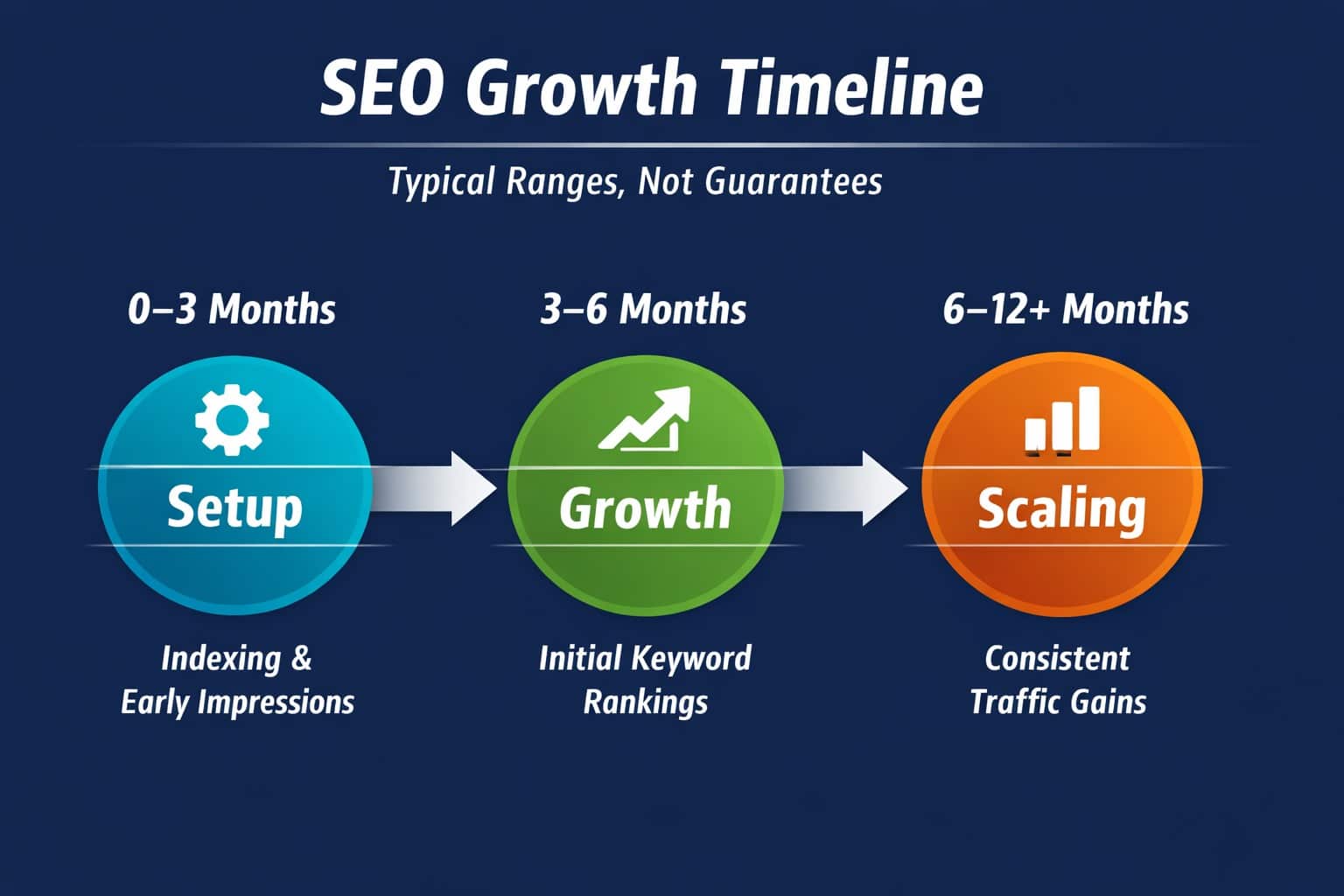
- 0–3 months (Setup): indexing + early impressions
- 3–6 months (Growth): early traction on long-tail keywords
- 6–12+ months (Scaling): more consistent traffic as content accumulates
Timelines vary by niche, competition, and site quality. Some keywords move fast, others take much longer.
Where Should You Build Your Blog?
Your technical setup determines how well your blog can perform.
Recommended Stack
Element | Recommendation | Why It Matters |
Platform | WordPress | Flexible, widely used, strong SEO ecosystem |
Domain | .com / .com.my | Brand trust + localisation |
Hosting | Reliable provider | Speed + uptime + stability |
Additional Considerations
- Choose lightweight themes
- Avoid unnecessary plugins
- Prioritise speed and clarity over heavy design
Even strong content can fail if:
- Your site is slow
- Your structure is messy
- Your pages are hard to crawl
How To Start A Blog In Malaysia (SEO-First Framework)
Step 1: Keyword Research (Your Foundation)
If no one is searching for your topic, your blog won’t grow.
What Beginners Do
- Write based on assumptions
- Choose topics randomly
What You Should Do
- Identify real search demand
- Analyse keyword difficulty, readability, and SERP competition
- Prioritise long-tail keywords with clear intent
Example targets:
- “how to start a blog in malaysia step by step”
- “blog cost malaysia 2026”
These tend to:
- Be easier to rank than broad keywords
- Match real user intent
- Convert better
Step 2: Search Intent Mapping (Critical Layer)
Search intent determines whether your content ranks or fails.
Intent Breakdown
Intent | User Goal | Best Content Type |
Informational | Learn | Guides, tutorials |
Commercial | Compare | Reviews, comparisons |
Transactional | Act | Service pages, product pages |
Why it matters:
Search systems tend to reward content that matches the intent behind the query, not just keyword usage.
Example:
Keyword: “best hosting malaysia”
In this case, the reader needs a comparison and recommendations, not a tutorial.
Step 3: Build Topic Clusters (Authority System)
Google’s guidance emphasises helpful, reliable, people-first content. In practice, covering a topic thoroughly (and connecting related pages clearly) often performs better because it’s easier for users (and search systems) to understand.
What This Means
A cluster structure helps you:
- Cover a topic from multiple angles
- Build internal links naturally
- Create a clear “content map” around one theme
Example Cluster
Pillar: How to start a blog in Malaysia
Supporting articles:
- Blog SEO guide for beginners
- Best hosting in Malaysia (comparison)
- Blog monetisation strategies for Malaysia
- Content plan for Malaysian SMEs
Result:
- Stronger internal linking
- Better topical coverage
- Higher chance of ranking for multiple related queries
Step 4: Create Content That Wins (Original Value)
Your content must go beyond what already exists by being:
- More specific
- More localised
- More actionable
Add Value With
- Malaysian examples
- Practical pricing considerations (without fake certainty)
- Simple frameworks and checklists
Instead of:
Blogs can make money”
Write something more useful like:
“With ~10,000 monthly visitors, earnings can vary widely depending on niche, audience location, and monetisation model (ads, affiliates, services). A better approach is to estimate revenue using your real RPM/commission rates once traffic data comes in.”
That kind of specificity builds trust without making unverifiable promises.
Step 5: Optimise For AI Search (AEO Layer)
AI features (like AI Overviews and other AI-driven summaries) may use and link to web content. Structuring your content clearly improves usability and discoverability, but inclusion is never guaranteed.
What AI and Modern Search Tend to Prefer
- Direct answers
- Clear headings
- Structured formatting (bullets, tables)
- Clean explanations with definitions and examples
How To Adapt
- Add “Quick Answer” sections
- Use short paragraphs and scannable formatting
- Define key terms simply
- Include step-by-step processes
Outcome:
- Better readability for humans
- Better extraction for machines
- Higher chance your content is referenced (not guaranteed, but improved odds)
Step 6: Technical SEO (Visibility Layer)
Technical SEO ensures your content can actually be found and processed.
Key Elements
- Fast loading speed
- Mobile optimisation
- Clean URLs
- XML sitemap
- Proper internal linking
Common issue: Many blogs fail not because of content quality, but because the site is slow, poorly structured, or difficult to crawl.
Step 7: Local SEO For Malaysia (Trust Layer)
Localisation gives you an advantage, but only if you go beyond adding “Malaysia” to titles.
Go Beyond “Malaysia” Keywords
Instead:
- Reflect real local behaviour
- Address local constraints (budget, payment methods, logistics, regulations where relevant)
- Use local examples and scenarios
Example:
Generic: “How to start a blog”
Localised: “How Malaysian SMEs Can Start A Blog On A Low Budget”
Impact:
- Higher relevance
- Better engagement
- Stronger rankings for local intent terms
Step 8: Monetisation Strategy (Conversion Layer)
The goal is not traffic. It’s outcomes.
Monetisation Methods
- Affiliate marketing
- Selling services
- Ads (display/network)
- Digital products (templates, guides, courses)
Strategic Insight
Low-quality traffic:
- Generates little revenue
High-intent traffic:
- Converts into leads and sales
A smaller audience with strong intent often beats large, irrelevant traffic.
Challenges You Will Face (And How To Overcome Them)
Common Challenges
- Slow growth
- Ranking difficulty
- Inconsistency
- Low authority early on
Practical Solutions
- Focus on clusters, not random posts
- Publish consistently (even 2–4 quality posts/month compounds)
- Improve depth and clarity instead of chasing volume
- Build credibility: examples, proofs, experience, and references
How Much Does It Cost To Start A Blog In Malaysia?
Cost Breakdown (RM/year, typical ranges)
Item | Typical Cost (RM/year) |
Domain | ~RM60–RM200+ (varies by extension/provider) |
Hosting | A few hundred RM/year to much higher for premium/managed |
SEO tools | RM0–RM2,000+ |
Content | Variable |
Key insight: The biggest investment is strategy and content quality, not tools.
Additional Layer: E-E-A-T (Trust & Authority Signals)
E-E-A-T (Experience, Expertise, Authoritativeness, Trust) isn’t a checklist, it’s a practical guideline for creating content people can rely on.
What To Include
- Real experience (examples, case notes, practical steps)
- Clear expertise (show you know the topic)
- Reliable references when claims matter
- Structured content that’s easy to verify and follow
Instead of generic advice:
- Use Malaysian scenarios
- Explain assumptions clearly
- Provide realistic ranges and decision frameworks
Real Insight: Why Most Blogs Fail
Because they treat blogging as writing, not as a system.
Failed Blogs
- Random topics
- No intent strategy
- No structure
- No conversion path
Successful Blogs
- Article topic clusters
- Intent-driven content
- Consistent execution
- Clear next steps (lead magnets, services, products)
Starting Your Blog Well
Starting a blog in Malaysia in 2026 is about building a structured, SEO-driven system that aligns with how people search and how modern search platforms evaluate content. When done correctly, your blog becomes a long-term digital asset that consistently drives traffic, builds authority, and generates revenue.
If you’re looking to build a blog that not only exists but actually ranks and converts, we help businesses design SEO-driven content systems tailored to Malaysian search behaviour. At Rankpage, Malaysia’s most reliable SEO agency, we combine technical SEO, content strategy, and localisation to turn blogs into scalable growth channels. Strike while the iron is hot and grab this opportunity to boost your blog growth, with Rankpage.
Sources
- Google Search Central — official SEO guidelines, AI features guidance, content quality best practices
- DOSM (Department of Statistics Malaysia) — internet/digital adoption context
- Ahrefs / Semrush — SEO research and competitive benchmarking (use as directional data, not absolute truth)
- HubSpot — blogging and content marketing benchmark reports (marketer-reported trends)
- Yoast — on-page SEO and site structure best practices (implementation guidance)