Why Multilingual SEO Matters in Malaysia
Malaysia is a multilingual digital market at real scale.
According to the Department of Statistics Malaysia, internet usage among individuals reached 98.0% in 2024, showing just how widespread digital search behaviour has become. Malaysia’s population was estimated at 34.2 million in 2025, including 9.9% non-citizens. That matters because the market is not only multilingual, but made up of audiences with different habits, needs, and expectations.
(Source: Department of Statistics Malaysia, ICT Use and Access by Individuals and Households Survey Report 2024; Current Population Estimates, Malaysia, 2025)
Recent demographic data also shows a highly diverse population mix. In Q4 2024, DOSM reported Malaysia’s population as 58.1% Malay, 22.4% Chinese, 6.5% Indian, and 12.3% Other Bumiputera. Ethnicity is not the same as language preference, but it is still a strong reminder that one-language SEO rarely reflects the full market.
(Source: Department of Statistics Malaysia, Demographic Statistics, Fourth Quarter 2024)
For SEO services, this means one important thing: Optimising for one language often means optimising for only one slice of demand.
What Multilingual SEO Looks Like in Practice
In many Malaysian campaigns, marketers often see patterns like these:
Language / Audience | Common Search Context |
English | Research-led searches, comparison, professional services |
Bahasa Melayu | Public-facing services, local needs, accessibility |
Chinese | Price-led queries, comparison, commercial decision-making |
Expat / migrant audiences | Simpler phrasing, hybrid or mixed-language searches |
These are not fixed rules. They are working patterns that should always be validated against your own Search Console data, keyword research, and live SERPs.
The key point is not that each language behaves neatly. It is that different audiences often search with different expectations, even when they are looking for the same thing.
Why Translation Alone Fails
Many businesses treat multilingual SEO as a translation task.
They take an English page, translate it into BM or Chinese, publish it, and expect it to rank.
That usually falls short.
Translation changes words. Good multilingual SEO adapts meaning.
A page can be grammatically correct and still fail because:
- The keywords are not how locals actually search
- The phrasing feels unnatural
- The examples do not fit local context
- The trust signals are wrong for that audience
- The page answers the question in the wrong way
That is why localisation matters. It is not cosmetic. It affects relevance, trust, and conversion.
The Core Parts of Multilingual SEO
1. Language and Audience Targeting
Start by treating each language as a different audience segment, not just a different version of the same page.
Different audiences may:
- Search with different wording
- Need different types of reassurance
- Respond to different content emphasis
- Convert at different stages of the journey
For example, the same accounting service might be searched as:
- A strategic business solution
- A compliance need
- A price comparison
- A quick local service query
Those are not just language differences. They are intent differences.
2. Keyword Research by Language and Intent
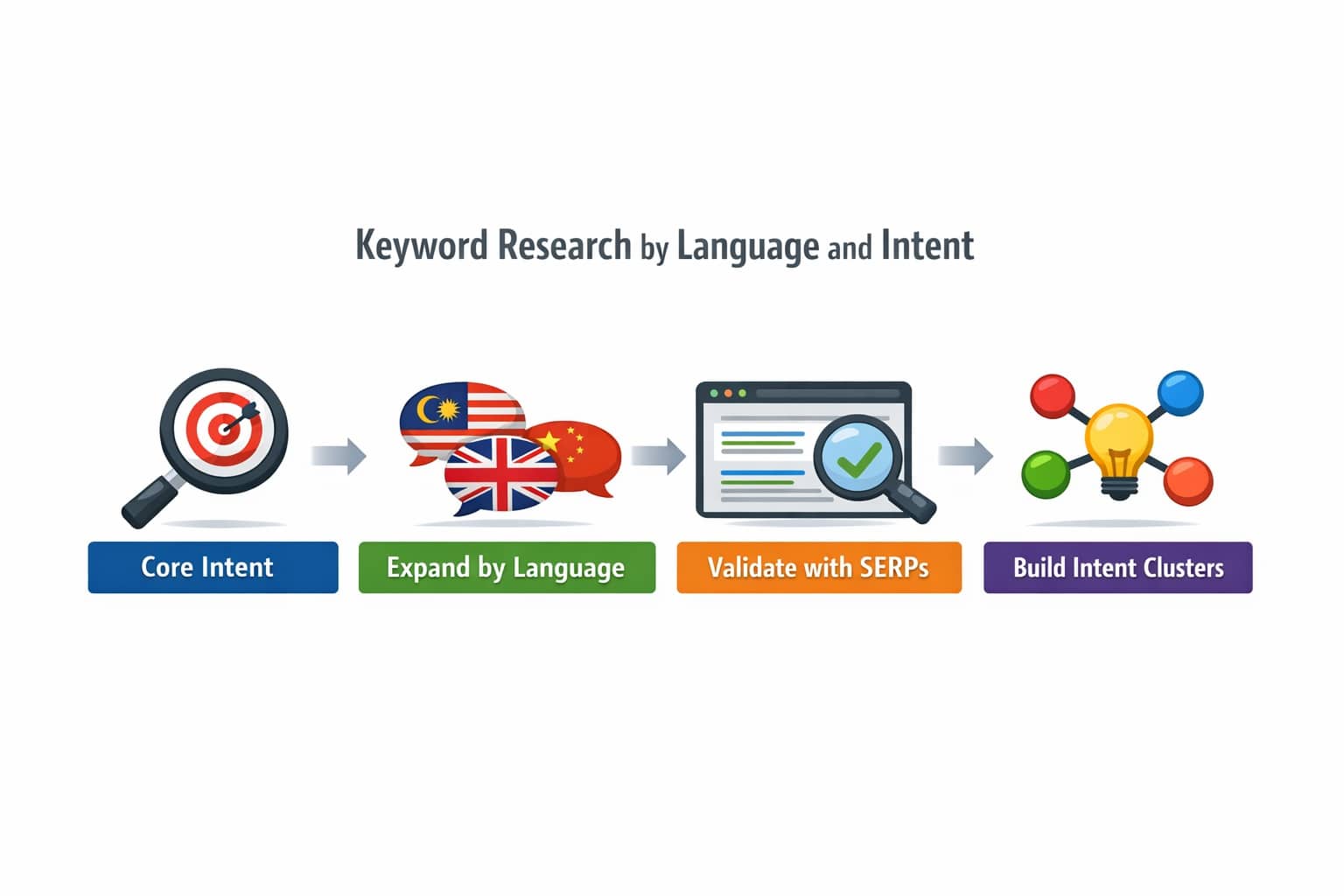
One of the biggest multilingual SEO mistakes is translating keywords directly.
Do not assume that a translated keyword is the keyword people actually use.
A better process looks like this:
- Start with the core intent
- Research each language separately
- Check live search results
- Build topic clusters based on how users actually phrase the need
Example
Intent | English | BM | Chinese |
Accounting services | accounting services Malaysia | perkhidmatan akaun syarikat | 会计服务 马来西亚 |
Even when these phrases describe the same service, they may not reflect the same level of urgency, trust expectation, or commercial intent.
That is why multilingual keyword research should be done independently, not by translation alone.
3. Content Localisation, Not Just Translation
Localisation means adapting content so it feels natural and useful to the audience reading it.
That includes:
- Tone and phrasing
- Local examples
- Local trust markers
- Currency and pricing references
- City or regional context
- Service expectations
In Malaysia, localisation might mean referring to:
- RM instead of USD
- Local business setups and compliance context
- Places like KL, Penang, Johor Bahru, or Subang
- Phrasing that reflects how people actually speak and search
When content feels generic or imported, trust drops quickly.
4. Technical SEO Structure Still Matters
Multilingual SEO is not just a content exercise. Search engines need a structure they can interpret clearly, and this is where technical SEO comes in.
Google recommends using different URLs for different language versions of a page, rather than relying only on browser settings, cookies, or automatic adaptation.
(Source: Google Search Central, Managing Multi-Regional and Multilingual Sites)
That usually means a setup like:
- com/
- com/bm/
- com/zh/
For many businesses, subdirectories are a practical and search-friendly option, although other URL structures can work too if implemented consistently. (Source: Google Search Central, Managing Multi-Regional and Multilingual Sites)
Key technical elements
- Separate URLs for each language version
- hreflang annotations
- XML sitemaps
- Clear internal linking between language versions
- A language switcher users can easily find
One nuance matters here: Google does not rely on hreflang or the HTML lang attribute alone to detect page language. Those elements help with clarity and targeting, but your page still needs clear, language-specific content.
(Source: Google Search Central, Localized Versions of Your Pages)
5. User Experience Across Languages
Multilingual SEO works best when users can control their own experience.
Good practice includes:
- One primary language per page
- A clear language switcher
- No confusing mixed-language layouts
- No forced assumptions about what users want
Google also warns that locale-adaptive pages can be harder to crawl and index fully, because Googlebot may not see every version the way users do. That is one more reason not to rely only on automatic redirects or browser-language detection.
(Source: Google Search Central, How Google Crawls Locale-Adaptive Pages)
Language Overlap Can Break SEO
Some words (like ‘air’ in English vs Bahasa Melayu) may look familiar across markets but carry different meanings, usage, or connotations.
That is where multilingual SEO can go wrong.
A term that seems harmless in one language may feel awkward, outdated, or misleading in another. Even between closely related languages, meaning is not always portable.
The practical lesson is simple:
Do not optimise from assumptions. Optimise from real usage.
That means:
- Checking live SERPs
- Validating search phrasing locally
- Reviewing connotation, not just dictionary meaning
- Avoiding copy-paste wording from nearby markets
If a term looks familiar, double-check it.
In multilingual SEO, similar does not always mean equivalent.
Mixed-Language Search Is Normal
Google has explicitly noted that in many countries and regions, users commonly search in more than one language. That supports what many Malaysian businesses already see in practice: search behaviour does not stay neatly inside one language box.
(Source: Google Search Central Blog, How Google Search Handles Multilingual Searches)
Examples of hybrid search behaviour may include:
- accounting services KL murah
- akaun company setup Malaysia
- 会计公司 KL price
These queries combine commercial intent, location, and language habits in ways that do not fit a single-language SEO strategy.
That creates:
- Hybrid queries
- Overlapping intent signals
- Blended keyword patterns
- Pages that need stronger contextual relevance
If your SEO strategy is fully siloed by language, you may miss how people actually search.
How AI Search Raises the Bar
AI-driven search is increasing the value of content that is clear, useful, and genuinely satisfying.
Google’s guidance for AI search performance emphasises helpful, unique, satisfying content, especially as users ask longer and more specific questions. For multilingual SEO, that means weak translations are less likely to compete with pages that are genuinely localised and easier to understand.
(Source: Google Search Central Blog, Top Ways to Ensure Your Content Performs Well in Google’s AI Experiences on Search)
In practice, that means:
- Language quality still matters
- Structure matters more
- Shallow translated pages are easier to ignore
- Original, audience-aware content has more value
So yes, multilingual SEO is still about language. But increasingly, it is also about whether the page actually deserves to be surfaced.
Common Multilingual SEO Mistakes in Malaysia
- Translating keywords directly without validation
- Assuming every language version should say the same thing
- Treating BM and Indonesian as interchangeable
- Publishing translated pages with no localisation
- Relying too heavily on automated translation
- Using one content structure for every audience
- Ignoring mixed-language search behaviour
- Setting up multiple language versions without proper technical signals
How to Build a Stronger Multilingual SEO Strategy
Keep the framework simple.
- Define the core business intents: What are the real services, offers, and high-value actions you want to rank for?
- Map likely audience segments: Who is searching in English, BM, Chinese, or mixed-language patterns?
- Research keywords per language: Do not just translate. Research each language separately.
- Validate in live SERPs: Check what Google is already rewarding for that query.
- Localise content properly: Adapt tone, examples, proof points, and trust cues.
- Build the technical structure: Use clear URLs, language targeting, and internal links.
- Track performance by language: Measure visibility, engagement, and conversions by audience segment, not just by page.
Multilingual SEO Is About Understanding People
Multilingual SEO in Malaysia is not about translating your website into multiple languages and hoping for the best.
It is about understanding how meaning, intent, trust, and behaviour shift across audiences.
The businesses that win are not the ones with the most translated pages. They are the ones that build content around how people actually search, how they evaluate what they find, and what makes them feel confident enough to act.
At Rankpage, Malaysia’s top SEO agency, we help businesses build multilingual SEO systems that go beyond translation, aligning content with real search intent across Malaysia’s diverse audience landscape. If your SEO feels fragmented across languages, we help turn it into a system that scales, adapts, and performs.