What Are Trust Signals?
A trust signal is any element on a website (or across the internet) that demonstrates credibility, reliability, and legitimacy to users and search engines.
Trust signals reduce uncertainty. When people visit a website for the first time, they often ask:
- Is this business real?
- Can I trust the information here?
- Is it safe to interact with this website?
Examples of trust signals include:
- HTTPS secure connections. (Source: Google Search Central Blog, “HTTPS as a ranking signal”, Aug 7, 2014)
- Customer reviews.
- Testimonials and case studies.
- Company contact details.
- Verified business registration (where applicable). (Source: SSM, Companies Act 2016 (Act 777), Section 30)
- Industry certifications.
- Media mentions.
Google’s quality rater guidelines also emphasise that trust is closely tied to whether content appears accurate, honest, safe, and reliable. (Source: Google Search Quality Evaluator Guidelines, Sep 11, 2025)
Why Trust Signals Matter For SEO
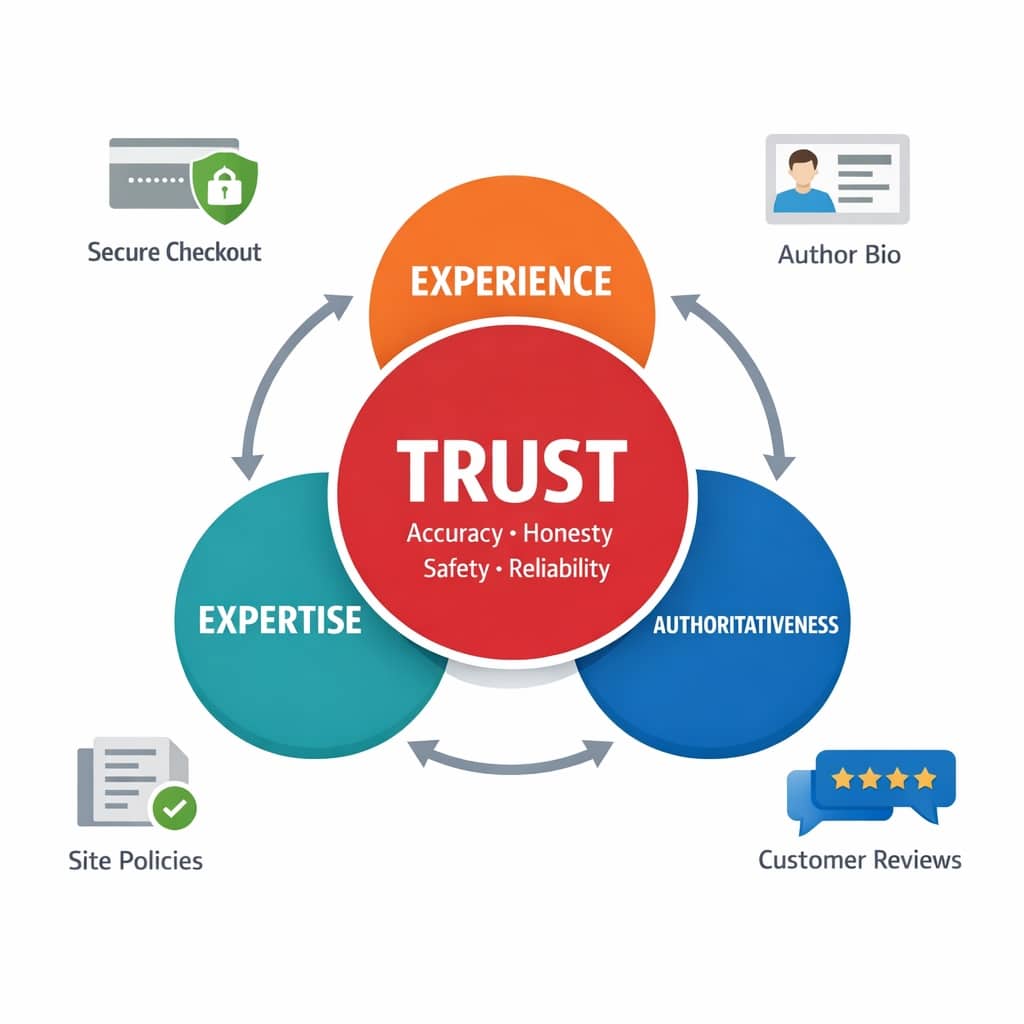
Trust signals influence search visibility through several mechanisms.
- They support E-E-A-T. Google’s quality rater guidelines describe trust as central to E-E-A-T. (Source: Google Search Quality Evaluator Guidelines, Sep 11, 2025)
- They improve user confidence. When people trust a site, they are more likely to enquire, purchase, or return.
- They strengthen authority. Google states it uses links as a signal to understand relevance and discover pages. (Source: Google Search Central, “Link best practices for Google”)
Quick Reference: Trust Signals → What They Help
Trust signal | What it reassures | What it supports |
HTTPS | Safety and legitimacy | A confirmed ranking signal and user trust (Source: Google Search Central Blog, “HTTPS as a ranking signal”, Aug 7, 2014) |
Clear identity (About, Contact, policies) | “This is a real business” | Trust and conversion confidence |
Reviews | Reputation and proof | Local visibility and conversions (Source: Google Business Profile Help, “Improve local ranking on Google”) |
Reputable links/mentions | Independent validation | Authority and discovery (Source: Google Search Central, “Link best practices for Google”) |
Structured data | Clarity for search systems | Better understanding and rich results eligibility (Source: Google Search Central, “Intro to structured data”) |
Key Aspects Of Trust Signals In Google SEO Malaysia
Website Credibility Signals
Website credibility signals are visible on-site elements that demonstrate transparency and professionalism.
Common examples include:
- HTTPS security certificate. (Source: Google Search Central Blog, “HTTPS as a ranking signal”, Aug 7, 2014)
- Clear contact information.
- Privacy policies and terms of service.
- About us pages explaining the business.
- Refund and return policies (where relevant).
- Verified company registration details (where applicable). (Source: SSM, Companies Act 2016 (Act 777), Section 30)
These elements reassure visitors that the website represents a legitimate organisation rather than an anonymous or temporary operation. (Sources: Google Search Quality Evaluator Guidelines, Sep 11, 2025; Google Search Central Blog, “HTTPS as a ranking signal”, Aug 7, 2014)
Social Proof Signals
Social proof signals show that other people have interacted with and trusted the business.
Examples include:
- Customer reviews.
- Case studies.
- Before-and-after project results.
- User-generated content.
Reviews are especially useful because they act as public reputation signals and help customers decide faster, particularly for local services. (Source: Google Business Profile Help, “Improve local ranking on Google”)
Authority Signals
Authority signals come from external sources that confirm credibility.
Examples include:
- Backlinks from reputable websites. (Source: Google Search Central, “Link best practices for Google”)
- Mentions in recognised news publications.
- Citations from industry organisations.
- Awards and recognitions.
- Expert quotes or interviews.
When multiple credible sources mention or link to a business, search systems can interpret this as independent validation. (Source: Google Search Central, “Link best practices for Google”)
Technical Trust Signals
Technical SEO performance contributes to trust because it affects usability and perceived safety.
Important technical trust signals include:
- Fast page loading speeds.
- Mobile-friendly design.
- HTTPS security. (Source: Google Search Central Blog, “HTTPS as a ranking signal”, Aug 7, 2014)
- Structured data markup. (Source: Google Search Central, “Intro to structured data”)
- Clean site architecture.
These technical elements help search engines understand and evaluate a site more effectively, while also improving user experience. (Sources: Google Search Central Blog, “HTTPS as a ranking signal”, Aug 7, 2014; Google Search Central, “Intro to structured data”)
Examples Of Trust Signals Malaysian Websites Should Use
SSM Business Registration Information
Displaying a Suruhanjaya Syarikat Malaysia (SSM) registration number helps confirm that a company is legally registered.
For registered companies, showing your registered name and company registration number on your website supports transparency and accountability. (Source: SSM, Companies Act 2016 (Act 777), Section 30)
Google Business Profile Reviews
Google Business Profile reviews are among the most important trust signals for local businesses.
Google’s guidance on improving local ranking emphasises having complete and accurate business information, and reviews can contribute to prominence while influencing customer decisions. (Source: Google Business Profile Help, “Improve local ranking on Google”)
Physical Office Location
Malaysian users often trust businesses more when they see a real office location.
Displaying the following can improve credibility:
- Office address.
- Google Maps integration.
- Phone numbers.
- WhatsApp contact links.
Local Media Mentions
Media coverage from reputable Malaysian publications can strengthen authority signals:
- Industry features.
- Expert commentary.
- News mentions.
How Trust Signals Influence Google SEO Malaysia
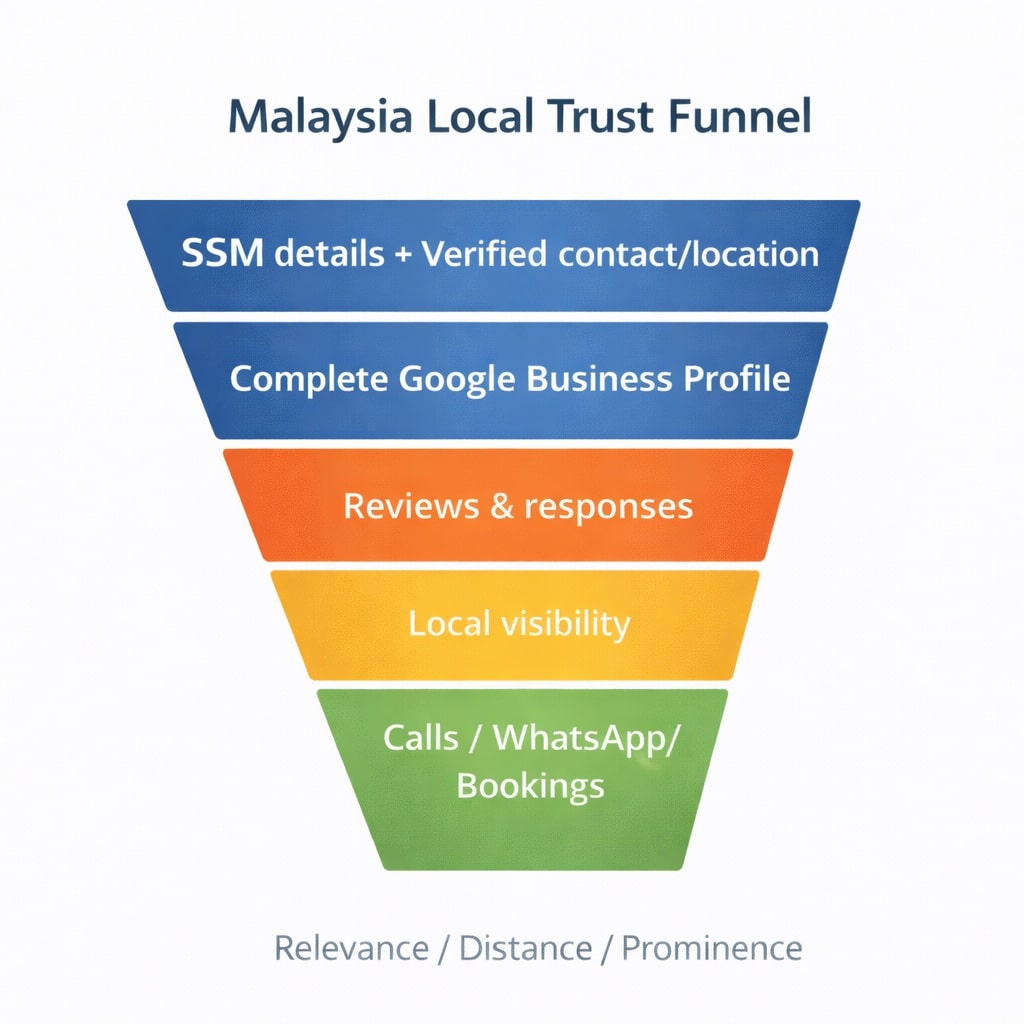
Trust signals affect search visibility through a few connected pathways:
They help Google recognise real entities
- Consistent business name, address, and phone number across listings.
- A complete Google Business Profile with matching website details. (Source: Google Business Profile Help, “Improve local ranking on Google”)
- Clear About and Contact pages that reflect a real operating business.
- Verified registration details (where applicable). (Source: SSM, Companies Act 2016 (Act 777), Section 30)
They increase user confidence and reduce drop-offs
- Secure browsing and forms with HTTPS. (Source: Google Search Central Blog, “HTTPS as a ranking signal”, Aug 7, 2014)
- Transparent policies (privacy, returns, refunds, cancellations).
- Clear service details, pricing ranges, or scope expectations.
They strengthen local SEO performance
- Keeping your Google Business Profile complete and up-to-date. (Source: Google Business Profile Help, “Improve local ranking on Google”)
- Building and responding to reviews consistently. (Source: Google Business Profile Help, “Improve local ranking on Google”)
- Publishing local proof such as case studies, local clients served, or location-based service pages.
They build authority through independent validation
- Links from reputable and relevant websites. (Source: Google Search Central, “Link best practices for Google”)
- Mentions in legitimate publications and industry portals.
- Memberships, certifications, and awards that can be verified.
They support AI-powered search experiences
- Helpful, reliable content and clear structure.
- Clear identity and reputation signals. (Source: Google Search Central, “AI features and your website”)
Common Trust Signal Mistakes Businesses Make
Some common mistakes include:
- Missing contact information.
- Lack of customer reviews.
- No author attribution on blog posts.
- Poorly secured websites (no HTTPS). (Source: Google Search Central Blog, “HTTPS as a ranking signal”, Aug 7, 2014)
- Inconsistent business information across directories.
Practical Ways To Strengthen Trust Signals
- Publish expert-driven content – Content written or reviewed by industry professionals helps demonstrate expertise and experience. (Source: Google Search Quality Evaluator Guidelines, Sep 11, 2025)
- Encourage authentic reviews – Customer feedback builds credibility and supports local visibility. (Source: Google Business Profile Help, “Improve local ranking on Google”)
- Earn high-quality backlinks – Mentions from reputable websites act as independent validation of authority. (Source: Google Search Central, “Link best practices for Google”)
- Display transparent business details – Clear company information helps users confirm legitimacy. (Source: SSM, Companies Act 2016 (Act 777), Section 30)
- Use structured data – Schema markup helps search engines understand business identity and services. (Source: Google Search Central, “Intro to structured data”)
Malaysia Trust Pack: 7 Signals That Instantly Reduce Buyer Doubt
When people compare two similar businesses, they often choose the one that’s easiest to verify. In Malaysia, verification usually comes down to proof of registration, reachable contact, and public reputation.
- Registered name and company registration number (SSM): Display this in your footer and Contact page so customers can quickly verify who they are dealing with. (Sources: SSM, Companies Act 2016 (Act 777), Section 30; SSM Announcement, Oct 11, 2019)
- A complete Google Business Profile: Keep categories, address, phone, hours, and services consistent with your website and other listings. (Source: Google Business Profile Help, “Improve local ranking on Google”)
- Reviews and review responses: A steady flow of genuine reviews, plus professional replies, signals active operations and customer care. (Source: Google Business Profile Help, “Improve local ranking on Google”)
- A real About page with accountable authorship: Add a named author (or reviewer), role, and relevant experience so visitors can trust the information. (Source: Google Search Quality Evaluator Guidelines, Sep 11, 2025)
- Clear policies that reduce risk: Include privacy policies, refund or cancellation policies (where relevant), and support or service terms so customers know what to expect.
- Structured data for your organisation and services: Structured data helps search engines understand what your business is and what you offer. (Source: Google Search Central, “Intro to structured data”)
- Reputable mentions and links: Aim for editorial mentions, associations, partnerships, and legitimate directories that reflect your real industry presence. (Source: Google Search Central, “Link best practices for Google”)
Strengthening Trust to Improve Your Business
Trust signals are one of the foundations of modern SEO. As search systems become more sophisticated, credibility, authority, and verified identity are increasingly important factors in determining which websites appear at the top of results.
Businesses looking to strengthen their Google SEO Malaysia performance should treat trust signals as a long-term strategic investment. Partner with a trusted SEO agency like Rankpage, in order to help your company build trust in the long run.