What Does Ranking On Google Page 1 Actually Mean?
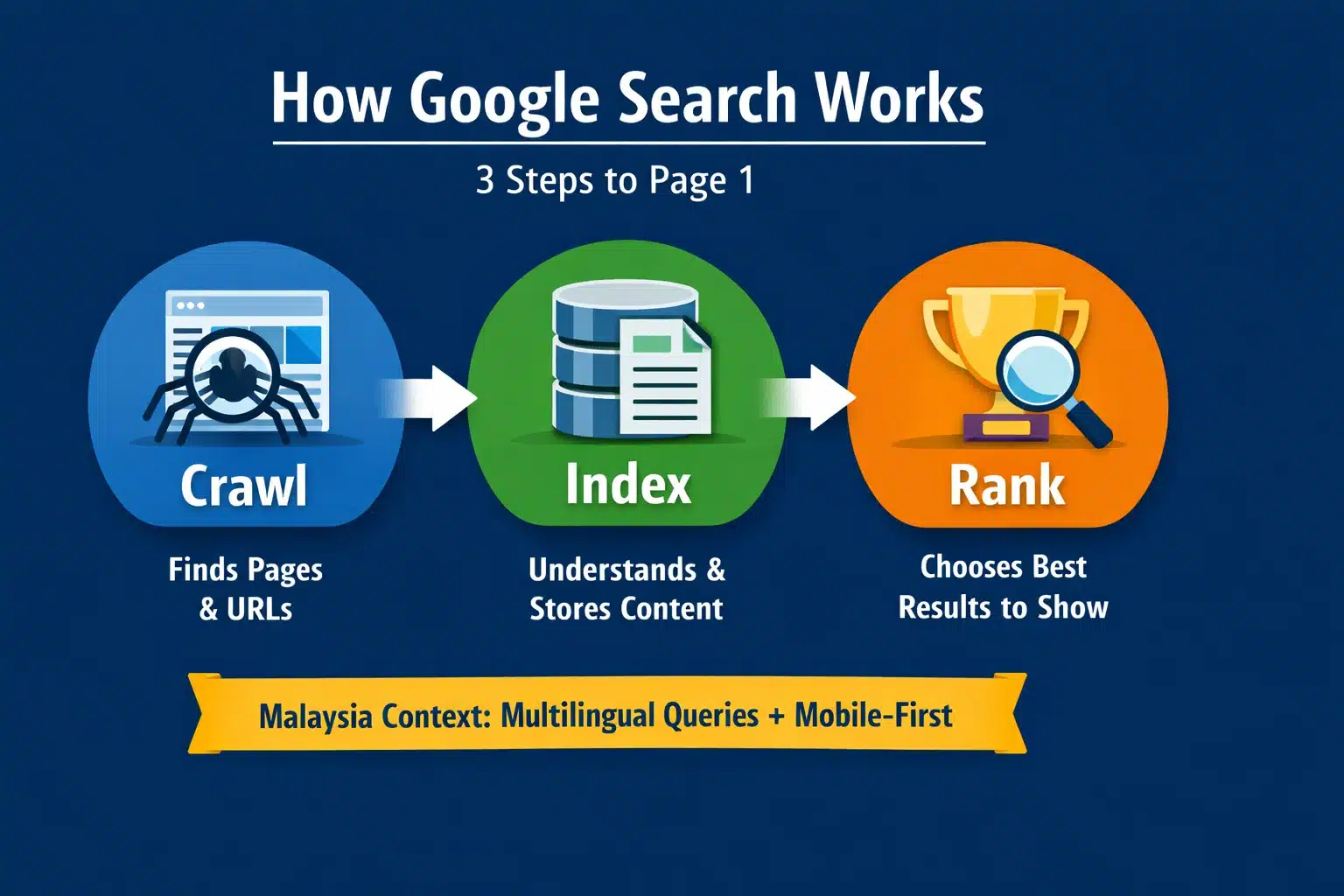
If you want to learn how to rank on Google page 1 in Malaysia, it’s important to note that Google’s ranking systems use a variety of signals and systems to decide what appears for a query, and may also use some site-wide classifiers alongside page-level signals (Source: Google Search Central).
Common areas Google evaluates include:
- Relevance to the search query
- Content quality and usefulness
- Trust signals (credibility, reputation, transparency)
- Page experience and usability
The objective of SEO is not to “game” Google, but to help the search engine understand that your website provides useful, trustworthy information that matches what users are searching for.
Why Google Page 1 Matters For Malaysian Businesses
For many companies, Google search is one of the most consistent sources of new leads and customers.
Studies analysing millions of search results show that the top results capture the majority of clicks (Source: Backlinko). This creates a strong advantage for businesses that appear at the top of search results.
Benefits Of Ranking On Page 1
- Higher organic traffic without paying for every click
- Increased brand credibility and trust
- More enquiries and sales opportunities
- Lower long-term customer acquisition costs
For Malaysian SMEs, this matters even more when ad costs rise and competition increases. Organic visibility allows businesses to generate traffic continuously without depending entirely on paid campaigns.
Who Should Focus On Google Page 1 Rankings?
While SEO can benefit almost any organisation, it is especially valuable for businesses that rely on discovery through search.
Businesses That Benefit Most From SEO
Business Type | Why SEO Matters |
Service providers | Customers search before hiring |
Local businesses | Local search drives foot traffic |
Professional firms | Authority and trust are critical |
E-commerce stores | Search drives product discovery |
For example, queries such as:
- Accounting firm KL
- Renovation contractor Penang
- SEO agency Malaysia
Often indicate a user is actively researching providers. Appearing in these results helps you reach potential customers when they are ready to make a decision.
How Google Ranking Works In Malaysia
Google’s ranking systems operate globally, but search behaviour in Malaysia has some unique characteristics. Understanding these patterns helps you design a more effective strategy.
Multilingual Search Behaviour
Malaysia’s multicultural environment means users frequently search in multiple languages.
Examples of equivalent searches may include:
English | Bahasa Melayu | Chinese |
Best cafe KL | Kedai kopi terbaik KL | 咖啡店 KL |
SEO agency KL | Agensi SEO KL | SEO 公司 KL |
This multilingual environment means businesses often benefit from content that addresses different language audiences. Depending on your customers, that might mean:
- Separate language pages for core services
- Targeting common multilingual phrases within content
- Clear service-area pages that match how locals search
Mobile-First Search
Mobile usage in Malaysia is extremely high (Source: DOSM). In parallel, Google predominantly uses the mobile version of content for indexing and ranking (mobile-first indexing) (Source: Google Search Central).
That means Google strongly rewards websites that are easy to use on smartphones, including:
- Fast load times
- Clear navigation
- Readable text and tap-friendly layouts
- Content parity (important content should not be hidden on mobile)
A slow or frustrating mobile experience can reduce ranking potential even if the desktop website looks great.
What’s Changed In SEO For 2026 (And What Malaysian SMEs Should Do)
SEO in 2026 is less about single keywords and more about proof.
When many pages target the same topic, Google’s systems try to identify the pages that are not just relevant, but also trustworthy and genuinely helpful. In practice, Malaysian business websites often win by building three types of proof:
- Proof of relevance
- Pages that match the query’s intent and answer it clearly
- Local context (service areas, buyer concerns, practical examples)
- Proof of trust
- Clear business identity (About page, real team or founder info, credentials)
- Case studies, testimonials, before-and-after examples
- Consistent business details across platforms
- Proof of usability
- Mobile-first indexing means mobile content matters most
- Strong page experience helps when results are similarly relevant (Source: Google Search Central)
This is why sustainable SEO results usually come from systems, not isolated tactics.
The Four Systems That Help Websites Reach Page 1
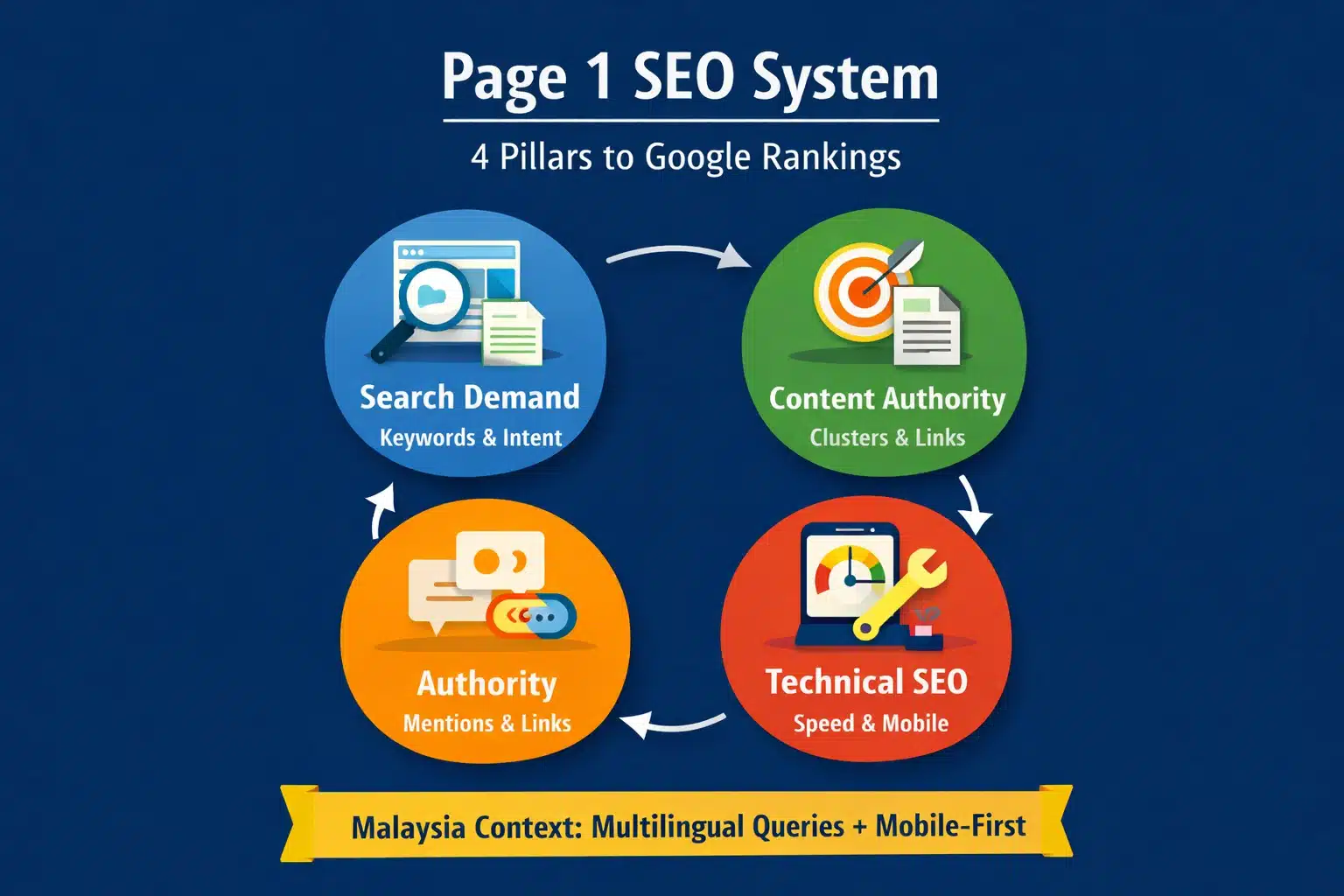
1. The Search Demand System
SEO begins by understanding what users are searching for.
This typically involves:
- Keyword research
- Search intent analysis
- SERP competition evaluation
Common tools include:
- Google Keyword Planner
- Ahrefs
- Semrush
(Source: Ahrefs)
Understanding Search Intent
Search queries usually fall into four categories:
Search Intent | Example |
Informational | What is SEO |
Commercial | Best SEO agency Malaysia |
Transactional | Hire SEO agency KL |
Navigational | Rankpage SEO |
If the search intent does not match the content, ranking becomes much harder. For example:
- A user searching “best accounting firm KL” likely wants comparisons and proof.
- A user searching “what is bookkeeping” wants a clear explanation.
2. The Content Authority System
Modern SEO increasingly revolves around topical authority.
Rather than publishing random articles, higher-performing websites organise content into structured topic clusters that cover a subject deeply and logically.
Example Of A Topic Cluster
Pillar Topic | Supporting Content |
SEO Guide | Keyword research guide |
Technical SEO guide | |
Link building guide | |
Local SEO guide |
This structure helps search engines understand that your website demonstrates depth, not just surface-level coverage.
Google’s quality rater guidelines emphasise the importance of Experience, Expertise, Authoritativeness, and Trustworthiness (E-E-A-T) when evaluating content quality (Source: Google Search Quality Rater Guidelines).
3. The Authority And Backlink System
Links and mentions still matter.
Google has stated that when other prominent websites link or refer to content, it can be a sign the information is trustworthy (Source: Google). Industry studies also continue to find strong correlation between backlinks and higher rankings (Source: Backlinko).
Common Ways Businesses Earn Backlinks And Mentions
- Digital PR campaigns
- Industry collaborations
- Guest articles (quality-first)
- Original research and data
- Partner pages and supplier listings
- Community sponsorships and event participation
Quality matters far more than quantity. A few strong links from reputable sites are often more impactful than many low-quality links.
4. The Technical SEO Infrastructure
Even excellent content may struggle to rank if the website has technical limitations. Technical SEO ensures search engines can properly crawl, index, and evaluate your website.
Important Technical SEO Factors
- Website speed
- Mobile friendliness
- Secure HTTPS connection
- Clean site architecture and internal linking
- Crawlability and indexing health
Google says there is no single “page experience signal,” but Core Web Vitals are used by ranking systems, and good page experience can help when multiple results are similarly relevant (Source: Google Search Central).
Local SEO: The Hidden Opportunity For Malaysian Businesses
For businesses serving specific geographic areas, local SEO can be extremely powerful.
When users search for services near them, Google often displays a local map pack that highlights nearby businesses.
Examples include:
- Dentist Bangsar
- Law firm Johor Bahru
- Kindergarten Subang Jaya
Ranking in these local results can generate highly targeted enquiries.
Important Local SEO Factors
- Optimised Google Business Profile
- Accurate business information (Name, Address, Phone)
- Consistent listings across directories
- Positive customer reviews and responses
- Location-based keywords and service-area pages
Local SEO is especially valuable for restaurants, clinics, professional services, home services, and retail businesses.
When Should Businesses Invest In SEO?
SEO is best viewed as a long-term growth strategy, not a short campaign.
Timelines vary a lot. Some low-competition queries can improve in weeks to a few months, while competitive keywords often take 6–18+ months, depending on:
- Keyword competitiveness
- Your website’s existing strength and history
- Content quality and consistency
- Earned mentions and link growth
- Technical health and site structure
Treat timelines as a guideline, not a guarantee.
Common Reasons Malaysian Websites Fail To Reach Page 1
Many websites struggle to rank not because SEO is impossible, but because the strategy is incomplete.
Common SEO Mistakes
- Publishing thin or low-quality content
- Lack of topical authority and clear structure
- Weak internal linking and messy site navigation
- Slow website performance (especially on mobile)
- Minimal authority-building (links, mentions, partnerships)
- Inconsistency (posting a few articles, then stopping)
SEO rewards consistency. Businesses that publish strategically over time usually outperform those that only publish occasionally.
Case Study: How Topic Authority Improves Rankings
Some studies suggest longer, more comprehensive pages often perform better in search results (Source: Backlinko). However, in practice, the real advantage often comes from content ecosystems, not just long articles.
For example, an SEO agency site might include:
- A pillar page explaining SEO strategy
- Guides about keyword research
- Tutorials on technical SEO services
- Articles about link building
- Local SEO pages for key Malaysian cities
Together, these pages reinforce each other and signal to Google that the website has depth and expertise on the topic.
Where SEO Fits Into A Business Growth Strategy
SEO works best when integrated with other marketing channels. Businesses that combine SEO with broader digital strategies often see stronger results.
Examples include:
- Content marketing
- Brand building
- Digital PR
- Website UX improvements
- Email nurturing for inbound leads
In many cases, SEO complements paid advertising by capturing organic traffic from users who prefer non-ad results, while paid campaigns help validate offers and generate immediate demand.
Securing Your Place on Google Page 1
Reaching Google Page 1 in Malaysia is not about shortcuts or isolated tactics. It requires a structured system that combines search demand research, authoritative content, trust signals (including quality mentions and links), and technically sound websites.
Businesses that invest consistently in these areas often build long-term visibility and sustainable organic traffic. For companies looking to accelerate growth online, working with reliable SEO specialists such as Rankpage can help design and implement a strategic SEO approach aimed at achieving strong Google rankings.