What Exactly Counts As A Typo?
Before analysing impact, we need to define what we mean by “typo”.
1. Genuine Typographical Errors
These are accidental mistakes such as:
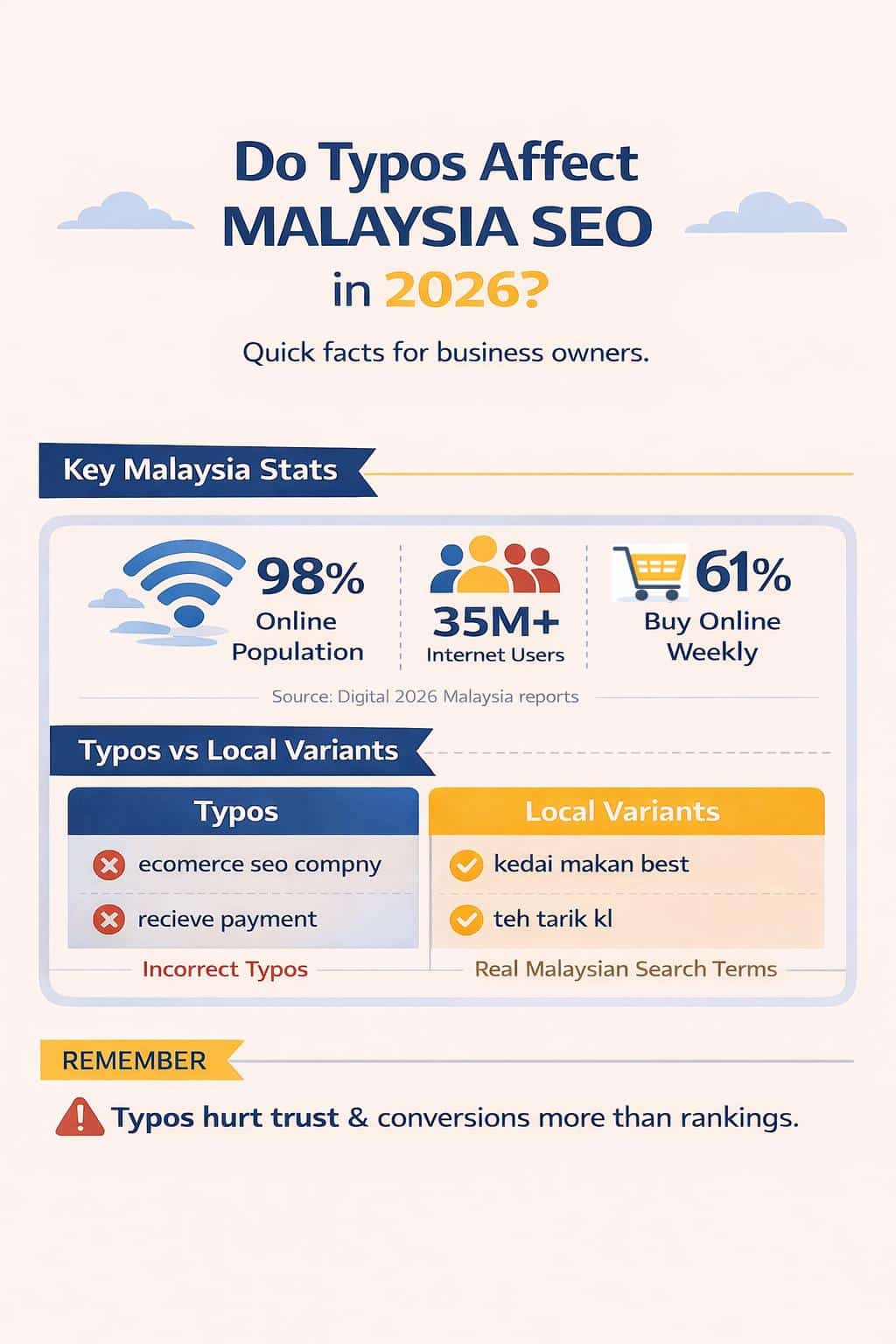
- “ecomerce seo compny”
- “recieve payment”
- “restarant kl”
They are unintended and usually reduce clarity and professionalism.
2. Alternative Spellings Or Local Variants
These may look inconsistent but reflect real Malaysian usage.
Examples:
- restoran vs restaurant
- kedai makan vs restaurant
- seo service murah kl
- teh tarik kl
These are not errors. They’re culturally valid search terms that mirror how Malaysians actually talk and type.
3. Romanised Spellings Of Non-English Words
This is where Malaysia becomes uniquely interesting for SEO.
Many popular search terms originate from Malay, Hokkien, Cantonese, Tamil, or other languages but are written in the Roman alphabet. There is often no single standardised spelling.
Examples:
- kuey tiao
- kueh tiao
- koay teow
- char kuey teow
- char koay teow
Or:
- mi goreng
- mee goreng
- mihun
- bee hoon
- bihun
Linguistically, this variation is normal. Malaysia has dozens of actively used languages, with more than 100 living languages across the country, on top of national Malay and widely used English. (Source: Ethnologue)
Malay is written in the Roman alphabet, while many Chinese dialects and Tamil words are also casually romanised for menus, signboards, chats, and search queries. That’s why one dish can appear as “char kuey teow”, “char koay teow” or “char kueh tiao”, and all feel “right” to different communities.
None of these are spelling mistakes in the way “recieve” is. They are community-specific spellings for the same intent.
From an SEO perspective, these are search variants, not typos. Aggressively “fixing” them may actually reduce your visibility for real Malaysian search behaviour.
4. Code-Switched Queries
Malaysia frequently mixes languages in one query, for example:
- “cheap ecommerce website malaysia”
- “seo service murah kl”
- “kedai makan best near me”
Modern search engines rely on AI and contextual models to interpret these hybrid phrases and return useful results, even when the query is half-English and half-Malay. (Source: Google Search Central)
Linguistic research also describes Malay–English code-switching as widely practised across Malaysian society, not just casual slang. Mixed-language queries are simply the search version of that everyday behaviour. (Source: Academic research on Malay–English code-switching – Languages journal / similar)
Calling these “bad grammar” is a misunderstanding of local search reality.
Do Typos Directly Affect Rankings?
Spelling & Grammar Are Not Direct Ranking Factors
Both Google spokespeople and independent SEO analyses agree on one key point: spelling and grammar are not confirmed direct ranking factors. (Source: Search Engine Journal – Spelling & Grammar Ranking Factor)
There is no “grammar penalty” switch in the core algorithm. A single typo does not automatically drop you from page one to page ten.
However, content with lots of errors is treated as low quality in human quality rating guidelines and is less likely to be trusted and linked to, both of which can affect performance over time. (Source: Google Search Quality Rater Guidelines)
How Google Actually Uses AI & Spell Correction
Google’s own engineers have shared that a significant share of queries contain spelling mistakes, and that they use large AI models specifically to interpret and correct those mistakes. (Source: Google Blog – Spelling in Google Search)
That means:
- Search can usually guess what “restarant kl” means.
- It can often rewrite “ecomerce seo compny” in the background.
- Exact character matching is less important than it was 10+ years ago.
But that does not mean you can ignore spelling. Your content still needs to be clear enough for algorithms and humans to understand what you offer.

How Typos Indirectly Affect Malaysia SEO
Typos don’t flip a specific ranking switch, but they influence signals that matter.
1. Search Intent Clarity
On-page SEO relies on clear keyword signals and consistent language.
If your page is meant to rank for “ecommerce seo company” but you repeatedly misspell it as “ecomerce seo compny”, semantic confidence weakens, especially if your competitors have cleaner, clearer pages.
Modern algorithms can infer meaning, but consistency strengthens ranking potential. Correct spelling and well-structured headings make it easier for search systems to align your page with the right search intent and topic. (Source: StackGo – Spelling and Grammar for SEO)
2. User Experience & Interaction Signals
Google has repeatedly said it doesn’t use Google Analytics metrics like bounce rate directly as ranking factors. (Source: Search Engine Journal – Is Bounce Rate a Ranking Factor)
However, Google does look at how people interact with results overall to judge whether those results are helpful. In practical terms, that includes patterns like:
- Whether users quickly return to the search results
- Whether they refine or repeat their queries
- Whether they continue engaging with your content
If a user lands on your page and sees obvious errors, trust drops. They’re more likely to leave or keep searching. Over time, that behaviour can contribute to negative quality signals and hurt your visibility indirectly. (Source: Search marketing industry commentary – various)
For Malaysia SEO, especially in ecommerce, perception matters just as much as technical compliance. Clean language helps users feel confident enough to stay, read, and buy.
3. Conversion Impact For Ecommerce Businesses
For ecommerce websites, typos can hit where it really hurts: revenue.
Errors in:
- Product titles
- Checkout instructions
- Shipping details
- Return policies
…can all reduce buyer confidence.
Malaysia is an online-heavy retail market: recent digital analyses estimate that a majority of internet users buy online weekly, and ecommerce revenue per user is high relative to GDP per capita. (Source: DataReportal – Digital in Malaysia; Department of Statistics Malaysia – Digital Economy reports)
A checkout typo that causes a 1–2% drop in completion rate can translate into millions of ringgit lost over a year for a busy mid-sized store. In that context, fixing spelling and clarity is not vanity; it’s a conversion rate optimisation (CRO) lever.
For businesses working with an ecommerce SEO company, tightening language in product pages and funnels often delivers faster ROI than chasing tiny ranking gains for additional keywords.
Should You Intentionally Target Misspelled Keywords?
Some marketers still argue that ranking for common misspellings can capture extra traffic.
In practice, three things are true in 2026:
- Google often auto-corrects queries or shows “Did you mean…?” results for the correct spelling. (Source: Google Blog – Spelling in Google Search)
- Most typo searches trigger SERPs for the corrected term anyway.
- Deliberately stuffing pages with incorrect English spelling looks spammy and low quality.
A smarter approach:
- Check Search Console for real impression data.
- If a misspelt keyword actually has measurable volume, mention it once or twice in body text or an FAQ, in a natural way (e.g. “Sometimes called ‘x’ by mistake…”).
- Avoid putting deliberate misspellings in titles, H1s, or navigation.
In Malaysia specifically, the real opportunity usually isn’t “recieve” vs “receive”; it’s:
- Malay vs English phrasing (e.g. “kedai makan best kl” vs “best restaurant in kl”)
- Romanised food and place variants (e.g. “kuey tiao” vs “koay teow”)
- Mixed-language queries that combine English product words with Malay intent words (“murah”, “best”, “dekat”, “near me”)
These aren’t wrong spellings; they’re how Malaysians actually search.
Romanised Variants: A Strategic Opportunity In Malaysia
Unlike accidental typos, romanised variants can represent meaningful traffic segments.
For example, if you run a frozen food ecommerce brand, your data may show:
- “char kuey teow frozen”
- “char koay teow frozen”
Both might generate impressions and clicks.
Best practice:
- Choose one primary spelling for your H1.
- Mention alternatives naturally in your introduction or product description.
- Keep readability and brand tone consistent.
Example:
“Char Kuey Teow, also spelled Koay Teow or Kueh Tiao, is one of Malaysia’s most popular noodle dishes.”
This approach:
- Captures variant search queries
- Maintains on-page SEO clarity
- Preserves user experience
This isn’t “typo optimisation”. It’s intelligent search intent alignment for a multilingual market.
On-Page SEO Best Practices For Malaysian Businesses
If you want practical actions, here’s how to tighten language without hurting local relevance.
1. Conduct A Language Audit
Use tools and methods like:
- Google Search Console
- Manual proofreading
- Grammar tools supporting English (and ideally Malay)
Identify:
- Repeated genuine typos
- Inconsistent spelling of your primary keywords
- Weak or vague metadata
For Malaysian sites, a language audit should also include:
- Checking Search Console → Search Results → Queries to see the actual split between English, Malay, and mixed-language queries bringing traffic.
- Segmenting key landing pages by intended language (full-English vs full-Malay) and ensuring each page sticks mostly to one language instead of random mixing.
- Reviewing top ecommerce product and category pages for:
- Common English spelling errors (“recieve”, “restarant”, “mibile”)
- Inconsistent use of Malay vs English terms (“penghantaran percuma” vs “free shipping”)
- Romanised food/place names that might need variant mentions in the body copy instead of aggressive correction.
2. Strengthen Semantic Consistency
Ensure that:
- Primary keywords are spelled consistently throughout the page.
- Headings clearly match the search intent and language.
- Internal links use clean, descriptive anchor text, not random half-phrases.
Consistency makes it easier for search systems to understand what the page is about and who it’s for.
3. Respect Malaysia’s Multilingual Reality
Do not over-correct culturally valid language. Instead:
- Consider separate Malay and English pages when appropriate (e.g. /my/ vs /en/ sections).
- Maintain a professional tone within each language.
- Avoid mixing languages randomly without intent, but feel free to mirror authentic query patterns (e.g. “murah”, “dekat”, “best”) where they make sense.
Malaysia SEO rewards relevance and clarity, not rigid textbook grammar.
Malaysia SEO Reality Check (2026)
- Roughly 97–98% of Malaysians are online. (Source: DataReportal – Digital 2026 Malaysia)
- Over 34–35 million individuals use the internet, with the vast majority on mobile. (Source: DataReportal – Digital 2026 Malaysia)
- A large majority of the population are active social media users. (Source: DataReportal – Digital 2026 Malaysia)
- A significant share of internet users buy online weekly, and ecommerce continues to grow into the hundreds of billions of ringgit annually. (Source: Department of Statistics Malaysia – Digital Economy reports)
In a market this connected, language quality is part of your product. It shapes whether people trust you enough to click, stay, and pay.
Do Typos Affect Malaysia SEO In 2026?
Typos do not directly reduce rankings. But they can:
- Weaken clarity
- Reduce trust
- Lower engagement
- Hurt conversions and revenue
For Malaysian business owners, especially in ecommerce, the real risk is credibility and lost sales, not a mysterious “grammar penalty”.
In 2026, SEO success in Malaysia is about:
- Search intent alignment
- Semantic clarity
- User trust
Clean, well-structured language supports all three.
If you want to know whether your current on-page SEO is strengthening or quietly undermining your visibility, Rankpage can audit your website and uncover structural, content, and intent gaps. As a performance-focused SEO agency in Malaysia, Rankpage builds scalable search systems designed for long-term growth, not short-term keyword tricks. Partner with Rankpage today, and help your business grow.