Key Takeaways
- AI search engines learn from connected content, not isolated blog posts.
- Topic clusters help AI understand depth, relevance, and expertise.
- Entity authority is about being recognised as a concept, not just ranking pages.
- Repetition across related pages improves AI confidence and citation likelihood.
- Strong internal linking turns content into a knowledge system AI can trust.
AI search engines evaluate coverage, not just individual articles.
In traditional SEO, a single well-optimised blog post could rank for a keyword and drive traffic. In AI-driven search, that approach is increasingly ineffective. AI systems look beyond one page to understand whether a website genuinely knows a topic.
AI evaluates:
- How many related pages exist
- Whether concepts are explained consistently
- How ideas connect across the site
A single article provides information. A connected group of articles forms a knowledge network. AI systems learn more confidently from the latter.
Isolated Blog Posts No Longer Work
Why repetition across pages helps AI learn: When the same concept is explained in multiple contexts, definitions, examples, comparisons, AI can validate accuracy and reduce uncertainty. This is why isolated posts are rarely cited, while clustered content is reused more often.
Table of Contents
What is Entity Authority
An entity is how AI understands “things,” not URLs.
In AI and modern search, an entity can be:
- A brand
- A service
- A concept
- An organisation or area of expertise
Entity authority means your brand is recognised as a reliable concept associated with specific topics, not just a website that publishes articles.
For example, AI does not see your business as a homepage and a blog. It sees:
- What topics you cover
- How consistently you explain them
- Whether your explanations align across pages
When AI links your brand with a topic repeatedly and accurately, authority is formed. Rankings may fluctuate, but entity authority compounds over time.
How Topic Clusters Help AI Understand Expertise
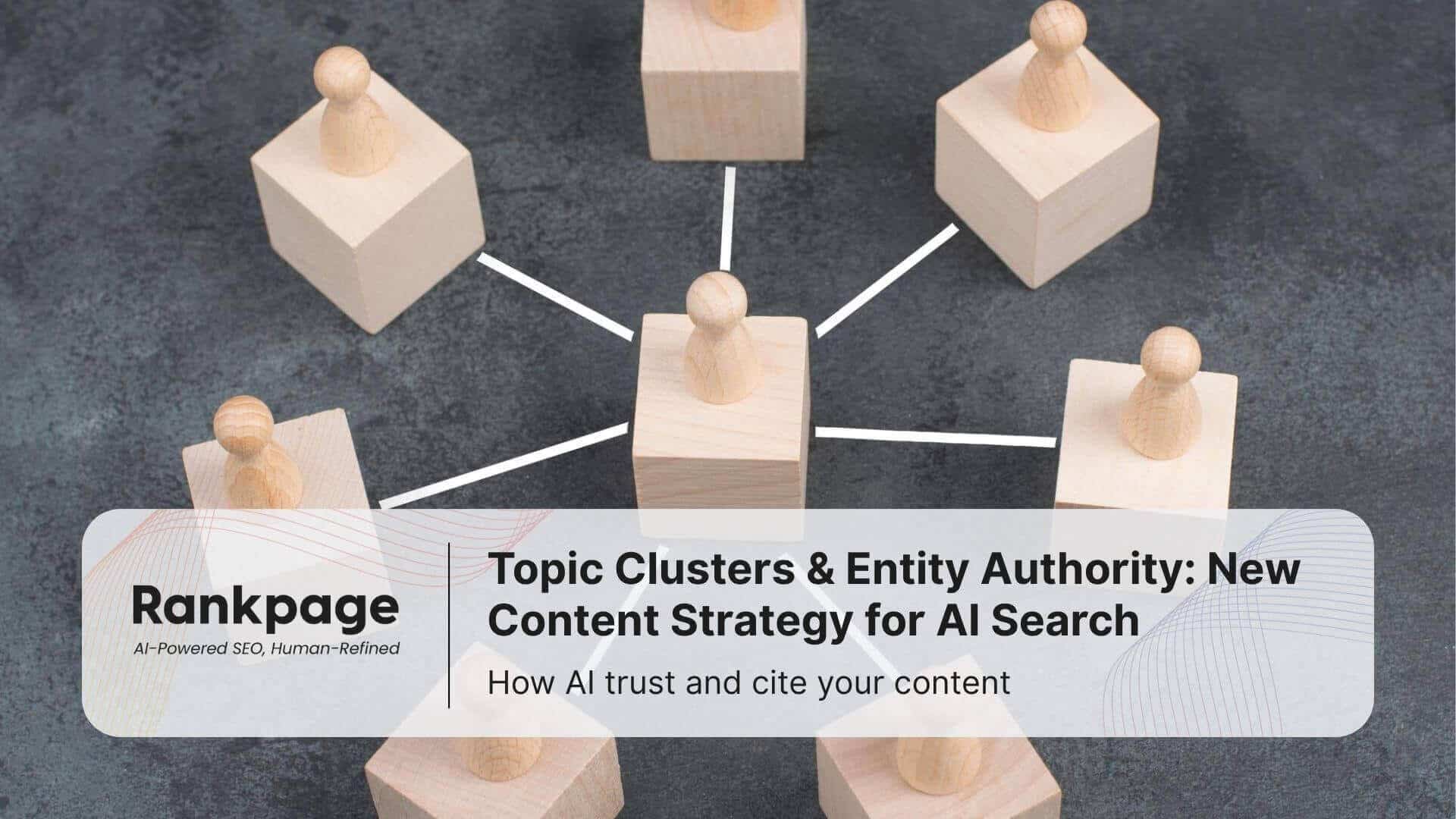
Topic clusters turn content into structured knowledge.
A topic cluster consists of:
- One core pillar that defines the main concept
- Multiple supporting pages that explain subtopics in depth
Instead of targeting one keyword per page, clusters focus on semantic relationships:
- Definitions
- Processes
- Examples
- Limitations
- Measurement
This structure helps AI systems understand how ideas relate, not just that they exist.
Why clusters outperform keyword-focused blogs: Keyword blogs optimise for matching queries. Topic clusters optimise for teaching. AI systems prefer sources that explain a subject from multiple angles, reinforcing confidence and trust.
Example of a GEO Topic Cluster
Core topic: Generative Engine Optimization
A strong cluster might include supporting topics such as:
- How AI citations work
- What builds entity trust
- The role of structured data in AI understanding
- How AI visibility is measured
Each page reinforces the same core concept using consistent terminology, while exploring different dimensions. Together, they signal depth, clarity, and authority.
How this improves AI confidence: When AI sees repeated, aligned explanations across related pages, it can:
- Validate definitions
- Cross-check claims
- Reduce ambiguity
This increases the likelihood of citation and reuse in AI-generated answers.
Common Mistakes Brands Make With Content Clusters
Even when attempting clusters, many brands weaken their results through poor execution.
Common issues include:
- Publishing too many unrelated topics that dilute focus
- Mixing sales pages directly into educational clusters
- Using inconsistent terminology across articles
- Treating clusters as navigation, not knowledge
Clusters work best when educational content is clearly separated from commercial intent and when definitions remain stable across the entire topic set.
Building Content That AI Can “Learn From”
AI learns through clarity, consistency, and structure.
Content that performs well in AI search usually shares these traits:
Clear Definitions
Key concepts are explained simply and directly, often within the first few sentences of a section.
Repeated Explanations in Different Contexts
The same idea is reinforced across multiple pages, examples, and comparisons without contradiction.
Logical Internal Linking
Internal links show AI how topics relate. Linking from foundational guides to advanced explanations such as a beginner guide to generative engine optimization helps establish learning paths.
For businesses aiming to improve AI search visibility, this approach turns content from a collection of posts into a system AI can reliably reference.
Conclusion
Topic clusters and entity authority represent a fundamental shift in content strategy for AI search. Instead of chasing individual rankings, brands must build connected knowledge that AI systems can understand, validate, and trust. For SMEs, this approach levels the playing field: clear structure, consistent explanations, and thoughtful internal linking can establish authority even without massive scale. In the AI era, the brands that teach best are the ones that get cited.
Frequently Asked Questions About Topic Clusters & Entity Authority
What is a topic cluster in AI search?
A topic cluster is a group of interlinked pages that collectively explain a subject, helping AI understand depth, relationships, and expertise.
How does entity authority differ from SEO authority?
Entity authority is about being recognised as a trusted concept, while SEO authority focuses more on pages, links, and rankings.
Can small websites build entity authority?
Yes. SMEs can build authority by focusing on one topic, using consistent terminology, and publishing connected, high-quality content.
Why does AI prefer clusters over single articles?
Clusters provide repeated, validated explanations that reduce uncertainty, making AI more confident in citing the source.
Should sales pages be part of topic clusters?
No. Educational clusters work best when sales pages are linked separately to avoid confusing intent.
How long does it take for topic clusters to impact AI visibility?
Results build gradually as AI systems observe consistent coverage, usually over several weeks to months.