1. Skipping Proper Keyword Research
A good campaign starts with intent, not guesses.
Many advertisers choose broad, expensive keywords like “best service Malaysia” and forget long-tail search phrases that buyers actually use. Use tools such as Google Keyword Planner or Ahrefs to find transactional phrases like “hire digital marketing agency KL” less competitive, higher intent.

2. Ignoring Negative Keywords
You pay for every irrelevant click you don’t block.
Without negative keywords, your ads appear for unrelated searches (like “free”, “jobs”, or “DIY”). Add exclusions weekly to prevent wasted spend and improve CTR.
3. Over-reliance on Broad Match
Broader reach isn’t always better.
Broad match keywords can display your ads in unrelated contexts, especially in Bahasa Malaysia or mixed-language queries. Use phrase or exact match for precision and better lead quality.
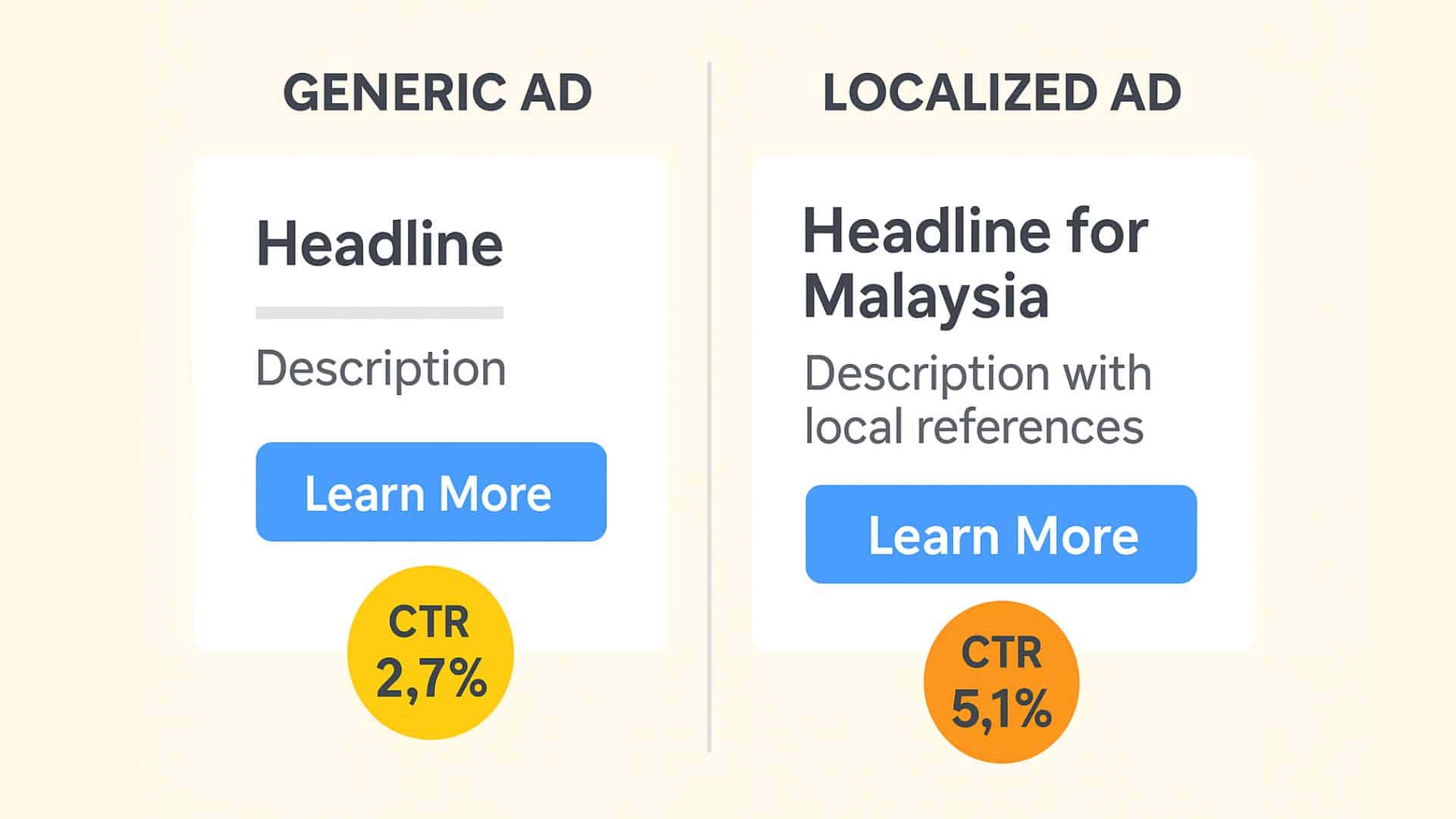
4. Weak Ad Copy That Fails to Localise
Generic ads don’t sell, relatable ones do.
Malaysian users respond better to ads that sound local and trustworthy. For example, “Trusted by 500+ Malaysian SMEs” outperforms “#1 Solution Worldwide.” Add local references like “based in Kuala Lumpur” or “available nationwide” for credibility.
5. Sending Clicks to a Weak Landing Page
Your ad might win the click, but your page must win the sale.
Too many brands link to their homepage instead of a focused landing page. Create dedicated pages that match ad intent, fast-loading, mobile-friendly, and with one clear CTA.
Tip: Use Rankpage’s CRO framework to align ad messaging and landing page content for higher conversions.
6. Forgetting Conversion Tracking
If you can’t measure, you can’t optimise.
Many businesses run campaigns without proper tracking in GA4 or Google Tag Manager. Set up form submissions, WhatsApp clicks, or checkout completions as conversion goals. Smart bidding depends on accurate data, without it, the algorithm is blind.
7. Switching to Smart Bidding Too Soon
Automation can’t learn from missing data.
Smart Bidding (Target CPA or ROAS) needs at least 30–50 conversions per month to work well. Start with manual or enhanced CPC while collecting data, then transition gradually once conversions stabilise.
8. Ignoring Mobile Performance
Most Malaysian users browse on mobile, yet many ads still aren’t optimised.
If your landing page loads slowly or your forms don’t display properly on small screens, expect a high bounce rate. Test on real devices, not just desktop previews.
9. Not Using Ad Extensions
Every extra line increases visibility and trust.
Sitelinks, callouts, location, and structured snippets improve CTR and make your ad look more credible. Always use extensions to claim more on-screen real estate, especially for local service ads.
10. No Regular Optimisation or A/B Testing
“Set and forget” is the fastest way to burn your budget.
Google Ads is dynamic; audiences shift, competitors change, and keywords evolve. Review data weekly, rotate ad creatives, and test new headlines or CTAs. Even small tweaks can boost conversions significantly.
Bonus Tip: Weak Account Structure
Don’t cram everything into one campaign.
Separate campaigns by service, location, or intent. This structure lets you allocate budgets wisely and measure which products or cities actually deliver ROI.
Read more: Manual vs Automated Bidding for Google Ads: Which One Wins?
Comparison Table: Common Google Ads Mistakes and Fixes
Mistake | Why It Happens | Fix | Result When Corrected |
| Skipping keyword research | Rushing campaign setup without user intent research | Use Keyword Planner & focus on long-tail search terms | Lower CPC and higher conversion intent |
Ignoring negative keywords | Advertisers forget to exclude irrelevant terms | Update negative keyword list weekly | Better CTR and reduced wasted spend |
| Overusing broad match | Desire for faster reach | Switch to phrase or exact match | More qualified leads and accurate targeting |
Generic ad copy | Copy-pasted text without localisation | Write locally relevant ads that sound human | Higher engagement and click-through rates |
| Weak landing pages | Linking to homepage instead of targeted content | Build dedicated, mobile-optimised pages with one CTA | More conversions with less bounce |
No conversion tracking | Campaigns launched without GA4 or Tag Manager setup | Track forms, calls, and checkouts as goals | Smarter bidding and measurable ROI |
Early Smart Bidding | Automating before data maturity | Wait until 30–50 conversions before switching | Stable CPA and stronger automation performance |
| Poor mobile optimisation | Desktop-first design approach | Test on mobile, reduce load time | Lower bounce rate and higher conversions |
Missing ad extensions | Advertisers skip setup or don’t know their impact | Add sitelinks, callouts, and locations | More visibility and trust signals in search results |
| Neglecting optimisation | “Set and forget” mindset | Review weekly, test creatives, adjust bids | Continuous improvement and stronger ROI |
Tip: “In Google Ads, it’s rarely the big decisions that fail campaigns it’s the small details that no one tracks.”
Now that we’ve seen what goes wrong, let’s talk about how to fix it with a smarter, structured approach.
How to Fix These Mistakes the Smart Way
- Start with clear goals (leads, calls, or sales).
- Build campaigns around specific themes, not generic groups.
- Implement GA4 tracking before launching.
- Optimise weekly and review search term reports.
- Combine human insights with automation, don’t let the algorithm guess for you.
“The best Google Ads results come from a human–AI partnership—data drives it, strategy directs it.”
Running Google Ads in Malaysia is about out-thinking them.
The difference between wasted ad spend and steady leads often comes down to structure, data accuracy, and message relevance.
At Rankpage, we help businesses turn clicks into measurable growth. Partner with Rankpage’s Google Ads experts to audit, optimise, and scale your campaigns with proven ROI-driven strategies.