Payment gateway SEO services in Malaysia are not just about visibility, it’s about proving trust, compliance, and technical reliability at every stage of the buyer journey.
Malaysia’s digital payments ecosystem is expanding rapidly. Depending on the research methodology used, Malaysia’s payments market is estimated around ~USD 287B–292B in 2026. At the same time, Bank Negara Malaysia reported 409 e-payment transactions per capita in 2024, roughly more than one e-payment per day on average.
This growth has created a more competitive environment where businesses aren’t only searching more, they’re evaluating more carefully.
Payment providers don’t win purely on features. They win on clarity, credibility, and ease of adoption.
In 2026, ranking for “payment gateway Malaysia” is only the entry point. The real differentiator is how effectively your content answers buyer concerns within seconds, especially around pricing, compliance, security, and integration.
What Payment Gateway SEO Must Target: Malaysia-Specific Intent
The most effective SEO strategies focus on high-intent, locally relevant keywords that reflect real business needs.
Malaysia’s environment is shaped by strong real-time payments adoption. A 2026 Visa report found:
- 96%+ of stores in Malaysia accept real-time payments
- Real-time payments make up about 27% of transactions (as reported in the same findings)
That’s why terms like these tend to outperform broad fintech keywords:
- Payment gateway Malaysia
- FPX integration Malaysia
- DuitNow QR payment gateway
- Payment API Malaysia
- Best payment gateway for SME Malaysia
- PCI DSS payment gateway Malaysia
- Payment gateway fees Malaysia
- Shopify / WooCommerce payment gateway Malaysia
These queries indicate active evaluation, meaning the user is closer to conversion and more likely to engage with solution-focused content.
What Payment Gateway SEO Must Prove: E-E-A-T and Conversion Signals
In fintech, ranking is only half the objective. Your content must establish credibility quickly and reduce perceived risk.
A buyer deciding on a payment gateway typically has two stakeholders:
- Business owner / finance lead (fees, settlement, disputes, reliability)
- Technical stakeholder (API quality, docs, time-to-integrate, edge cases)
If your pages don’t answer both, buyers move on.
Critical conversion signals (make these visible above the fold)
- Regulatory clarity and operating model (how you work with partners/rails, what you support)
- Security posture (PCI DSS scope, encryption basics, data handling)
- Transparent transaction fees and billing logic (what’s charged, when, and why)
- Integration readiness (docs, SDKs, plugins, sandbox, sample flows)
- Support and onboarding timelines (realistic, not vague)
If you can’t publish every detail, publish what you can, and clearly state what depends on business type (SME vs enterprise), volume, and risk review.
How Malaysian Businesses Evaluate Payment Gateway Providers
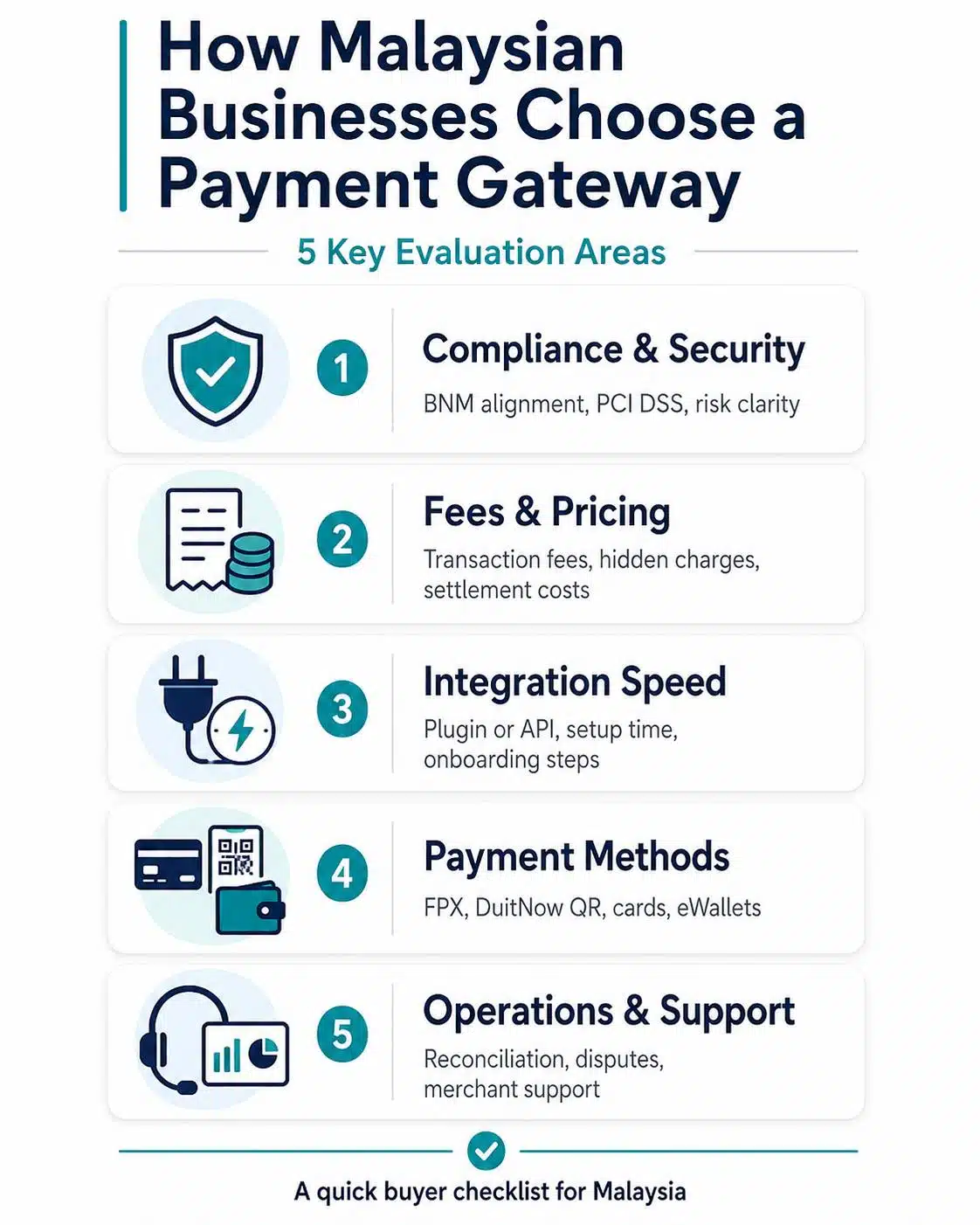
The buying journey is multi-layered and involves both business and technical stakeholders.
Malaysia’s fintech landscape is crowded. One industry mapping counted ~360 active fintech firms in 2025, which increases comparison-driven behaviour. Buyers are systematically eliminating providers that don’t meet specific criteria.
Decision criteria breakdown
| Factor | What Buyers Look For | SEO Opportunity |
|---|---|---|
| Compliance and risk | Clear operating model, audit readiness, security posture | Authority pages + trust hubs |
| Fees | Transparent pricing, minimums, hidden charges, refund fees | Pricing + comparison pages |
| Integration | Docs quality, plugins, SDKs, sandbox, webhooks | Developer SEO assets |
| Payment methods | FPX, DuitNow QR, cards, eWallets | Payment-method pages |
| Operations | Settlement, reconciliation, disputes/chargebacks | Ops explainer pages |
Typical search journey
| Stage | Example Queries | Intent |
|---|---|---|
| Awareness | What is payment gateway Malaysia | Educational |
| Consideration | Best payment gateway for SME Malaysia | Comparative |
| Decision | Billplz vs iPay88 fees | Transactional |
| Validation | Is this payment gateway PCI compliant | Trust |
A strong SEO strategy ensures you appear across all stages, especially validation queries that decide the shortlist.
Core SEO Strategy for Payment Gateway Providers: Step-by-Step
Step 1: Build Malaysia-Focused Landing Pages (Conversion Hubs)
Your core pages should directly target high-intent local keywords while functioning as conversion hubs.
What to include on your main “Payment Gateway Malaysia” page
- Supported payment methods (FPX, DuitNow QR, cards, eWallets)
- Who it’s for (SME vs enterprise, platforms supported)
- Pricing model overview (how pricing works, what influences it)
- Settlement and reconciliation basics
- Security and compliance posture overview
- Integration pathways (plugin vs API)
- A clear onboarding path (what happens after “Contact Sales”)
Make it scannable
- Use short sections with plain-language headings like Fees, Integration, Security, Onboarding, Support, Use cases.
- Put proof assets near the top: docs link, sandbox link, uptime/status link, and a simple integration checklist.
Step 2: Create FPX and Payment-Method Pages (High-Conversion SEO)
Payment-method pages capture highly specific and valuable search intent.
Instead of one generic “Features” page, create separate pages for:
- FPX payments
- DuitNow QR
- Cards (Visa/Mastercard)
- eWallets (list supported wallets if applicable)
- Recurring billing (if supported)
- Refunds and reversals (merchant workflows)
What a high-performing payment-method page includes
- What the method is used for (common merchant scenarios)
- A simple “how it works” flow
- Integration options (plugin vs API endpoints)
- Common edge cases (timeouts, refunds, webhook retries)
- FAQs that reflect real buyer concerns
Avoid sweeping adoption claims unless you can cite an official or named survey. If you reference adoption, phrase it as “varies by study,” then focus on practical implementation intent.
Step 3: Build Comparison Content (Your Conversion Engine)
Comparison pages shouldn’t just list differences, they should guide decisions.
Create pages like:
- Payment gateway for SME vs enterprise (Malaysia)
- FPX gateway vs card gateway (when each matters)
- Hosted payment page vs direct API integration
- Best payment gateway for Shopify Malaysia (with decision criteria)
How to structure comparison pages
- Start with an “If you are X, choose Y” summary
- Segment by use case: subscription, marketplace, high-volume retail, cross-border
- Explain trade-offs (fees vs flexibility, speed vs control, plugin vs custom)
- Include a short “implementation checklist” and timeline expectations
Step 4: Showcase Compliance and Security Authority (E-E-A-T Layer)
Compliance content should go beyond definitions and provide practical clarity without giving legal advice.
Create a Trust and Compliance Hub and link to it from all commercial pages.
Recommended pages inside the hub
- Security overview (data handling basics, encryption, access controls)
- PCI DSS explanation (what it means for merchants, scope clarity)
- Fraud and risk controls overview (high-level)
- Disputes and chargebacks process (if cards supported)
- Data privacy approach (high-level, policy links)
- Uptime/status and incident communication approach
Be precise, simple, and honest. If something is handled via partners or depends on merchant category, say so clearly.
Step 5: Highlight Integration Speed (An Underrated Conversion Driver)
Integration speed is often the deciding factor when providers appear similar.
Replace vague lines like “fast onboarding” with specifics:
- A clear onboarding sequence (KYC → account setup → sandbox → go-live)
- What merchants need to prepare
- Realistic timelines (and what changes them)
Example structure
- Fastest path: plugin setup (typical timeline)
- API path: sandbox integration → QA → production
- Enterprise path: additional review, testing, reconciliation requirements
This reduces uncertainty and increases conversions because it answers “how soon can we launch?”
Step 6: Build Developer SEO Assets (Docs as Acquisition)
Developer content should be treated as a primary acquisition channel, not an afterthought.
High-impact developer pages
- API overview with a simple integration flow
- Webhooks guide (events, retries, signatures)
- Error codes and “how to fix” troubleshooting pages
- Sample flows: FPX payment, DuitNow QR, refunds, recurring billing
- Platform guides: WooCommerce, Shopify, Magento, custom checkout
Optimization rules
- Each page should answer one intent clearly
- Use consistent naming for endpoints/features
- Include quick-start steps and “common pitfalls”
If your docs are strong, they become sticky: tech stakeholders will bookmark them, and sales cycles shorten.
Read More: Guide to Company Secretarial Services SEO in Malaysia
Step 7: Optimize for AI Search (AEO Strategy)
AI-driven search rewards clarity, structure, and completeness.
What to do
- Put the direct answer near the top of each page
- Use short definitions, then practical steps
- Use tables to summarise differences (fee models, integration options)
- Keep each page focused on one major intent
- Maintain consistent terminology across the site
AEO isn’t separate; it’s the result of clean structure and genuinely helpful content.
Where Most Payment Gateway SEO Strategies Fail
Many providers underperform because they focus on visibility instead of usability.
Common mistakes
- Targeting only broad keywords without intent depth
- Ignoring Malaysia rails and buyer-specific queries (FPX, DuitNow QR)
- Hiding or confusing pricing (even if it depends, explain the model)
- Weak internal linking (buyers can’t find docs, compliance, onboarding)
- No structured conversion flow (pages don’t guide the next step)
- Developer content left unoptimized or hard to search
Fixing these usually improves both rankings and conversions quickly because it aligns with how real buyers evaluate risk.
Cost vs ROI of Payment Gateway SEO in Malaysia
SEO requires consistent investment but delivers compounding returns over time, especially for high-intent B2B queries.
Important: SEO costs vary widely depending on scope, competition, and deliverables. Treat the ranges below as illustrative, and validate them against your plan (content volume, technical depth, authority building).
| Area | Estimated Cost |
|---|---|
| Content creation | RM3,000 – RM10,000 |
| Technical SEO | RM2,000 – RM5,000 |
| Authority building | RM3,000 – RM8,000 |
If you want a more defensible version of this section, replace the table with 3 example packages (Starter / Growth / Enterprise) describing what’s included, rather than implying a universal benchmark.
Winning Payment Gateway SEO in Malaysia Requires Depth, Not Just Keywords
Payment gateway SEO in Malaysia is no longer about ranking broadly. It’s about aligning with how real buyers search, evaluate, and decide in a high-trust environment.
The providers that win in 2026 do three things consistently
- Build high-intent Malaysia landing pages that convert
- Publish payment-method and comparison pages that shorten evaluation
- Maintain developer and compliance assets that prove reliability
At Rankpage, your trusted SEO agency in Malaysia, we help payment providers build SEO systems that connect high-intent search behaviour with conversion-ready content. If you want organic visibility that turns into qualified B2B leads (not just traffic), we can help you build a strategy that compounds.
Disclaimer: This article is for informational purposes only and does not constitute legal, regulatory, or financial advice. Requirements can vary by business model and risk profile. Always verify with official guidance and your acquiring/partner banks.
Sources
- Bank Negara Malaysia (BNM) Annual Report 2024 – e-payment transactions per capita (409)
- Visa (Jan 2026) – Malaysia real-time payments acceptance (96%+) and share of transactions (~27%)
- ResearchAndMarkets – Malaysia payments market estimate for 2026 (USD 291.79B)
- Mordor Intelligence – Malaysia payments market estimate for 2026 (USD 286.79B)
- Malaysia Fintech Report 2025 mapping summary – ~360 active fintech firms (2025)
- PayNet press releases and reporting (payments transaction updates)
- Ipsos Malaysia – non-cash economy and e-wallet adoption survey insights
Frequently Asked Questions About Payment Gateway Provider SEO
What Keywords Should Payment Gateway Providers Target In Malaysia?
High-intent keywords such as payment gateway Malaysia, FPX integration, DuitNow QR payment gateway, and payment API Malaysia are most effective for attracting B2B buyers who are actively evaluating options.
Why Is FPX Important For Payment Gateway SEO?
FPX is a locally relevant payment method and a common evaluation requirement, so searches for FPX integration often signal purchase intent,not just curiosity.
How Does Compliance Affect SEO?
In a regulated category, compliance and security clarity improves trust signals. Pages that explain your approach (without overclaiming) tend to convert better and support E-E-A-T.
What Makes Payment Gateway SEO Different From Other SaaS SEO?
Buyers evaluate payment providers with higher perceived risk, so you must address pricing transparency, security posture, compliance clarity, and integration readiness earlier in the journey.
How Important Is Integration Speed In SEO Content?
Integration speed is often a deciding factor. Publishing realistic onboarding steps and timelines reduces uncertainty and increases conversions.
How Can Payment Gateway Providers Optimize For AI Search?
Use answer-first structure, keep pages single-intent, add structured FAQs, and ensure terminology is consistent across landing pages, docs, and trust assets.