What Does “Chinese Brands” Mean In This Context?
In this article, “Chinese Brands” refers specifically to companies originating from mainland China, not Malaysian businesses owned by local Chinese entrepreneurs.
This distinction matters because the competitive dynamics are fundamentally different:
Brands from China often operate with:
- Cross-border supply advantages
- Platform ecosystem dominance and performance marketing
- A strategy built around rapid expansion and market penetration
In contrast, Malaysian businesses operate within:
- Local regulations and compliance frameworks
- Cultural familiarity and local customer expectations
- Physical presence, service coverage, and accessibility
This difference creates a real opportunity: when a buyer is searching locally and deciding quickly, local intent signals can outweigh brand scale if you build the right system.
Why This Matters For Malaysian Businesses In 2026
Competition is no longer local, it is global, but decided locally.
Several key shifts are shaping the landscape:
- Search is now a first decision touchpoint for many categories
- Foreign brands are investing heavily in visibility
- AI search experiences are changing how content is surfaced and selected
- Price competition is becoming more aggressive
Brands like Mixue scale quickly by combining:
- High outlet density
- Strong brand recall
- Consistent digital presence
But when users search for:
- “Best dessert near me”
- “Cafe open late KL”
- “Affordable ice cream PJ”
The outcome often depends less on brand size and more on whether a business is the best local match at the moment of intent.
What the data suggests in Malaysia (why visibility is now survival)
Malaysia’s digital commerce environment is already large enough that visibility isn’t optional.
- E-commerce has reached massive scale, which means more decision journeys start online.
- Digital payments and QR usage have surged, which reduces friction from discovery → decision → purchase.
The practical implication for Malaysian SMEs is simple: when it’s easy for buyers to find you and trust you, they convert faster. When they can’t, they default to whoever looks most obvious, credible, and convenient in the results.
How Local SEO Becomes A Competitive Advantage
Local SEO allows Malaysian businesses to win in high-intent moments where decisions actually happen.
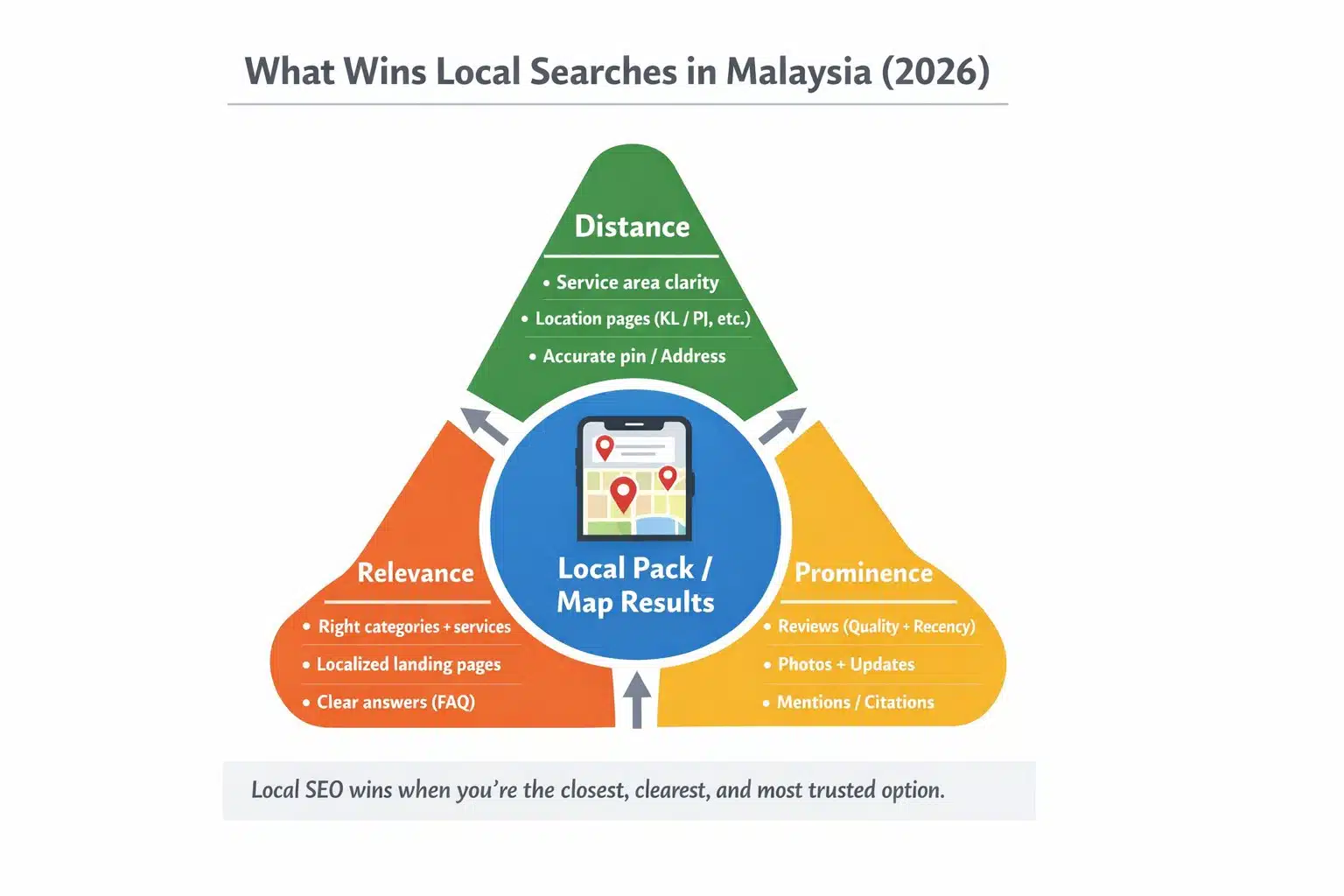
The local ranking triad (the framework behind local visibility)
For local results, visibility is shaped mainly by:
- Relevance (how well you match what someone is searching for)
- Distance (how close you are to the searcher or the searched area)
- Prominence (how established and trusted you appear online)
This is why local SEO can outperform scale. Large brands can buy reach, but local businesses can win by being the closest, clearest, most trusted choice at the moment of intent.
Proximity-Based Search Dominance
Location-based searches are where local businesses can reliably compete.
A well-optimised local business can outrank larger brands when:
- You clearly match the query (relevance)
- You are genuinely nearby or explicitly serve the area (distance)
- Your online presence shows proof and trust (prominence)
That’s the “equaliser” effect: proximity and proof can outperform budget.
Trust And E-E-A-T Signals
Local businesses benefit from trust signals that are hard to scale quickly:
- Real customer reviews from Malaysians
- Recognisable presence within communities
- Clear contact details, consistent address details, and legitimacy
- Photos, updates, and proof that the business is active
Trust is not a slogan. It’s evidence:
- review volume + quality + recency
- consistent business information across the web
- real-world proof (photos, updates, store/team credibility)
When your trust and EEAT signals are stronger, the decision becomes easier.
Cultural And Behavioural Alignment
Malaysia is a bilingual market, and code-mixed language is common online.
That means the winning strategy isn’t “English only” or “BM only.” It’s:
- testing what people actually use in your niche
- matching the language pattern of the intent
- writing in a way that feels local, not imported
On the conversion side, Malaysians are increasingly comfortable with frictionless digital payment flows and QR. Visibility is one half of the equation; conversion readiness is the other.
Speed And Accessibility Advantage
Local businesses can often offer operational advantages that matter at decision-stage:
- Faster response times (especially via WhatsApp)
- Immediate availability
- Physical access and convenience
- Clear “open now,” “same-day,” or “nearby” positioning
These are not just operations advantages, they are search advantages, because many local searches are time-sensitive and convenience-driven.
Key Local SEO Strategies To Compete Effectively
Winning against Chinese brands requires strategic positioning, not just effort.
1) Optimise Google Business Profile (GBP)
Your GBP is your storefront in search.
Do this consistently to keep your GBP optimized:
- Ensure complete and accurate information (categories, hours, services)
- Upload real photos regularly (storefront, products, team, process)
- Post updates (promotions, new items, seasonal changes)
- Actively collect and respond to reviews
Tip: Don’t treat reviews like vanity metrics. Treat them like conversion assets.
2) Target High-Intent Local Keywords
Avoid competing head-on for broad, generic terms.
Instead focus on:
- “Near me” intent (where proximity matters)
- Location modifiers (KL, PJ, Subang, Penang, Johor)
- Problem-based queries (“fix,” “repair,” “urgent,” “same day,” “open now”)
- Comparison intent (“best,” “affordable,” “premium,” “halal,” “family-friendly”)
High-intent searches are where local SEO drives real outcomes.
3) Build Location-Based Landing Pages
Create pages that include:
- Specific locations and service areas you actually serve
- Local context and landmarks (so users know you’re relevant)
- Real customer scenarios (what people ask, what they need)
- Practical details: pricing anchors, operating hours, parking, booking steps
Location pages should not be duplicate templates. They should read like real, local service coverage.
4) Create Information-Gain Content
Most content online is repetitive. That is exactly why local businesses can win.
Move beyond generic “SEO blog content”:
- Answer real Malaysian questions
- Provide clarity and decision support
- Use local examples and pricing context
- Include constraints and trade-offs (so buyers trust you)
Examples of high-value content angles:
- “How much does X cost in KL / PJ?”
- “What to expect in your first visit / consult?”
- “Which option is best for Y?”
- “What’s included / not included?”
- “Common mistakes Malaysians make when choosing X”
This content doesn’t just rank, it converts.
5) Strengthen Technical And UX Signals
Poor UX undermines even the best SEO strategy.
Prioritise:
- Mobile speed
- Clean navigation
- Clear CTA flow (call, WhatsApp, book, get directions)
- Short forms (especially on mobile)
- Trust elements near conversion points (reviews, certifications, guarantees)
If a user finds you but can’t act quickly, you lose the moment.
The Local Authority Checklist (What serious competitors implement)
If you want local SEO to be a real equaliser, you need signals platforms can trust, and signals Malaysians instantly recognise.
A) Google Business Profile proof signals
- Correct primary and secondary categories
- Weekly photo uploads (real storefront, menu/services, team)
- Regular updates and Posts
- Review velocity (steady, not bursts)
- Review responses that are human and helpful
B) Website proof signals
- A dedicated page for each core service + each priority area served
- Pricing anchors (or “from RM___” ranges) where appropriate
- Fast mobile performance + simple conversion flow
- Structured FAQ sections for decision-stage questions
C) Off-site proof signals
- Consistent NAP across key directories
- Cleanup of duplicates/incorrect listings
- Local mentions: partners, community pages, local publications
- Social proof you can embed or reference across pages
This is how you build prominence without paying for it forever.
Real-World Examples Of Local SEO Winning
Example 1: Local Dessert Shops vs Mixue
Local dessert brands can rank higher for niche queries like “premium dessert cafe PJ” by focusing on experience, quality, and specific intent rather than competing on price.
What wins here:
- stronger “premium” positioning
- better photos and menu clarity
- higher review quality and local proof
- clearer differentiation (vibe, ingredients, signature items)
Example 2: Clinics vs International Chains
Clinics that highlight doctor credentials, local compliance context, and clear pricing anchors often outperform larger but generic competitors.
What wins here:
- trust-first content (credentials, process, expectations)
- decision support (price ranges, what’s included)
- strong review reputation
- location clarity and easy booking
Example 3: SME Services vs Global Providers
Accounting firms and agencies that reference local requirements (e.g., LHDN, SSM) often outperform generic global providers for decision-stage searches.
What wins here:
- local relevance (compliance context)
- detailed service pages
- local case scenarios (SME realities)
- clear conversion paths (WhatsApp/call)
Common Mistakes Malaysian Businesses Make
Many businesses lose visibility due to avoidable SEO gaps:
- Ignoring Google Business Profile updates
- Using generic, non-localised content
- Over-relying on social media for discovery
- Not collecting reviews consistently
- Maintaining slow or outdated websites
- Publishing content that “sounds SEO” but doesn’t help decisions
The biggest mistake is treating SEO like a one-time task instead of a system.
How AI Search Changes The Competition In 2026
Search is no longer only about ranking,it’s also about being selected and summarised.
AI-driven experiences increasingly surface:
- direct answers
- short summaries
- structured snippets
- recommended sources
This shifts the game from “who wrote the longest article” to “who provides the clearest, most defensible answer.”
AI-ready content: write to be extractable, not generic
To compete effectively:
- Put a one-sentence answer at the top of important sections
- Use short FAQ blocks that answer real decision questions
- Add local proof: service areas, constraints, clear steps, real photos
- Make claims specific and supported by visible evidence (credentials, policies, process)
A practical “Be the chosen answer” framework
- Answer first: one sentence that directly solves the query
- Decision support: pricing anchors, what to expect, comparisons
- Local specifics: neighbourhoods, landmarks, access, operational details
- Trust proof: credentials, awards, review highlights, clear legitimacy
This improves classic SEO and increases the chance your content is selected when search becomes more summary-driven.
Building A Sustainable Competitive Edge
Local SEO is not a one-off tactic. It is a long-term system.
Key components include:
- Consistent content creation (with real information gain)
- Authority building through mentions and PR
- Technical optimisation
- Conversion-focused UX
- A review engine (collection + response + trust reinforcement)
Over time, this builds:
- Stronger rankings
- Greater trust
- More inbound demand
- Reduced reliance on paid ads
If Chinese brands compete with speed and scale, local businesses can compete with precision and relevance.
Targeting the Relevant Factors
Chinese brands may dominate on scale, but Malaysian businesses can dominate on relevance, trust, and intent.
Local SEO allows you to win where decisions actually happen, at the point of search.
If you are looking to build a structured SEO system that delivers consistent growth, Rankpage helps Malaysian businesses turn local search into real, measurable results. As Malaysia’s most reliable SEO agency, we focus on strategies that align with how Malaysians search, evaluate, and choose.
Sources
- Google Business Profile Help: Local ranking factors framework (relevance, distance, prominence)
- Google Search Central: SEO Starter Guide (how changes can take time; weeks to months)
- Google Search Central: Core updates documentation (ranking systems can take time to reflect improvements)
- Google Search Help: AI Overviews explanation (AI snapshots and discovery)
- Google Search Central: AI features documentation (how AI experiences use web sources)
- Department of Statistics Malaysia (DOSM): Malaysia Digital Economy releases (e-commerce scale and digital economy indicators)
- Bank Negara Malaysia (BNM): Annual reporting on payments trends (QR transaction growth and cashless adoption)
- Search Engine Land: Industry guidance on SEO timelines (typical ranges; varies by competition)
- Research on Malaysia’s bilingual language use/code-mixing context (for language strategy framing)
- Malaysian news reporting on Mixue Malaysia scale (example of rapid outlet density growth)