SEO services for tax consultants in Malaysia are about being visible when clients actively search for tax filing, compliance, or audit help, especially during high-pressure decision moments.
Search still dominates how people discover services. Industry research commonly cited in the SEO space suggests:
- Many online journeys start with search.
- Organic search is often one of the largest drivers of trackable website traffic (exact shares vary by industry and measurement).
- Google remains the dominant search engine globally, so “SEO visibility” is still largely “Google visibility.”
Search behaviour has also changed. Many users get answers directly on the results page or through AI summaries, meaning fewer clicks to websites. The implication is simple:
SEO is no longer just about being found. It’s about being trusted, extracted, and chosen.
What Makes SEO for Tax Consultants Different (Trust + Compliance Driven)
YMYL: Why Tax SEO Has Higher Standards
Tax consulting sits in a “financial decisions” category. That means higher scrutiny, stronger expectations for accuracy, and heavier weighting on credibility and transparency.
EEAT Signals That Influence Rankings
To compete, your site needs real trust signals, not generic “SEO content.”
- Show professional credentials (where relevant).
- Make experience and specialisation obvious.
- Demonstrate regulatory familiarity (without overclaiming).
- Use real-world scenarios (anonymised) and explain assumptions.
A nuance many firms miss is that search engines aren’t only evaluating the content, they’re evaluating the entity behind it. Your About page, author profile, policies, and service credibility all influence visibility.
Why SEO Is Critical for Tax Consultants in Malaysia
Search Demand Is High and Urgent
Tax-related searches often spike around deadlines, compliance risk, and penalty fears. That urgency creates high-intent traffic that’s more likely to convert when your page matches the problem and clearly explains next steps.
SEO Leads Can Outperform Outbound (But It Depends)
Inbound leads (including SEO) often close at higher rates than outbound outreach, but outcomes vary widely. The deciding factors are usually positioning, response speed, proof of credibility, and how well your page reduces uncertainty.
Core Industry Keywords You Must Target
Primary Commercial Keywords
- Tax consultant Malaysia
- Tax consultant KL
- Tax consultant services
High-Intent Conversion Keywords
- Tax filing Malaysia
- SST compliance Malaysia
- Corporate tax filing Malaysia
- LHDN audit help
Problem-Based Keywords
- Late tax penalty Malaysia
- How to reduce tax legally Malaysia (use careful wording and disclaimers)
- SST registration threshold Malaysia
Generic keywords bring traffic, but problem-based keywords bring clients.
Where SEO Works Best for Tax Consultants
Channels That Drive Enquiries
| Channel | Role |
|---|---|
| Google Search | Captures active demand |
| Google Maps | Drives local enquiries |
| AI Search | Builds shortlist visibility |
| Website Content | Educates and converts |
Malaysia is mobile-first, and many prospects prefer fast contact (often WhatsApp). Your SEO should connect directly to a frictionless enquiry path.
Who Should Invest in SEO (And Who Should Not)
Best Fit
SEO is usually a strong fit for:
- SME-focused tax consultants
- Firms offering corporate tax, SST, and compliance services
- Consultants targeting specific industries (e-commerce, logistics, expats, etc.)
Less Suitable (Short-Term)
SEO may be a poor short-term fit if:
- Your services are unclear or not packaged well
- You can’t publish or update content consistently
- Your team can’t respond quickly to leads (slow response reduces ROI)
SEO works best when paired with clear positioning, not generic service listings.
When Should Tax Consultants Start SEO
Start at least 3–6 months before your busiest demand window. Rankings typically lag behind content creation and authority building.
Key Malaysian Filing Timelines (Use These for Content Planning)
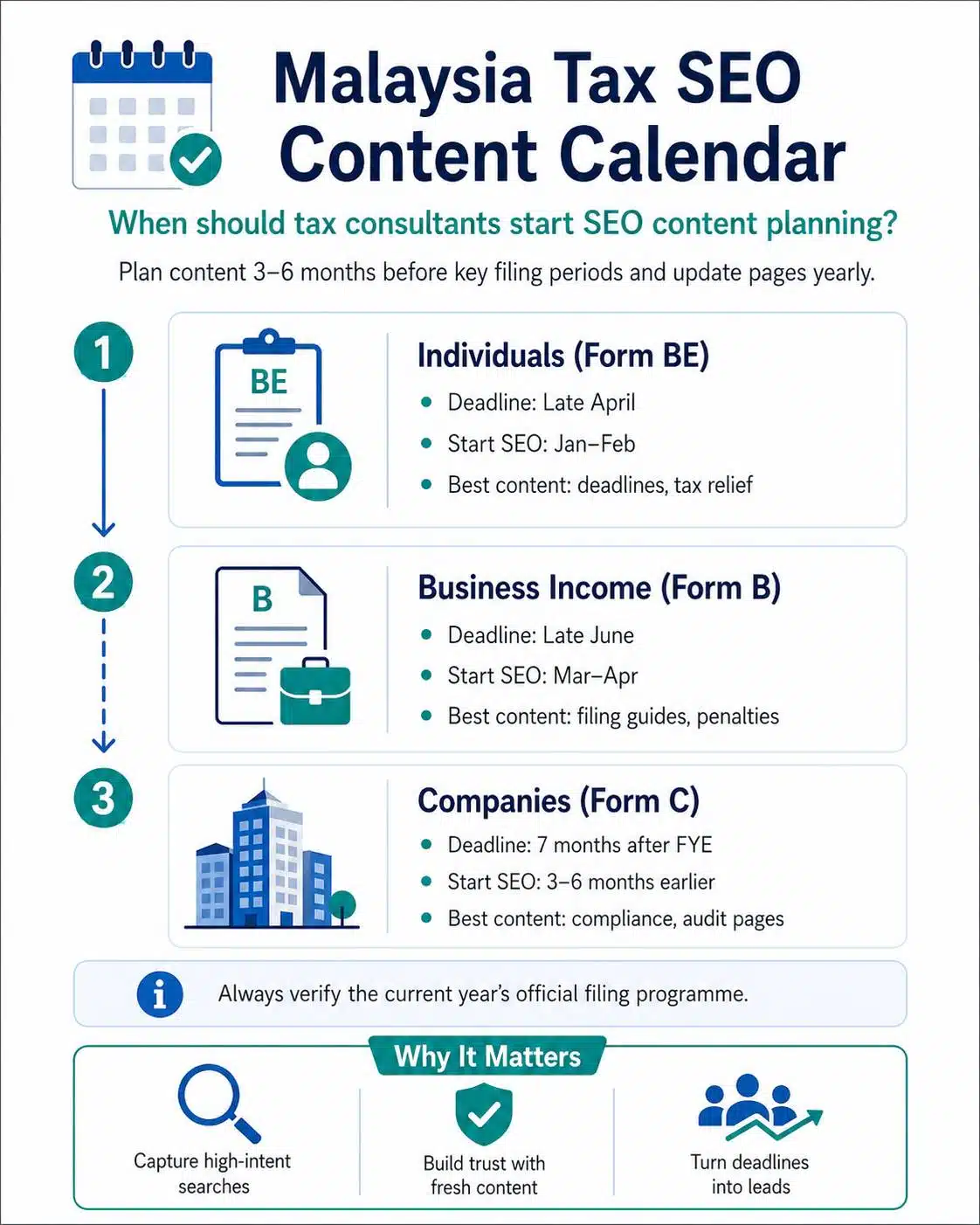
Rather than “one fixed season,” Malaysia deadlines depend on taxpayer type and (for companies) financial year-end. Use these as planning anchors, then make your articles year-specific.
- Individuals (employment income, Form BE): due around late April for manual filing; e-filing may have a grace period (varies by year)
- Individuals with business income (Form B): due around late June for manual filing; e-filing may have a grace period (varies by year)
- Companies (Form C): commonly due within 7 months from the close of accounts (not a fixed June/July deadline for every company)
Publish deadline content that is clearly tied to the relevant year (e.g., “YA2025 filing programme (2026)”) and visibly updated.
How SEO for Tax Consultants Works (Step-by-Step Framework)
Step 1: Build a Keyword Strategy Around Real Tax Problems
Instead of broad keywords, anchor your strategy around what people actually panic-search for:
- Filing deadlines and submissions
- Compliance requirements
- Penalties and late filing risks
- Audit support / audit readiness
- Cost-saving questions (carefully framed and disclaimer-safe)
Group keywords by intent (transactional vs informational) so you know what pages should sell and what pages should educate.
Step 2: Create High-Converting Service Pages
Your service pages should do the heavy lifting for enquiries.
Essential pages
- Tax filing services Malaysia
- SST compliance advisory
- Corporate tax consulting
- Tax audit support / audit defence
What makes them convert
- Clear scope (what you handle and what you don’t)
- Realistic timelines and steps
- “Documents to prepare” checklist
- FAQ section addressing price/process/confidentiality
- Strong contact path (WhatsApp + form + call option)
A great service page answers “Can you solve my problem right now?” in under 30 seconds.
Step 3: Publish Regulatory Updates (EEAT Booster)
Regulatory updates are underused because they require maintenance, and that’s exactly why they build trust.
High-value topics
- Year-specific filing timelines and “what changed” explainers
- MyInvois / e-invoicing updates in plain language
- SST compliance checklists and common pitfalls
- Audit process explainers (carefully written, non-alarming)
Make freshness obvious
- Add a visible Last reviewed date
- Add a short What changed note when you update the post
Step 4: Add Cost-Saving Content (Conversion Driver)
Cost-saving content works when it’s cautious, compliant, and realistic.
Good angles
- Eligibility-focused tax relief explanations
- Scenario-based SME considerations (not promises)
- Documentation guides (what to keep, what to prepare)
Avoid guarantees. Use conservative language such as “may be eligible,” “depends on facts,” and “subject to current guidance.”
Step 5: Local SEO Optimisation
Local SEO often produces the fastest, most practical wins.
What to do
- Optimise Google Business Profile (services, description, categories, photos)
- Keep NAP consistent (Name, Address, Phone) across directory listings
- Collect reviews consistently and reply professionally
- Add service areas (KL, PJ, Penang, Johor, etc.)
- Set response expectations (business hours + typical reply window)
Many tax leads are time-sensitive; make WhatsApp contact obvious.
Step 6: Build Authority with Backlinks
Backlinks still matter, but quality beats quantity.
High-signal backlink sources
- Professional directories (where allowed)
- Industry publications and SME portals
- Speaking / webinar pages and event listings
- Partner ecosystems (software, payroll, accounting tools)
Link-worthy “reference assets”
- Document prep guides
- Filing checklists (year-specific)
- SST overview in plain language
- Audit preparation framework
Step 7: Optimise for AI Search (AEO Layer)
AI summaries typically pull from pages that are clear, structured, and cautious.
Make your content easier to extract
- Put a short answer at the top of key sections
- Use headings that match search intent (“deadline,” “penalty,” “documents needed”)
- Add compact FAQs
- Be explicit about limitations and scope (especially on cost-saving topics)
Step 8: Conversion Optimisation
Organic conversion rates vary, but high-intent tax queries can convert strongly when your site reduces uncertainty.
What increases enquiries
- WhatsApp button + clear “what happens next”
- Proof (reviews, testimonials, credentials, experience)
- Clear timelines and next steps
- Document checklist to reduce friction
- Anonymised scenarios to build confidence
Client Intake Checklist (Add This to Your Service Pages)
This reduces back-and-forth, qualifies leads faster, and improves conversions.
- Taxpayer type: individual / sole proprietor / partnership / company
- What you need help with: filing / SST / audit support / advisory
- Urgency: deadline date + what triggered the enquiry (notice, reminder, audit letter)
- Last submission status (if applicable)
- Preferred contact method + best times to reach you
- Key documents relevant to the case (income, expenses, prior filings, notices/letters, SST docs if applicable)
Content Depth Matters for Authority
Depth isn’t just for rankings, it’s for credibility.
- Detailed guides tend to attract more mentions and citations because they become reference material
- For YMYL topics like tax, clarity + structure + visible updates are part of trust
- “Maintenance” (updates) is a competitive advantage, not a chore
Common Challenges in SEO for Tax Consultants
- High competition in KL and major cities
- Hard to differentiate content without real expertise signals
- Keeping up with regulatory changes and deadlines
- Building authority from scratch (especially for newer firms)
- Slower feedback loop than paid ads
Costs of SEO for Tax Consultants in Malaysia
| SEO Tier | Monthly Cost |
|---|---|
| Basic | RM1,500 – RM3,000 |
| Mid-tier | RM3,000 – RM8,000 |
| Advanced | RM8,000+ |
Costs vary based on competition, content volume and quality, authority-building effort, technical complexity, and whether you’re optimising a single location or multiple branches. SEO is best viewed as a compounding investment rather than a short-term expense.
Illustrative Example: How SEO Drives Real Results
A KL-based tax consultant focuses on:
- Tax filing Malaysia
- SST compliance Malaysia
Strategy
- Builds service pages with document checklists and timelines
- Publishes year-specific filing timeline updates
- Adds SST compliance guides and FAQs
- Improves Google Business Profile (reviews, services, service areas)
- Adds fast WhatsApp enquiry flow
Outcome after 6 months
- Increased visibility for high-intent queries
- Better lead quality (more ready-to-engage prospects)
- More consistent enquiries
SEO for Tax Consultants Is About Visibility, Trust, and Timing
SEO for tax consultants in Malaysia is no longer just about rankings. It’s about becoming the trusted answer for filing, compliance, and audit-related decisions.
Firms that combine regulatory awareness, structured content, strong local SEO, and real-world clarity will consistently outperform competitors.
At Rankpage, Malaysia’s trustworthy SEO partner, we help tax consultants build SEO systems aligned with real search intent and compliance-driven demand. If you want consistent enquiries (not just traffic), we can help turn SEO into a reliable acquisition channel.
Disclaimer: This article is for general marketing and informational purposes only. It is not tax advice. Tax rules and deadlines can change, and outcomes depend on individual facts. Always refer to the latest guidance from the relevant Malaysian authorities or consult a qualified professional for your situation.
Sources
- Google — Search Quality Rater Guidelines (PDF), published 11 Sep 2025
- StatCounter — Search Engine Market Share Worldwide, accessed Mar 2026
- BrightEdge — Organic Search as Share of Trackable Web Traffic, published 2019
- SparkToro — Zero-Click Search Study (US/EU open web clicks), published 1 Jul 2024
- Think with Google (Google/Ipsos) — How People Use Their Smartphones in Moments That Matter (PDF), published 2016
- LHDN — ITRF Deadlines page, last updated 20 Nov 2025
- LHDN — RF Filing Programme for 2026 (PDF), published 30 Dec 2025
- LHDN — Company tax filing guidance (Form C timeline), accessed 2026
- Search Engine Land — Long-form content & backlinks guide, published 11 Aug 2025
- HubSpot — Business blogging and inbound links statistic (citing BKA Content), updated 7 Jul 2025
- Ahrefs — Search traffic study (share of pages with zero traffic in Ahrefs index), published 1 Dec 2023
Frequently Asked Questions About SEO for Tax Consultants
What Is SEO for Tax Consultants?
SEO for tax consultants is the process of improving your website and local presence so potential clients can find (and trust) your services when searching for tax filing, SST compliance, audits, penalties, or advisory help.
Why Are Keywords Like “Tax Filing Malaysia” and “SST Compliance” So Important?
They reflect urgent, high-intent searches from people who are actively trying to solve a specific compliance problem, which typically converts better than broad keywords like “tax services.”
Do Regulatory Updates Improve SEO Rankings?
They often help because they signal freshness and relevance for a YMYL topic, and they can attract mentions and citations when your content is clearly written, accurate, and visibly updated.
How Long Does It Take to See SEO Results for a Tax Consultancy?
Many firms see noticeable progress in about 3–6 months, depending on competition, website quality, content consistency, and how quickly authority and reviews build.
Should Tax Consultants Publish “How to Reduce Tax” Content?
Yes, but it should be written carefully: explain eligibility and scenarios without guarantees, keep language conservative, and make it clear that outcomes depend on facts and current guidance.
How Do We Stay Accurate When Deadlines and Rules Change?
Use year-specific pages, show a visible “Last reviewed” date, and update the content whenever official programmes or guidance change, so readers and search engines can trust it.