For many Malaysian import/export businesses, referrals and trade fairs used to be enough to generate leads. But in 2026, global buyers increasingly begin their sourcing journey online first.
Whether they are looking for halal-certified suppliers, OEM manufacturers, freight forwarding partners, or alternative ASEAN sourcing options during shipping disruptions, procurement teams now rely heavily on Google and AI-assisted search experiences to research suppliers before making contact.
This shift has become even more important amid ongoing global trade uncertainty. For example, in May 2026, conflict-related incidents and elevated risk in/around the Strait of Hormuz were widely reported as disrupting maritime operations and increasing routing and insurance uncertainty—pushing procurement teams to diversify supply chains and reduce sourcing risk.
In this guide, we explore how SEO works for the import/export industry, why Malaysia is uniquely positioned for global trade visibility, and what businesses can do to improve rankings, credibility, and international discoverability.
What Is SEO for the Import Export Industry?
SEO for import/export businesses involves improving online visibility so overseas buyers, distributors, and procurement teams can discover suppliers more easily through search engines and AI-assisted search experiences.
Unlike traditional consumer SEO, import/export SEO is heavily B2B-focused. Search intent is often tied to:
- Supplier sourcing
- Manufacturing capabilities
- Compliance requirements
- Shipping access
- Certifications
- Regional trade expertise
A buyer searching for “OEM electronics manufacturer Malaysia” is not casually browsing. They are often evaluating suppliers for real procurement opportunities.
This makes SEO particularly valuable for:
- Manufacturers
- Exporters
- Freight forwarders
- Warehousing providers
- OEM suppliers
- Industrial businesses
- Trading companies
Why SEO Matters More for Malaysian Import Export Businesses in 2026
Global Procurement Has Become Digital-First
Today’s procurement teams rarely rely solely on trade directories or exhibitions.
Before contacting a supplier, buyers commonly review:
- Google search results
- Website credibility
- Certifications
- Case studies
- Export experience
- Product specifications
- Compliance information
If your business is difficult to find online, competitors may win the opportunity first.
Malaysia Benefits From Regional Trade Shifts
Global sourcing behaviour is changing rapidly.
Many international companies are reducing overdependence on a single manufacturing market through “China+1” sourcing strategies. ASEAN countries, including Malaysia, are benefiting from this diversification trend.
Malaysia holds several advantages:
- Strategic ASEAN location
- Strong port infrastructure
- Mature electronics ecosystem
- Halal ecosystem leadership
- A business environment where English is widely used alongside major regional languages (e.g., Malay, Mandarin, Tamil), which can help cross-border communication for some industries
- Industrial manufacturing capabilities
However, overseas buyers cannot engage suppliers they cannot discover online.
AI-Assisted Search Is Changing Supplier Discovery
Buyers are increasingly using AI-assisted search experiences instead of relying purely on traditional search results.
Search behaviour is becoming more conversational:
- “Who are reliable glove suppliers in Malaysia?”
- “Best halal food exporters in ASEAN”
- “Which Malaysian OEM factories export to Europe?”
Google’s AI Overviews and related AI search experiences can change how results are displayed and which sites get visibility, so supplier websites benefit from:
- Structured content
- FAQ optimisation
- Entity SEO
- AI-readable pages
- Clear informational content
SEO in 2026 is no longer just about rankings. It’s also about visibility inside AI-generated summaries and answer formats.
How Global Buyers Actually Search for Malaysian Suppliers
Buyers Search Using Specifications, Not Just Generic Terms
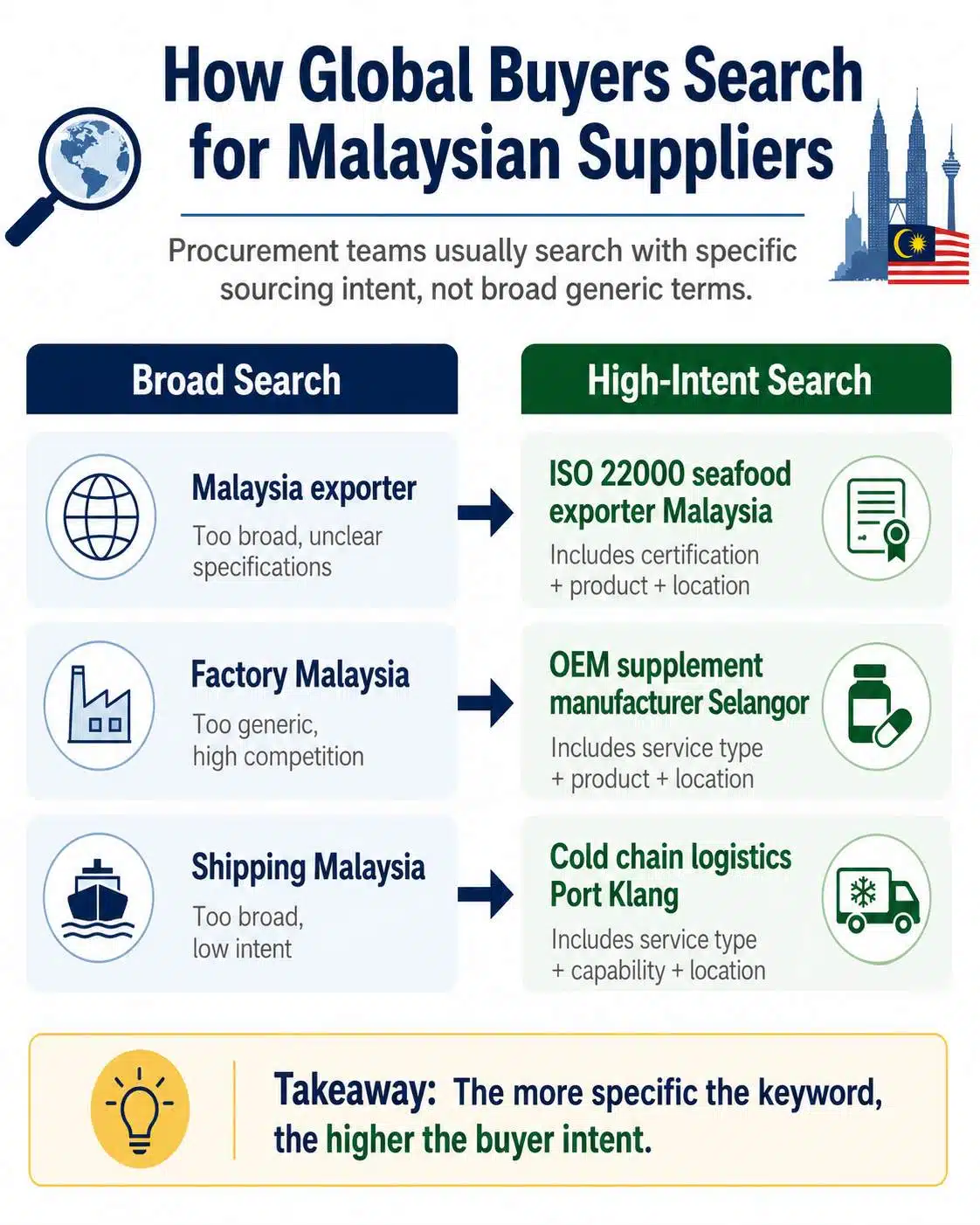
One of the biggest SEO mistakes import/export companies make is targeting overly broad keywords.
International buyers often search using:
- Product standards
- Technical specifications
- Manufacturing capabilities
- Industry certifications
- Shipping locations
- Compliance terms
For example:
Generic Search → High-Intent Search
- “Malaysia exporter” → “ISO 22000 seafood exporter Malaysia”
- “Factory Malaysia” → “OEM supplement manufacturer Selangor”
- “Shipping Malaysia” → “Cold chain logistics Port Klang”
Specific searches usually convert better because they reflect genuine procurement intent.
Geography Strongly Influences Search Intent
Industrial geography matters heavily in import/export SEO. Different regions in Malaysia carry different trade associations:
- Port Klang: Freight forwarding, warehousing
- Penang: Electronics manufacturing
- Johor Bahru: Singapore-linked trade
- Shah Alam: Industrial manufacturing
- Pasir Gudang: Heavy industry logistics
- Kulim Hi-Tech Park: Advanced manufacturing
Optimising for industrial clusters and trade hubs can improve relevance significantly.
The Most Important SEO Elements for Import Export Businesses
Industry-Specific Keyword Research
Keyword strategy should reflect how real procurement teams search.
Strong import/export SEO keywords often include:
- Product category
- Industry specification
- Export region
- Certification
- Logistics terms
- Compliance references
Examples of valuable SEO keyword themes:
- Export-focused: “Furniture exporter Malaysia”
- Manufacturing: “OEM cosmetic manufacturer Malaysia”
- Logistics: “Port Klang warehouse services”
- Compliance: “Halal-certified food supplier Malaysia”
- Regional: “ASEAN semiconductor supplier”
These keywords usually carry stronger commercial intent than broad traffic terms.
Technical SEO and Website Experience
A surprising number of import/export websites still look outdated, slow, or incomplete. For international buyers, this can reduce trust immediately.
A strong B2B trade website should include:
- Fast loading speeds
- Mobile responsiveness
- SSL security
- RFQ forms
- Downloadable catalogues
- Product specification sheets
- Export market information
- Contact accessibility
Many procurement managers review supplier websites while travelling or attending trade exhibitions, making mobile optimisation especially important.
International SEO
International SEO becomes critical when targeting multiple countries. This may involve:
- Country-specific landing pages
- hreflang implementation
- Multilingual SEO
- Regional product pages
- Localised shipping content
For example:
- English content for global audiences
- Bahasa Indonesia targeting Indonesia
- Mandarin pages for Chinese buyers
- Arabic content for Middle Eastern trade
This can improve visibility across international markets.
Why Regulatory and Compliance Content Improves SEO
This is one of the largest missed opportunities in the industry.
Many competitors focus only on marketing-style content while ignoring compliance-related searches that real buyers actually care about.
Compliance Builds Trust
International procurement teams often evaluate:
- Export capabilities
- Certifications
- Legal compliance
- Product standards
- Customs expertise
Trust signals matter heavily in B2B trade.
Valuable EEAT Signals for Import Export Websites
Strong trust indicators may include:
- MITI approvals
- MATRADE participation
- SIRIM certifications
- Halal certification
- ISO compliance
- Export licenses
- Trade association memberships
These signals improve both buyer confidence and EEAT positioning.
Compliance Content Can Generate Search Traffic
Useful SEO content ideas include:
- HS code guides
- Import permit explanations
- SST guidance
- Incoterms explanations
- Export documentation requirements
- Halal export procedures
- Customs compliance updates
This type of content can attract:
- Informational searches
- Commercial searches
- AI-generated visibility
- Long-tail B2B traffic
How Local SEO Works for Import Export Businesses
Some import/export companies assume local SEO only matters for retail businesses. That is no longer true.
Industrial and Port-Based Searches Are Highly Valuable
Many commercial searches include logistics or industrial locations:
- “Freight forwarding Port Klang”
- “Johor customs broker”
- “Warehouse near Westport”
- “Penang EMS manufacturer”
These searches often have very strong conversion intent.
Google Business Profile Still Matters
Even international B2B businesses benefit from:
- Google Maps visibility
- Reviews
- Accurate business information
- Operational photos
- Updated business categories
This can improve both local trust and international credibility.
Content Marketing for Import Export Businesses
Most Industry Content Is Too Generic
Many import/export websites only publish:
- Basic company profiles
- Product listings
- Corporate announcements
This limits discoverability significantly.
Better Content Opportunities
Higher-performing content often includes:
- Shipping disruption updates
- Export market insights
- Customs explainers
- Commodity trend analysis
- ASEAN sourcing guides
- Supply chain commentary
- Trade compliance updates
This creates more authority and relevance.
Using Current Trade Disruptions Strategically
Periods of disruption can shift buyer priorities toward supplier resilience and diversification.
For example, when shipping routes face heightened risk and uncertainty, buyers may search more actively for:
- Alternative suppliers
- ASEAN sourcing partners
- Regional logistics options
Malaysian exporters that publish clear trade insights can strengthen both SEO authority and buyer trust during these periods.
Step-by-Step SEO Strategy for Malaysian Import Export Businesses
Step 1: Identify Commercial Buyer Intent
Understand:
- What buyers actually search for
- Which certifications matter
- Which locations matter
- Which industries drive demand
Avoid targeting generic vanity keywords only.
Step 2: Build Industry-Specific Landing Pages
Examples:
- “Halal Food Exporter Malaysia”
- “OEM Electronics Manufacturer Penang”
- “Cold Chain Logistics Port Klang”
Specific pages usually outperform generic service pages.
Step 3: Improve Trust and EEAT Signals
Add:
- Certifications
- Export experience
- Client industries
- Compliance information
- Case studies
- Manufacturing capabilities
This improves conversion confidence.
Step 4: Optimise for International SEO
Focus on:
- Multilingual targeting
- Country-specific SEO
- Technical SEO
- Structured metadata
- AI readability
Step 5: Publish Industry-Relevant Content Consistently
Strong ongoing content may include:
- Trade insights
- Export regulations
- Supply chain trends
- Industry developments
- Procurement guidance
Common SEO Mistakes Import Export Businesses Make
- Using generic keywords only: Broad keywords usually attract weak-quality traffic.
- Ignoring compliance information: This weakens EEAT and buyer trust.
- Having thin product pages: Buyers often need product specs, MOQ, export capabilities, and shipping details.
- Neglecting mobile experience: A poor mobile site can reduce international conversions.
- Treating SEO like short-term advertising: B2B SEO often compounds over time through authority and trust.
How Much Does SEO Cost for Import Export Businesses?
SEO pricing depends on:
- Industry competitiveness
- International targeting
- Technical complexity
- Content volume
- Geographic scope
In Malaysia, SEO retainers are commonly quoted across a wide range depending on deliverables (technical fixes, content volume, multilingual needs, and the number of markets targeted).
As a rough reference:
- Basic local/industrial SEO is often quoted from ~RM1,000 to RM3,000/month
- National B2B SEO programmes are often quoted from ~RM3,000 to RM8,000+/month
- International, multi-market or multilingual SEO commonly starts around ~RM5,000 to RM10,000+ and can go higher depending on scope
Businesses targeting multiple countries may also require:
- Translation
- Technical SEO support
- Multilingual content
- International keyword research
(Note: these are common market quotes, not official benchmarks—packages vary significantly by goals and deliverables.)
Future Trends for Import Export SEO
AI Search Will Continue Expanding
Businesses increasingly need:
- Structured content
- Conversational FAQs
- Entity SEO
- AI-readable formatting
Supply Chain Volatility Will Affect Search Behaviour
Global disruptions may continue influencing:
- Supplier diversification
- ASEAN sourcing demand
- Regional logistics searches
Trust Signals Will Matter More
Procurement teams are becoming increasingly cautious regarding:
- Compliance
- Certifications
- Supplier reliability
- Trade credibility
Strong EEAT positioning may become even more important moving forward.
SEO As a Growth Tool for Import/Export
SEO is becoming increasingly important for Malaysian import/export businesses operating in a more competitive and uncertain global trade environment. As buyers rely more heavily on digital research and AI-assisted search experiences, businesses that invest in stronger online visibility may gain a major long-term advantage.
At Rankpage, Malaysia’s top SEO agency, we help Malaysian businesses build SEO strategies focused on real commercial visibility, international discoverability, and sustainable long-term growth. Whether you operate in logistics, manufacturing, exporting, or industrial services, we can help strengthen your digital presence in increasingly competitive global markets.
Sources
- MATRADE
- Ministry of Investment, Trade and Industry (MITI)
- Royal Malaysian Customs Department
- Department of Statistics Malaysia (DOSM)
- Reuters
- World Bank
- ASEAN Secretariat
- Google Search Central
- SIRIM
- International Trade Administration (ITA)
Frequently Asked Questions About SEO for Import Export Businesses
What Is SEO for Import Export Businesses?
SEO for import/export businesses means improving your online visibility so international buyers, distributors, and procurement teams can find your company more easily through search engines and AI-assisted search experiences.
Why Is SEO Important for Malaysian Exporters?
SEO helps Malaysian exporters get discovered earlier in the buying journey, build credibility with proof points like certifications and case studies, and compete more effectively when buyers shortlist suppliers based on online research before reaching out.
Does Local SEO Matter for Import Export Businesses?
Yes. Local SEO matters because many high-intent B2B searches include industrial areas, ports, and logistics zones, and showing up for those location-based searches can attract buyers and partners looking for specific capabilities near specific trade hubs.
What Keywords Should Import Export Businesses Target?
Import/export companies should focus on procurement-style keywords that combine what you sell with how buyers qualify suppliers, such as product specifications or standards, manufacturing capabilities, certifications, and industrial or port locations. This usually performs better than broad keywords because it matches real sourcing intent.
How Long Does SEO Take for Import Export Companies?
SEO usually takes several months to show meaningful traction in competitive B2B niches, especially if you’re targeting multiple countries, because results depend on technical improvements, content depth, authority building, and search engines re-evaluating your site over time.
Can SEO Help During Supply Chain Disruptions?
Yes. During disruption-heavy periods, buyers often search more actively for alternative suppliers, ASEAN sourcing options, and logistics partners that can reduce risk, so companies with timely, clear content and strong visibility are better positioned to capture that shifting demand.