Which Language Do Malaysians Search in Most Often?
According to Google Malaysia (2024), over 65% of local users combine both languages in searches. This means pure-English SEO misses part of the audience, while pure-Bahasa limits overall reach.
Search behaviour breakdown:
Language | Typical Search Use | SEO Advantage | Risk |
English | Research, comparison, professional services | Wider reach, higher search volume | High competition |
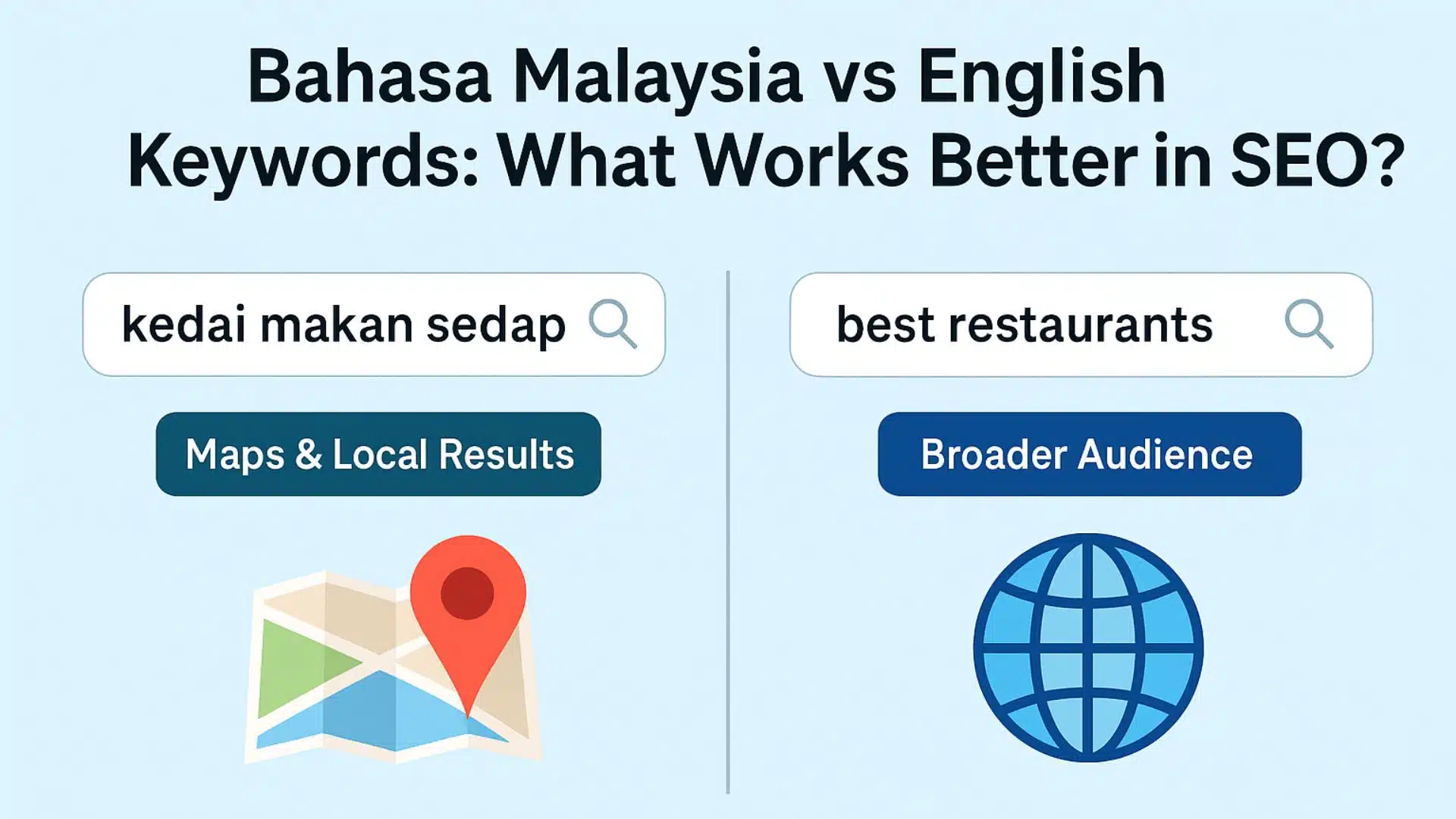
Bahasa Malaysia | Local intent, informal, community searches | Better local CTR & conversion | Lower total volume |
Manglish | “real people” searches (“cheapest kedai makanan to tapau KL”) | Authentic and relatable | Harder to optimise precisely |
Tip: Monitor how customers talk in reviews and WhatsApp chats, that’s your real keyword source.
When Should You Use Bahasa Malaysia Keywords?
Bahasa keywords perform best when your target audience is local and the service involves daily needs.
For example:
- Restaurants, workshops, and clinics
- Beauty salons and tuition centres
- Localised service areas (such as Shah Alam, Johor Bahru)
Example keywords:
- “kedai printing murah KL”
- “salon rambut wanita JB”
- “akauntan perniagaan kecil Malaysia”
Use Bahasa Malaysia keywords in:
✅ Google Business Profile posts
✅ Social media captions
✅ Website headings and FAQs
✅ Schema metadata for location
When English Keywords Still Win
English keywords are ideal when your service has regional reach or B2B focus.
If your audience includes professionals, startups, or international buyers, English still dominates search results.
Example keywords:
- “SEO agency Malaysia”
- “digital marketing company KL”
- “accounting software Malaysia”
These are perfect for websites targeting both local and global visibility.
Note: Many top-ranking Malaysian brands use English for site structure and Bahasa for supporting blog content, a bilingual SEO mix that appeals to both algorithms and humans.
How to Combine Bahasa and English Keywords Naturally
Search engines reward natural, bilingual phrasing, not forced translation.
Avoid “keyword stuffing” in two languages, instead, blend contextually.
Example:
“Our kedai runcit in Petaling Jaya offers kaw kaw and same-day pickup.”
Google recognises “kedai runcit” as local and “same-day pickup” as English, enhancing both local and semantic relevance.
Checklist for bilingual SEO content:
- Use Bahasa Malaysia in headings (H2/H3) where relevant.
- Mix English + Bahasa in meta descriptions naturally.
- Translate CTAs based on audience intent (“Hubungi Kami” vs “Get a Quote”).
- Maintain consistent tone and spelling across versions.
Learn more in our guide: Local SEO Checklist for Malaysian SMEs
Case Study: English vs Bahasa Keyword ROI
Website Type | Keyword Example | Traffic (Est.) | Conversion Rate | Best Language |
Auto Workshop | “car repair in KL” | High | Medium | Both |
Tuition Centre | “kelas bahasa inggeris Shah Alam” | Medium | High | Bahasa |
SaaS Company | “CRM software Malaysia” | Very High | Moderate | English |
Local Salon | “salon rambut wanita JB” | Medium | High | Bahasa |
Note: Bahasa delivers more qualified local leads, while English drives higher awareness and search volume.
Which Language Performs Better in Voice Search?
Voice searches in Malaysia are increasingly conducted in Bahasa or Manglish. When users say “Find me durian shop yang paling dekat sini,” Google triggers results with Bahasa relevance.
To optimise for voice:
- Include conversational questions in your content like “Di mana kedai cermin mata murah di JB?”.
- Add FAQPage schema.
- Write naturally, like people speak, not textbook formal.
Also read: Google Ranking Factors for SMEs: How to Rank in “Near Me” Searches
The Best Strategy: Dual-Language SEO for Malaysian Businesses
In 2025, SEO isn’t about choosing Bahasa or English, it’s about balancing both. Bilingual SEO improves engagement, ranking, and conversion, especially for mobile users.
Quick strategy:
- Use English keywords for website architecture and blogs.
- Use Bahasa Malaysia keywords for Google Business Profile and community posts.
- Include Manglish phrases where relevant for social visibility.
- Track keyword performance separately using Google Search Console filters.
Conclusion: The Real Winner Is Local Relevance
In Malaysia, SEO success isn’t defined by language alone, it’s about creating real connections.
If your content sounds natural, matches search intent, and reflects your community, both Bahasa and English can rank well.
Whether you’re targeting corporate clients in KL or daily shoppers in JB, adapting your language strategy can multiply your reach.
Need help building a bilingual SEO strategy that actually ranks? Rankpage, Malaysia’s leading SEO agency, crafts English–Bahasa keyword frameworks tailored for real Malaysian audiences.
Let your business be found by the right people in any language.