Quick Comparison Table
| Factor | B2B SEO | B2C SEO |
| Audience | Decision-makers, managers, procurement | Individual consumers |
| Intent | Research, evaluation, vendor comparison | Discovery, comparison, purchase |
| Keywords | Often niche, specific, long-tail | Often broader, higher volume |
| Content | Guides, case studies, service pages | Product/category pages, reviews, buying guides |
| Sales cycle | Often longer, multi-touch | Often shorter, varies by product type |
| Conversion goal | Leads, demos, consultations | Purchases, bookings, signups |
| Competitive set | Other service providers, directories | Brands, marketplaces, publishers, review sites |
What Is B2B SEO?
B2B SEO refers to search optimisation designed to attract business buyers rather than individual consumers. Instead of driving immediate purchases, the goal is usually to generate qualified leads that can convert into contracts, retainers, or long-term relationships.
Typical B2B Industries
- SaaS providers
- Accounting and corporate service firms
- Logistics companies
- Manufacturing suppliers
- B2B agencies and consultancies
How B2B Search Behaviour Works
B2B search tends to be more analytical and risk-aware. Buyers often:
- Research multiple providers
- Compare features and pricing models
- Check credibility and proof
- Revisit the same vendors before contacting them
Modern B2B buying is often non-linear, involving multiple stakeholders and repeated back-and-forth between evaluation stages. That’s why content that supports decision-making often performs better long-term. (Source: Gartner)
Malaysia Example
A Malaysian SME searching “payment gateway Malaysia” is usually evaluating:
- Integration options
- Fees and settlement terms
- Fraud prevention
- Compliance
- Onboarding speed and local support
That means B2B SEO often wins by combining:
- Clear service pages
- Comparison-friendly information
- Trust signals
- Educational content that answers real buyer questions
What Is B2C SEO?
B2C SEO focuses on optimising websites to attract consumers searching for products or services for personal use. For B2C brands, organic visibility often needs to support the full journey, from discovery to purchase.
Common B2C Sectors
- Ecommerce stores
- Beauty brands
- Restaurants and cafes
- Travel and hospitality
- Consumer electronics retailers
How B2C Search Behaviour Works
B2C searches can be fast and transactional. Users commonly want:
- Quick comparisons
- Prices and promotions
- Reviews and ratings
- Where to buy, including delivery and return details
For ecommerce, strong SEO is closely tied to product discoverability: clean site structure, clear product data, and supportive content that helps shoppers evaluate options. (Source: Google Search Central ecommerce best practices)
Malaysia Examples
- “Best shampoo Malaysia” often implies reviews and comparisons
- “Cheap laptop Malaysia” often implies pricing, specs, and availability
- “Best cafe in PJ” often implies location, menus, photos, and ratings
Key Features That Differentiate B2B SEO and B2C SEO
1) Audience Targeting and Messaging
B2B SEO Targets Professionals
Common personas include:
- Company directors
- Procurement and purchasing staff
- Finance and operations managers
- Founders and team leads
These users often care about:
- Efficiency and reliability
- ROI and total cost
- Compliance, security, and risk
- Vendor credibility and delivery capability
B2C SEO Targets Consumers
B2C audiences may be browsing or comparing. They often care about:
- Price and promotions
- Convenience, including delivery time and returns
- Brand reputation and social proof
- Lifestyle benefits, such as comfort, appearance, taste, or experience
B2B messaging should feel credible and specific, while B2C messaging should feel clear, persuasive, and easy to act on.
2) Search Intent
Search intent affects not just what you write, but when that content influences a conversion.
B2B Intent Usually Looks Like
- Problem diagnosis
- Solution research
- Supplier evaluation
Examples:
- Corporate tax consultant Malaysia
- Warehouse management software
- Payroll outsourcing Malaysia
B2C Intent Usually Looks Like
- Discovery
- Comparison
- Purchase readiness
Examples:
- Best hair salon KL
- Budget gaming laptop Malaysia
- Skincare for oily skin
B2B content often supports earlier research and confidence building, while B2C content often sits closer to the purchase decision.
3) Keyword Strategy
A common mistake is assuming high search volume equals the best keyword. In reality, the best keywords are the ones that match your conversion path.
B2B Keyword Strategy
B2B keywords are often more specific and intent-driven, including:
- Service + location
- Solution terms
- Industry-specific needs
Examples:
- Corporate secretary Malaysia
- Payment gateway Malaysia
- SST registration for SMEs
These keywords may attract fewer searches, but they can drive higher-value leads.
B2C Keyword Strategy
B2C keywords are often broader:
- “Best [product] Malaysia”
- “Cheap [product]”
- “Top [brand/type]”
- “Near me” local-intent searches
These terms can drive larger traffic, but competition is usually stronger.
Build keyword clusters (whether B2B or B2C) by stage:
- Informational
- Comparison
- Transactional
4) Content Strategy
This is where B2B and B2C diverge most clearly.
B2B Content That Builds Authority
B2B buyers typically need proof and clarity. Strong formats include:
- Service pages with scope and deliverables
- Industry guides that explain complex topics simply
- Case studies with real outcomes
- Comparison pages where appropriate
- FAQs that address objections such as pricing, timeline, compliance, and support
Why it works: it reduces perceived risk and helps stakeholders justify the decision. (Source: Gartner)
B2C Content That Reduces Purchase Friction
B2C customers often need clarity fast. Strong formats include:
- Category pages designed for discovery
- Product pages with specs, benefits, price, delivery, and returns
- Buying guides that simplify choice
- Review and comparison content that builds confidence
- Listicles and “best of” pages for broad intent
Google’s ecommerce guidance supports this approach: ecommerce sites benefit from clear structure and helpful product information. (Source: Google Search Central ecommerce best practices)
5) Sales Cycle and Conversion Path
B2B: Longer and Multi-Touch
B2B conversions often require:
- Research
- Approvals
- Internal alignment
- Multiple interactions before contact
A strong SEO journey might look like:
- Guide article
- Service page
- Case study
- Contact form or call booking
Because B2B buying is often non-linear, people may move back and forth between these steps. (Source: Gartner)
B2C: Often Faster, but Still Variable
Many B2C purchases are quicker, especially for low-cost items. But higher-priced consumer purchases can still involve:
- Repeated comparisons
- Review checks
- Price monitoring
Note that while B2C cycles are often shorter, they still vary by product category and price point.
Pricing and Cost Differences in B2B vs B2C SEO
SEO budgets vary by market competition and business goals, but the cost drivers differ.
What Often Makes B2B SEO Costlier
B2B SEO may require higher investment in:
- Expert-led long-form content
- Interviews with subject matter experts
- Case studies and proof assets
- Conversion optimisation for lead quality
- Link earning and digital PR
What Often Makes B2C SEO Costlier
B2C SEO commonly requires investment in:
- Product and category optimisation at scale
- Technical ecommerce SEO improvements
- Structured data and internal linking
- Ongoing content such as buying guides and comparisons
- Review generation and management
Ecommerce performance is strongly tied to site structure and product clarity. (Source: Google Search Central ecommerce best practices)
Pros and Cons
Pros and Cons of B2B SEO
Advantages
- Higher-value conversions
- Lower competition on niche terms in many industries
- Strong long-term authority building
- Better lead quality when intent is matched correctly
Challenges
- Smaller search volume
- Longer sales cycles
- Requires deeper expertise and proof
- Attribution can be harder because the path to sale is longer
Pros and Cons of B2C SEO
Advantages
- Larger search demand
- Faster conversion opportunities
- Big upside from strong category and product visibility
- Potential for viral traffic through guides and listicles
Challenges
- Intense keyword competition
- Greater dependence on pricing, UX, and brand trust
- Heavy competition from marketplaces and publishers
- Content often needs frequent updates due to stock, promos, and trends
B2B SEO vs B2C SEO in Malaysia
Malaysia adds local factors that shape SEO outcomes.
B2C Malaysia: Marketplaces Are a Major Competitive Force
In many consumer categories, large ecommerce platforms attract significant user attention and often compete strongly on commercial searches. (Source: Similarweb Malaysia ecommerce rankings)
What This Means for B2C Brands
If you’re a consumer brand, you often need:
- Strong category pages
- Unique value beyond price
- Comparison and review content that helps buyers choose
- Clear fulfilment details such as shipping, delivery time, and returns
Example:
A Malaysian skincare brand targeting “best sunscreen Malaysia” may compete with:
- Brand websites
- Ecommerce retailers
- Marketplace pages
- Review-style listicles and comparison posts
B2B Malaysia: Trust Signals Tend to Matter More
For B2B queries like “corporate secretary Malaysia” or “payroll outsourcing Malaysia,” buyers often check:
- Credibility and track record
- Compliance readiness
- Testimonials and case studies
- Clarity of scope and process
Quick Malaysia Trust Checklist
For B2B service pages, consider adding:
- Company registration details where appropriate
- Certifications and professional memberships
- Industries served and client types
- Clear deliverables and timelines
- Case studies, even short mini-case snippets
- FAQs addressing compliance, data handling, and onboarding
This helps improve trust and conversion quality, especially against generic directories or thin service pages.
Malaysian Case Studies
Case Study: B2B SEO for Professional Services
A Malaysian accounting firm may target:
- SST registration Malaysia
- SME tax consultant Malaysia
Instead of publishing only service pages, it could also create:
- “SST registration checklist for SMEs”
- “Common SST filing mistakes and how to avoid penalties”
- “Tax calendar for SMEs: key deadlines”
Over time, these pages can:
- Capture intent from businesses researching compliance
- Build trust before the enquiry
- Generate stronger inbound leads from readers who need professional help
Case Study: B2C SEO for Ecommerce
An electronics store might target:
- Best gaming laptop Malaysia
- Budget mechanical keyboard
It can combine:
- Category pages
- Product pages
- Comparison content
- Buying guides
This helps the store show up for both research-stage and purchase-stage searches.
When Businesses Should Focus on B2B SEO
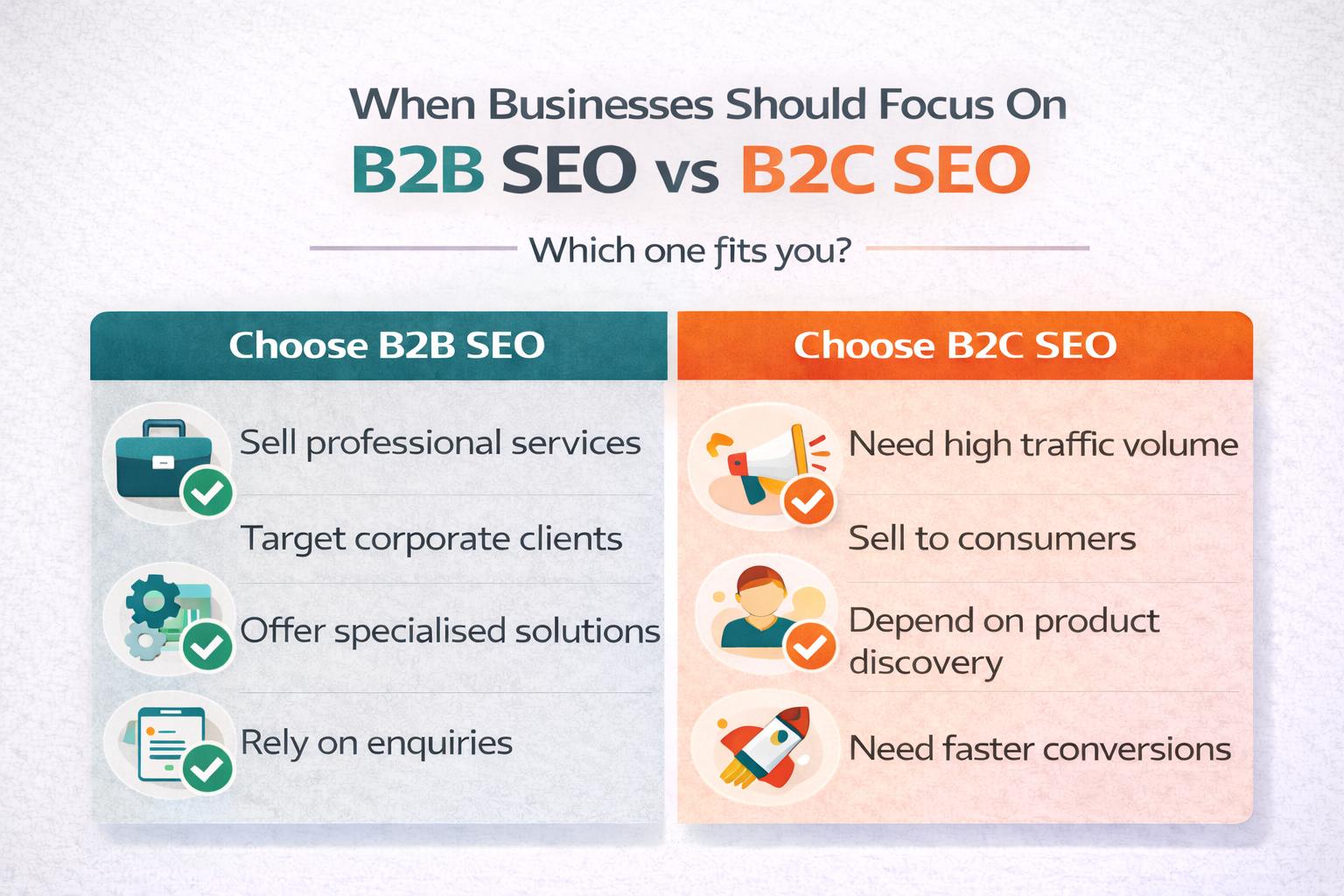
B2B SEO is usually the best fit if you:
- Sell professional services
- Target corporate clients
- Provide specialised solutions
- Operate in niche industries
- Rely on enquiries rather than instant checkout
Common examples:
- Consulting firms
- SaaS providers
- Logistics companies
- Corporate services
- Manufacturing suppliers
When Businesses Should Focus on B2C SEO
B2C SEO works best if you depend on:
- High traffic volume
- Product discovery and comparison
- Ecommerce transactions
- Local consumer demand
Success typically relies on:
- Strong product and category pages
- Helpful buying guides and comparisons
- Location-based optimisation for local services
- A consistent review strategy where relevant
What to Measure
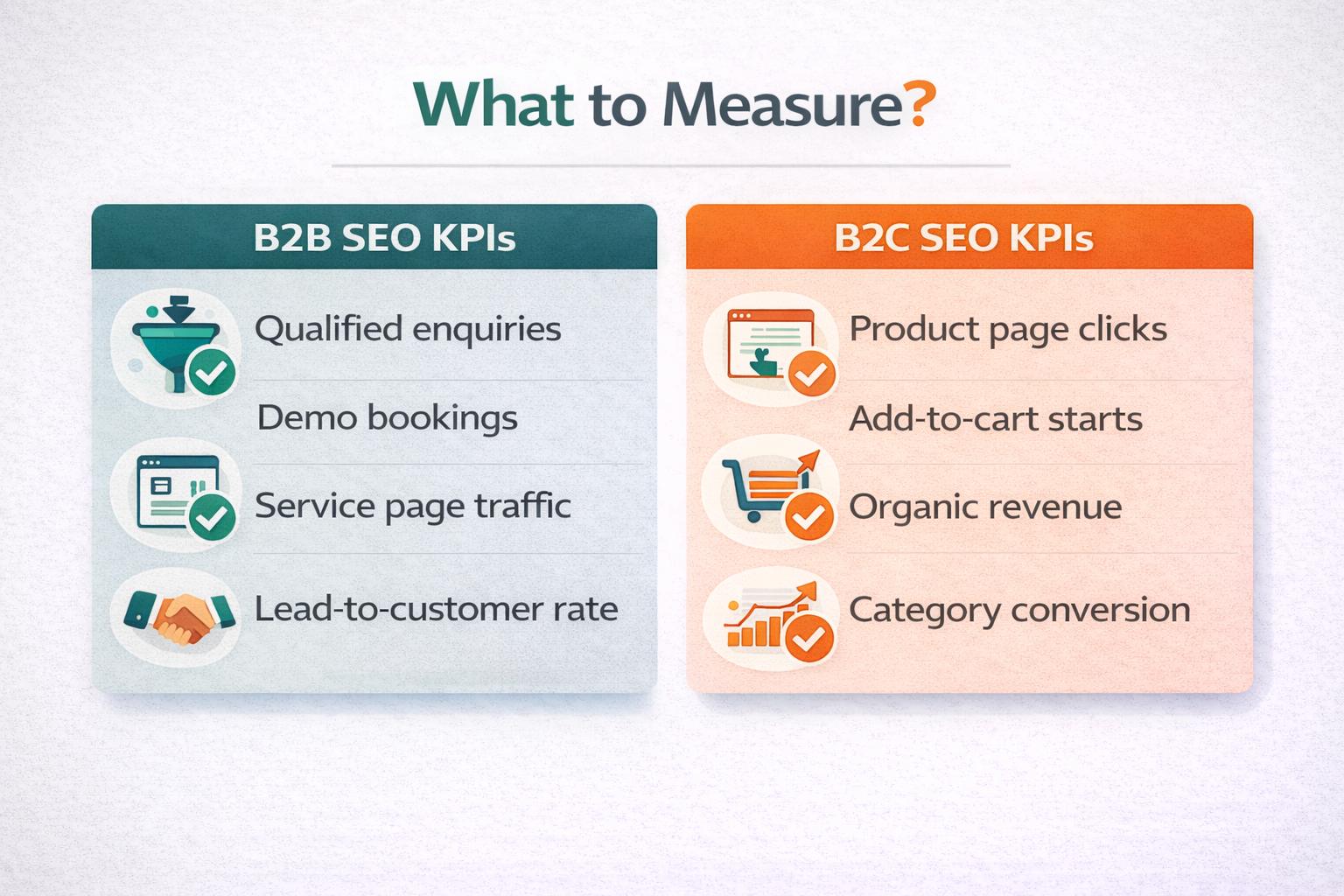
Rankings are only useful if they lead to business outcomes.
B2B SEO KPIs
Track:
- Qualified enquiry rate
- Consultation or demo bookings
- Organic traffic to key service pages
- Conversion rate by landing page
- Lead-to-customer conversion rate where possible
B2C SEO KPIs
Track:
- Organic clicks to category and product pages
- Add-to-cart and checkout starts
- Organic revenue or bookings
- Click-through rate from search
- Conversion rate by category
Some SEO changes can show impact quickly, while broader improvements can take weeks to months depending on competition and site quality. (Source: Google SEO Starter Guide)
Understanding The Difference Between B2B and B2C SEO
B2B SEO and B2C SEO share the same technical foundation, but the strategy differs because audience behaviour, intent, and conversion paths differ.
- B2B SEO wins by building credibility, educating buyers, and providing proof that reduces risk.
- B2C SEO wins by maximising discoverability, supporting comparison, and making purchase decisions easier.
For Malaysian businesses, the distinction matters because:
- Consumer categories often face strong marketplace and publisher competition
- B2B buyers often need stronger trust signals before converting
If your company sells to both businesses and consumers, the best approach is usually to build separate keyword clusters and content funnels for each audience. To boost the SEO performance of your business and facilitate growth, get in touch with Malaysia’s number one SEO agency Rankpage.
Rankpage can help your company do SEO the right way, whether it’s B2B or B2C, so don’t miss out on this opportunity!